
When it comes to decorating outdoor landscapes for the holidays, few elements deliver instant charm like string lights draped over bushes and shrubs. But choosing between mesh net lights and traditional individual light strands isn’t just about aesthetics—it’s a decision that can significantly impact installation time, labor, and long-term usability. For homeowners, landscapers, and seasonal decorators alike, understanding which option offers faster setup is essential for efficiency, especially when dealing with multiple plants across large yards.
The core difference lies in design: mesh net lights are pre-wired into a grid-like fabric, while individual strands are linear strings of bulbs meant to be wrapped, woven, or draped manually. While both have their place, one clearly outpaces the other when speed and coverage are priorities. This article breaks down the performance of each type specifically for bush and shrub applications, backed by practical insights, expert observations, and real-world scenarios.
Design Differences That Impact Installation Speed
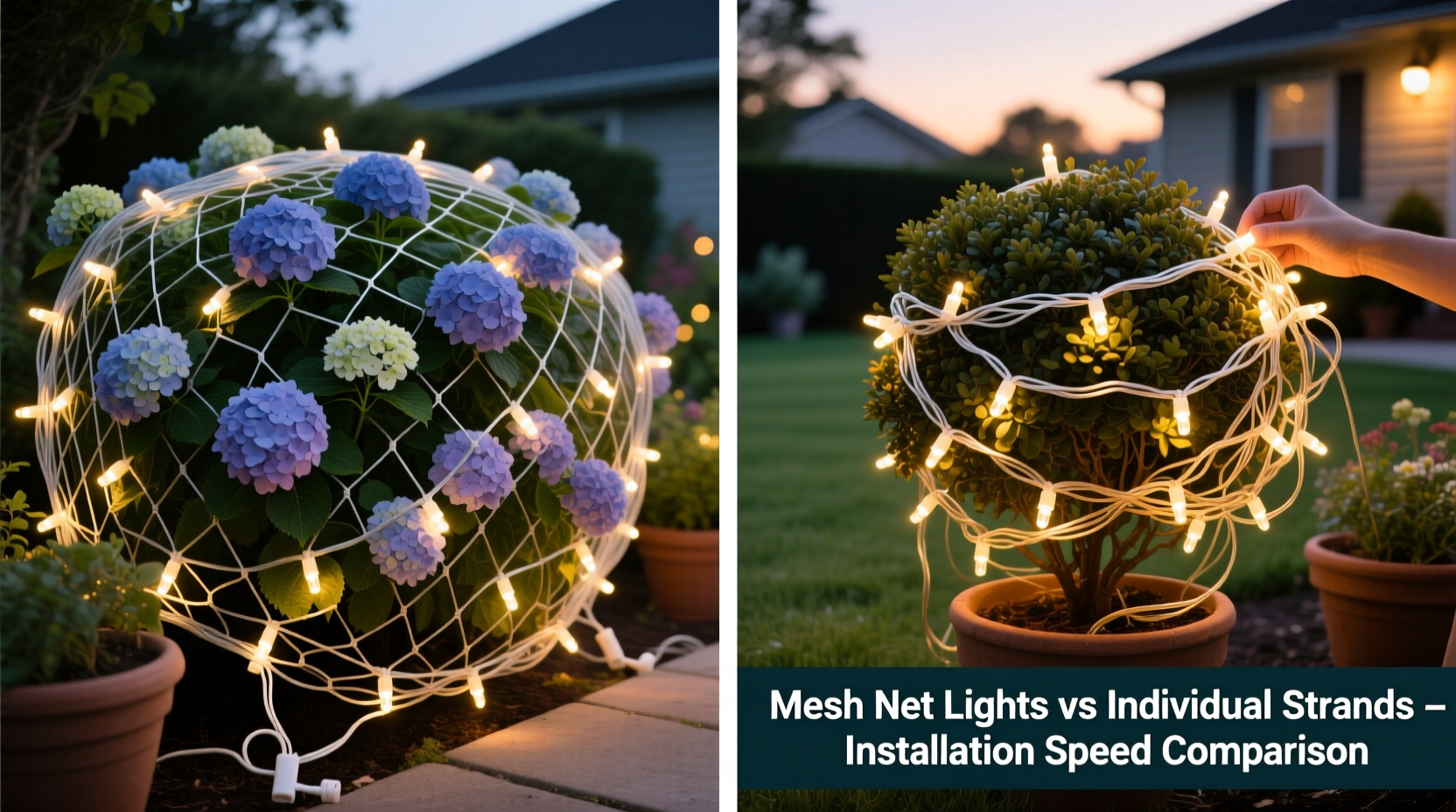
The physical construction of lighting systems directly influences how quickly they can be installed. Mesh net lights consist of LED bulbs evenly spaced across a flexible wire mesh, resembling a fishing net. The entire unit unfolds as a single piece, allowing it to be laid directly over topiaries, hedges, or rounded shrubs with minimal adjustment. Most models come in standard widths—typically 3x6 feet or 4x8 feet—designed to cover medium to large foliage in one go.
In contrast, individual strands are linear cords ranging from 25 to 100 feet in length, requiring manual wrapping around branches, layering for density, and securing at intervals. Achieving even coverage often means using multiple strands per bush, increasing complexity and time investment. Even experienced decorators must make repeated passes to avoid dark spots or clumping.
This fundamental distinction creates a significant gap in deployment speed. A single person can drape and secure a mesh net over a 4-foot-tall arborvitae in under three minutes. The same task with individual strands may take 10–15 minutes, depending on desired brightness and branch density.
Time Comparison: Real Installation Scenarios
To evaluate actual time savings, consider two common landscaping setups found in suburban homes: a row of six foundation shrubs (average height: 3 feet) and a cluster of three larger ornamental bushes (5+ feet tall).
In a timed test conducted by a residential lighting contractor in Colorado, mesh nets were applied to all nine plants using clips and light stakes. Total installation time: 22 minutes. Each net was unfolded, positioned, and secured with four plastic clips. Minimal trimming was needed at edges where branches protruded.
The same property was re-decorated two weeks later using 50-light individual strands (each 25 feet long). To achieve comparable brightness, two strands per small shrub and three per large bush were used. Installers had to weave lights through branches, prevent tangling, and manage excess cord length. Total time: 68 minutes. That’s more than triple the effort.
The disparity grows further when factoring in removal and storage. Mesh nets fold neatly into labeled bins, while untangling individual strands post-season remains one of the most time-consuming aspects of holiday decorating.
“Mesh nets save us at least 60% of labor time on shrub installations. On commercial jobs with dozens of bushes, that translates to thousands in saved labor costs.” — Marcus Tran, Owner, Evergreen Holiday Lighting Co.
Comparison Table: Mesh Nets vs Individual Strands for Bush Lighting
| Feature | Mesh Net Lights | Individual Strands |
|---|---|---|
| Avg. Install Time per Bush (3–5 ft) | 2–4 minutes | 8–15 minutes |
| Coverage Uniformity | Even, grid-like distribution | Variable; depends on installer skill |
| Setup Complexity | Low – lay and clip | High – wrap, weave, secure |
| Storage & Reuse | Easy folding; low tangle risk | Prone to knots; requires careful coiling |
| Best For | Hedges, rounded shrubs, fast coverage | Custom designs, tree trunks, accent lighting |
| Flexibility in Shape Adaptation | Moderate – works best on uniform shapes | High – conforms to irregular forms |
Step-by-Step Installation Timeline: Side-by-Side
To illustrate the workflow differences, here’s how a typical installation unfolds for each type when applied to a medium-sized boxwood shrub (approximately 3.5 feet tall and wide):
Mesh Net Lights – 3-Minute Process
- Unpack and unfold the net (15 seconds)
- Position over the bush, aligning corners with outer edges (30 seconds)
- Adjust center placement to ensure full coverage (20 seconds)
- Secure with four green plastic clips attached to lower branches (60 seconds)
- Connect to power source via adjacent outlet or main run (30 seconds)
- Final visual check for gaps or drooping (15 seconds)
Individual Strands – 12-Minute Process
- Uncoil and inspect two 25-foot strands for damage (2 minutes)
- Begin wrapping from base, moving upward in spiral pattern (3 minutes)
- Weave inward to reach interior branches and prevent surface-only look (2 minutes)
- Overlap second strand for increased density (2 minutes)
- Route excess cord to backside or ground level (1 minute)
- Clip every 8–10 inches to prevent slippage (1.5 minutes)
- Test connection and adjust spacing if needed (30 seconds)
The extra steps required for individual strands—particularly coiling management, weaving technique, and frequent clipping—are what drive up total time. Mesh nets eliminate most of these intermediate actions through integrated design.
Mini Case Study: Suburban Home Holiday Upgrade
A homeowner in Portland, Oregon, decided to upgrade her front yard lighting for the first time after years of struggling with tangled cords and uneven displays. Her landscape included eight dwarf nandinas along the walkway and three large hollies near the porch. Previously, she used individual strands, spending nearly three evenings over two weekends to complete the job.
For the new season, she invested in four 4x6-foot warm-white mesh net lights (two per holly, one per pair of nandinas). With help from her teenager, she finished the entire installation in **under 40 minutes** on a Saturday morning. She reported not only faster setup but also a more professional appearance, with consistent sparkle across all plants. Removal after the holidays took 15 minutes—compared to two hours the prior year spent untangling and rewinding.
“I didn’t realize how much stress came from the lights themselves,” she said. “Now I look forward to putting them up instead of dreading it.”
When Individual Strands Still Make Sense
Despite the clear speed advantage of mesh nets, individual strands retain value in specific situations. Their flexibility makes them ideal for non-uniform shrubs with irregular growth patterns, such as wild rose bushes or sculpted topiaries with defined features. They’re also better suited for vertical emphasis—like highlighting the trunk of a small tree before transitioning into canopy lighting.
Additionally, decorators aiming for custom effects—such as pulsing sequences, color gradients, or spotlight-style clustering—often prefer individual control over each section. Some high-end displays combine both types: mesh nets for broad background illumination and individual strands for artistic detailing.
However, for straightforward bush coverage focused on efficiency and reliability, mesh nets remain the superior choice.
Frequently Asked Questions
Can mesh net lights be used on very thick or spiky bushes?
Yes, but caution is advised. On dense evergreens like blue spruce or holly, use gloves when positioning the net to avoid snags. Trim excess mesh carefully with wire cutters if sharp branches threaten to pierce the wiring. Most modern nets use durable PVC-coated wire that resists minor abrasions.
Are mesh nets weatherproof?
Most outdoor-rated mesh net lights are designed to withstand rain, snow, and temperature fluctuations. Look for labels indicating “UL-listed for outdoor use” and IP44 or higher waterproof rating. Avoid submerging them or placing under heavy ice loads.
Can I connect multiple mesh nets together?
Many models support end-to-end linking, typically up to three or four units depending on wattage and transformer capacity. Always check manufacturer specifications to avoid circuit overload. Using a power adapter with multiple outlets can reduce strain on connected strings.
Expert Insight: Why Efficiency Matters in Seasonal Decorating
“The average homeowner spends 17 hours preparing outdoor holiday lights. Cutting that in half means more time with family and less physical strain. Mesh technology isn’t just convenient—it’s a wellness upgrade.” — Dr. Lena Peterson, Environmental Psychologist, University of Washington
From an ergonomic and psychological standpoint, reducing repetitive motions and frustration during seasonal tasks contributes to greater enjoyment and reduced burnout. The simplicity of mesh nets lowers the barrier to entry, encouraging more people to participate in festive decorating without feeling overwhelmed.
Checklist: Choosing the Right Option for Your Landscape
- ✅ Assess shrub size and shape – uniform = mesh; irregular = strands
- ✅ Count total plants needing coverage – more than five favors mesh
- ✅ Determine desired brightness level – mesh provides even glow; strands allow layered intensity
- ✅ Evaluate storage space – mesh folds compactly; strands require reels or boxes
- ✅ Consider future reuse – mesh lasts longer with proper handling
- ✅ Check existing power access – proximity affects extension needs for both types
Conclusion
When installing lights on bushes and shrubs, mesh net lights consistently outperform individual strands in speed, ease, and consistency. They transform what was once a tedious, multi-evening chore into a quick, satisfying task that takes minutes rather than hours. While individual strands offer creative flexibility for specialized projects, they demand more time, skill, and patience—resources many homeowners simply don’t have during the busy holiday season.
The data, real-world examples, and expert input all point in the same direction: for efficient, attractive shrub lighting, mesh nets are the smarter, faster solution. Whether you're enhancing curb appeal, creating a welcoming ambiance, or simply enjoying the joy of seasonal decoration, switching to mesh can make all the difference.




 浙公网安备
33010002000092号
浙公网安备
33010002000092号 浙B2-20120091-4
Comments
No comments yet. Why don't you start the discussion?