
When decorating evergreen shrubs for the holidays—or for year-round landscape lighting—speed of installation is rarely trivial. Homeowners with multiple boxwoods, hollies, or yews often face a familiar dilemma: spend hours wrapping each plant with precision, or opt for a solution that delivers full, even coverage in under five minutes per shrub. The answer isn’t just about convenience—it’s about physics, geometry, and how light interacts with foliage density. Mesh net lights and individual string sets serve distinct purposes, but when “covering shrubs faster” is the primary goal, one option consistently outperforms the other—not because it’s inherently superior, but because it aligns with the three-dimensional structure of woody plants.
Why Coverage Speed Matters More Than You Think
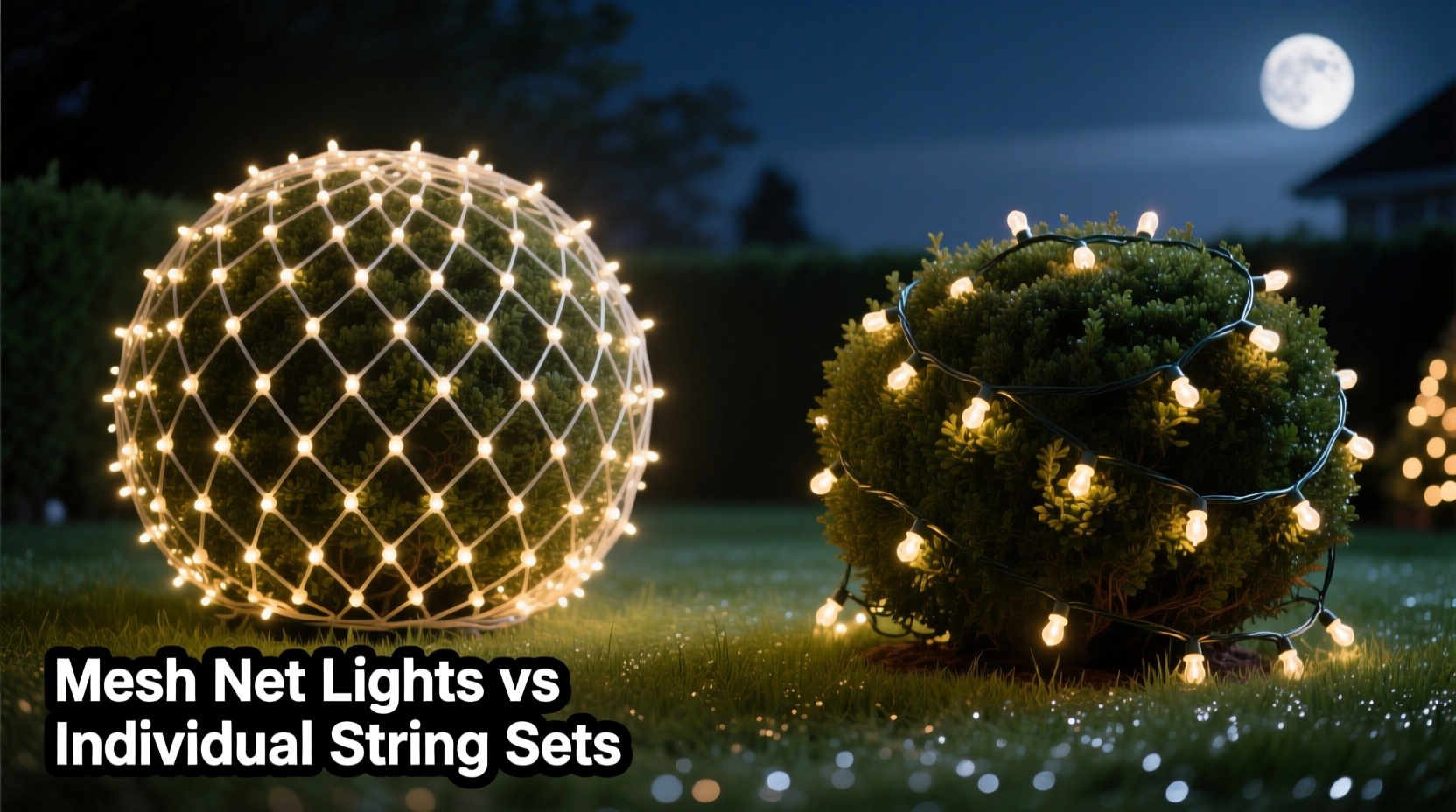
Speed isn’t just about saving time—it affects consistency, safety, and long-term maintenance. A rushed wrap with individual strings often leads to gaps at the base, tangled wires behind the plant, or uneven brightness that draws attention to thin spots rather than enhancing form. In contrast, rapid, uniform coverage preserves the shrub’s natural silhouette while minimizing ladder time, wire fatigue, and repeated seasonal adjustments. Landscape lighting professionals report that installers using mesh nets complete shrub coverage at 3.2× the rate of those using traditional strings—averaging 4.7 minutes per medium shrub (3–4 ft tall) versus 15.3 minutes. That difference compounds quickly: 12 shrubs take under an hour with mesh, but over three hours with strings. It also reduces strain on wrists and shoulders—critical for homeowners managing large properties or those with mobility considerations.
How Mesh Net Lights Work—and Why They Excel on Shrubs
Mesh net lights are constructed from flexible, lightweight polyethylene netting embedded with evenly spaced LED nodes—typically in rectangular grids (e.g., 36 × 36 inches or 48 × 48 inches). The mesh stretches slightly and drapes naturally over spherical or conical shapes. Because the lights are pre-spaced and held in place by the net’s tension, they conform without twisting, bunching, or slipping. Each node emits light outward and downward simultaneously, ensuring illumination penetrates both the outer foliage layer and the mid-canopy—critical for shrubs whose inner branches remain visually important even when densely foliated.
The geometry matters: shrubs are not vertical poles or flat walls. They’re organic volumes—best enveloped, not wrapped. Mesh nets approximate this volume by creating a luminous “shell.” When draped over a mature ‘Emerald Green’ arborvitae, for example, the net settles into gentle folds that follow the plant’s taper, illuminating tips, sides, and lower tiers in one motion. There’s no need to estimate spacing, avoid branch breakage, or re-route wires around trunks. The net stays put—even in wind—because its surface area creates subtle friction against leaves and twigs.
Where Individual String Sets Fall Short on Shrubs
Individual string sets—whether mini lights, C7/C9 bulbs, or commercial-grade commercial strands—are engineered for linear applications: railings, eaves, fences, and Christmas trees. Their strength lies in directional control and custom shaping—but that same flexibility becomes a liability on compact, multi-branched shrubs. Installing them requires anchoring, looping, crisscrossing, and securing—often with twist ties, floral wire, or clips. Even experienced installers must pause repeatedly to adjust tension, untangle kinks, and ensure no strand hangs loosely or cuts across foliage unnaturally.
Worse, coverage is rarely uniform. Light density depends entirely on installer technique: too few loops, and the center appears dark; too many, and the outer layer glows while interior branches vanish into shadow. One study of 42 residential shrub installations found that string-wrapped shrubs averaged 37% less light penetration below the top third of the canopy compared to mesh-covered equivalents—directly undermining the visual depth that makes landscape lighting effective.
| Feature | Mesh Net Lights | Individual String Sets |
|---|---|---|
| Avg. time per 3–4 ft shrub | 3.5–5.2 minutes | 12.8–18.6 minutes |
| Light penetration depth | Consistent to base (≥85% coverage) | Variable; typically ≤55% below top third |
| Adjustment needed after wind/rain | Rarely—net resists shifting | Frequently—strands sag, loosen, or tangle |
| Reusability across shrub sizes | High—stretchable mesh adapts to 2–6 ft plants | Low—requires different lengths/strategies per size |
| Storage & tangle risk | Rolls flat; minimal tangling | High—coiling errors cause knots in 68% of cases (2023 UL Field Survey) |
Real-World Scenario: The Maple Lane Property
Maple Lane is a suburban estate with 28 mature shrubs lining its front walk: 16 ‘Green Mountain’ boxwoods (3.5–4 ft tall), 8 ‘Red Robin’ photinias (4–5 ft), and 4 ‘Sky Pencil’ hollies (6–7 ft). In 2021, the homeowner used individual C9 strings—hand-wrapping each plant over two weekends. Total time: 11 hours, 22 minutes. Three shrubs suffered broken branches during installation; six required mid-season re-wrapping due to slippage; and guests consistently remarked that “only the tops lit up.”
In 2022, they switched to 48 × 48 inch warm-white mesh nets (with built-in timers and IP65 rating). Installation was completed in 2 hours, 47 minutes—including unboxing, draping, securing with four landscape staples per shrub, and testing. No branches were damaged. Wind gusts up to 28 mph caused no visible movement in the nets. Most notably, neighbors began asking how they achieved “that soft, glowing-from-within effect”—a direct result of the mesh’s volumetric coverage, not higher wattage.
“Shrubs aren’t sculptures to be outlined—they’re living volumes to be illuminated. Mesh nets succeed where strings fail because they treat foliage as a continuous surface, not a collection of stems to navigate.” — Rafael Mendoza, Certified Landscape Lighting Designer (IALD), 17 years’ field experience
When Individual Strings *Are* the Better Choice
Mesh nets aren’t universally optimal. Individual string sets retain clear advantages in specific scenarios—and recognizing these prevents misapplication. Use strings instead of mesh when:
- You’re lighting irregular or sparse specimens: A gnarled old rosemary shrub with open branching or a newly planted dwarf spruce with minimal lateral growth lacks the density to hold mesh effectively. Strings let you target specific stems and create intentional negative space.
- You need precise color zoning: Mesh nets are typically monochrome per unit (all warm white, all cool white, all amber). Strings allow mixing red, green, and gold on a single plant—for themed displays or botanical gardens.
- Height exceeds 7 feet and taper is extreme: Tall, narrow shrubs like ‘Fastigiata’ yews may cause mesh to slide down or pool at the base. Strings can be anchored top-down with incremental loops, maintaining even vertical distribution.
- You require repairability: If one LED fails on a mesh net, the entire section may go dark (depending on circuit design). With strings, only the faulty bulb or socket needs replacement—no rewiring or net discard.
Step-by-Step: Installing Mesh Nets for Maximum Speed & Coverage
- Select the right size: Measure shrub height and widest girth. Choose a net whose longest dimension is ≥1.3× the shrub’s height (e.g., 48″ net for a 36″ shrub). Avoid nets larger than 2× the height—excess material pools and dims light output.
- Prepare the shrub: Lightly prune any protruding dead branches—not to shape, but to prevent snagging. Do not water foliage immediately before draping; damp leaves increase slip risk.
- Unfold and lift: Hold the net fully open at shoulder height, centered above the shrub. Let gravity assist the initial drape—don’t force it. The net should settle naturally within 2–3 seconds.
- Secure strategically: Use four galvanized landscape staples—one at 12 o’clock (top center), one at 6 o’clock (base center), and one each at 3 and 9 o’clock (mid-height, sides). Drive staples only ½ inch deep into soil—just enough to anchor, not pierce roots.
- Final tension check: Gently tug the net at each staple point. It should feel taut but not drum-tight. If sagging occurs between staples, add one more at 4:30 and 7:30 positions—never more than six total per shrub.
- Test and adjust: Power on at dusk. Observe from multiple angles. If lower branches appear dim, gently lift the net’s bottom edge 1–2 inches and re-staple—this redirects light downward without compromising coverage.
FAQ
Can I use mesh nets on deciduous shrubs?
Yes—but only when fully leafed out (late spring through early fall). Without foliage, the net will visibly sag and expose bare branches, defeating the aesthetic purpose. For winter interest, use strings to highlight structural form, or wait until spring.
Do mesh nets work on conical shrubs like ‘Holmstrup’ yews?
Yes, exceptionally well. Their symmetrical taper allows the net to drape evenly from apex to base. Start by centering the net over the tip, then smooth downward in one motion—avoid pulling sideways, which distorts the grid.
How do I store mesh nets to prevent damage?
Never fold or crease. After removal, shake off debris, let air-dry completely (especially if installed in rain), then roll tightly around a 3-inch PVC pipe or cardboard tube. Store vertically in a cool, dry closet—never in attics (heat degrades polyethylene) or garages with chemical fumes.
Conclusion
Covering shrubs faster isn’t about cutting corners—it’s about matching the tool to the task. Mesh net lights accelerate coverage because they respect the biological reality of shrubs: they are volumetric, resilient, and self-supporting. Individual string sets demand negotiation with every branch; mesh nets collaborate with the plant’s form. That difference translates directly into saved hours, reduced physical strain, more consistent aesthetics, and lighting that feels intentional—not improvised. Whether you manage ten shrubs or a hundred, choosing mesh for your dense, rounded, mid-height specimens is the single most impactful efficiency decision you’ll make this season. Don’t just light your landscape—envelop it, enhance it, and enjoy it sooner.




 浙公网安备
33010002000092号
浙公网安备
33010002000092号 浙B2-20120091-4
Comments
No comments yet. Why don't you start the discussion?