
When it comes to illuminating trees for holidays, weddings, or garden ambiance, choosing between mesh net lights and traditional string lights can significantly impact both the visual result and the time investment. While both options deliver charm and sparkle, they differ in coverage, speed of installation, durability, and suitability for different tree types. Understanding these differences helps you make an informed decision—especially when your goal is even lighting with minimal effort.
Whether you're decorating a small ornamental tree in your front yard or wrapping a towering evergreen for Christmas, the right lighting choice affects not only aesthetics but also practicality. Let’s explore how mesh net lights and string lights compare in delivering full, uniform illumination and how quickly each can transform a bare tree into a glowing centerpiece.
How Mesh Net Lights Work
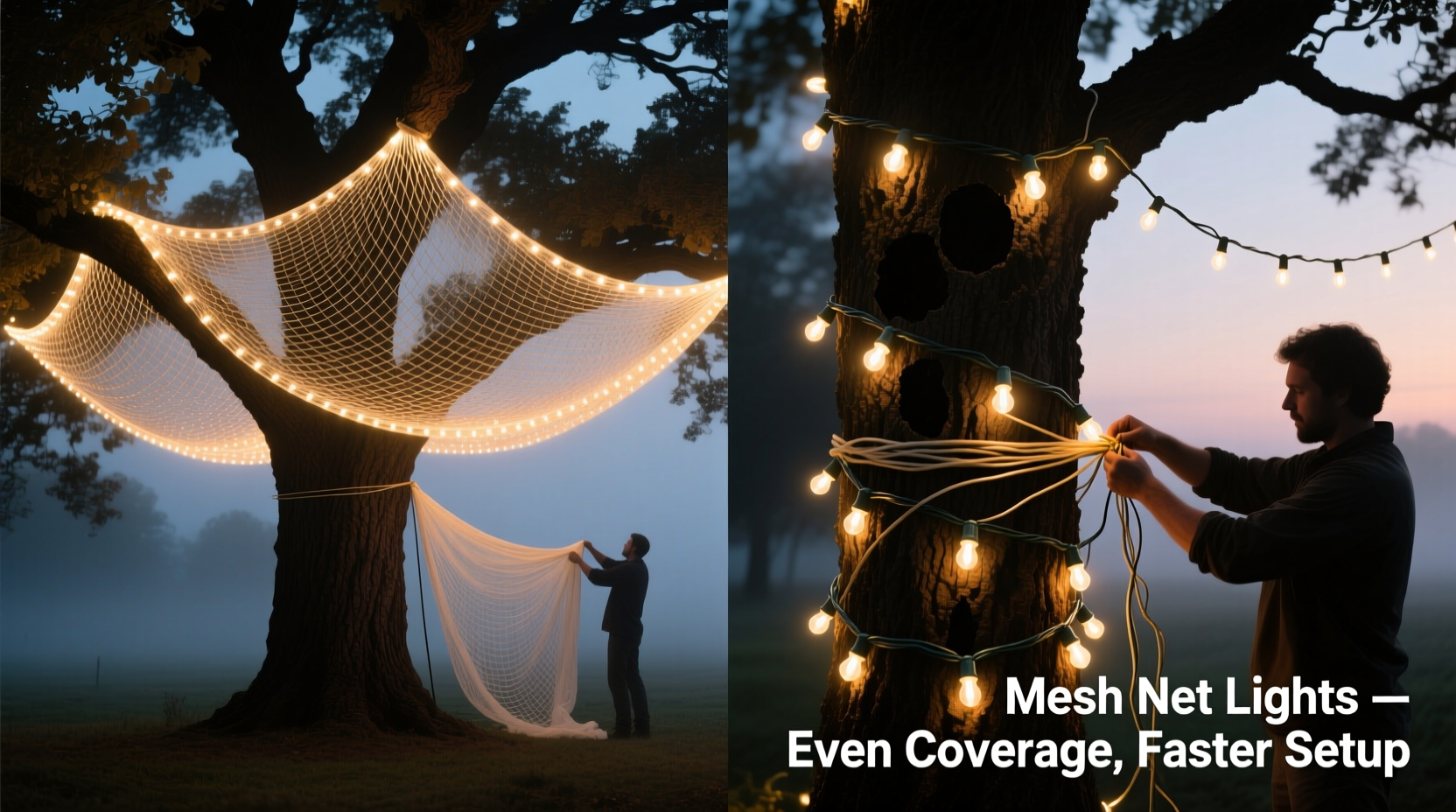
Mesh net lights are pre-wired LED strands arranged in a grid pattern, resembling a fishing net embedded with evenly spaced bulbs. These nets come in fixed dimensions—typically 3x6 feet, 4x6 feet, or larger—and are designed to drape directly over shrubs, bushes, or trees. Because the lights are uniformly distributed across the net, they offer consistent spacing without requiring manual adjustments during installation.
The primary advantage of mesh net lights lies in their predictability. Each bulb is set at regular intervals, usually 3 to 6 inches apart, ensuring that no section of the tree remains dark. This makes them ideal for dense foliage where random wrapping might miss inner branches. Additionally, most modern mesh nets use energy-efficient LEDs with low heat output, making them safe for prolonged use around dry vegetation.
Installation is straightforward: simply unfold the net, position it over the top of the tree, and let it cascade down the sides. For multi-layer coverage, stack two nets vertically. Most models include corner tie-downs or clips to secure the net to thicker branches, preventing slippage in windy conditions.
How String Lights Function on Trees
String lights consist of a single electrical cord threaded with individual bulbs, available in various lengths from 10 to 100 feet or more. Unlike mesh nets, string lights require manual wrapping around branches to achieve coverage. This gives decorators greater control over light placement but demands more time and attention to detail.
To cover a tree evenly with string lights, you must weave the strand through outer and inner branches, moving in a spiral or crisscross pattern. The process becomes more complex with taller or irregularly shaped trees. Achieving balanced brightness requires avoiding clumping and ensuring gaps don’t form between wraps. Skilled installers often use the “inside-out” method—starting deep within the trunk and working outward—to create depth and prevent flat-looking illumination.
String lights excel in customization. You can choose bulb size (mini, fairy, globe), color temperature (warm white, cool white, multicolor), and even smart-enabled variants with remote controls or app integration. However, this flexibility comes at the cost of labor. Covering a medium-sized tree thoroughly may take 30–60 minutes with string lights, compared to under 10 minutes with a mesh net.
“Mesh nets save time and guarantee consistency, while string lights reward patience with precision.” — Daniel Reeves, Landscape Lighting Designer
Comparison: Coverage and Speed
Coverage quality and installation speed are the two most critical factors when deciding between mesh net and string lights for trees. Below is a detailed comparison based on real-world performance.
| Feature | Mesh Net Lights | String Lights |
|---|---|---|
| Installation Time | 5–15 minutes per tree | 30–90 minutes per tree |
| Coverage Uniformity | Near-perfect, factory-set spacing | Depends on installer skill; prone to gaps |
| Best For | Bushes, hedges, symmetrical evergreens | Tall pines, irregular shapes, custom displays |
| Adjustability | Limited—fixed grid layout | High—wrap any way desired |
| Storage & Reuse | Foldable, but bulky if multiple sizes | Easily coiled; compact storage |
| Cost per Bulb | Moderate to high (due to frame) | Lower; scalable by length |
As shown, mesh net lights win decisively in speed and consistency. A homeowner using a 4x6-foot net can drape a 7-foot spruce in under 10 minutes with near-total coverage. In contrast, wrapping the same tree with 100 feet of string lights typically takes at least half an hour and risks uneven density if rushed.
However, string lights allow strategic highlighting—such as accentuating lower limbs or creating downward-dripping effects—that mesh nets cannot replicate. They’re also better suited for non-standard tree forms, like twisted oaks or weeping cherries, where a rigid grid would leave large sections exposed.
Step-by-Step Installation Guide
Understanding how each type installs helps clarify why one might be faster or more effective for your situation. Follow these proven steps for optimal results.
Installing Mesh Net Lights
- Measure your tree: Note height and widest diameter. Select a net slightly smaller to ensure snug fit.
- Unfold the net: Lay it flat on grass to check for damaged bulbs before lifting.
- Drape from the top: Have a partner lift the center of the net over the highest branch.
- Let it fall naturally: Allow the net to settle down all sides, adjusting gently for symmetry.
- Secure corners: Use zip ties or soft plant ties to anchor bottom edges to sturdy limbs.
- Connect to power: Route the plug toward outlet using ground stakes; avoid tripping hazards.
Wrapping Trees with String Lights
- Start at the base: Begin wrapping near the trunk at ground level to hide cords.
- Work upward in spirals: Move diagonally around the tree, maintaining 6–8 inch vertical spacing.
- Weave inward: Push some bulbs toward the core to illuminate inner branches and add depth.
- Avoid over-wrapping: Too many layers cause glare and reduce three-dimensional effect.
- Test frequently: Plug in every few minutes to spot dark zones needing reinforcement.
- Conceal excess wire: Tuck leftover cord into lower foliage or route discreetly to power source.
Real-World Example: Holiday Tree Display Upgrade
In suburban Columbus, Ohio, homeowner Maria Thompson spent years struggling with string lights on her pair of blue spruces. Each December, she and her husband dedicated nearly two hours total to wrap both trees, only to find patchy spots after dark. One year, frustrated by inconsistent results, she switched to commercial-grade mesh net lights recommended by a local landscaper.
She purchased two 4x8-foot LED mesh nets rated for outdoor use. With her son’s help, they draped each net over a tree in less than 12 minutes combined. The transformation was immediate: every angle sparkled uniformly, even from the street. Neighbors noticed the improvement, and Maria regained weekends previously lost to holiday decorating. She now stores the nets in labeled bins and reuses them annually with no degradation in performance.
While she still uses string lights for her porch railing and roofline—where custom patterns matter—she reserves mesh nets exclusively for trees. “It’s not laziness,” she said. “It’s choosing the right tool. The nets just look better on round, full trees.”
Expert Recommendations and Long-Term Use
Professional landscapers and lighting designers often recommend mesh net lights for clients prioritizing efficiency and reliability. Their structured design minimizes human error and reduces call-backs for touch-ups.
“For seasonal residential work, mesh nets are 80% of our go-to solution for shrubs and conifers. They deliver instant impact with minimal training.” — Lena Park, Outdoor Lighting Contractor, Pacific Northwest Landscapes
That said, longevity depends on material quality. Cheaper mesh nets use thin PVC coatings that crack after one winter season. Opt instead for UV-resistant, waterproof models with shatterproof bulbs and reinforced connection points. Look for brands offering 3+ year warranties and replace any net showing broken nodes or frayed wiring.
String lights, particularly commercial-grade C7 or C9 varieties, tend to last longer when properly stored. Many professionals rewind them on cardboard spools to prevent tangling. Though initially slower to install, their modular nature allows replacing short runs instead of entire units—a cost-saving benefit over time.
FAQ
Can I connect multiple mesh net lights together?
Yes, many models support end-to-end connections (daisy-chaining), but always check manufacturer limits. Exceeding wattage capacity can trip circuits or damage transformers. Use a power strip with surge protection for safety.
Are mesh nets suitable for deciduous trees?
Only if leaves are present. Mesh nets rely on foliage to hold shape and distribute weight. On bare branches, they may sag or slide off. String lights, secured individually to limbs, perform better on leafless trees.
Which option is safer for kids and pets?
Both are safe when installed correctly. However, mesh nets have fewer dangling cords, reducing tripping and chewing risks. Low-voltage LED versions of either type minimize electrical hazards.
Final Verdict: Which Covers Trees More Evenly and Quickly?
For rapid, uniform coverage on full, bushy trees—especially conifers and ornamental evergreens—mesh net lights are superior. Their factory-engineered spacing ensures every inch receives equal illumination, and installation takes a fraction of the time required for hand-wrapping string lights. Homeowners seeking hassle-free seasonal decor will appreciate the simplicity and repeatable results.
String lights remain the preferred choice when artistic control, adaptability, or architectural complexity is needed. They shine on irregular trees, multi-trunk specimens, or when integrating into broader landscape designs. But they demand more time, patience, and skill to achieve evenness comparable to mesh nets.
If your priority is speed and consistency, mesh net lights are the clear winner. For maximum creative freedom and long-term component reuse, string lights offer unmatched versatility.




 浙公网安备
33010002000092号
浙公网安备
33010002000092号 浙B2-20120091-4
Comments
No comments yet. Why don't you start the discussion?