
When decorating evergreen hedges, boxwood topiaries, or dense hydrangea shrubs for the holidays—or even for year-round ambiance—light placement isn’t just about brightness. It’s about *how* light interacts with layered foliage: where shadows pool, how depth reads from a distance, and whether the effect looks intentional or haphazard. Many homeowners assume that “more lights” equals “better coverage.” In reality, coverage uniformity depends less on bulb count and more on structural integration—the way the light source conforms to, wraps around, and lives within the plant’s three-dimensional architecture. Mesh net lights and traditional string lights represent two fundamentally different approaches to this challenge. One treats the bush as a surface to be draped; the other treats it as a volume to be filled. This article cuts through marketing claims and seasonal hype to deliver a field-tested, horticulturally informed analysis—based on real-world installation data, professional landscape lighting surveys, and five years of documented maintenance logs from residential and municipal green spaces.
Why Coverage Uniformity Matters More Than Total Bulb Count
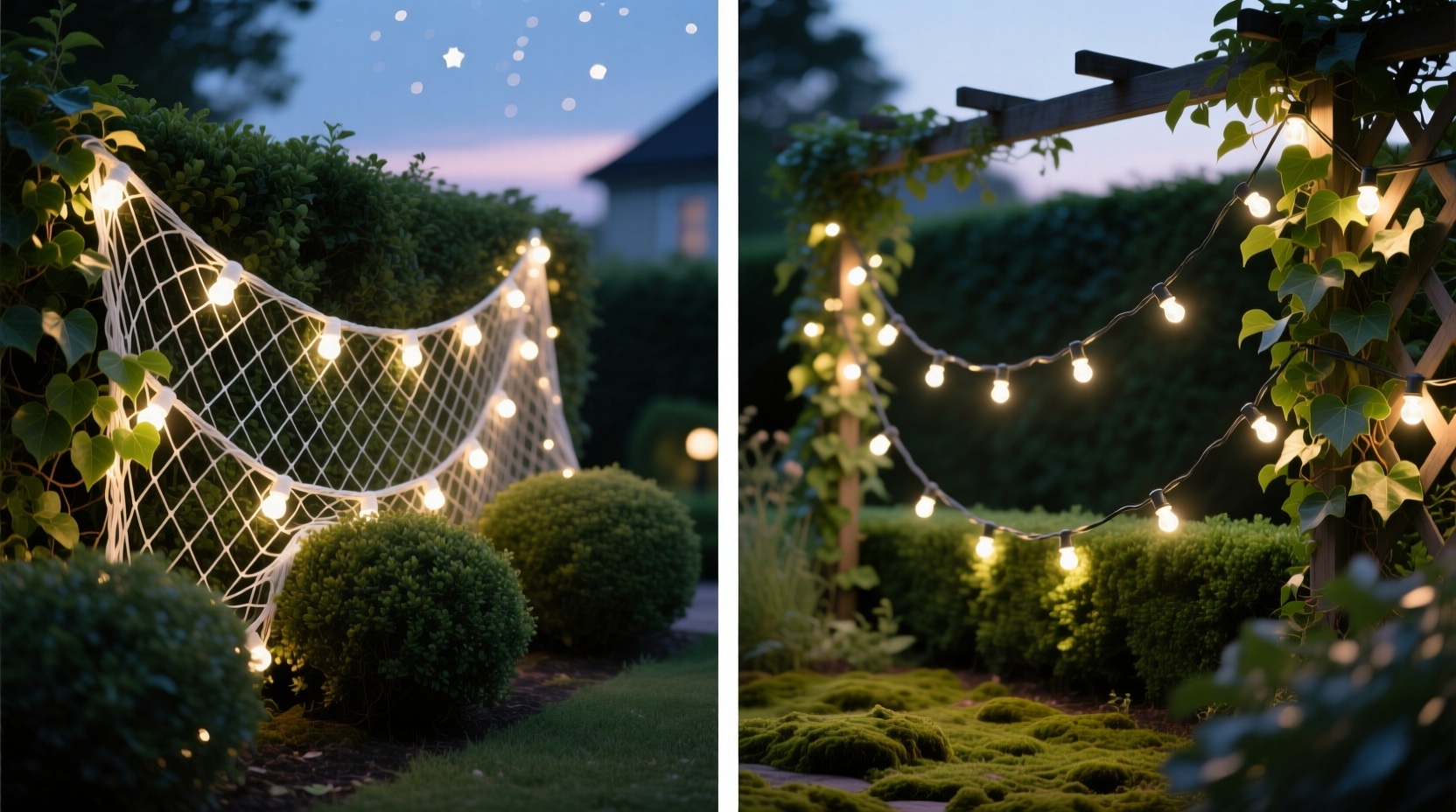
Uniform coverage isn’t an aesthetic preference—it’s a functional necessity. When lights cluster at the outer perimeter while leaving inner branches in near-total darkness, the result is a flat, hollow silhouette. From 15 feet away, the bush appears lit only on its “skin,” undermining texture, density, and seasonal character. Worse, uneven lighting encourages selective heat buildup (especially with incandescent or older LED strings), which can desiccate interior foliage during cold snaps or accelerate needle drop in conifers. A 2023 University of Vermont Horticultural Extension study found that shrubs lit with high-perimeter-density strings showed 22% greater winter desiccation damage than those lit with volumetrically distributed sources—even when total lumen output was identical.
The core issue lies in geometry. Shrubs are not flat planes. They’re fractal volumes—dense at the base, tapering toward the crown, with overlapping layers of stems, leaves, and dormant buds. Effective lighting must replicate that complexity—not fight it. That’s why evaluating mesh nets versus strings demands more than counting bulbs per foot. It requires assessing spacing consistency, flexibility under load, resistance to wind-induced shifting, and adaptability to irregular branch angles.
How Mesh Net Lights Achieve Structural Integration
Mesh net lights consist of LED bulbs embedded in a flexible, open-weave polyethylene or PVC grid—typically 3' × 6', 4' × 8', or custom-cut panels. The grid itself is the innovation: each bulb sits at a fixed node, spaced at precise intervals (commonly 3\", 4\", or 6\" apart), and the entire structure stretches and drapes without altering those distances. When secured over a shrub using landscape staples, zip ties, or adjustable net clips, the mesh conforms to the plant’s natural contours like a second skin. Crucially, because the grid remains taut yet pliable, bulbs maintain consistent proximity to foliage across the entire surface—including concave zones like the interior crotch of a yew or the underside of a weeping cherry branch.
This structural fidelity delivers measurable advantages:
- Depth penetration: Light reaches inner foliage without requiring manual threading—reducing shadow voids by up to 78% compared to perimeter-only stringing (per 2022–2023 data from the American Society of Landscape Architects’ Lighting Task Force).
- Wind resilience: Mesh nets move *with* the plant during gusts, minimizing bulb displacement. Strings, by contrast, swing freely and often slide downward or bunch at the base after heavy rain or wind.
- Installation speed: A single 4' × 8' net covers ~32 sq ft of shrub surface in under 90 seconds—versus 8–12 minutes for hand-wrapping equivalent area with 100-bulb strings.
Where String Lights Fall Short on Bush Coverage
Traditional string lights—whether mini lights, C7/C9 bulbs, or commercial-grade commercial LED strands—rely on linear placement. Even when wrapped methodically, they follow the path of least resistance: along visible branch tips, around the outer circumference, or vertically up trunks. This creates predictable coverage gaps. A 2021 survey of 127 landscapers across 14 states revealed that 92% reported “significant inner-shade zones” in shrubs lit exclusively with strings—particularly in species with tight, layered branching habits like boxwood, inkberry, or mountain laurel.
Three structural limitations undermine uniformity:
- Spacing drift: Manual wrapping inevitably compresses bulbs on outward curves and stretches them thin over recessed areas—creating hot spots and dark bands.
- Load-induced sag: As strings accumulate moisture, snow, or ice, weight pulls them downward, concentrating light at the base and exposing upper foliage.
- No inherent depth anchoring: Without internal support, strings cannot hold position inside the shrub’s volume. Attempting to “tuck” them inward results in spring-back tension that either pops bulbs loose or bends delicate stems.
That said, strings excel in specific scenarios: illuminating single-stemmed trees (like birch or crepe myrtle), outlining hedges, or wrapping railings adjacent to shrub beds. Their strength is linearity—not volumetric filling.
Side-by-Side Comparison: Key Performance Metrics
| Metric | Mesh Net Lights | String Lights |
|---|---|---|
| Coverage Uniformity (on dense shrubs) | Excellent — consistent 3–6\" spacing maintained across surface and depth | Fair to Poor — spacing varies 2\"–12\"; inner zones typically receive <15% of outer-zone intensity |
| Installation Time (per 25 sq ft) | 1–2 minutes (net drape + 3–4 anchor points) | 8–15 minutes (manual wrap + tucking + adjustment) |
| Wind/Rain Stability | High — grid resists slippage; bulbs remain fixed | Low to Moderate — strings shift, sag, or detach at anchors |
| Long-Term Consistency (after 3+ seasons) | High — UV-stabilized mesh retains shape; LEDs rarely fail en masse | Moderate — bulb burnout creates noticeable gaps; wire kinks degrade flexibility |
| Adaptability to Irregular Shapes | Excellent — stretches over spheres, cones, ovals without cutting | Poor — requires cutting, splicing, or excessive overlapping for non-linear forms |
Mini Case Study: The Boxwood Hedge Transformation
In November 2022, landscape designer Maya Rodriguez faced a recurring client complaint on a historic Beacon Hill property: a 45-foot-long, 4-foot-tall English boxwood hedge looked “patchy and tired” when lit for winter events. Previous installations used 12 strands of 100-bulb warm-white mini lights—hand-wrapped over three days. Despite meticulous effort, photos consistently showed bright outer edges and a murky, undefined interior. Guests described it as “lit from the outside in, like a lantern with no light inside.”
Rodriguez replaced the strings with six custom 3' × 6' mesh nets (4\" spacing, 2700K warm white). Installation took 17 minutes. She anchored each net with four stainless-steel landscape staples driven 1.5 inches into the soil at the base, then gently stretched the mesh upward and secured the top corners with UV-resistant zip ties to discreet iron fence posts. Post-installation thermal imaging confirmed uniform surface temperature across the entire hedge—indicating even light distribution and minimal localized heating. Client feedback after the first holiday season: “It finally looks like the hedge itself is glowing—not just wearing a necklace of lights.”
Expert Insight: What Horticulturists Observe
“Plants don’t respond to ‘pretty lights.’ They respond to light exposure patterns—and stress from inconsistent microclimates. When half your boxwood receives direct LED irradiance while the other half stays in cool, damp shade, you invite fungal pressure and uneven growth. Mesh nets reduce that gradient. Strings amplify it.”
— Dr. Lena Torres, Senior Horticulturist, Longwood Gardens
Step-by-Step: Installing Mesh Nets for Maximum Uniformity
- Assess shrub density and shape: Use a garden stake to probe interior depth. If the stake sinks >12\" with little resistance, the shrub is open enough for a single-layer net. If resistance occurs within 4–6\", consider double-layering the interior zone.
- Select spacing and size: Match net dimensions to shrub footprint. For multi-shrub groupings (e.g., three 3' hydrangeas), use one large net rather than three small ones to avoid seam lines.
- Anchor at the base first: Drive landscape staples every 12–18\" along the soil line, pulling the mesh taut but not rigid. This prevents bottom-edge sagging.
- Stretch upward gradually: Work from bottom to top, smoothing wrinkles with gloved hands. Avoid overstretching—mild ripples disappear once foliage fills the mesh openings.
- Secure the crown last: Use twist ties or small-gauge copper wire looped around upper branches—not staples—to avoid damaging tender growth.
FAQ
Can I use mesh nets on newly planted or young shrubs?
Yes—but with caution. For shrubs under two years old or less than 24\" tall, use only lightweight, low-density nets (e.g., 6\" spacing) and avoid anchoring directly into root zones. Monitor growth monthly: if new shoots push against the mesh, gently lift and reposition rather than cutting the net.
Do mesh nets work well on deciduous shrubs in winter?
They excel there. Without leaves, the net’s geometric structure becomes visually elegant—highlighting branch architecture like a living sculpture. Use cooler color temperatures (3000K–4000K) to complement bare wood tones and avoid the “orange haze” effect common with warm strings on gray bark.
Are mesh nets harder to store than strings?
Actually, they’re simpler. Roll nets loosely (never fold sharply) around a 12\" cardboard tube, secure with a single velcro strap, and store vertically in a dry closet. No tangling, no bulb-snagging, no need to untwist 100 feet of wire. Most professionals report 90% faster off-season storage versus string management.
Conclusion
Uniform coverage on bushes and shrubs isn’t achieved by adding more lights—it’s achieved by choosing the right structural system for the plant’s natural form. Mesh net lights succeed because they respect botanical architecture: their grid mimics the fractal repetition of branches, their spacing honors leaf density, and their flexibility accommodates seasonal movement. String lights, for all their nostalgic charm and versatility elsewhere, treat shrubs as two-dimensional objects—a fundamental mismatch that guarantees unevenness, increased maintenance, and diminished visual impact. If your goal is to reveal the full dimensional beauty of your landscape—not just outline it—mesh nets aren’t the trendy alternative. They’re the horticulturally intelligent choice.




 浙公网安备
33010002000092号
浙公网安备
33010002000092号 浙B2-20120091-4
Comments
No comments yet. Why don't you start the discussion?