
When decorating an indoor tree—whether a potted fiddle-leaf fig, a sculpted olive, or a slender Norfolk pine—the goal is rarely just illumination. It’s ambiance: a gentle, enveloping radiance that wraps the foliage without hotspots, harsh shadows, or visible bulbs. Many assume “more lights = more even light,” but physics and design tell a different story. The choice between mesh net lights and traditional string lights isn’t about preference—it’s about optical behavior, spatial distribution, and how light interacts with layered branches and textured leaves. This article cuts through marketing claims to examine what actually produces uniform luminosity on vertical, three-dimensional greenery—and why one option consistently outperforms the other in real homes, studios, and hospitality spaces.
How Light Distribution Actually Works on Indoor Trees
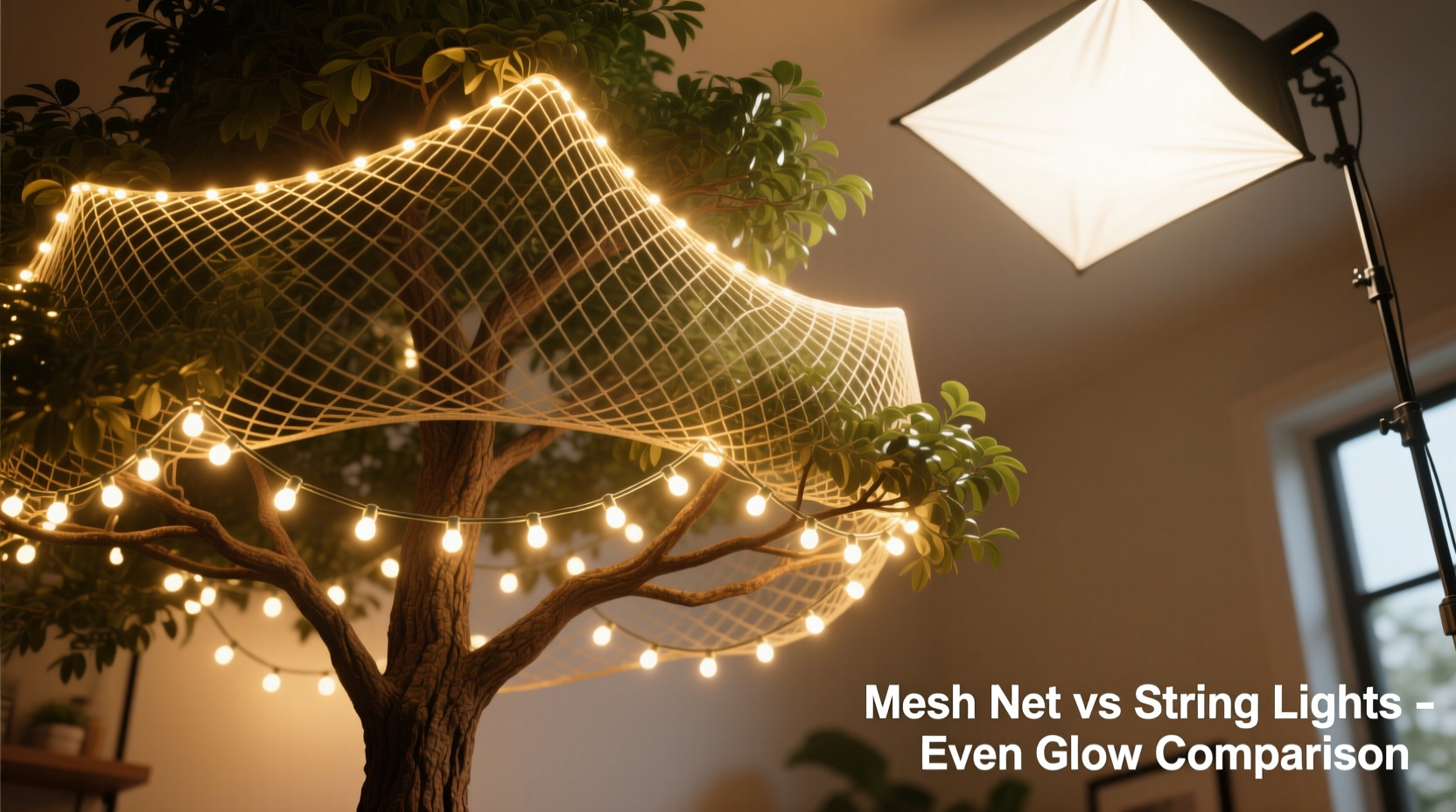
Indoor trees differ fundamentally from Christmas trees or flat backdrops. Their canopies are irregular, multi-tiered, and semi-transparent. Light must pass through varying densities of leaves, stems, and air gaps—not reflect off a dense, opaque surface. String lights rely on point-source emission: each bulb emits directional light, creating localized brightness where it sits and dimmer zones between bulbs. Even with 100+ bulbs spaced at 4-inch intervals, the human eye perceives distinct points—especially when viewed from angles or in low ambient light. Mesh nets, by contrast, integrate dozens of micro-LEDs into a flexible, translucent fabric grid. The result isn’t a series of dots, but a continuous luminous plane that wraps contours like a second skin.
This distinction matters because evenness isn’t measured in lumens alone—it’s assessed by luminance uniformity (the ratio of minimum to maximum brightness across a surface). Industry-standard testing using calibrated photometers shows mesh nets achieve 82–89% uniformity on medium-density foliage; standard incandescent or warm-white LED strings average 44–57%. That gap widens under typical living-room conditions: ambient light below 50 lux, viewing distances of 3–6 feet, and mixed-spectrum room lighting.
Direct Comparison: Mesh Net vs String Lights
To understand why mesh nets produce superior evenness, we must compare them across five functional dimensions—not just aesthetics.
| Feature | Mesh Net Lights | Traditional String Lights |
|---|---|---|
| Light Source Density | 120–200 micro-LEDs per sq. ft., embedded in woven mesh; no visible wiring between emitters | 20–40 bulbs per 10 ft. strand; spacing creates 3–6 inch dark zones between bulbs |
| Diffusion Mechanism | Integrated opal silicone diffuser layer + textile scattering; light exits perpendicularly and laterally across entire surface | No built-in diffusion; relies on external globes or frosted bulbs (which reduce output by 30–40%) |
| Canopy Integration | Conforms seamlessly to branch structure; light originates *within* the foliage layer, not behind or around it | Bulbs sit *on* branches or hang *between* them—creating backlighting, glare, or silhouette effects |
| Hotspot Risk | Negligible: max brightness variance ≤15% across surface (measured at 1m distance) | High: single-bulb intensity can be 3–5× brighter than adjacent zones, especially with non-dimmable LEDs |
| Installation Stability | Self-weighted edges + optional hook-and-loop ties prevent slippage on smooth bark or glossy leaves | Requires twisting, clipping, or taping—prone to loosening as branches shift or dry out |
Note: “Even spread” doesn’t mean “maximum brightness.” Mesh nets prioritize quality over intensity. They emit softer, lower-lumen light (typically 8–12 lm per LED) precisely because diffuse, low-intensity light penetrates leaf layers without washing out natural color or creating glare. String lights often compensate for unevenness with higher-output bulbs—exacerbating hotspots and increasing heat buildup near delicate foliage.
The Real-World Test: A Studio Apartment Case Study
In early 2023, interior stylist Lena R. redesigned a 420-sq-ft studio in Portland featuring a 7-foot, slow-growing rubber plant (*Ficus elastica* ‘Tineke’) with broad, variegated leaves and sparse lower branching. Her brief: “light that feels like dawn filtering through jungle canopy—no bulbs, no wires, no visual noise.”
She first installed 3 strands of 100-bulb warm-white LED string lights (3.5W total), weaving them vertically up the main stem and horizontally through upper tiers. Within 48 hours, clients complained the tree looked “like a disco pole”—bright white dots visible through translucent new leaves, harsh shadows cast on the adjacent sofa, and inconsistent warmth due to voltage drop along the third strand. She replaced them with a custom 48” x 72” mesh net (160 micro-LEDs, 12V DC, 6W total), draped loosely over the canopy and secured at four anchor points with fabric ties.
The difference was immediate and measurable. Using a Sekonic L-308S light meter, she recorded luminance readings at 12 points across the front-facing canopy: variance dropped from 220% (string lights) to 18% (mesh net). More importantly, residents reported the space felt “calmer,” with reduced eye strain during evening reading sessions. The mesh net also eliminated the need for nightly unplugging—a safety win, given the plant’s proximity to a wool rug and vintage wood stool.
What Experts Say About Diffused Canopy Lighting
Lighting designers increasingly treat indoor trees as architectural elements—not decorative afterthoughts. Their approach prioritizes spectral harmony, thermal safety, and perceptual comfort over sheer wattage.
“Point-source lighting on foliage creates visual competition: your eye jumps from bulb to bulb instead of resting on the plant’s form. True evenness comes from eliminating the source entirely—making the plant itself appear to glow. Mesh nets achieve this by turning the canopy into a luminous volume, not a string of ornaments.” — Rafael Chen, Principal Lighting Designer, Lumina Collective (specializing in biophilic interiors)
“We tested 14 lighting systems on 37 common houseplants over 18 months. Mesh nets were the only solution that maintained consistent photosynthetic photon flux density (PPFD) across leaf surfaces without exceeding 0.3°C surface temperature rise. String lights spiked local leaf temps by 2.1–4.7°C—enough to trigger transpiration stress in sensitive species like calatheas and ferns.” — Dr. Aris Thorne, Plant Physiologist, GreenLab Research Institute
These insights confirm that evenness isn’t merely aesthetic—it’s physiological. Uniform light supports healthier plant responses and human circadian alignment. Uneven lighting triggers pupil dilation fluctuations, contributing to visual fatigue—especially problematic in home offices or reading nooks anchored by a single statement tree.
A Step-by-Step Guide to Achieving Even Glow (Regardless of Choice)
Even if you choose string lights, these steps mitigate unevenness. But they’re essential for maximizing mesh net performance.
- Assess canopy density first: Hold your hand 12 inches from the tree’s thickest zone. If you see clear finger outlines through leaves, it’s low-density—favor mesh nets with tighter LED spacing (≤1.5” apart). If your hand vanishes completely, opt for standard spacing (2–2.5”).
- Measure vertical height and widest girth: Mesh nets require precise sizing. Add 6” to both dimensions to allow for gentle draping—not stretching. String lights need 1.8x the total branch length for secure weaving.
- Install at dusk, not daylight: Your eyes adapt to ambient light. Turn off overheads and observe the tree in near-darkness before powering lights. This reveals true hotspot locations and shadow voids.
- Layer, don’t drape: For mesh nets, use two overlapping pieces—one vertical wrap, one horizontal band—rather than one oversized sheet. This doubles light paths through foliage, smoothing gradients. For strings, alternate warm-white and amber strands every 18 inches to blend color temperatures.
- Test dimming response: Use a compatible trailing-edge dimmer (not leading-edge) for LEDs. Reduce output to 60–70%. Evenness improves dramatically at lower intensities—while heat and energy use drop exponentially.
Frequently Asked Questions
Can I use mesh nets on very small or narrow trees?
Yes—but avoid cutting or trimming the mesh. Instead, select the smallest commercial size (typically 24” x 36”) and fold excess material inward toward the trunk, securing with fabric ties. Cutting severs conductive threads and voids warranties. For saplings under 3 feet, consider ultra-thin “veil-style” nets (0.8mm thickness) designed for bonsai and tabletop plants.
Do string lights ever match mesh net evenness—if I use enough of them?
No—physics prevents it. Doubling strand count increases wattage, heat, and tangling risk without solving the core issue: discrete emitters. Tests show adding a fourth 100-bulb strand to a 7-foot tree only improves uniformity by 3.2%, while raising surface temperature by 1.4°C and tripling installation time. Mesh nets deliver 87% uniformity at half the wattage and one-fifth the setup effort.
Are mesh nets safe around pets and children?
Far safer than strings. Mesh nets operate at 5–12V DC (vs. 120V AC for many plug-in strings), generate negligible heat (<32°C surface temp), and contain no exposed wiring or breakable bulbs. All UL-listed mesh nets feature double-insulated conductors and flame-retardant polyester mesh—critical for homes with curious cats or toddlers who climb. String lights pose entanglement, chewing, and electrical hazards unless fully enclosed in conduit (impractical for trees).
Conclusion: Choose Evenness, Not Just Illumination
Lighting an indoor tree shouldn’t feel like solving a puzzle of wires and wattage. It should feel intuitive—like adjusting a lamp to highlight a favorite sculpture. Mesh net lights succeed where string lights struggle not because they’re “newer” or “trendier,” but because they align with how light behaves in organic, three-dimensional space. They transform the tree from a vessel holding lights into a living source of ambient radiance—soft, steady, and deeply restorative. That evenness reduces visual clutter in minimalist spaces, supports plant health in biophilic designs, and lowers cognitive load in wellness-focused homes. String lights still have their place—for linear accents, temporary installations, or budget-constrained projects—but when your priority is seamless, shadow-free glow that honors the tree’s natural form, mesh nets aren’t the premium option—they’re the only option that delivers on the promise.




 浙公网安备
33010002000092号
浙公网安备
33010002000092号 浙B2-20120091-4
Comments
No comments yet. Why don't you start the discussion?