
When selecting an engagement ring or fine jewelry piece, the choice of stone setting plays a crucial role in both appearance and longevity. Two of the most popular settings—micro pave and prong—are often compared for their brilliance, security, and cost. While both elevate the visual impact of diamonds, they differ significantly in craftsmanship, maintenance, and overall value. Understanding these differences helps buyers determine whether the dazzling sparkle of micro pave truly justifies its premium price over the classic prong setting.
The Anatomy of Sparkle: How Settings Influence Brilliance
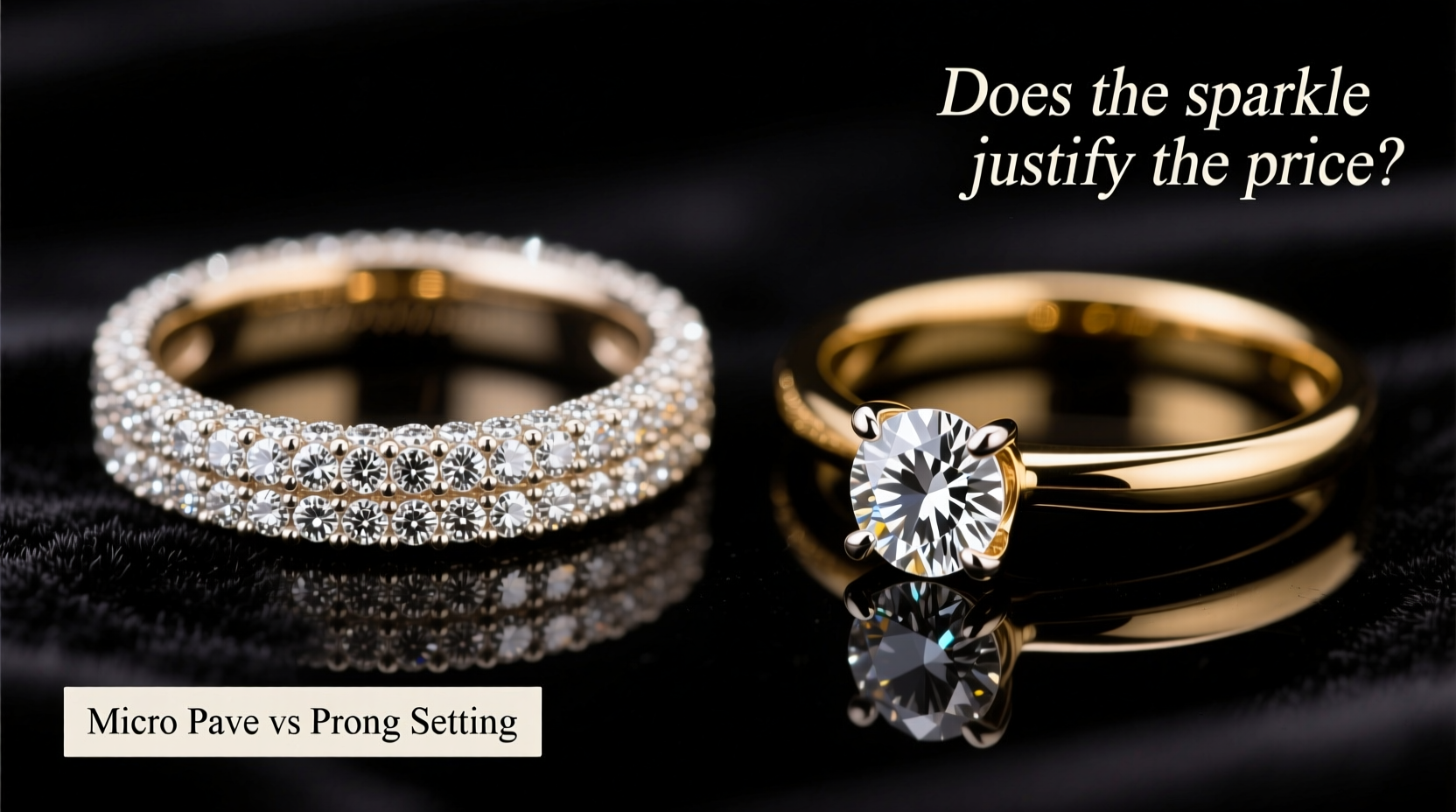
Diamonds reflect and refract light based on how much surface area is exposed. The setting determines how much metal covers the stone and how freely light can enter and exit. Prong settings use three to six slender metal claws to hold a single center or accent stone, maximizing light exposure. This design allows maximum brilliance with minimal interference from the mounting.
In contrast, micro pave settings feature dozens—or even hundreds—of tiny diamonds set closely together across the band or halo, each secured by microscopic beads of metal. The result is a continuous shimmer that mimics a solid strip of diamond. Because so many stones are involved, the overall sparkle is intense and eye-catching, especially under direct light.
“Micro pave creates a ‘carpet of light’ effect—it’s not just about individual stones but the cumulative glow.” — Julian Hartman, Master Jewelry Designer
However, more sparkle doesn’t always mean better performance. Light return depends on cut quality and placement as much as setting style. A well-cut diamond in a simple four-prong setting can outshine a poorly executed micro pave band.
Construction & Craftsmanship: Why Micro Pave Costs More
The price difference between micro pave and prong settings isn’t arbitrary—it reflects labor intensity and technical precision. A standard prong setting for a solitaire diamond may take 1–2 hours to complete. A micro pave band, however, can require 8–15 hours of meticulous handwork by a skilled setter.
Each micro pave diamond must be individually placed into pre-drilled holes, then secured using tiny metal beads raised from the surrounding surface. These beads are often less than 0.1mm thick, requiring magnification and steady hands. Even minor inconsistencies in bead size or stone alignment are immediately visible, making quality control rigorous.
Prong settings, while also requiring skill, are far more forgiving. As long as the prongs are evenly spaced and securely tightened, the aesthetic remains consistent. Repairs and adjustments are simpler, too, since fewer stones are involved and access is easier.
Comparison Table: Micro Pave vs Prong Setting
| Feature | Micro Pave Setting | Prong Setting |
|---|---|---|
| Number of Stones | High (50–200+) | Low (1–6) |
| Labor Time | 8–15+ hours | 1–3 hours |
| Sparkle Level | Very High (continuous glitter) | Moderate to High (focused on center stone) |
| Durability | Moderate (beads wear down; stones loosen) | High (easier to maintain and repair) |
| Cost Premium | +40% to +100% over basic setting | +10% to +20% |
| Cleaning Difficulty | High (debris traps between stones) | Low (open structure) |
| Lifetime Maintenance | Regular re-tipping every 2–3 years | Occasional tightening (every 5+ years) |
Real-World Example: Choosing Between Elegance and Practicality
Sophia, a graphic designer from Portland, wanted a vintage-inspired engagement ring with maximum sparkle. Her jeweler presented two options: a cathedral-style band with a center diamond in a six-prong setting ($4,200), and a nearly identical design with micro pave shoulders ($6,800).
She chose the micro pave version, captivated by the way it caught light during her proposal photos. However, within 18 months, she noticed two small diamonds were loose. After a $220 repair and learning that the beads would need re-tipping every few years, she admitted she might have preferred the prong design for daily wear.
Her experience highlights a key truth: micro pave delivers unmatched glamour but demands ongoing care. For those with active lifestyles or who prioritize low maintenance, prong settings offer enduring elegance without constant upkeep.
Maintenance & Longevity: What You’re Really Paying For
The initial purchase price is only part of the story. Over a decade, the hidden costs of micro pave become apparent. Tiny beads erode from friction against clothing, skin, and surfaces. When beads thin, stones wobble and eventually fall out. Most jewelers recommend professional inspections every 6–12 months and re-tipping (rebuilding worn beads) every 2–3 years at an average cost of $150–$300.
Prong settings face similar wear, but repairs are faster and cheaper. A bent prong can be reset in minutes. Replacing a lost accent diamond in a prong setting is straightforward. In micro pave, replacing a missing stone requires resetting adjacent beads to match, increasing time and cost.
- Micro pave risks: Stone loss, bead erosion, difficult cleaning, higher insurance premiums
- Prong advantages: Easy repairs, better airflow (less grime buildup), compatibility with resizing
Step-by-Step Guide: Evaluating Your Setting Choice
- Assess your lifestyle: Do you work with your hands, exercise frequently, or wear gloves regularly? High-impact routines favor prong settings.
- Define your aesthetic priority: Are you drawn to subtle elegance or bold, continuous sparkle?
- Review your budget holistically: Include estimated maintenance costs over 10 years, not just upfront price.
- Inspect craftsmanship: Use a loupe to check bead uniformity, stone alignment, and metal finish quality.
- Ask about warranty and service: Some brands offer free micro pave touch-ups for 3–5 years—this can offset long-term costs.
Frequently Asked Questions
Can micro pave settings be resized?
Resizing a micro pave band is possible but risky. Adding length may break the stone pattern; reducing size can crush diamonds near the seam. Always consult a specialist—expect higher fees and longer turnaround.
Do prong settings make diamonds look bigger?
Yes. By minimizing metal around the girdle, prong settings expose more of the diamond’s surface, enhancing perceived size. Four- or six-prong designs also allow light to enter from all angles, boosting fire and scintillation.
Is micro pave outdated?
No, but trends are shifting. While micro pave dominated the 2010s, today’s consumers increasingly favor minimalist styles and durable settings. That said, it remains popular in bridal suites and red-carpet pieces where visual impact trumps practicality.
Final Verdict: Does the Sparkle Justify the Price?
The answer depends on what you value most. If your priority is jaw-dropping brilliance and you’re willing to invest time and money into upkeep, micro pave delivers a luxurious, high-impact look that few settings can match. It’s ideal for special occasion pieces or as a complement to a prong-set center stone.
But for everyday wear, especially engagement rings meant to last decades, the prong setting offers superior durability, easier maintenance, and better long-term value. Its timeless design ensures it never looks dated, and its functionality stands up to real life.
In the end, the sparkle of micro pave is undeniable—but so are its trade-offs. The price premium isn’t just for beauty; it’s for artistry, fragility, and future care. Weigh these factors honestly, and you’ll find a setting that shines not just today, but for years to come.




 浙公网安备
33010002000092号
浙公网安备
33010002000092号 浙B2-20120091-4
Comments
No comments yet. Why don't you start the discussion?