
When choosing a Micro SD card, speed class ratings like C4 and C10 often appear in product descriptions, but their real-world impact can be confusing. The difference between Class 4 (C4) and Class 10 (C10) seems small on paper—just two numbers—but it represents a significant jump in minimum sustained write speeds. For casual users, the upgrade might seem unnecessary. For others, especially those recording HD video or using action cameras, it could be essential. This article breaks down what these classes mean, how they perform in practice, and whether spending more on a C10 card delivers tangible benefits.
Understanding Speed Class Ratings
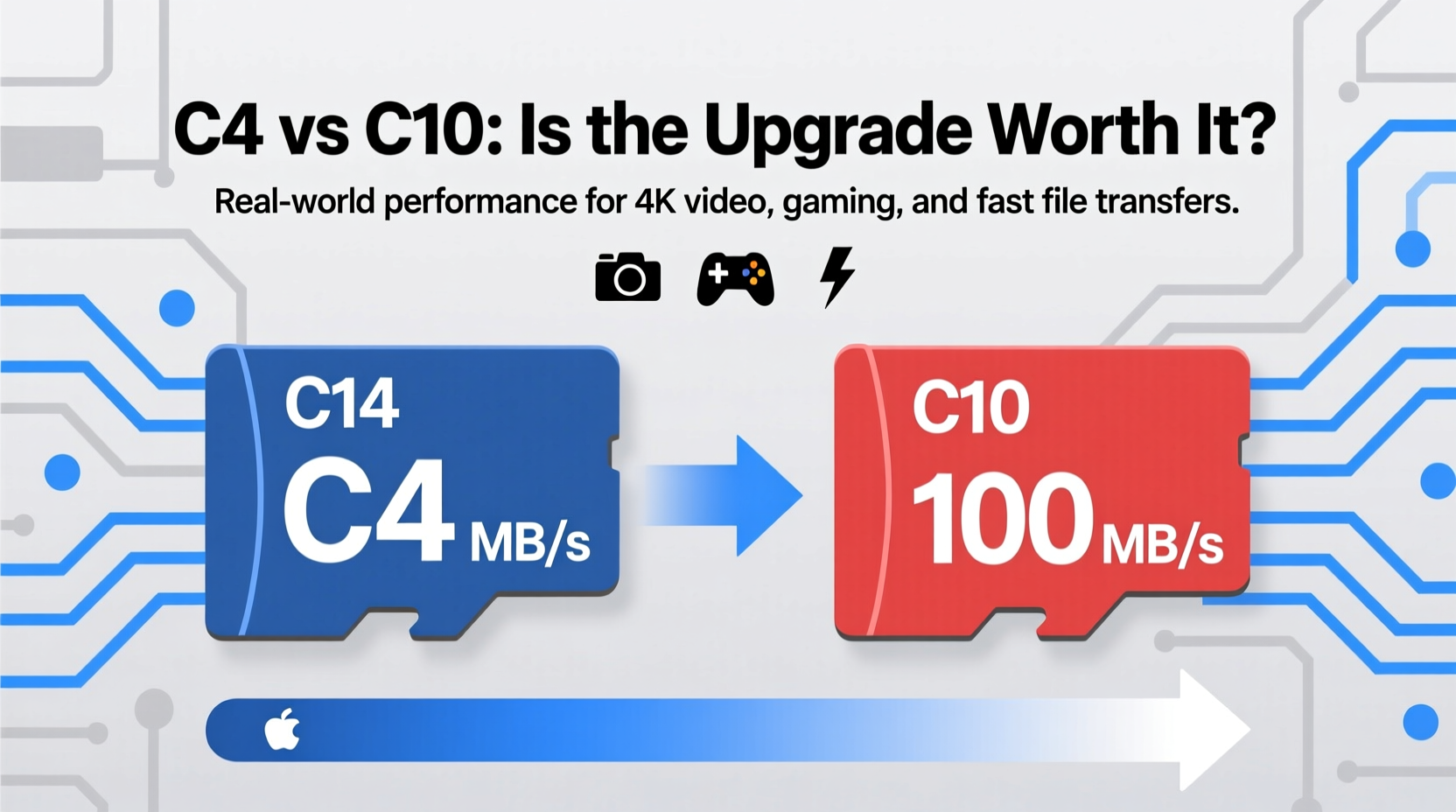
The \"C\" in C4 and C10 stands for \"Class,\" a standard defined by the SD Association to indicate the minimum sustained write speed of a memory card. This is critical because burst speeds—often advertised prominently—don’t reflect consistent performance during prolonged tasks like video recording or large file transfers.
- C4: Minimum sustained write speed of 4 MB/s
- C10: Minimum sustained write speed of 10 MB/s
This means a C10 card guarantees at least 10 megabytes written per second, more than double that of a C4 card. While both may have similar peak read speeds, the sustained write performance is where C10 pulls ahead, particularly under continuous load.
“Minimum write speed is far more important than maximum read speed when choosing a card for video or high-speed data logging.” — David Lin, Embedded Systems Engineer
Real-World Performance Comparison
To understand whether the upgrade from C4 to C10 matters, consider how each performs in common applications:
| Use Case | C4 Performance | C10 Performance |
|---|---|---|
| Standard Definition Video (480p) | Adequate | More than sufficient |
| Full HD Video (1080p) | May struggle; risk of dropped frames | Reliable recording |
| Time-Lapse Photography | Possible buffer overflow | Smooth operation |
| Smartphone App Storage | Acceptable for basic apps | Faster app launches, smoother multitasking |
| Dash Cam Recording | Risk of corrupted files during loop recording | Consistent, reliable overwrites |
The table illustrates a key point: while C4 cards can handle lightweight tasks, they become bottlenecks as demands increase. C10 cards offer headroom for higher-resolution media and ensure stable performance even under extended use.
Mini Case Study: Dash Cam Failure with C4
Consider Mark, a rideshare driver who installed a budget dash cam using a C4-rated Micro SD card. The camera recorded in 1080p at 30fps, requiring roughly 8–12 MB/s of sustained write speed. Initially, everything seemed fine. However, after three weeks, he discovered gaps in his footage—entire minutes missing during heavy traffic commutes.
Upon investigation, he found that the C4 card couldn’t keep up with the constant data stream during long drives, causing the camera to either freeze or overwrite previous data incorrectly. After switching to a C10 card, the recording became seamless. No more gaps. No more corrupted files.
This example highlights a crucial lesson: even if a device supports a certain resolution, using an underspecced card undermines its functionality. The savings from choosing C4 were quickly outweighed by the risk of losing critical evidence.
Step-by-Step Guide: Choosing the Right Card
Selecting between C4 and C10 isn’t just about price—it’s about matching performance to need. Follow this process to make the right decision:
- Identify your device’s requirements. Check the manual or manufacturer’s website for recommended speed class.
- Determine your primary use case. Are you shooting HD video, running apps from the card, or storing documents?
- Estimate bitrates. Full HD video typically requires 8–15 MB/s. If your content exceeds 4 MB/s, avoid C4.
- Check for UHS ratings. Many C10 cards also carry UHS-I or U3 ratings, offering even better performance.
- Compare prices per GB. Sometimes C10 cards are only slightly more expensive per gigabyte, making them a better long-term value.
- Purchase from reputable brands. SanDisk, Samsung, and Kingston offer reliability and warranties.
When Is C4 Still Acceptable?
Despite its limitations, C4 isn’t obsolete. It remains viable in specific scenarios:
- Storing music, e-books, or low-resolution photos
- Older smartphones with limited app usage
- Basic GPS devices that log location infrequently
- Budget-friendly projects where cost is the top priority
If your workflow doesn’t involve constant writing or high-bitrate media, a C4 card may suffice. But as soon as you step into HD recording or multitasking environments, the limitations become apparent.
Expert Insight: Why Minimum Speed Matters
Many consumers focus on advertised read speeds—sometimes as high as 100 MB/s—even though those numbers rarely reflect real-world sustained performance. What truly matters is the minimum guaranteed write speed, which determines whether a card can keep up with incoming data without choking.
“The difference between a smooth 4K recording and a corrupted file often comes down to one thing: sustained write performance. Class rating exists to protect against that failure.” — Lena Patel, Digital Forensics Analyst
This is especially relevant for security devices, drones, and body cams, where uninterrupted recording is non-negotiable. In such cases, opting for C10 isn’t just an upgrade—it’s a necessity.
FAQ
Can I use a C4 card in a device that recommends C10?
You can, but not without risk. The device may function initially, but you’re likely to experience recording interruptions, slow app loading, or file corruption, especially during prolonged use.
Is there a noticeable speed difference in everyday phone use?
For light users—browsing, messaging, occasional photos—the difference may be minimal. However, if you install apps on the card or shoot HD video, a C10 will deliver noticeably smoother performance.
Are all C10 cards faster than C4?
All C10 cards guarantee a higher minimum write speed (10 MB/s vs. 4 MB/s). However, actual performance depends on the brand, NAND quality, and controller. Some premium C4 cards may outperform budget C10s in read speed, but not in sustained writes.
Final Verdict: Is the Upgrade Worth It?
The short answer: yes, in most modern use cases. While C4 cards still exist and serve niche purposes, the marginal price difference between C4 and C10 makes the latter a smarter investment. You’re not just buying speed—you’re buying reliability, future-proofing, and peace of mind.
Today’s devices—from budget smartphones to action cameras—are capable of producing high-quality content that pushes older speed classes to their limits. Spending a few extra dollars on a C10 card reduces the risk of data loss, improves responsiveness, and ensures compatibility with newer hardware.
Moreover, as software becomes more demanding and media resolutions continue to rise, even entry-level devices benefit from faster storage. A C10 card today may seem like overkill for a simple task, but it will remain useful longer as your needs evolve.




 浙公网安备
33010002000092号
浙公网安备
33010002000092号 浙B2-20120091-4
Comments
No comments yet. Why don't you start the discussion?