
Anxiety affects millions of people worldwide, disrupting focus, sleep, and daily functioning. As interest in non-pharmaceutical interventions grows, two practices consistently emerge at the forefront: mindfulness meditation and deep breathing. Both are praised for calming the mind and regulating the nervous system. But are they truly different? And if so, which one offers better relief for anxiety? The answer isn’t as straightforward as it seems—because while these practices overlap significantly, their mechanisms, benefits, and long-term impacts vary in subtle but meaningful ways.
Understanding the distinctions—and synergies—between mindfulness meditation and deep breathing can help individuals make informed choices about which technique to use, when, and how often. This article explores both methods from a physiological, psychological, and practical standpoint, offering clarity on their unique roles in anxiety management.
What Is Mindfulness Meditation?
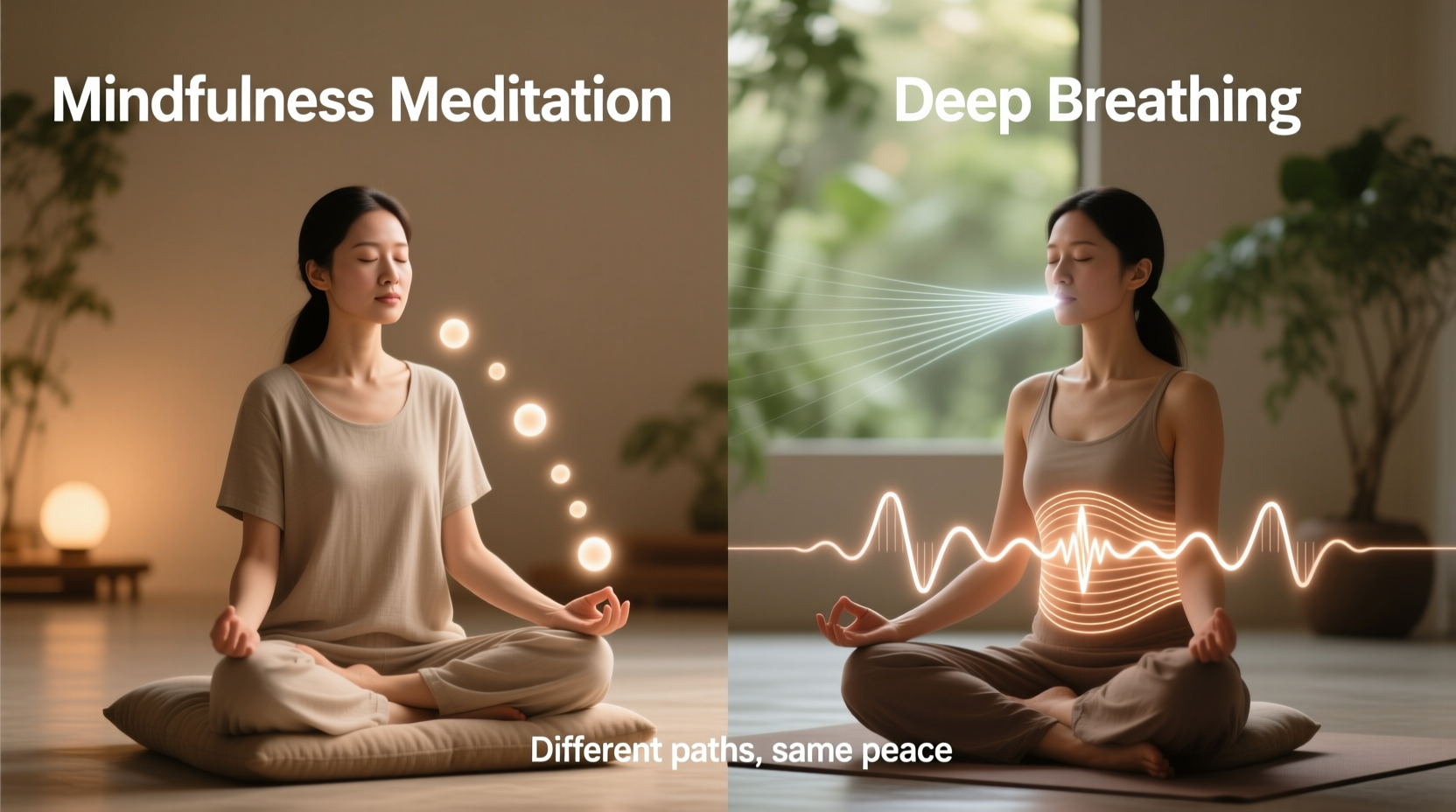
Mindfulness meditation is a mental training practice rooted in ancient Buddhist traditions but widely adapted into modern psychology and medicine. It involves paying deliberate, non-judgmental attention to the present moment—observing thoughts, emotions, bodily sensations, and surroundings without reacting or becoming entangled in them.
A typical mindfulness session might involve sitting quietly, focusing on the breath, and gently redirecting attention whenever the mind wanders. Over time, this builds awareness, emotional regulation, and cognitive flexibility. Research has shown that regular mindfulness practice can reduce activity in the amygdala—the brain’s fear center—while strengthening connections in the prefrontal cortex, which governs decision-making and emotional control.
“Mindfulness isn’t about stopping thoughts—it’s about changing your relationship with them.” — Dr. Jon Kabat-Zinn, Founder of Mindfulness-Based Stress Reduction (MBSR)
This distinction is crucial for anxiety sufferers. Instead of trying to suppress anxious thoughts—a strategy that often backfires—mindfulness teaches acceptance and detachment. This shift in perspective reduces the emotional charge of anxiety over time, leading to lasting resilience.
Deep Breathing: A Physiological Reset Button
Deep breathing, also known as diaphragmatic or abdominal breathing, is a physiological technique designed to activate the parasympathetic nervous system—the body’s “rest and digest” mode. Unlike shallow chest breathing (common during stress), deep breathing engages the diaphragm, allowing fuller oxygen exchange and triggering a rapid calming effect.
One of the most studied forms is box breathing: inhale for four counts, hold for four, exhale for four, pause for four. Another popular method is 4-7-8 breathing: inhale for four seconds, hold for seven, exhale slowly for eight. These patterns work quickly—often within minutes—to lower heart rate, reduce blood pressure, and interrupt the stress response.
Unlike mindfulness, which requires sustained mental discipline, deep breathing is more accessible in acute moments of panic or tension. It acts like a biological circuit breaker, halting the cascade of stress hormones such as cortisol and adrenaline.
Key Differences Between the Two Approaches
While both mindfulness and deep breathing reduce anxiety, they operate through different pathways and serve distinct purposes. Understanding these differences helps determine when each is most effective.
| Aspect | Mindfulness Meditation | Deep Breathing |
|---|---|---|
| Primary Focus | Awareness of present-moment experience | Regulation of breath and autonomic nervous system |
| Time to Effect | Gradual (days to weeks of consistent practice) | Immediate (within minutes) |
| Mechanism | Cognitive restructuring, neural plasticity | Physiological regulation via vagus nerve stimulation |
| Skill Required | Moderate to high (attention control, patience) | Low (simple to learn, easy to apply) |
| Best For | Chronic anxiety, rumination, emotional reactivity | Acute anxiety, panic attacks, physical tension |
| Durability of Benefit | Long-term resilience and structural brain changes | Short-term relief; effects fade without repetition |
The table illustrates a critical insight: deep breathing excels in crisis intervention, while mindfulness builds enduring mental strength. Think of deep breathing as emergency first aid and mindfulness as long-term fitness training for the mind.
How They Work Together: Synergy in Practice
In reality, many mindfulness practices incorporate deep breathing as an anchor point. Focusing on the breath is one of the most common entry points into mindfulness. However, the intention differs: in deep breathing exercises, the goal is to alter the pattern of respiration for physiological benefit; in mindfulness, the breath is simply a focal object to cultivate awareness.
Combining both approaches can be powerful. For example, someone experiencing a panic attack might start with 4-7-8 breathing to stabilize their nervous system. Once calmer, they can transition into a brief mindfulness exercise—observing thoughts without judgment—to prevent the cycle of fear about future attacks.
Step-by-Step Guide: Integrating Both Techniques
- Recognize the onset of anxiety: Notice physical signs (racing heart, tight chest) or mental patterns (catastrophic thinking).
- Apply deep breathing (2–5 minutes): Use box breathing or 4-7-8 technique to calm the body.
- Shift into mindful observation: Once stabilized, bring attention to the present—observe thoughts as passing clouds, not truths.
- Label emotions gently: Silently note “worry,” “fear,” or “tension” without fighting them.
- Return to breath as needed: If anxiety spikes again, revert to deep breathing before resuming mindfulness.
This hybrid approach leverages immediate physiological relief and deeper psychological processing, offering both quick results and long-term growth.
Real-World Example: Managing Work Anxiety
Sarah, a project manager in her mid-30s, began experiencing anxiety before team meetings. Her heart would race, her thoughts would spiral, and she’d feel physically ill. Initially, she tried ignoring the symptoms, which only made them worse.
After consulting a therapist, she learned to use deep breathing in the five minutes before each meeting. She practiced 4-7-8 breathing in her office, which reduced her physical symptoms significantly. But she still felt mentally overwhelmed afterward.
She then added a 10-minute mindfulness session each morning, focusing on observing her thoughts without judgment. Over three weeks, she noticed a shift: the same stressful thoughts arose (“I’ll mess up the presentation”), but they no longer triggered the same level of fear. She could acknowledge them and let them pass.
Sarah’s case shows how deep breathing managed the acute symptoms, while mindfulness changed her relationship with anxiety itself. Together, they created a sustainable coping strategy.
Expert Insights: What Science Says
Numerous studies support both techniques. A meta-analysis published in *JAMA Internal Medicine* found that mindfulness meditation programs showed moderate evidence in improving anxiety, depression, and pain. Meanwhile, research from *Frontiers in Psychology* demonstrated that slow, controlled breathing significantly reduces sympathetic nervous system activity—key in anxiety reduction.
“Breathing is the bridge between the mind and body. When you regulate the breath, you send a direct message to the brain: ‘You are safe.’” — Dr. Patricia Gerbarg, Assistant Clinical Professor of Psychiatry, New York Medical College
Experts agree that while deep breathing provides rapid symptom relief, mindfulness addresses the root causes of chronic anxiety—such as hypervigilance, perfectionism, and avoidance behaviors. Long-term mindfulness practitioners show increased gray matter density in brain regions linked to self-regulation and decreased reactivity to stressors.
Actionable Checklist: Choose the Right Tool for Your Anxiety
- ✅ Use deep breathing when: You’re in the middle of a panic attack, feeling tense before a presentation, or need fast physical relaxation.
- ✅ Use mindfulness meditation when: You’re caught in repetitive worry, struggling with emotional triggers, or want to build long-term mental resilience.
- ✅ Combine both when: Acute anxiety follows chronic stress, or you want to prevent relapse after a difficult episode.
- ✅ Practice daily: Even 5 minutes of mindfulness or 2 minutes of deep breathing strengthens your baseline calm.
- ✅ Track progress: Keep a journal noting which technique helped in specific situations and how you felt afterward.
Frequently Asked Questions
Can I do deep breathing during mindfulness meditation?
Yes—many mindfulness practices use the breath as an anchor. The key difference lies in intent: in mindfulness, you observe the breath naturally without trying to change it; in deep breathing, you deliberately control the rhythm to achieve relaxation.
Which is better for panic attacks—mindfulness or deep breathing?
Deep breathing is typically more effective during a panic attack due to its immediate physiological impact. Mindfulness may feel too difficult in the moment but can be used afterward to process the experience and reduce fear of future attacks.
How long does it take for mindfulness to reduce anxiety?
Some people notice subtle shifts within a week of daily practice, but significant changes usually occur after 4–8 weeks of consistent effort (10–20 minutes per day). Deep breathing, in contrast, can reduce symptoms within minutes of use.
Final Thoughts: It’s Not Either/Or—It’s Both/And
The question of whether mindfulness meditation or deep breathing is better for anxiety misses a fundamental truth: they are complementary tools, not competitors. Deep breathing gives you control in the storm; mindfulness helps you weather future storms with greater ease.
For immediate relief, reach for structured breathing. For lasting transformation, commit to regular mindfulness practice. And when possible, integrate both—using breath as a gateway to presence, and presence as a foundation for peace.




 浙公网安备
33010002000092号
浙公网安备
33010002000092号 浙B2-20120091-4
Comments
No comments yet. Why don't you start the discussion?