
When crafting intricate holiday dioramas, architectural models, dollhouse interiors, or delicate paper sculptures, lighting isn’t decorative—it’s structural storytelling. A single misplaced bulb can overwhelm a 1:12 scale fireplace; excessive heat can warp handmade paper snowflakes; inconsistent spacing can break the illusion of depth in a miniature village. That’s why choosing between mini Christmas lights (often called “micro” or “5mm” LEDs) and macro strings (typically 10–15mm bulbs on thicker cords) demands more than aesthetics—it requires understanding voltage tolerance, thermal output, wiring flexibility, and visual scale fidelity. This isn’t about brightness alone. It’s about precision, longevity, and how light behaves at human-hand scale.
Understanding the Core Differences: Physics, Not Just Size
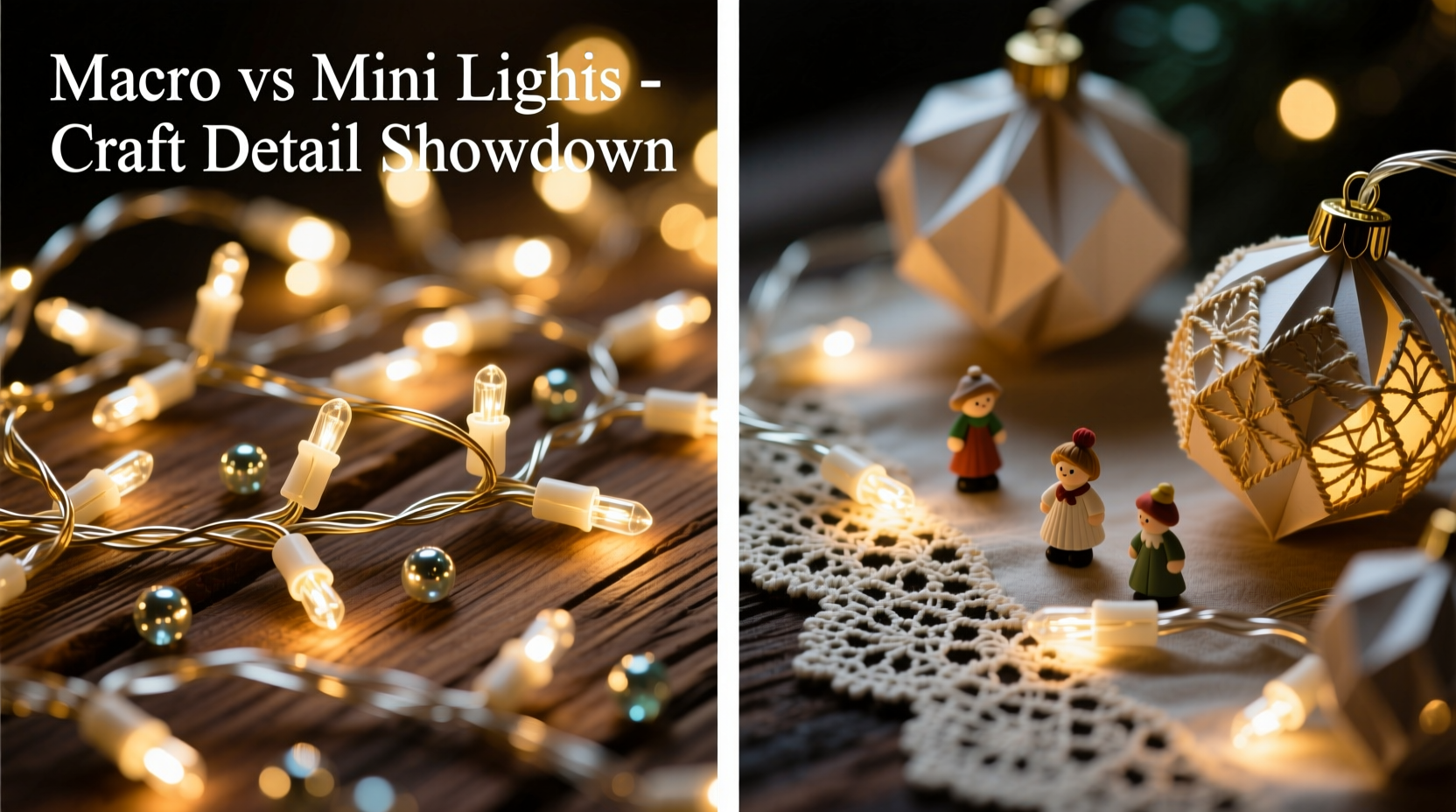
“Mini” and “macro” refer to both physical dimensions and underlying engineering choices—not marketing labels. Mini lights are usually 2–5mm LED bulbs with ultra-fine 28–32 AWG wire, often wired in series with built-in current-limiting resistors. Macro strings use larger 10–15mm incandescent or high-output LED bulbs on 20–24 AWG stranded copper wire, frequently configured in parallel circuits. These distinctions cascade into real-world consequences:
- Voltage sensitivity: Most mini strings operate at 12V or 24V DC and fail catastrophically if overvolted—even by 2V. Macro strings tolerate wider fluctuations (e.g., 120V AC ±10%) due to robust internal design.
- Heat generation: Incandescent macro bulbs emit significant radiant heat (up to 65°C surface temp). Mini LEDs run cool (<35°C), critical when embedding near foam, resin, or dried botanicals.
- Wiring integrity: Mini wires fracture after ~3–5 gentle bends at the bulb base. Macro wires withstand repeated repositioning and soldering without insulation fatigue.
- Optical dispersion: Mini LEDs project narrow, directional beams (12–25° viewing angle). Macro bulbs diffuse light broadly (120–180°), creating softer ambient glow but less pinpoint control.
These aren’t theoretical trade-offs. They define whether your hand-sculpted gingerbread house glows warmly from within—or melts at the eaves.
Performance Comparison: What Matters in Practice
| Feature | Mini Christmas Lights (2–5mm LED) | Macro Strings (10–15mm) |
|---|---|---|
| Scale Suitability | Ideal for 1:12 scale and smaller (dollhouses, jewelry box scenes, terrariums). Bulb size matches matchsticks, pencil leads, or fine-gauge wire. | Better for 1:6 scale and larger (mantel displays, tabletop villages, large-scale paper art). Bulbs visually dominate under 1:12. |
| Luminous Efficacy | 2–8 lumens per bulb. High efficiency but low total output—requires dense placement for even illumination. | 15–45 lumens per bulb (LED) or 30–60+ (incandescent). Fewer bulbs needed for equivalent brightness. |
| Thermal Safety | Surface temp ≤32°C. Safe for direct contact with PLA filament, hot glue, pressed flowers, and thin cardstock. | Incandescent: 55–70°C. LED versions: 40–50°C. Risk of warping thin plastics or browning delicate organics. |
| Wiring Flexibility | Ultra-thin wire allows threading through 0.8mm drill holes. Ideal for hidden routing behind laser-cut layers. | Stiffer cord resists tight curves. Requires ≥2mm clearance for clean bends—limits integration in layered micro-structures. |
| Durability Under Manipulation | Fragile solder joints. Prone to failure when bulbs are repositioned or bent repeatedly during prototyping. | Robust bulb bases and strain-relieved connections survive frequent adjustment and field repairs. |
| Power Management | Often require constant-current drivers or regulated USB power. Voltage drop becomes problematic beyond 3m runs. | Compatible with standard wall adapters or battery packs (AA/CR123). Minimal voltage drop up to 10m. |
Real-World Craft Application: When Each Excels
In 2023, ceramicist Lena Torres spent six weeks building a 30cm-tall porcelain nativity scene with hollow, hand-thrown figures. Her goal: interior backlighting that mimicked candlelight through translucent clay. She tested both types:
“We tried macro LEDs first—they lit the figures beautifully, but the heat cracked two Mary figurines overnight. Switching to 3mm warm-white minis with custom 9V regulated power solved it. We drilled 1.2mm holes in the bases, threaded the wires, and used epoxy putty to seal the entry points. The light was softer, yes—but controllable, safe, and invisible from the outside. That tiny bulb became the soul of each piece.” — Lena Torres, Studio Ceramics Artist & Lighting Consultant
Conversely, woodworker Marco Chen built a 1.2m-long illuminated train layout featuring a working station platform, signal lights, and animated crossing gates. He needed bright, reliable, serviceable lighting for public display. Macro strings won decisively:
- He embedded 12mm warm-white LEDs inside hollow wooden platform railings—no drilling required. Their broad dispersion lit ticket windows evenly.
- When a bulb failed mid-exhibition, he swapped it in under 90 seconds using standard bulb sockets—no soldering iron needed.
- The thicker wire resisted vibration from nearby foot traffic, while mini wires would’ve fatigued and shorted within days.
These examples reveal a pattern: mini lights excel where invisibility, thermal safety, and dimensional fidelity are non-negotiable. Macro strings win where brightness, serviceability, and mechanical resilience outweigh scale concerns.
A Step-by-Step Selection Framework for Your Next Project
Don’t guess. Use this actionable workflow before purchasing a single bulb:
- Measure your smallest critical dimension. Is the thinnest structural element (e.g., a paper-thin roof ridge, a 0.5mm wire armature) ≥1.5mm thick? If yes, mini lights are viable. If not, macro strings risk visual dominance.
- Test thermal tolerance. Place a sample bulb (powered at intended voltage) against your material for 10 minutes. Check for discoloration, softening, or odor. If compromised, eliminate incandescent macro options immediately.
- Map your power path. Sketch the longest continuous wire run from power source to farthest bulb. If >3m, calculate voltage drop: for mini lights, assume 0.3V loss per meter; for macro, 0.05V/m. If drop exceeds 10% of supply voltage, choose macro or add local regulators.
- Assess access needs. Will bulbs need replacement mid-project or post-installation? If yes, macro strings with screw-base or push-fit sockets reduce future headaches. Mini lights demand desoldering or pre-wiring.
- Validate color consistency. Order 3–5 bulbs from the same batch. Illuminate identical white paper swatches under controlled lighting. Compare with a spectrometer app (e.g., Lux Light Meter Pro) or calibrated monitor. Batch variation exceeds ±150K CCT in budget mini lights—critical for seamless gradients.
What Experts Recommend—and Why
Lighting engineers don’t prescribe one-size-fits-all solutions. Their guidance centers on functional hierarchy:
“In miniature architecture, light is a structural material. You wouldn’t use rebar where toothpicks suffice—or vice versa. Mini LEDs are the ‘toothpicks’: precise, lightweight, thermally inert. Macro strings are the ‘rebar’: load-bearing, visible, resilient. Choose based on what the craft *does*, not what it *looks like*.” — Dr. Aris Thorne, Director of Applied Photonics, Rhode Island School of Design
This philosophy aligns with industry practice. Model railroading associations (NMRA, NTRAK) mandate macro strings for mainline lighting due to reliability standards, while the International Guild of Miniature Artisans specifies mini LEDs for all interior work below 1:12 scale. Neither is “better”—they’re tools calibrated for distinct functional thresholds.
FAQ: Clarifying Common Misconceptions
Can I cut and rewire mini light strings safely?
Yes—but only if they’re DC-powered LED strings with individual resistors per bulb. Cutting AC-incandescent mini strings breaks the series circuit and risks fire. Always verify wiring diagrams and use a multimeter to confirm continuity before reconnecting. Never cut macro strings unless explicitly labeled “cut-to-length” (most are not).
Why do some macro LED strings feel hotter than others?
Thermal management varies drastically. Cheap macro LEDs cram high-lumen chips into undersized aluminum housings, causing heat buildup. Premium versions (e.g., those certified UL 2388) use die-cast heatsinks and thermal pads. Touch-test: if you can’t hold the bulb base comfortably for 5 seconds, avoid it for crafts involving heat-sensitive materials.
Do mini lights really last longer than macro strings?
LED lifespan ratings (e.g., 50,000 hours) assume ideal conditions: stable voltage, ambient temps <30°C, no mechanical stress. In real craft use, mini lights often fail sooner due to wire fatigue at solder joints. Macro strings, with their robust construction, typically outlast mini lights in high-handling environments—even if rated for fewer hours. Durability ≠ rated lifespan.
Conclusion: Light as Intentional Craft, Not Afterthought
Choosing between mini Christmas lights and macro strings isn’t about compromise—it’s about clarity of purpose. If your craft lives in the realm of millimeters, whispers, and fragility—where a single degree of heat can unravel weeks of work—mini lights are your disciplined ally. If your project demands visibility, endurance, and ease of maintenance across meters and months, macro strings provide unshakeable foundation. The most elegant solutions often blend both: mini lights for intimate, interior moments; macro strings for structural, environmental presence. What matters isn’t which you choose, but how deliberately you choose it. Measure twice. Test once. Illuminate with intention.




 浙公网安备
33010002000092号
浙公网安备
33010002000092号 浙B2-20120091-4
Comments
No comments yet. Why don't you start the discussion?