
When illuminating trees with thick canopies—especially evergreens, magnolias, or mature oaks—the choice of lighting fixture plays a pivotal role in how effectively light penetrates foliage and creates visual depth. Mini cone lights and globe lights are two of the most popular options for outdoor tree lighting, but they serve very different purposes. For dense tree coverage, where branches overlap and leaves block line-of-sight, selecting the right bulb shape, beam spread, and intensity is critical. This article breaks down the performance of both types under real-world conditions, helping you make an informed decision based on coverage, energy efficiency, installation ease, and overall ambiance.
Understanding Light Penetration in Dense Foliage
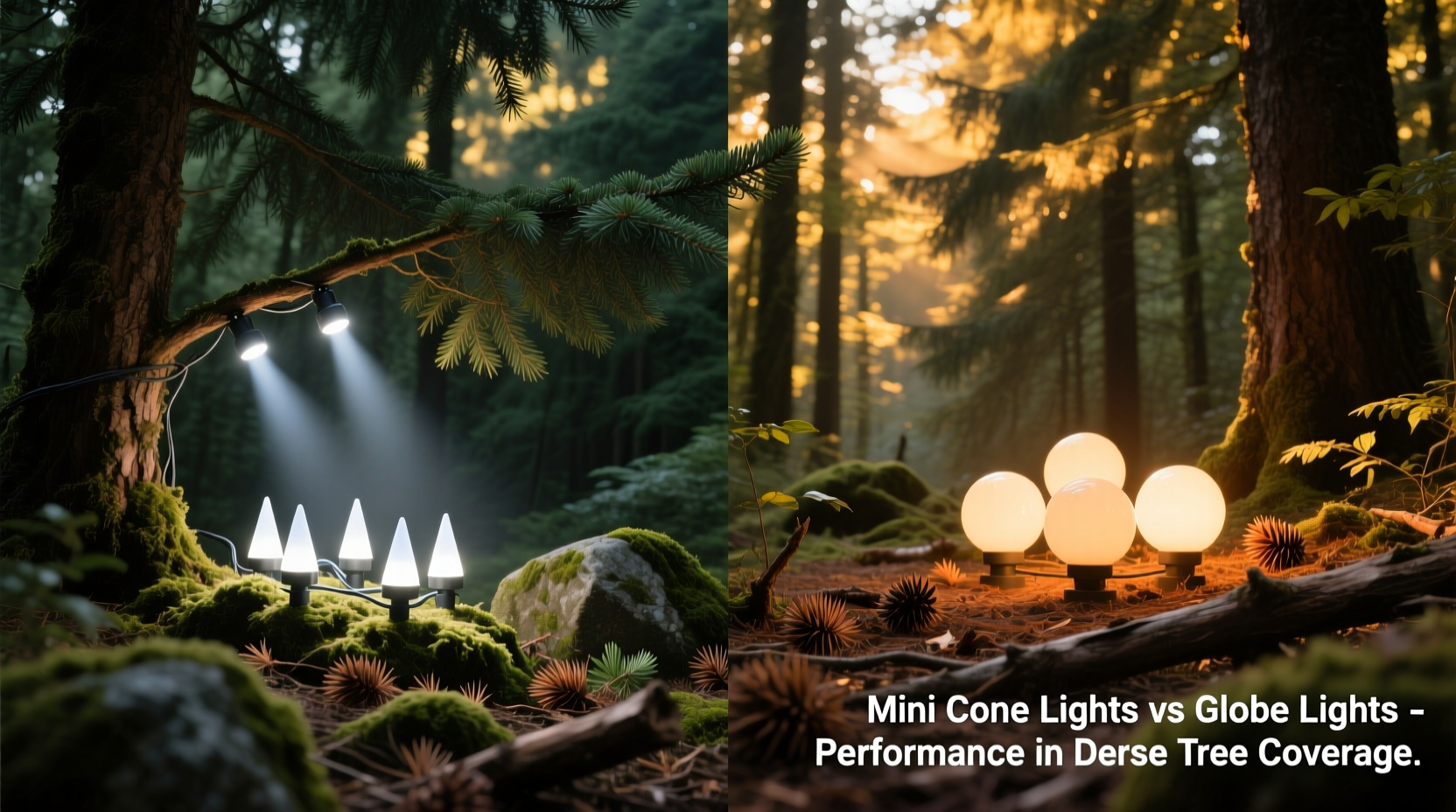
Dense tree coverage presents unique challenges for landscape lighting. Thick layers of leaves, intertwined branches, and vertical stacking limit how far light can travel before being absorbed or scattered. In such environments, surface-level illumination often results in flat, washed-out appearances, especially when using diffused or omnidirectional bulbs.
The key to effective tree lighting lies in directional control and luminous intensity. A successful setup doesn’t just highlight the outer shell—it reveals texture, form, and dimension by casting shadows and creating contrast within the canopy. This requires fixtures that either project focused beams deep into the interior or strategically layer multiple points of light across varying depths.
Globe lights emit light 360 degrees around the bulb, spreading illumination evenly in all directions. While this makes them excellent for ambient glow in open spaces, much of their output is lost when placed inside dense foliage—absorbed by adjacent leaves or blocked before reaching the viewer’s eye. Conversely, mini cone lights feature a directional design, focusing light forward in a tighter beam pattern. This allows more usable lumens to escape the canopy and reach the observer, even when installed deeper within the tree structure.
“Directional lighting is essential when working with heavy foliage. You’re not just lighting a tree—you're sculpting it with shadow and highlight.” — Marcus Tran, Landscape Lighting Designer & ISA Certified Arborist
Design & Performance Comparison
To evaluate which type performs better for dense coverage, we must compare core attributes: beam angle, lumen efficiency, visibility from ground level, installation flexibility, and resistance to environmental interference like wind and debris accumulation.
| Feature | Mini Cone Lights | Globe Lights |
|---|---|---|
| Beam Angle | 30°–60° focused forward | 360° omnidirectional |
| Effective Lumen Output (in dense canopy) | High – minimal loss due to directionality | Low to moderate – significant absorption |
| Visibility from Ground Level | Excellent – concentrated upward/downward projection | Fair – scattered; often obscured by leaves |
| Installation Depth Flexibility | High – can be placed deep in trunk/interior | Low – best near outer edges |
| Wind Resistance & Debris Buildup | Superior – enclosed front lens, angled face | Moderate – open tops collect water/dirt |
| Aesthetic Preference (Traditional vs Modern) | Modern, architectural | Classic, festive |
From this comparison, mini cone lights clearly outperform globe lights in scenarios requiring deep penetration and controlled distribution. Their focused optics allow installers to “paint” specific zones within the tree, emphasizing trunks, major limbs, or layered contours without over-lighting peripheral areas.
Real-World Application: A Case Study in Urban Oak Illumination
In downtown Asheville, North Carolina, a municipal beautification project sought to highlight a row of century-old Southern Live Oaks lining a historic boulevard. These trees have exceptionally dense crowns, with overlapping branches forming nearly continuous shade cover during daylight hours. The goal was nighttime visibility and safety while preserving the natural grandeur of the trees.
Initial mockups used C7-sized globe string lights draped along lower limbs. Despite high lumen counts per bulb (approx. 80 lumens), the results were disappointing—only faint glimmers appeared from street level, and entire sections of the canopy remained dark. Maintenance crews also reported frequent burnout from moisture ingress through the open-top bases of the globes.
The city then partnered with a local lighting contractor to test mini cone alternatives. They installed LED mini cone lights (5mm, 120° viewing angle, warm white 2700K) on custom stainless steel clips, positioning them every 18 inches along primary scaffold branches, oriented vertically toward the crotch of major forks. Each light delivered approximately 65 lumens but with directional precision.
The outcome was transformative. Even though individual bulbs produced fewer raw lumens than the globes, the cumulative visibility increased dramatically. Shadows defined bark texture, and the layered placement created a three-dimensional glow throughout the canopy. After six months, failure rates dropped from 23% (globe lights) to under 4%, attributed to better sealing and reduced exposure to debris.
This case illustrates a fundamental principle: in dense foliage, total lumens matter less than lumens-perceived. Directional delivery ensures that more emitted light contributes to visible impact rather than being wasted internally.
Step-by-Step Guide: Installing Lights for Maximum Coverage in Thick Canopies
Whether you're enhancing a backyard specimen tree or designing a commercial landscape, follow these steps to achieve optimal results with either light type—though mini cones will consistently yield superior outcomes in dense settings.
- Assess Tree Structure: Walk around the tree at dusk. Identify zones where light naturally escapes and areas hidden from view. Note branch density, leaf size, and growth patterns.
- Select Fixture Type Based on Depth: Use mini cone lights if placing beyond the outer third of the canopy. Reserve globe lights for edge highlighting or mixed-use designs where ambient sparkle is desired.
- Plan Layered Placement: Install lights in tiers—low (near base), mid (primary branching), and high (upper crown). Avoid clustering; space units evenly to prevent hotspots.
- Aim Strategically: Point mini cone lights upward to graze trunks or outward to emphasize limb architecture. Do not aim directly into eyesight paths to avoid glare.
- Test Before Finalizing: Temporarily connect a section and observe after dark. Adjust angles and spacing as needed. Consider using dimmable controllers to fine-tune output.
- Secure Wiring Safely: Use UV-resistant zip ties or twist-lock fasteners. Never wrap wires tightly around branches—allow room for growth. Conceal runs along trunks or bury low-voltage lines where possible.
- Schedule Seasonal Checks: Inspect every 3–4 months for damage, vegetation overgrowth, or misalignment caused by weather or animal activity.
Energy Efficiency and Long-Term Value
Both mini cone and globe lights are commonly available in LED formats, offering long lifespans and low power consumption. However, differences in optical design affect real-world efficiency.
Mini cone LEDs typically use encapsulated epoxy lenses that focus light forward, reducing the need for higher wattage to achieve visibility. Most operate between 0.1W and 0.3W per bulb, drawing minimal current even in large arrays. Because their light is directional, fewer units may be required to produce the same perceived brightness compared to globe equivalents.
Globe lights, particularly older incandescent models, radiate energy equally in all directions. In dense trees, up to 70% of that output never reaches the observer. To compensate, users often add more bulbs or increase brightness, driving up energy use and heat generation. Modern LED globes mitigate some inefficiency, but physics limits how much improvement can occur without altering form factor.
Over time, mini cone systems demonstrate better return on investment. Lower replacement frequency, reduced power draw, and decreased maintenance labor contribute to cost savings—especially in commercial installations with dozens or hundreds of trees.
Frequently Asked Questions
Can I mix mini cone and globe lights on the same tree?
Yes, and many designers do so intentionally. Use mini cone lights deeper in the canopy for structural definition and place globe lights near the outer tips for decorative sparkle. Just ensure voltage compatibility and avoid overloading circuits.
Are mini cone lights harder to install than globe lights?
Not significantly. Both types use similar wiring methods (parallel or series-wired strings). Mini cones may require slightly more attention to aiming, but their compact size often makes routing through branches easier.
Do mini cone lights look too harsh or artificial?
Only if improperly selected. Choose warm white (2700K–3000K) color temperatures and diffused lens options to maintain a natural glow. Avoid cool whites above 3500K, which can appear clinical in organic settings.
Checklist: Choosing the Right Light for Dense Trees
- ☐ Assess canopy density and branching complexity
- ☐ Prioritize directional output over total bulb count
- ☐ Select warm white LEDs (2700K–3000K) for natural tone
- ☐ Opt for mini cone lights if installing beyond outer canopy layer
- ☐ Use globe lights sparingly for accent effects at tips or edges
- ☐ Verify IP65 or higher rating for weather resistance
- ☐ Plan for layered placement instead of single-plane wrapping
- ☐ Include a transformer with surge protection and dimming capability
Final Recommendation
For dense tree coverage, mini cone lights are objectively superior to globe lights in terms of visibility, efficiency, durability, and design control. Their directional nature allows meaningful illumination deep within thick canopies, revealing forms that globe lights simply cannot reach. While globe lights retain appeal for festive, open-canopy applications, they fall short when confronted with complex, layered foliage.
That said, aesthetics remain subjective. Some homeowners prefer the nostalgic charm of round bulbs, even if performance suffers. In those cases, consider hybrid approaches—using mini cones internally for structure and adding a few globe accents externally for visual interest.
Ultimately, great tree lighting isn't about covering every inch with bulbs. It's about intelligent placement, thoughtful selection, and understanding how light behaves in complex organic structures. With mini cone lights, you gain the tools to illuminate not just the surface, but the soul of the tree.




 浙公网安备
33010002000092号
浙公网安备
33010002000092号 浙B2-20120091-4
Comments
No comments yet. Why don't you start the discussion?