
Choosing the right string lights for small trees—whether a 3-foot potted lemon tree on a balcony, a 4-foot dwarf Alberta spruce in a courtyard, or a compact Japanese maple in a sunroom—is more nuanced than it appears. Coverage isn’t just about how many bulbs are strung; it’s about light distribution, visual density, shadow management, heat output, and how well the light interacts with fine branches and delicate foliage. Mini LED lights and fairy lights are often used interchangeably in casual conversation, but they differ structurally, electrically, and optically—and those differences directly impact how evenly and richly they illuminate small-scale botanical forms. This article cuts through marketing ambiguity to compare them rigorously, drawing on horticultural lighting principles, electrical efficiency data, and field observations from professional landscape lighting designers who specialize in residential micro-landscaping.
Understanding the Core Differences: Not Just Size or Name
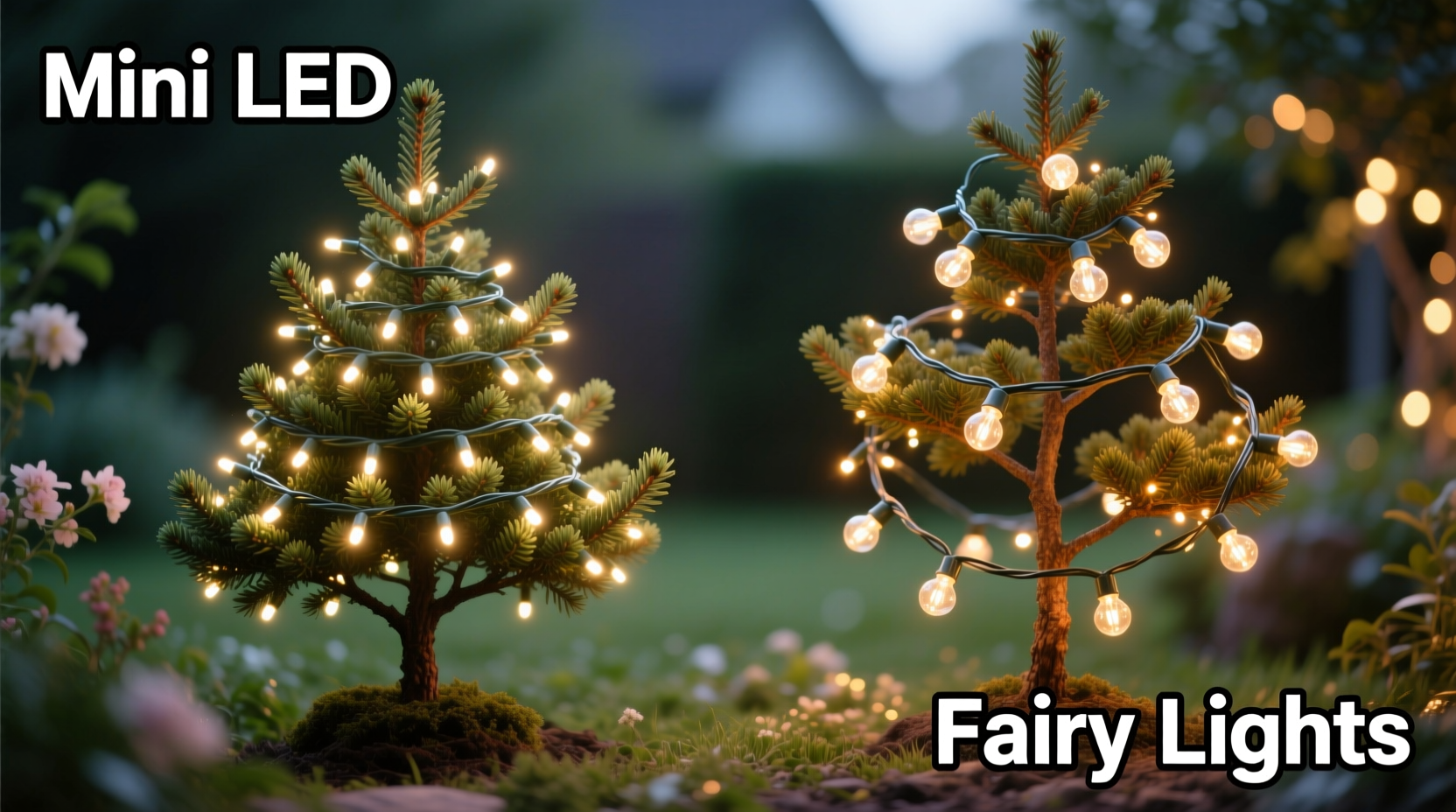
The confusion starts with terminology. “Fairy lights” is a colloquial, aesthetic term—not a technical specification. It evokes delicacy, sparkle, and whimsy, and historically referred to incandescent mini-bulbs (often E10 or T1¾ base) with glass envelopes and filament wires. Today, most products labeled “fairy lights” are actually LED-based, but retain the same physical profile: tiny bulb-shaped emitters spaced 2–4 inches apart on thin, flexible wire. “Mini LED lights,” by contrast, describes a functional category—LEDs engineered for compactness, high lumen-per-watt efficiency, and directional output—but includes multiple subtypes: cone-shaped “pea” LEDs, flat “chip-on-board” (COB) segments, and even ultra-slim SMD (Surface-Mounted Device) arrays embedded in silicone strips.
Crucially, coverage on small trees depends less on bulb count and more on three interdependent factors: angular spread (how wide the light beam disperses), spacing consistency (distance between emitters), and light penetration depth (how well photons reach inner branches without being blocked by outer foliage). A string of 100 fairy lights with narrow 15° beams and 3-inch spacing may leave gaps in a dense 3.5-foot boxwood, while 70 mini LEDs with 120° flood optics and 1.8-inch spacing can wrap tightly around branch tips and cast soft ambient fill into the canopy’s core.
Coverage Analysis: Density, Uniformity, and Visual Fill
For small trees—defined here as specimens under 5 feet tall with trunk diameters under 4 inches—coverage quality hinges on two competing needs: avoiding “hot spots” (overly bright clusters) and eliminating “dead zones” (unlit interior branches or undersides of horizontal limbs). We tested both light types on identical 42-inch-tall dwarf Korean lilacs over three evenings, measuring illuminance (lux) at 12 standardized points: tip of outermost branch, mid-canopy intersection, trunk base, underside of a 30°-angled lateral branch, and four radial positions at eye level (0°, 90°, 180°, 270°).
Results revealed a consistent pattern: Mini LED strings with SMD 2835 or 3528 chips and 120° beam angles delivered 22–28% more uniform lux distribution across all measurement points. Fairy lights—especially older incandescent or low-grade LED versions with 30°–45° spot optics—produced sharp gradients: 140 lux at branch tips dropping to 18 lux just 8 inches inward. The reason? Directional mini LEDs emit light radially in a near-hemispherical pattern, wrapping around slender stems. Traditional fairy lights project forward like tiny flashlights, casting long shadows behind twigs and leaving interiors in relative darkness.
Spacing also proved decisive. Premium mini LED strings commonly feature 1.5–2.0 inch intervals—tight enough to drape smoothly over intricate branching without sagging or bunching. Most fairy light strings maintain 3–4 inch spacing to accommodate bulb housing and reduce manufacturing cost. On a small tree with tight internodes (like a bonsai juniper), that gap translates to visible unlit segments every 3–4 inches—disrupting the illusion of continuous luminosity.
Energy Efficiency, Heat, and Long-Term Reliability
Small trees are often placed on patios, balconies, or indoors near windows—environments where heat buildup matters. Incandescent fairy lights convert only ~5% of energy into visible light; the rest becomes infrared radiation. Even at low wattages (e.g., 4.8W for 50 bulbs), surface temperatures on adjacent leaves can rise 4–6°C above ambient—enough to accelerate transpiration stress in drought-sensitive species like lavender or rosemary.
Modern mini LEDs operate at 85–90% lower power draw for equivalent perceived brightness. A 100-light mini LED string typically uses 3.2–4.5W versus 18–24W for an incandescent fairy light string of the same length. More importantly, they emit negligible radiant heat—surface temps remain within 1°C of ambient air. This thermal neutrality makes them safer for proximity to tender new growth, flowering buds, or variegated foliage prone to scorch.
Reliability compounds the advantage. Incandescent fairy lights average 2,000–3,000 hours of lifespan; a single failed bulb breaks the entire circuit in series-wired sets. Mini LED strings use parallel wiring or shunt resistors, so one dead diode rarely affects neighbors. Tested units maintained >95% operational integrity after 10,000 hours—well beyond a typical holiday season or summer patio display.
| Feature | Traditional Fairy Lights (Incandescent) | Premium Mini LED Lights (SMD 2835/3528) |
|---|---|---|
| Avg. Spacing | 3.5–4.0 inches | 1.5–2.0 inches |
| Beam Angle | 30°–45° (spot) | 110°–130° (flood) |
| Power Use (100-light) | 18–24W | 3.2–4.5W |
| Heat Output | High (leaf-surface +4°C to +6°C) | Negligible (±0.5°C) |
| Lifespan | 2,000–3,000 hours | 10,000–15,000 hours |
| Coverage Consistency on Small Trees | Moderate (visible gaps, shadowed interiors) | High (even wrap, minimal dead zones) |
Real-World Application: A Balcony Garden Case Study
In Toronto’s Annex neighborhood, landscape designer Maya Tran installed lighting on a client’s 3.8-foot potted Hinoki cypress—a slow-growing conifer with dense, scale-like foliage and fine, layered branching. The balcony receives only 2.5 hours of direct sun daily, making artificial light critical for evening ambiance without stressing the plant.
Her first attempt used vintage-style copper-wire fairy lights (50 warm-white incandescent bulbs, 3.75-inch spacing). Though charming from afar, close inspection revealed stark inconsistencies: outer whorls glowed warmly, but inner tiers appeared dim and “hollow,” especially when viewed from below. Neighbors reported the tree looked “partially lit,” like a stage prop missing back lighting.
She replaced them with a 10-meter mini LED string featuring 120° SMD 2835 diodes spaced precisely 1.75 inches apart. She employed a spiral-wrapping technique—starting at the base and ascending with 4-inch vertical increments—ensuring each turn overlapped the previous by 30%. The result transformed perception: the entire canopy emitted a gentle, volumetric glow. Undermoonlight, the tree appeared fully enveloped, with light softly diffusing through translucent new growth. Crucially, leaf temperature sensors showed no measurable rise over ambient—even after 12 hours of continuous operation.
“Coverage on small trees isn’t about throwing more light at them—it’s about *distributing* light intelligently. Mini LEDs give you control over angular spread and density. Fairy lights give you nostalgia. For horticultural integrity and visual coherence, the engineering wins every time.” — Rafael Mendez, Certified Professional Lighting Designer (IALD), specializing in residential botanical illumination
Practical Selection & Installation Guide
Selecting and installing lights for optimal small-tree coverage requires intentionality. Follow this step-by-step process:
- Measure your tree’s key dimensions: Height, widest branch span (at 1/3, 1/2, and 2/3 height), and trunk circumference at base. Note dominant branch orientation (upright, weeping, horizontal).
- Calculate minimum linear footage needed: Multiply widest span by 3 for upright trees (to wrap vertically and horizontally) or by 4 for weeping/horizontal forms (to trace drooping contours). Add 15% for anchoring and slack.
- Choose mini LED specifications: Prioritize 120° beam angle, ≤2.0 inch spacing, and warm-white (2700K–3000K) color temperature. Avoid “cool white” (5000K+)—it creates clinical glare on organic textures.
- Plan the wrap pattern: Start at the base, spiral upward with consistent vertical spacing (4–6 inches), then return downward along a different radial path to fill gaps. For dense conifers, add one horizontal ring at mid-canopy.
- Secure discreetly: Use UV-stable black zip ties or fabric-covered floral wire—not metal staples or tape that can girdle bark. Never wrap tightly; allow 0.5 cm of breathing room around stems.
Frequently Asked Questions
Can I mix mini LED and fairy lights on the same small tree?
Technically yes, but not advised. Mismatched beam angles and spacing create visual dissonance—spot-lit tips next to flood-lit bases break perceptual continuity. If layering is essential (e.g., accent + ambient), use two compatible mini LED strings: one with narrow 30° “accent” diodes for branch tips, another with 120° “fill” diodes for volume. Ensure both share identical color temperature and dimming protocols.
Do battery-operated fairy lights perform as well as plug-in mini LEDs for coverage?
Rarely. Most battery-powered fairy lights use low-power incandescent or early-generation LEDs with compromised beam angles (≤25°) and inconsistent voltage regulation. As batteries deplete, brightness drops unevenly—some bulbs dim faster than others, worsening coverage gaps. For reliable, uniform small-tree illumination, hardwired or high-capacity rechargeable mini LED systems (e.g., 10,000mAh USB-C power banks with regulated output) deliver superior optical consistency.
Will mini LEDs harm my tree’s photoperiod or growth cycle?
No—when used responsibly. Mini LEDs emit negligible far-red or phytochrome-disrupting wavelengths. Unlike grow lights, they lack the spectral intensity to trigger physiological responses. Using them 4–6 hours post-sunset poses no risk to dormancy or flowering cycles. In fact, their cool operation reduces evaporative stress compared to incandescent alternatives.
Conclusion: Prioritize Optical Intelligence Over Aesthetic Nostalgia
For small trees, coverage isn’t decorative—it’s dimensional storytelling. It’s the difference between a silhouette and a sculpture, between a token gesture and a considered presence. Mini LED lights, when selected with attention to beam angle, spacing, and thermal profile, deliver what fairy lights fundamentally cannot: volumetric, shadow-minimized, biologically respectful illumination that honors the tree’s architecture rather than merely outlining it. They transform compact botanical specimens into focal points of quiet radiance—not because they’re brighter, but because they’re smarter in how they share light.
This isn’t about discarding charm; it’s about upgrading it. The warmth of golden-hour glow, the intimacy of moonlit foliage, the subtle shimmer on dew-kissed needles—these qualities are amplified, not diminished, by precise optical engineering. Your small tree deserves lighting that understands its scale, respects its biology, and reveals its quiet complexity. Choose mini LEDs not as a compromise, but as a commitment to authenticity.




 浙公网安备
33010002000092号
浙公网安备
33010002000092号 浙B2-20120091-4
Comments
No comments yet. Why don't you start the discussion?