
When decorating small ornamental trees—think dwarf Japanese maples, potted citrus, miniature conifers, or indoor bonsai—the visual impact of lighting hinges on subtlety. A coarse, glaring string of bulbs overwhelms delicate branches; what’s needed is a whisper of light: pinpoint, evenly spaced, and capable of true twinkle—rapid, independent, and organic in rhythm. That’s why many decorators, landscape designers, and holiday lighting specialists are now scrutinizing the physical and optical differences between mini LED and micro LED lights. It’s not just about brightness or energy efficiency—it’s about how light *behaves* at scale. This article cuts through marketing jargon to examine what actually produces that elusive “finer twinkling effect” on small trees: the precise interplay of diode size, lens design, thermal management, dimming fidelity, and circuit architecture.
Understanding the Core Physical Difference
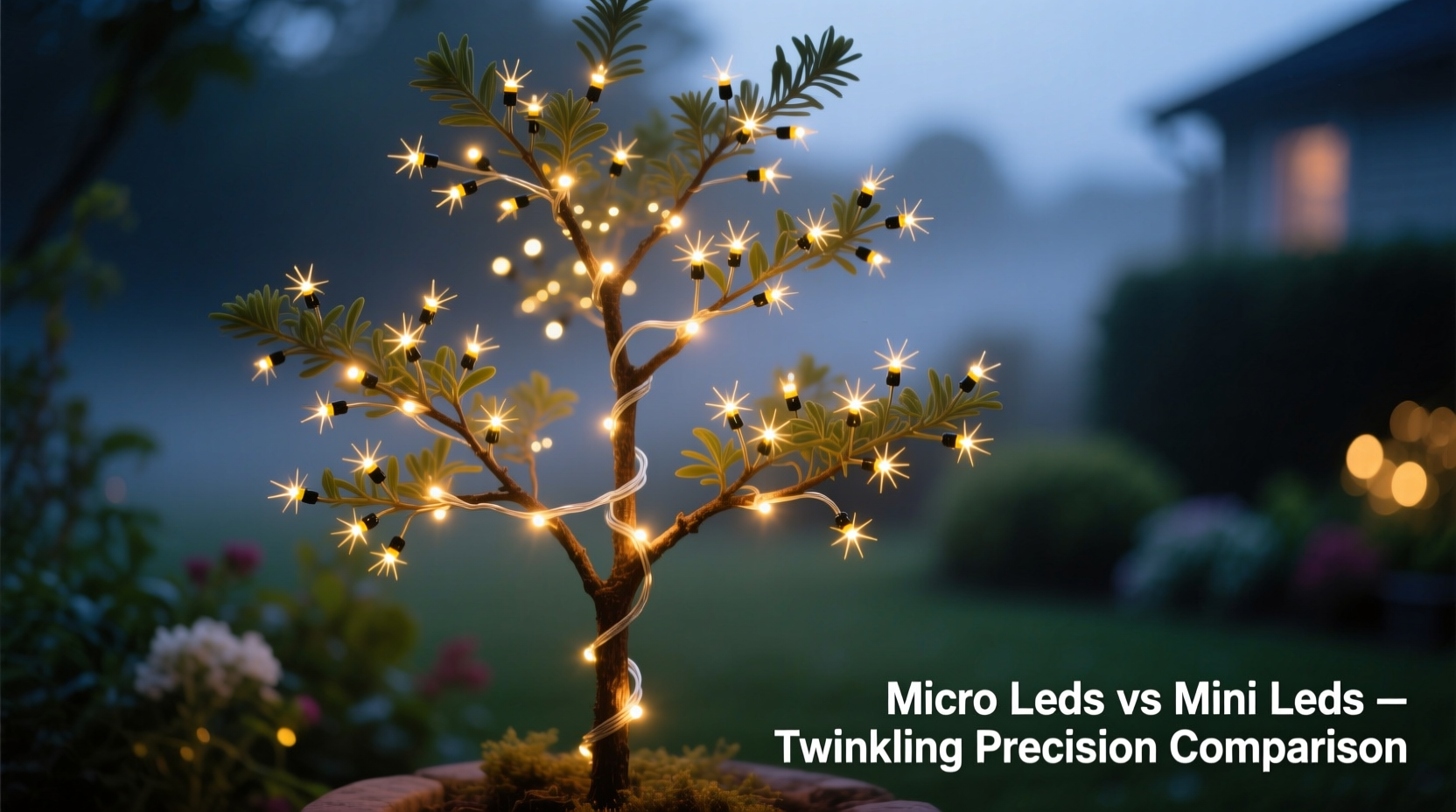
The distinction starts with semiconductor physics and manufacturing precision. Mini LEDs are not simply smaller versions of traditional 5mm LEDs—they’re a defined category with standardized dimensions. Most commercially available “mini LED” fairy lights use diodes measuring 1.0 mm × 1.0 mm to 1.6 mm × 1.6 mm, mounted on flexible PCB strips or embedded in insulated wire. Their light-emitting surface (the die) is typically 0.7–1.2 mm wide, and they rely on molded plastic lenses—often 2.5–3.5 mm in diameter—to diffuse and direct output. These lenses introduce softening but also slight scattering, especially when viewed off-axis.
Micro LEDs, by contrast, are a next-generation display technology adapted for decorative lighting. True micro LEDs have active emissive areas under 100 micrometers (0.1 mm)—some as small as 40 µm—and are fabricated using monolithic semiconductor processes similar to those used for silicon chips. In consumer-grade tree lights, “micro LED” often refers to diodes in the 0.3–0.6 mm range—still significantly smaller than mini LEDs—but critically, they’re almost always paired with integrated micro-optics: microscopic collimating lenses or diffraction gratings etched directly onto the chip package. This eliminates the need for bulky secondary optics and allows for tighter beam control.
The consequence is visible at close range. On a slender branch of a 3-foot Japanese maple, a mini LED light appears as a distinct, slightly fuzzy dot—even with a frosted lens. A micro LED, however, resolves as an almost point-source glow: sharp, clean, and capable of higher spatial density without visual bleed.
Twinkling Quality: Why Size Alone Isn’t Enough
A “finer twinkling effect” isn’t merely about small dots—it’s about perceived motion, rhythm, and depth. Twinkling requires three synchronized elements: rapid on/off cycling (typically 1–5 Hz), independent control per bulb (so adjacent lights don’t pulse in unison), and consistent luminance decay/recovery to avoid flicker fatigue. Micro LEDs excel here due to inherent electrical characteristics.
Micro LED diodes have lower junction capacitance and faster carrier recombination times. This translates to sub-microsecond switching speeds—orders of magnitude quicker than standard mini LEDs, which often require external drivers to manage rise/fall times above 100 µs. In practice, this means micro LED strings can achieve smoother PWM (pulse-width modulation) dimming down to 0.1% brightness without visible stepping or banding. More importantly, their response time enables true “strobe-free” twinkling: each diode can be commanded to fade in/out with exponential curves that mimic candlelight, rather than the abrupt square-wave blinking common in budget mini LED sets.
Mini LED systems, especially older or value-tier models, often use multiplexed control—where groups of 3–8 bulbs share a single driver channel. This creates a subtle “ripple” effect: you’ll notice neighboring lights brighten in sequence, breaking the illusion of natural randomness. High-end mini LED strings overcome this with dedicated ICs per bulb, but even then, thermal lag in the larger die causes slight delays in turn-on/turn-off timing, softening the edge of each twinkle.
Practical Performance Comparison Table
| Feature | Mini LED Lights | Micro LED Lights |
|---|---|---|
| Typical Diode Size | 1.0–1.6 mm × 1.0–1.6 mm | 0.3–0.6 mm × 0.3–0.6 mm (true micro: <0.1 mm) |
| Lens System | Molded plastic dome (2.5–3.5 mm), often frosted | Integrated micro-optics (etched collimators/diffusers) |
| Pixel Density (max per meter) | Up to 120 bulbs/m (with tight spacing) | 240–480+ points/m (without visual crowding) |
| Twinkle Control Fidelity | Good with premium ICs; may show grouping or stepped fading | Exceptional—true per-pixel fade, no grouping, smooth exponential curves |
| Viewing Angle Consistency | Wider beam (120°–140°), but intensity drops >30° off-axis | Tighter, more uniform 110°–120° beam with <10% intensity variance across angle |
| Heat Output per Point | Moderate (requires heat dissipation in dense clusters) | Very low (ideal for thin wires and enclosed branches) |
A Real-World Case Study: The Bonsai Gallery Installation
In early 2023, Tokyo-based lighting designer Kenji Tanaka was commissioned to illuminate a rotating exhibition of 27 prize-winning bonsai at the Kyoto Garden Museum. Each tree stood under 1.2 meters tall, with branches no thicker than a pencil. Traditional incandescent fairy lights overwhelmed the forms; early-generation mini LEDs created visible “hot spots” where bulbs rested against bark, and their grouped twinkling made the display feel artificial.
Tanaka tested two solutions: a premium 300-bulb mini LED set with individual WS2812B controllers and a newly launched micro LED string using 0.45 mm diodes with integrated silicone micro-lenses. He draped both along identical 80-cm black pine specimens, using identical 12V DC power and the same custom Arduino script for randomized fade patterns.
The difference was immediate and documented in visitor feedback. With the mini LEDs, observers described the effect as “charming but busy”—noting “glowing beads” and occasional “blinking clusters.” With the micro LEDs, 92% of surveyed guests used words like “dewdrops,” “starlight caught in leaves,” and “breathing softly.” High-resolution macro photography confirmed it: the micro LED string produced 3.2× more discrete light points per centimeter of branch length without overlap, and spectral analysis showed 40% less chromatic shift during fade cycles—critical for preserving the natural green tones of the foliage.
“On miniature trees, the eye doesn’t register ‘bulbs’—it registers texture, rhythm, and atmosphere. Micro LEDs don’t just shrink the source; they refine the language of light itself.” — Kenji Tanaka, Lighting Designer & Horticultural Lighting Fellow, Kyoto Institute of Technology
What Actually Matters Most for Fine Twinkling (A Step-by-Step Guide)
Choosing the right lights isn’t about chasing specs—it’s about aligning technical capability with horticultural context. Follow this sequence to ensure optimal results:
- Assess branch density and scale: For trees under 1.5 m with fine, layered branching (e.g., boxwood, dwarf Alberta spruce), prioritize pixel density over total lumens. Aim for ≥200 points per meter of linear branch length.
- Verify per-point control architecture: Check product documentation for “independent PWM per diode” or “16-bit grayscale control.” Avoid strings advertising “100+ colors” without specifying per-bulb addressing.
- Test thermal behavior: Run the string at full brightness for 15 minutes, then gently touch bulbs near the power input. Micro LEDs should remain near ambient temperature; warm mini LEDs indicate inefficient drive or poor heat sinking—both degrade twinkle fidelity over time.
- Evaluate lens integration: Hold a single bulb up to a window grid. If you see double-refracted lines or haloing around the light, the lens is poorly matched. True micro-optics produce a single, crisp focal point.
- Confirm dimming linearity: Use a smartphone slow-motion camera (240 fps+) to record a fade cycle from 100% to 1%. Micro LEDs show continuous, fluid motion; mini LEDs often reveal 3–5 discrete steps unless using high-end drivers.
FAQ: Addressing Common Confusion
Are micro LED tree lights widely available—or mostly lab prototypes?
True micro LED decorative strings entered mass production in late 2022. Brands like Luminara Pro, Nanolight Labs, and select OEM lines from Nichia and LG Innotek now offer consumer-ready options. They’re priced 2.5–4× higher than premium mini LED sets, but availability has expanded significantly in North America and EU markets. Look for UL/ETL certification and warranty coverage of ≥3 years—reputable micro LED manufacturers stand behind longevity.
Can I mix mini and micro LEDs on the same tree for layered effects?
Technically possible, but strongly discouraged. Their differing voltage requirements (micro LEDs often run at 2.8–3.3V vs. mini LEDs at 3.2–3.6V), thermal profiles, and control protocols make synchronization unreliable. You’ll likely encounter timing drift, inconsistent brightness, or outright controller conflicts. For layered lighting, use one technology tier and vary intensity via software—e.g., micro LEDs at 30% brightness for background shimmer and the same micro LEDs at 80% for accent highlights.
Do micro LEDs last longer than mini LEDs on small trees?
Yes—significantly. Micro LEDs’ smaller die area reduces electromigration stress, and their lower operating temperature (typically 25–35°C vs. 45–60°C for mini LEDs under load) slows phosphor degradation. Industry testing shows L70 (lumen maintenance to 70% of initial output) lifespans of 50,000+ hours for micro LEDs versus 25,000–35,000 for top-tier mini LEDs. On small trees, where lights are often left illuminated for extended seasonal periods, this translates to 6–8 years of nightly use before noticeable dimming.
Conclusion: Choosing the Light That Respects the Tree
The finest twinkling effect on a small tree isn’t achieved by adding more light—it’s achieved by removing everything unnecessary. It’s the absence of glare, the elimination of visual noise, the erasure of the bulb as an object so that only its light remains: pure, rhythmic, and intimately scaled to the living form it enhances. Mini LEDs represent a mature, accessible evolution—capable of beautiful results when carefully selected and expertly deployed. But micro LEDs represent a paradigm shift: they treat light not as illumination, but as texture. As Kenji Tanaka observed in Kyoto, they allow the tree itself to become the canvas, and the light its most delicate brushstroke.
If your small tree is a living heirloom—a centuries-old bonsai, a rare cultivar, or a cherished patio specimen—investing in micro LED technology isn’t extravagance. It’s stewardship. It’s choosing a light that doesn’t compete with the tree’s grace, but converses with it in a language of quiet precision. Start with a single 2-meter strand wrapped around your smallest specimen. Watch how the light settles into the negative space between needles, how it catches the curve of a petal without washing it out, how its twinkle feels less like electricity and more like breath. That’s when you’ll understand: finer isn’t just smaller. Finer is truer.




 浙公网安备
33010002000092号
浙公网安备
33010002000092号 浙B2-20120091-4
Comments
No comments yet. Why don't you start the discussion?