
Walk into any seasonal decor aisle or scroll through online lighting listings, and you’ll see “fairy lights” and “mini LED string lights” used side by side—sometimes as synonyms, sometimes as distinct categories. That ambiguity confuses shoppers: Are they buying the same product under different names? Is one inherently better for outdoor use? More energy-efficient? Safer around children or pets? The answer isn’t yes or no—it’s contextual. Understanding the technical and practical distinctions helps avoid disappointment, wasted budget, and mismatched expectations. This isn’t about marketing labels. It’s about diodes, wire gauges, IP ratings, thermal management, and real-world performance.
What Defines a “Fairy Light” — Historically and Functionally
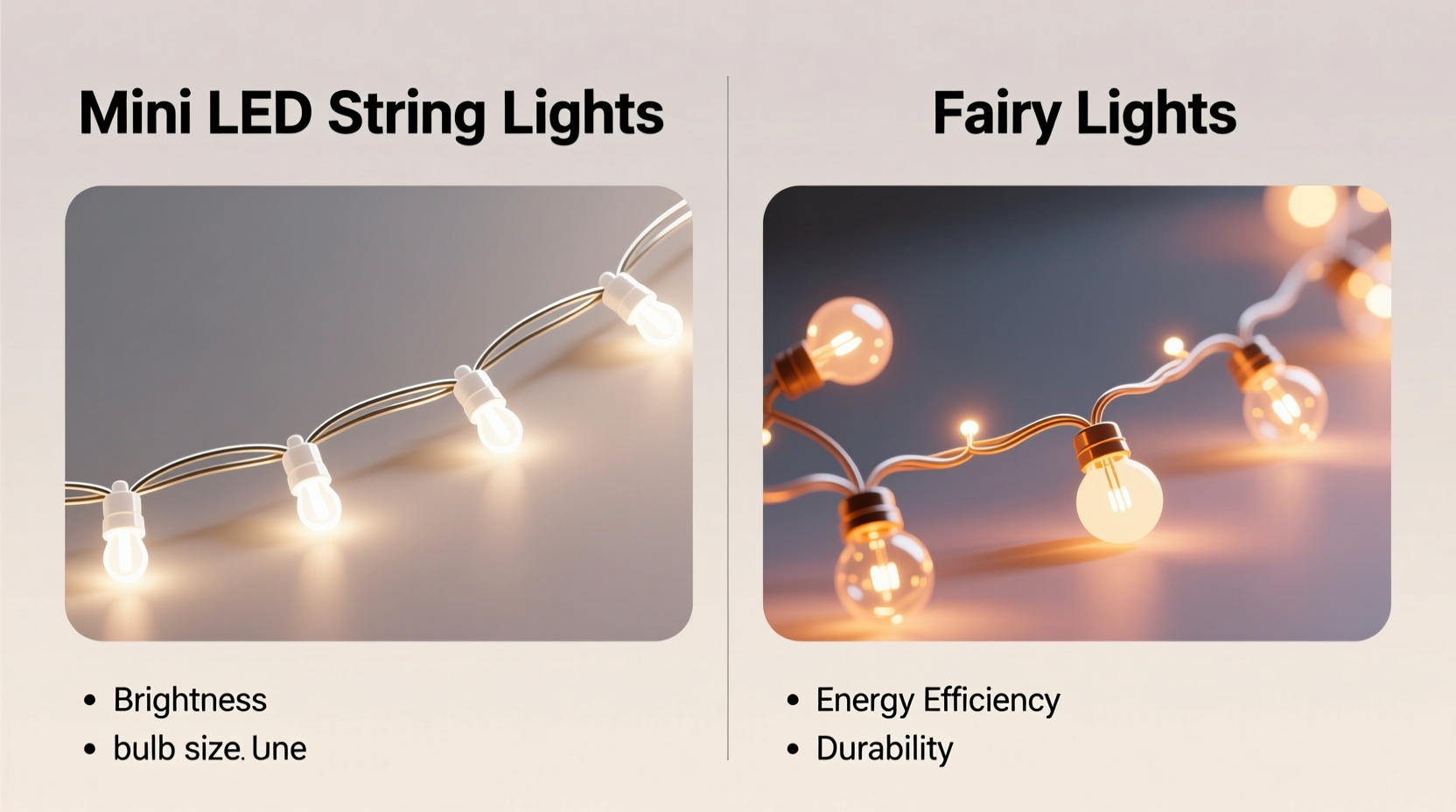
The term “fairy lights” predates LEDs by nearly a century. Originating in early 20th-century Europe, it described delicate incandescent bulbs—often hand-blown glass, wired in series, powered by low-voltage transformers—used to mimic the soft, scattered glow of fireflies or enchanted woodland scenes. Their charm lay in subtlety: low lumen output (typically 0.5–2 lumens per bulb), warm color temperature (2700K–3000K), and gentle diffusion. They were never meant for illumination; they were atmospheric tools.
Today, “fairy lights” remains a stylistic and experiential descriptor—not a technical specification. Retailers apply it to any string light with small, closely spaced bulbs (≤5 mm diameter), a relaxed spacing (6–12 inches between nodes), and a primary purpose of ambient or decorative effect. That includes both legacy incandescent versions and modern LED variants. Crucially, many products marketed as “fairy lights” prioritize aesthetics over engineering rigor: thinner wires, minimal insulation, non-replaceable bulbs, and limited weather resistance.
What Makes a “Mini LED String Light” Technically Distinct
A “mini LED string light” is defined first by its semiconductor technology—and second by its engineering intent. These strings use surface-mounted device (SMD) LEDs—commonly SMD 3528 or SMD 2835 chips—measuring just 2.8 × 3.5 mm or 2.8 × 3.5 mm respectively. Unlike older incandescent fairy lights, each LED operates at low voltage (typically 2–3.4V DC), generates negligible heat, and delivers 8–15 lumens per node depending on chip quality and drive current.
What separates premium mini LED strings from generic “fairy lights” is construction discipline: thicker copper-clad wiring (often 22–20 AWG), robust PVC or silicone jacketing, sealed solder joints, and integrated constant-current drivers or resistors per segment. Many meet IP44 (splash-resistant) or IP65 (jet-water resistant) standards—making them viable for covered patios, pergolas, or balcony railings year-round. They’re also engineered for longevity: rated for 25,000–50,000 hours (vs. 1,000–3,000 for incandescent fairy lights).
“Calling all LED strings ‘fairy lights’ blurs critical performance boundaries. A well-engineered mini LED string isn’t just brighter—it’s thermally stable, electrically isolated, and built for duty cycles that exceed seasonal use. Confusing the two leads consumers to install indoor-rated lights outdoors, risking failure—or worse, electrical hazard.” — Dr. Lena Torres, Lighting Engineer, Illumination Design Group
Key Differences at a Glance: Technical & Practical Comparison
| Feature | Traditional Fairy Lights (Incandescent) | Generic LED Fairy Lights | Premium Mini LED String Lights |
|---|---|---|---|
| Bulb Type | Miniature incandescent (glass filament) | Low-cost SMD or DIP LEDs | High-bin SMD 2835/3528 or COB micro-LEDs |
| Lifespan | 1,000–3,000 hours | 10,000–20,000 hours | 25,000–50,000+ hours |
| Energy Use (per 100 bulbs) | 40–60W | 4–8W | 3–6W (with efficiency-optimized drivers) |
| IP Rating | None (indoor only) | Rarely rated; often IP20 | Commonly IP44, IP65, or IP67 |
| Wire Gauge & Insulation | Thin, brittle stranded wire; minimal jacket | 24–22 AWG; basic PVC | 22–20 AWG tinned copper; UV-stabilized silicone or thick PVC |
| Heat Output | High (bulbs get hot to touch) | Low-moderate (warm near driver) | Negligible (even after 8+ hours) |
| Dimmability | Compatible with standard dimmers | Often non-dimmable or flickers with trailing-edge dimmers | Most support PWM or 0–10V dimming with compatible controllers |
Real-World Application: When the Difference Becomes Critical
A homeowner in Portland, Oregon, installed a set of $12 “copper wire fairy lights” labeled “for indoor/outdoor use” along her cedar deck railing in early October. By late November—after three rainstorms and overnight temperatures dipping to 3°C—the string failed completely. The insulation cracked, moisture entered the connections, and the transformer shorted. She assumed “outdoor use” meant weather tolerance. It didn’t. The product lacked an IP rating, used unjacketed 26 AWG wire, and had no conformal coating on PCB nodes.
Contrast that with her neighbor, who invested in a $42 set of “mini LED string lights” rated IP65, with silicone-jacketed 20 AWG wire and a waterproof 24V DC transformer. Installed in the same location, same month, those lights operated continuously through winter—without dimming, discoloration, or corrosion. The difference wasn’t price alone. It was thermal resilience, ingress protection, and consistent forward voltage regulation across all 200 nodes.
This divergence matters most in four scenarios:
• Outdoor permanence (e.g., wrapping trees, lining fences, architectural accents)
• Commercial or hospitality settings where uptime and safety compliance are non-negotiable
• Child- or pet-heavy homes, where low heat and shatterproof construction reduce burn or ingestion risk
• Smart home integration, where stable DC input and uniform color rendering (CRI >90) enable seamless scheduling and scene control
How to Choose Wisely: A 5-Step Decision Framework
- Define your environment: Indoor only? Covered patio? Fully exposed eaves? Uncovered garden? Match the IP rating accordingly: IP20 (dry indoor), IP44 (damp indoor/covered outdoor), IP65+ (uncovered outdoor, high humidity).
- Verify power architecture: Avoid AC-powered “fairy lights” with exposed plug-in transformers for outdoor use. Prefer UL/ETL-listed 24V or 12V DC systems with waterproof connectors and surge-protected inputs.
- Inspect the wire spec: Look for AWG size (22 or lower is better), jacket material (silicone > PVC > bare copper), and whether the wire is tinned (corrosion-resistant) or bare.
- Check thermal design: Does the listing mention “constant current drivers,” “thermal pads,” or “heat-dissipating PCBs”? If not, assume passive cooling only—fine for short runs, risky for long installations (>30 ft) or enclosed spaces.
- Test color consistency: Order a 10-bulb sample first. Run it for 2 hours. Observe for visible color shift (yellowing at ends), flicker, or uneven brightness—signs of poor binning or inadequate current regulation.
FAQ: Clarifying Common Misconceptions
Are all LED string lights “mini LED” lights?
No. “Mini LED” refers specifically to SMD-type LEDs under 3.5 mm in size, mounted directly onto flexible printed circuits. Larger LED strings—like C7, C9, or G40 bulbs—use discrete LED packages and different thermal and electrical designs. Not every LED string qualifies as “mini LED,” even if marketed as such.
Can I cut fairy lights or mini LED strings to length?
Only if explicitly designed for field-cutting—indicated by copper cut marks every 3–6 inches and solder pads at each node. Most traditional fairy lights and cheap LED strings are wired in series; cutting disrupts the circuit and voids safety certifications. Always verify manufacturer instructions before modifying.
Why do some “fairy lights” cost more than “mini LED strings”?
Premium fairy lights often use hand-finished copper wire, artisanal glass bulbs, or vintage-style filaments—prioritizing nostalgia over efficiency. Conversely, high-end mini LED strings invest in industrial-grade components: aerospace-grade silicone, military-spec connectors, and LM-80–tested LEDs. Price reflects engineering integrity—not just aesthetics.
Final Considerations: Beyond Brightness and Bulbs
The distinction between mini LED string lights and fairy lights ultimately rests on intentionality. Fairy lights evoke mood—soft, fleeting, romantic. Mini LED strings embody reliability—precise, adaptable, enduring. Neither is superior in absolute terms. But conflating them ignores critical variables: electrical safety margins, thermal decay curves, photometric consistency, and lifecycle cost.
A $8 fairy light string may seem economical until it fails after 47 days of outdoor use—requiring replacement, rewiring, and lost ambiance. A $38 mini LED string may appear expensive until you calculate its 12-year operational lifespan, 85% lower electricity cost versus incandescent, and zero maintenance beyond wiping dust from lenses twice yearly.
More importantly, responsible lighting choices affect sustainability. The average consumer discards 3–5 decorative light sets annually. Premium mini LED strings reduce that waste significantly—while delivering richer color rendering (CRI 92+ vs. 70–80 on budget LEDs), tighter beam control (reducing light pollution), and compatibility with renewable-energy microgrids (via 12–24V DC input).




 浙公网安备
33010002000092号
浙公网安备
33010002000092号 浙B2-20120091-4
Comments
No comments yet. Why don't you start the discussion?