
When it comes to holiday lighting, the difference between mini lights and C7 bulbs isn’t just about size or brightness—it’s also about reliability, longevity, and how much hassle you’ll face when a single bulb fails. Many homeowners discover too late that not all light strings are created equal when it comes to repairs. One burned-out bulb can turn a festive display into a frustrating puzzle. Understanding the structural and electrical differences between mini lights and C7 bulbs reveals which option truly wins in terms of repairability and long-term convenience.
How Mini Lights Work and Why They Fail
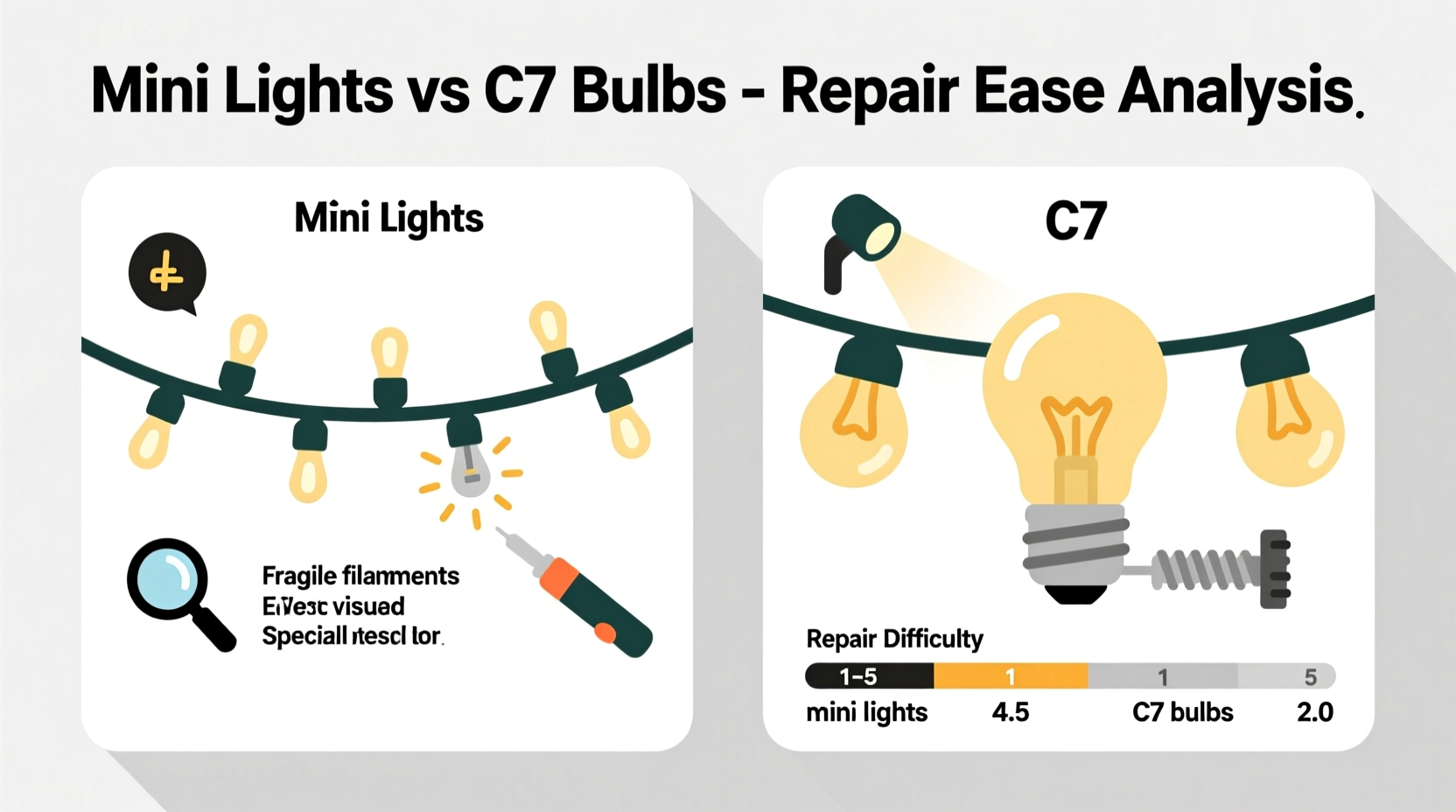
Mini lights—those tiny, 2.5-volt bulbs commonly used in holiday displays—are typically wired in series. This means electricity flows from one bulb to the next in a continuous loop. If one bulb burns out or becomes loose, the circuit breaks, and the entire string—or a large section of it—goes dark. While this design keeps manufacturing costs low, it creates significant challenges when diagnosing and repairing failures.
The root issue lies in the series circuit. Since each bulb shares the same current path, a single point of failure disrupts the flow. Worse still, some mini light strings use shunted sockets designed to bypass a dead bulb automatically. In theory, this prevents total blackouts. But in practice, these mechanisms often fail due to corrosion, poor contact, or manufacturing defects. As a result, users end up testing each bulb manually with a multimeter or using a specialized light tester to locate the faulty one.
Another complicating factor is the fragility of the bulbs themselves. Mini lights have delicate filaments and thin glass enclosures. They’re prone to damage during installation, storage, or exposure to wind and moisture. Over time, repeated expansion and contraction from heat cycles weaken connections, increasing the likelihood of intermittent failures that are difficult to trace.
The Structure and Reliability of C7 Bulbs
C7 bulbs, named for their approximate size (7/8 inch in diameter), operate differently. Most are 120-volt incandescent or LED bulbs wired in parallel across standard household voltage. Unlike mini lights, where one failure can kill the whole string, C7 bulbs function independently. When one bulb burns out, the rest stay lit. This fundamental difference drastically simplifies troubleshooting and repair.
Because each C7 bulb receives full line voltage, they don’t rely on neighboring bulbs to complete a circuit. This makes them inherently more reliable for outdoor or permanent installations. Homeowners can spot a dead bulb instantly by visual inspection—there’s no need for diagnostic tools or guesswork. Replacement is straightforward: unscrew the faulty bulb and install a new one, just like changing a household lightbulb.
C7 bulbs are also physically sturdier. Their larger base and thicker glass make them more resistant to vibration, weather, and accidental impact. They’re commonly used in commercial displays, marquees, and architectural lighting where uptime and serviceability are critical. Even when used seasonally, their robust construction means fewer replacements over time.
“Parallel-wired systems like C7 strings are far more user-serviceable. You don’t need an electrician to fix a single bulb outage.” — Marcus Tran, Electrical Lighting Technician with 18 years in seasonal display maintenance
Repair Comparison: Step-by-Step Breakdown
To understand the real-world implications, consider what happens when a single bulb fails in each type of string.
Fixing a Dead Mini Light String
- Unplug the string and inspect for visibly damaged or discolored bulbs.
- Check for loose bulbs by gently pressing each one into its socket.
- If no obvious fault is found, use a light tester to scan each socket for continuity.
- Replace any defective bulb with an exact voltage match (usually 2.5V).
- If the string remains dark, check for a blown fuse in the plug—common in mini light sets.
- In older sets, a single “shunt” failure may require replacing the entire section or string.
This process can take 20 minutes or more, especially if multiple bulbs are failing. And because mini lights degrade over time, fixing one often uncovers others on the verge of failure.
Replacing a Failed C7 Bulb
- Identify the dark bulb during a nighttime inspection.
- Ensure the power is off at the outlet or circuit breaker.
- Unscrew the dead bulb by hand or with a soft cloth for grip.
- Screw in a new 120V C7 bulb of matching type (incandescent or LED).
- Restore power and verify operation.
The entire process takes under five minutes and requires no special tools. There’s no circuit tracing, no guesswork—just direct replacement.
Comparison Table: Mini Lights vs C7 Bulbs
| Feature | Mini Lights | C7 Bulbs |
|---|---|---|
| Wiring Type | Series | Parallel |
| Voltage per Bulb | 2.5V | 120V |
| Effect of One Burned-Out Bulb | Entire string or section goes dark | Only that bulb is off |
| Repair Difficulty | High – requires testing and diagnosis | Low – visual identification and swap |
| Replacement Time | 10–30+ minutes | Under 5 minutes |
| Durability | Low – fragile filaments and glass | High – robust construction |
| Common Use Case | Indoor trees, delicate outdoor wraps | Outdoor displays, rooflines, commercial |
Real-World Example: The Holiday Display Dilemma
Consider Sarah, a homeowner in Vermont who decorates her house every December. She uses two types of lights: mini lights on her front porch railing and C7 bulbs along the roofline. Last year, after a heavy snowstorm, she noticed half of the mini light string had gone dark. Over the next three evenings, she spent hours testing bulbs, replacing fuses, and eventually cutting out a damaged section. By contrast, when one C7 bulb failed later that season, she spotted it immediately during her nightly walk. The next day, she replaced it in less than three minutes while standing on a step ladder. The rest of the display never missed a beat.
Sarah switched entirely to C7 bulbs the following year. “I love the look,” she said, “but more importantly, I don’t have time to troubleshoot fairy lights anymore. With C7s, I know exactly what’s wrong and how to fix it.”
Maintenance Checklist for Long-Lasting Holiday Lights
- ✅ Inspect all strings for frayed wires or cracked sockets before installation
- ✅ Test each string individually before hanging
- ✅ Use only outdoor-rated extension cords and outlets with GFCI protection
- ✅ Avoid daisy-chaining more than three light strings unless rated for it
- ✅ Store lights on reels or cardboard spools to prevent tangling and breakage
- ✅ Keep spare bulbs and fuses matched to each string type
- ✅ Clean bulb contacts occasionally with electrical contact cleaner
- ✅ Replace aging mini light strings every 3–5 years, even if functional
Frequently Asked Questions
Can I replace a mini light bulb with any small bulb?
No. Mini lights are typically 2.5 volts and must be replaced with bulbs of the same voltage and base type (usually E12 candelabra). Using a higher-voltage bulb will result in dimness or failure to light. Always check packaging for compatibility.
Are LED C7 bulbs worth the extra cost?
Yes. While LED C7 bulbs have a higher upfront cost, they consume up to 90% less energy, generate less heat, and last 25,000 to 50,000 hours—compared to 2,000–3,000 for incandescent. Over several seasons, LEDs pay for themselves in energy savings and reduced replacements.
Why do my mini lights keep blowing fuses?
Mini light strings have built-in fuses in the plug to protect against overcurrent. Repeated fuse blowouts usually indicate a short circuit—often caused by pinched wires, water intrusion, or a bulb inserted incorrectly. Check for damaged insulation and ensure all bulbs are fully seated. If problems persist, retire the string for safety.
Final Thoughts: Choosing for Repairability
When evaluating mini lights versus C7 bulbs, repair ease should weigh heavily in your decision—especially if you value efficiency and reliability. Mini lights offer a charming, dense glow ideal for wrapping trees or outlining windows, but their series wiring makes them high-maintenance. C7 bulbs, with their independent operation and simple replacement, are far more practical for large-scale or hard-to-reach installations.
For those committed to mini lights, investing in newer models with better shunting technology or upgrading to LED mini strings can reduce failure rates. However, even modern versions suffer from the inherent limitations of series circuits. For maximum durability and minimal repair effort, C7 bulbs remain the superior choice.
The goal of holiday lighting shouldn’t be to create a maintenance burden. It’s to enhance beauty, celebrate tradition, and bring joy—not frustration. By choosing lighting systems designed for easy repair, you reclaim time, reduce stress, and ensure your display shines brightly, season after season.




 浙公网安备
33010002000092号
浙公网安备
33010002000092号 浙B2-20120091-4
Comments
No comments yet. Why don't you start the discussion?