
When it comes to decorating large outdoor trees for the holidays or special events, choosing the right type of lighting can dramatically affect the final aesthetic. Two of the most popular options—mini lights and C9 bulbs—each bring distinct advantages and visual effects. While mini lights offer a delicate, twinkling effect, C9 bulbs deliver bold, vibrant illumination that stands out from a distance. The decision isn’t just about personal taste; it involves understanding scale, brightness, energy use, durability, and installation logistics. For homeowners, landscapers, and holiday decorators, making an informed choice ensures a stunning display that aligns with both vision and practicality.
Understanding Mini Lights and C9 Bulbs
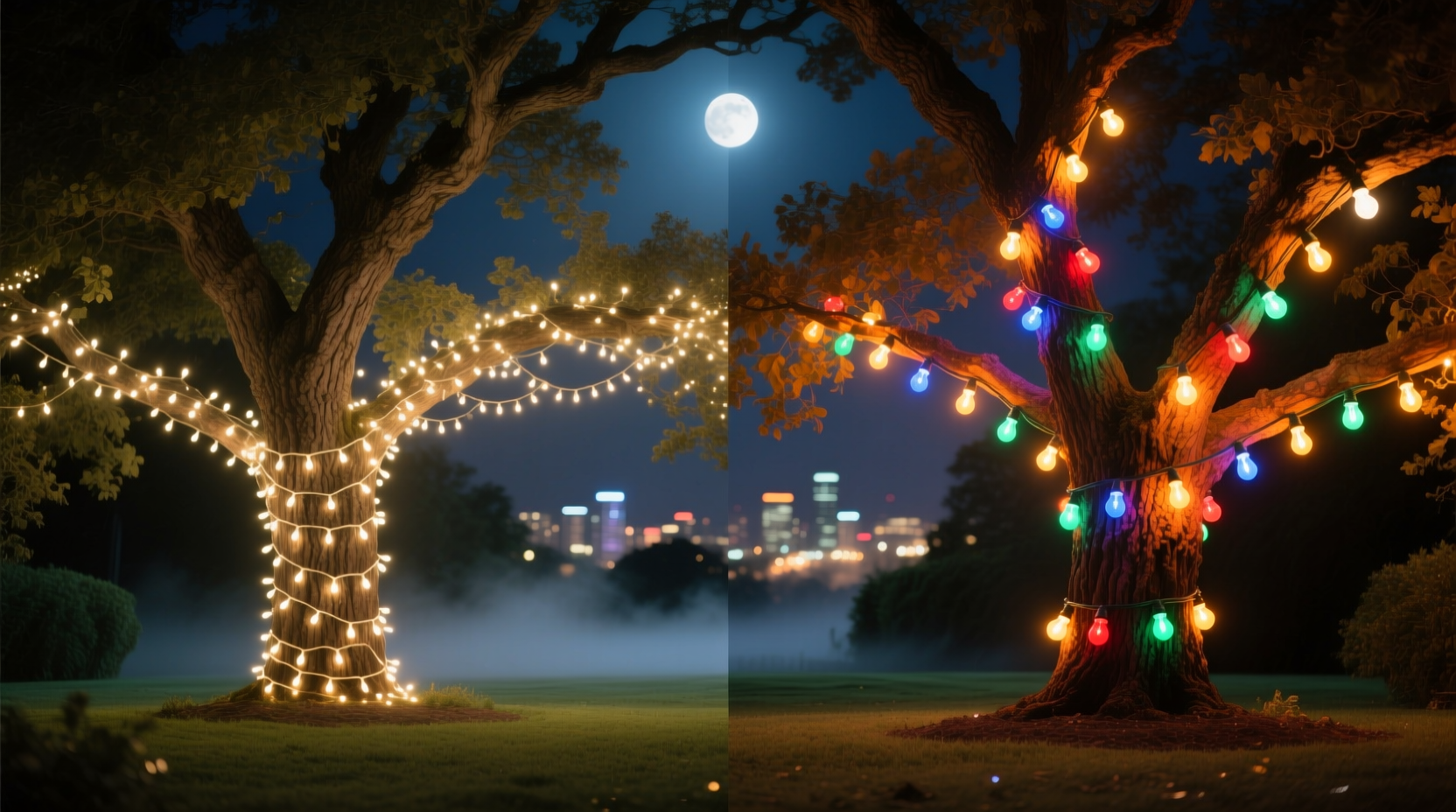
Before comparing their performance on large trees, it's essential to define what each type of light offers.
Mini lights, also known as fairy lights or Christmas mini lights, are small incandescent or LED bulbs typically ranging from 1/4 inch to 3/8 inch in size. They are usually spaced 4 to 6 inches apart on a string and come in warm white, cool white, and multicolor varieties. These lights are favored for their subtle, sparkling appearance and are often used on smaller trees, shrubs, railings, and architectural details.
C9 bulbs, on the other hand, are much larger—about 1.5 inches long—with an E17 or E26 base. They are commonly used in commercial displays and large-scale residential lighting due to their high visibility and strong output. Spaced 12 inches apart, C9 strings cover more ground per strand and are ideal for outlining structures, wrapping trunks, or illuminating tall evergreens.
Visual Impact: Coverage and Aesthetic Appeal
The visual difference between mini lights and C9 bulbs on a large tree is significant and depends largely on the desired mood and viewing distance.
Mini lights create a dense, shimmering canopy when wrapped tightly around branches. Their small size allows for intricate layering, producing a magical, starry-night effect. This is especially effective on trees with fine foliage, like spruces or firs, where thousands of tiny points of light mimic snowflakes or fireflies. However, on very large trees—especially those over 20 feet—mini lights may appear too faint from a distance unless densely installed.
C9 bulbs, by contrast, are designed for maximum visibility. Each bulb emits significantly more lumens than a mini light, making them ideal for trees viewed from across the street or illuminated at night in open yards. Their spacing creates a rhythmic, bold pattern that emphasizes the tree’s structure. When strung vertically from top to bottom or spiraled around thick limbs, C9s command attention and convey grandeur. They are frequently used in municipal displays, shopping centers, and homes aiming for a dramatic statement.
“On trees taller than 25 feet, you need luminosity to compete with ambient light. That’s where C9s shine—literally.” — Daniel Reeves, Professional Holiday Lighting Designer
Comparison Table: Mini Lights vs C9 Bulbs for Large Trees
| Feature | Mini Lights | C9 Bulbs |
|---|---|---|
| Bulb Size | ~1/4” – 3/8” | ~1.5” |
| Lumens per Bulb | 2–6 (LED), 10–20 (incandescent) | 80–150 (LED), 200+ (incandescent) |
| Spacing | 4–6 inches | 12 inches |
| String Length (Typical) | 25–100 ft (50–350 bulbs) | 25–100 ft (25–100 bulbs) |
| Power Consumption (per 25-light string) | 0.8W (LED), 40W (incandescent) | 9W (LED), 125W (incandescent) |
| Best For | Fine detail, close-up viewing, natural sparkle | Long-distance visibility, bold statements, commercial appeal |
| Durability (Outdoor Use) | Good (if rated for outdoors) | Excellent (thicker casing, weather-resistant) |
| Installation Time | High (requires dense wrapping) | Moderate (fewer strands, wider spacing) |
Practical Considerations: Installation and Maintenance
Installing lights on large outdoor trees isn’t just about aesthetics—it’s a logistical challenge. The size and weight of the lights, number of strings needed, and ease of attachment all influence the process.
Mini lights require more labor. To achieve full coverage on a 30-foot pine, you might need 10–15 strands of 100-count mini lights, carefully wrapped from the trunk outward. This can take several hours and may require ladders or lifts. Because the bulbs are small, they’re more prone to damage during handling, and individual bulb failures can be harder to spot and replace.
C9 bulbs, while heavier per strand, cover more area with fewer runs. You might only need 4–6 strands of 25-count C9s to outline the major limbs or create vertical columns of light. Their larger sockets make them easier to handle, even with gloves, and many modern C9 LED strings are shatterproof and UV-resistant. Replacement bulbs are also more accessible and standardized.
Step-by-Step Guide: Choosing and Installing Lights on a Large Tree
- Assess the tree size and location. Measure height and spread. Determine if it’s best viewed up close or from afar.
- Decide on the mood. Soft glow = mini lights. Bold statement = C9 bulbs.
- Calculate coverage needs. For mini lights: aim for 100 bulbs per foot of tree height. For C9s: 25 bulbs per 6–8 feet of vertical space.
- Select LED versions. LEDs consume less power, run cooler, and last longer—critical for extended seasonal use.
- Test one string first. Hang a sample strand overnight to evaluate brightness and color temperature.
- Install with care. Start from the trunk and work outward. Use tree clips every 12–18 inches to prevent sagging.
- Connect to a GFCI outlet. Use outdoor-rated extension cords and timers for safety and automation.
- Inspect weekly. Check for loose connections, damaged wires, or wildlife interference.
Real-World Example: Residential Display Transformation
In suburban Denver, homeowner Maria Thompson faced a dilemma with her towering 35-foot blue spruce. For years, she used mini lights, but neighbors and passersby often missed the display entirely after dark. “It looked beautiful up close,” she said, “but from the sidewalk, it was just a dark silhouette with a few sparkles.”
After consulting a local lighting service, she switched to commercial-grade C9 LED strings in warm white. Using six 25-bulb strands, she created vertical runs from the top to the lower branches, emphasizing the tree’s height. The transformation was immediate. “It lit up the whole front yard. People started stopping to take pictures. It felt like we were part of the neighborhood celebration.”
She later added a single strand of mini lights around the inner core for depth, combining both styles effectively. This hybrid approach demonstrated that while C9s provided the primary visibility, mini lights added texture when viewed up close.
Energy Efficiency and Long-Term Costs
Despite their larger size, modern LED C9 bulbs are surprisingly energy-efficient. A full set of 100 LED C9s consumes about 9 watts—less than a standard nightlight. In contrast, older incandescent C9s could use over 100 watts per string, making them costly for month-long displays.
Mini LED strings are even more efficient, with a 100-light strand using as little as 4 watts. However, because more strings are needed for equivalent coverage, the total energy use can add up. For example, covering a large tree with 10 mini light strings (40 watts total) uses slightly more power than 4 C9 strings (36 watts).
Upfront cost is another factor. LED C9 bulbs are more expensive per bulb—around $1.50–$3.00—but their longevity (often 25,000–50,000 hours) offsets replacement costs. Mini lights are cheaper individually ($0.10–$0.50 per bulb) but may need replacing every 3–5 seasons due to breakage or dimming.
Climate and Environmental Factors
Outdoor conditions play a crucial role in bulb performance. In regions with heavy snow, ice, or wind, C9 bulbs have an advantage. Their larger, sealed housings resist moisture ingress better than mini lights, which can develop condensation inside the socket. Cold temperatures can also cause brittle plastic in low-quality mini lights to crack.
UV exposure degrades plastics over time. High-quality C9 strings are typically made with UV-stabilized materials, while budget mini lights may yellow or become opaque after a single season. Always verify that your lights are rated for outdoor use (look for UL certification and weatherproof seals).
Hybrid Approach: Combining Mini Lights and C9 Bulbs
Some of the most impressive tree displays blend both types of lighting. This layered technique uses C9 bulbs to define the tree’s outer shape and major branches, creating a bold framework. Mini lights are then used internally or along finer twigs to add depth, texture, and a sense of volume.
This method works particularly well on irregularly shaped trees or those with dense canopies. The C9s ensure visibility from the street, while the mini lights reward closer inspection with a rich, immersive glow. It requires more planning and materials but offers the best of both worlds.
Frequently Asked Questions
Can I mix mini lights and C9 bulbs on the same tree?
Yes, and many professional displays do. Use C9s for outlining and structural emphasis, and mini lights for interior detailing. Just ensure both operate on compatible voltages and use separate circuits if needed.
Which is safer for trees—mini lights or C9s?
Both are safe when installed correctly. Avoid tying strings too tightly, which can girdle growing branches. Use flexible clips instead of wire or rope. LED versions generate minimal heat, reducing fire risk and bark damage.
How many lights do I need for a 25-foot tree?
For mini lights: roughly 2,500 bulbs (25 strings of 100). For C9s: 75–100 bulbs (3–4 strings of 25), depending on spacing and desired density.
Final Recommendations
The choice between mini lights and C9 bulbs ultimately depends on your goals. If you want an intimate, enchanting glow visible primarily from your porch or driveway, mini lights are a charming option—especially on trees with dense foliage. But if your tree anchors a streetscape, welcomes guests from afar, or you simply want a commanding presence, C9 bulbs are the superior choice for brightness, durability, and visual impact.
For most large outdoor trees over 20 feet, C9 LED bulbs provide the best balance of efficiency, visibility, and ease of installation. Their bold appearance ensures your effort is seen and appreciated, even in neighborhoods with competing displays. That said, don’t rule out creativity—combining both types can yield a dynamic, multi-dimensional effect that evolves as viewers move closer.




 浙公网安备
33010002000092号
浙公网安备
33010002000092号 浙B2-20120091-4
Comments
No comments yet. Why don't you start the discussion?