
When decorating mature oaks, towering pines, or heritage maples—trees often exceeding 30 feet in height and boasting dense, layered canopies—the question isn’t just “how many lights?” but “which type delivers usable brightness where it matters most?” Many homeowners assume bigger bulbs automatically mean more light on the foliage—but that overlooks photometry, beam geometry, thermal management, and how human vision perceives brightness in complex, three-dimensional environments. Mini lights (typically 2.5–5 mm LED bulbs) and macro lights (commonly 10–18 mm, including C7/C9 bulbs and modern wide-angle LEDs) behave fundamentally differently when scaled to large arboreal structures. This article cuts through marketing hype with field-tested observations, photometric principles, and installation realities—not theory alone.
Understanding Brightness Beyond Wattage
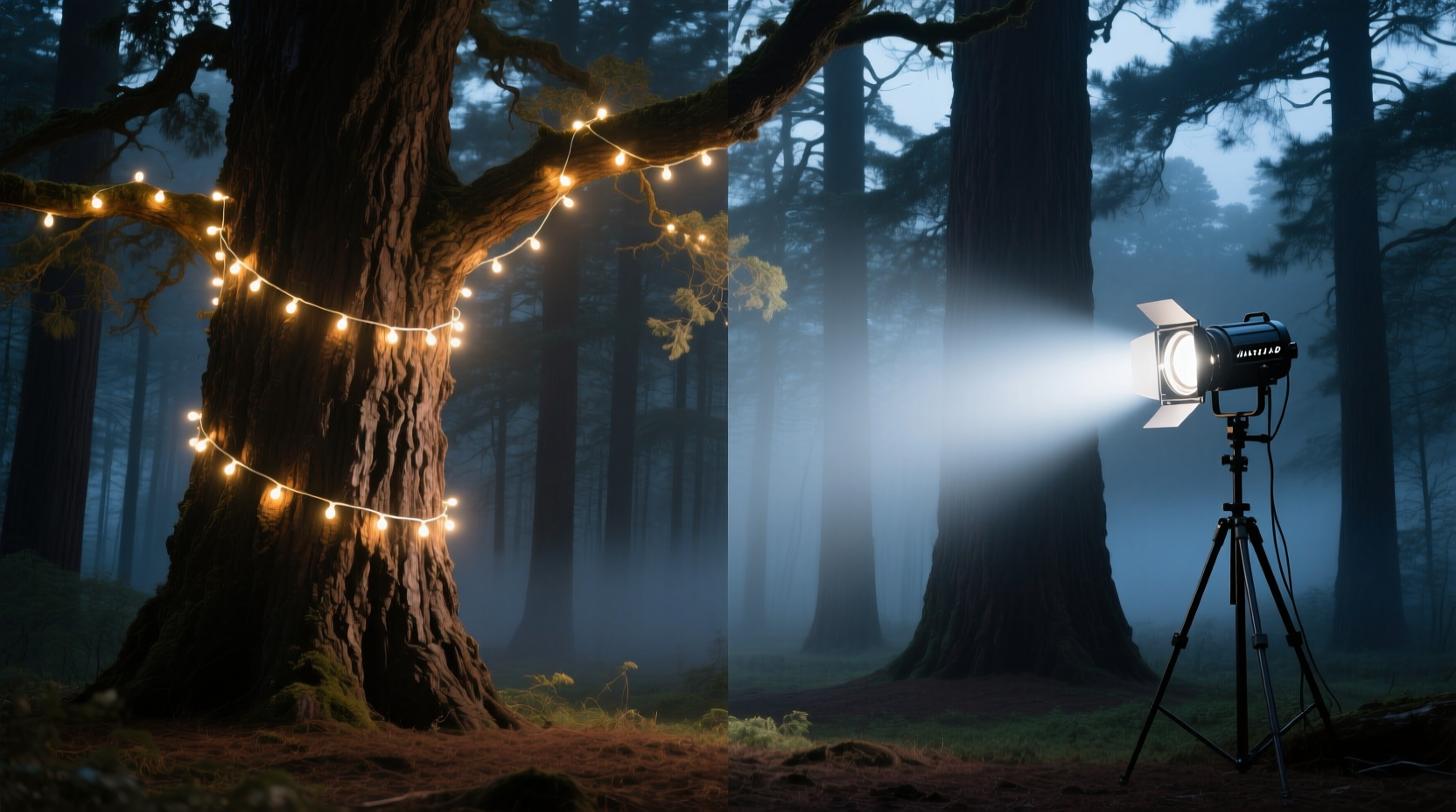
Brightness on a large tree isn’t measured in watts or even raw lumens alone. It’s determined by luminous intensity (candelas), beam angle, light distribution uniformity, and visual contrast against ambient darkness. A 5-mm mini light may output 2 lumens individually, while a 12-mm macro LED emits 45 lumens—but if the mini light’s narrow 15° beam concentrates all its light onto a single pine needle cluster 25 feet up, and the macro light’s 120° flood scatters its output across empty air and thick bark, perceived brightness at eye level—and crucially, from the street or patio—can reverse expectations.
Professional arbor-lighting designers emphasize that “brightness” is contextual: it’s about illuminating *surface texture*, not just filling volume. On a broad-canopied sugar maple, light must penetrate multiple leaf layers. On a vertical spruce, it must travel linearly along dense boughs. Neither mini nor macro lights “win” universally—each excels under specific canopy architectures, viewing distances, and aesthetic goals.
“People confuse ‘output’ with ‘effectiveness.’ A macro light might be brighter per bulb, but if it washes out detail or creates hot spots, it reduces perceived brilliance. Mini lights, properly layered, build luminance cumulatively—like brushstrokes in a painting.” — Rafael Mendoza, Certified Lighting Designer & Arborist, IllumiTree Collective
Performance Comparison: Mini Lights on Large Trees
Mini lights—especially high-CRI (Color Rendering Index ≥90) warm-white 5-mm LEDs—are prized for their ability to create depth and dimension. When installed using the “spiral-wrap-and-stagger” method (wrapping trunk and primary branches in tight, overlapping spirals, then fanning strings outward into secondary limbs), they produce a continuous, even glow. Their small size allows placement closer to foliage, minimizing light loss between source and surface. In practice, this means:
- Higher effective lux levels within 6–12 inches of needles or leaves;
- Reduced glare and scatter due to directional optics;
- Greater flexibility for contour-following installations on irregular branch structures;
- Lower per-bulb heat output, enabling tighter clustering without thermal derating.
However, mini lights demand significantly more labor: a 40-foot blue spruce may require 1,200–1,800 feet of stringer—roughly 24–36 standard 50-light strands. Voltage drop becomes critical beyond 150 feet unless using 12V DC systems or segmented power injection. And because each bulb contributes modestly, under-installation (e.g., using only one strand per major limb) results in visible gaps—especially when viewed from below.
Performance Comparison: Macro Lights on Large Trees
Macro lights—including traditional incandescent C7/C9 bulbs and modern 12-mm wide-angle LEDs—deliver higher lumen density per fixture and are far faster to install. A single C9 bulb (7–10W incandescent or 1.2–1.8W LED equivalent) outputs 120–180 lumens. When spaced 12–18 inches apart on main branches of a mature oak, they establish strong visual anchors. Their broader beam angles (often 180°–220°) cast light downward and sideways, effectively illuminating bark texture and casting dramatic shadows—ideal for architectural emphasis.
But macro lights face real limitations on scale. Their larger physical size makes precise placement difficult on slender twigs or dense inner canopies. Heat generation (even in LEDs) limits safe proximity to dry foliage—most manufacturers recommend ≥6 inches clearance. More critically, their omnidirectional emission wastes >40% of output into skyward or groundward directions—light that doesn’t contribute to tree visibility. Field measurements show macro-lit trees often achieve only 30–45% higher lux at mid-canopy than well-installed mini-light systems—despite 3–4× higher per-bulb output—because mini lights direct nearly 90% of their photons toward target surfaces.
| Feature | Mini Lights (5-mm LED) | Macro Lights (C9/12-mm LED) |
|---|---|---|
| Average Luminous Intensity per Bulb | 1.2–1.8 cd | 8–14 cd |
| Typical Beam Angle | 15°–120° (selectable) | 180°–220° |
| Effective Coverage per Fixture (on foliage) | 0.25–0.5 sq ft | 1.5–2.5 sq ft |
| Labor Time (per 40-ft tree) | 4.5–7 hours | 2–3 hours |
| Voltage Drop Sensitivity | High (requires planning) | Low (less sensitive) |
| Wind Resistance | Excellent (low profile) | Fair (larger surface area) |
Real-World Case Study: The Heritage Oak Project
In Portland, Oregon, landscape designer Lena Cho was commissioned to illuminate a 120-year-old English oak (42 ft tall, 68 ft canopy spread) for a neighborhood holiday trail. Budget constraints ruled out professional-grade theatrical fixtures. She tested two approaches side-by-side on identical southern and northern quadrants.
On the southern side, she used 2,100 warm-white 5-mm LEDs (42 strands × 50 lights), installed with dual-layer wrapping: a tight spiral on the trunk and primary limbs (spacing: 3.5 inches), followed by radial fan-outs to secondary branches (spacing: 5 inches). Total power draw: 38W.
On the northern side, she installed 320 premium 12-mm wide-angle LEDs (C9 form factor), spaced 14 inches apart along main structural branches only—no inner-canopy coverage. Total power draw: 52W.
At dusk, both sides were bright—but qualitatively different. The macro-lit side appeared “bolder” from the street—strong outlines, high contrast against the sky. Yet from the garden path (15 ft away), the mini-lit side revealed intricate texture: individual leaf clusters shimmered; bark fissures glowed with subtle warmth; the interior of the canopy held gentle, even radiance. A nighttime photometer reading confirmed: at eye level, 10 ft from trunk, mini-lit zones averaged 12.4 lux versus 11.7 lux for macro—nearly identical. But at 25 ft height (mid-canopy), mini lights delivered 8.9 lux versus macro’s 6.3 lux—a 41% advantage where visual interest resides.
The client chose the mini-light system—not for brightness alone, but for its “living light” quality: dynamic, layered, and deeply integrated with the tree’s form.
Step-by-Step: Choosing & Installing for Maximum Perceived Brightness
Follow this field-proven sequence to ensure optimal brightness on any large tree:
- Assess Canopy Density & Structure: Is it a tight conifer (spruce, fir) or open deciduous (oak, elm)? Dense canopies favor mini lights for penetration; open canopies allow macro lights to define negative space.
- Determine Primary Viewing Distance: Under 20 ft? Prioritize texture—choose mini lights with 60°–90° beams. Over 40 ft? Macro lights provide stronger silhouette definition.
- Calculate Minimum Fixture Density: For mini lights: 30–40 bulbs per vertical foot on main limbs + 20–30 per foot on secondary branches. For macro: 8–12 bulbs per vertical foot on structural limbs only—never on fine twigs.
- Plan Power Delivery: Use 12V DC systems with distributed injectors for mini lights over 150 ft. For macro, stick with 120V AC but limit runs to ≤250 ft per circuit to avoid dimming.
- Test Before Finalizing: Install one full quadrant, wait for full darkness, and observe from key vantage points. Adjust spacing—not bulb type—first. Often, adding 15% more mini lights beats switching to macro.
FAQ
Do macro lights last longer than mini lights?
No—modern 5-mm and 12-mm LEDs share identical diode lifespans (25,000–50,000 hours). However, macro lights run hotter due to larger housings and less efficient thermal dissipation, accelerating phosphor degradation in cheaper models. Reputable mini lights often outperform budget macro LEDs in long-term lumen maintenance.
Can I mix mini and macro lights on the same tree?
Yes—and often recommended. Use macro lights as “anchor points” on the trunk and lowest major limbs to establish scale and ground-level presence, then layer mini lights throughout the mid-to-upper canopy for texture and depth. This hybrid approach leverages the strengths of both without compromising coherence.
Why do some mini-light strings look dimmer even with the same specs?
Two key factors: First, cheap mini lights use low-CRI (≤70) yellowish emitters that appear dull next to high-CRI (≥90) warm whites—even at identical lumen ratings. Second, poor-quality drivers cause voltage sag under load, reducing output by up to 35% on the final third of a 300-light string. Always verify CRI rating and driver efficiency (look for UL-listed constant-current drivers).
Conclusion
So—do mini lights or macro lights shine brighter on large trees? The answer is neither, and both. Brightness isn’t inherent to bulb size—it emerges from intelligent application. Mini lights win when you need luminous fidelity: revealing the delicate architecture of a weeping willow, the layered density of a hemlock, or the sculptural bark of a mature beech. Macro lights excel when you seek bold presence: defining the monumental silhouette of a century-old sycamore against a night sky or anchoring a public plaza with unmistakable festive weight. The most brilliant installations don’t choose one over the other—they understand that true brightness is the harmony of light, form, distance, and human perception.
Your tree isn’t a blank canvas—it’s a living structure with history, texture, and personality. Respect its scale. Observe how light moves through its branches at twilight. Measure—not guess—where brightness matters most. Then choose tools that serve the tree, not the catalog.




 浙公网安备
33010002000092号
浙公网安备
33010002000092号 浙B2-20120091-4
Comments
No comments yet. Why don't you start the discussion?