
When holiday season arrives, even the smallest living spaces deserve a touch of festive charm. But for those in compact apartments, dorm rooms, or studio lofts, decorating with traditional Christmas lights can be more frustrating than fun. Limited wall space, fragile surfaces, and strict rental rules often make stringing lights a logistical nightmare. Enter the mini projector Christmas light—a modern alternative promising big sparkle without the clutter. But how does it truly compare to classic string lights when every square inch counts?
This guide dives deep into the practical realities of both options, weighing brightness, installation, visual impact, energy use, and overall suitability for tight quarters. Whether you're aiming for cozy warmth or dazzling spectacle, understanding the trade-offs will help you decorate smarter, not harder.
Space Efficiency: The Core Challenge
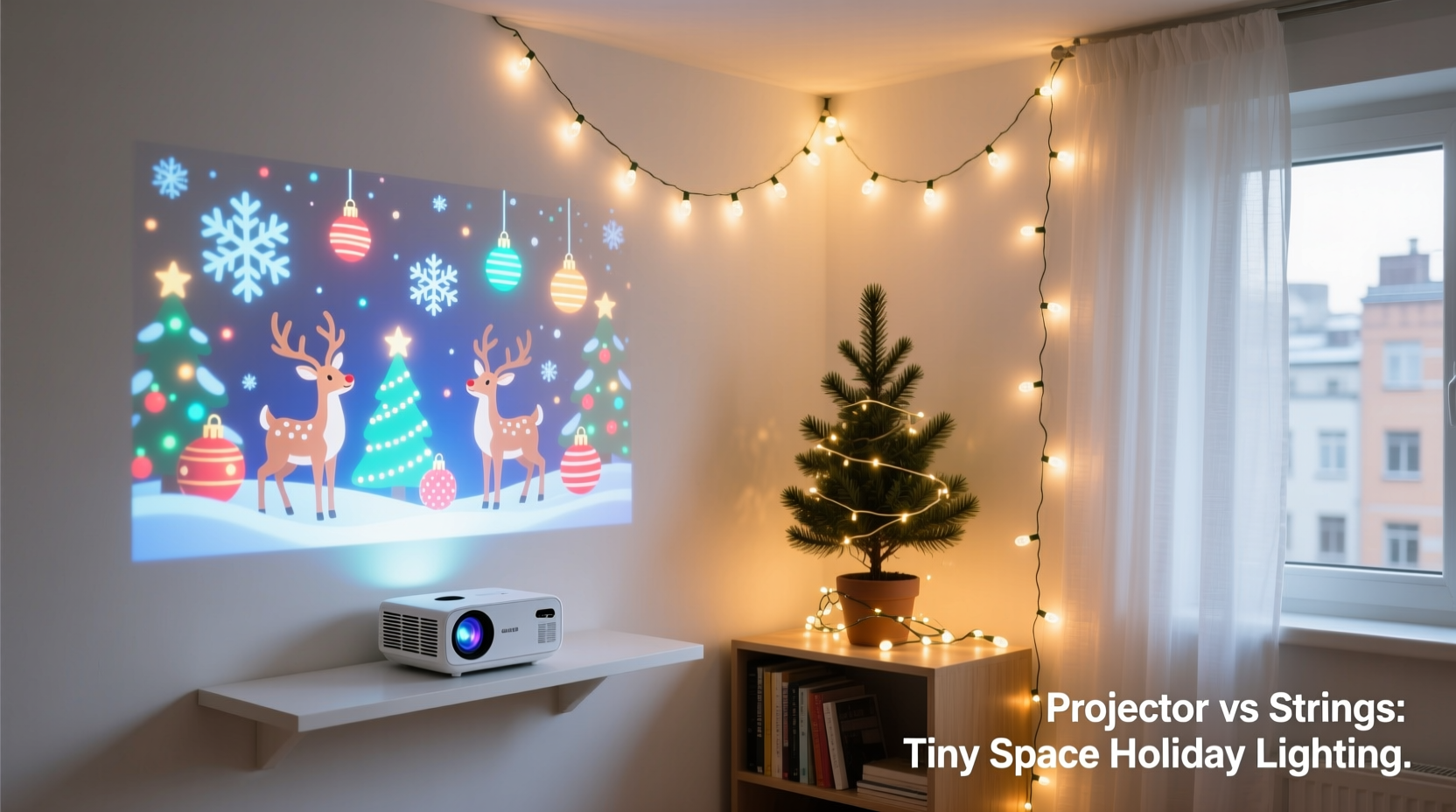
In tiny spaces, every object competes for attention. Traditional Christmas light strings require horizontal or vertical surface area—walls, shelves, window frames, or bed frames. Even lightweight plastic hooks leave marks, and adhesive mounts risk damaging paint. For renters or minimalist dwellers, this can be a dealbreaker.
Mini projector lights, on the other hand, occupy minimal footprint—often no larger than a coffee mug. Positioned on a shelf, windowsill, or table, they cast light outward rather than taking up physical space. This makes them ideal for studios under 300 square feet where floor and wall real estate is at a premium.
However, projection quality depends heavily on room layout. A projector aimed at a blank wall in a cluttered room may look disjointed. Conversely, traditional strings can be woven through existing décor—bookshelves, curtain rods, or plant stands—to integrate seamlessly without adding new fixtures.
Installation & Setup: Effort vs. Impact
Traditional string lights demand time and precision. Untangling wires, measuring spacing, securing clips, and hiding cords can take hours. In a small space, poor planning leads to overcrowding—one strand too many turns a cozy glow into visual noise.
Projector lights simplify setup dramatically. Most models plug into a standard outlet, auto-focus within seconds, and project patterns instantly. Some offer remote controls for adjusting speed, color, or animation mode. No ladders, no tape, no fear of knocking over furniture during installation.
“Time spent decorating should enhance joy, not drain it. Projector lights reduce setup friction, especially in constrained environments.” — Lena Tran, Urban Lifestyle Designer
Yet, simplicity comes with limitations. Projectors rely on ambient darkness. In rooms with significant natural light or multiple artificial sources, the effect diminishes. Traditional strings remain visible regardless of lighting conditions and offer consistent illumination throughout the day and night.
Visual Quality & Ambiance Comparison
The aesthetic experience differs fundamentally between the two. String lights provide tangible, three-dimensional sparkle. Individual bulbs create pinpoint glimmers that catch movement and reflect off surfaces. When placed near mirrors or metallic objects, they amplify light naturally, enhancing perceived space.
Projectors simulate stars, snowflakes, or falling lights across walls and ceilings. While immersive, the effect is flat—more cinematic than interactive. There’s no physical presence, no subtle flicker from bulb to bulb. For some, this lacks authenticity; for others, it’s a welcome abstraction that avoids visual clutter.
Color accuracy also varies. LED string lights now offer warm white, cool white, multicolor, and smart RGB options controllable via app or remote. Projectors typically cycle through preset modes—red/green for Christmas, blue/white for winter—but lack fine-tuning. High-end models support Bluetooth control, but most budget units do not.
Performance Summary: Key Features Compared
| Feature | Mini Projector Lights | Traditional String Lights |
|---|---|---|
| Footprint | Small (single base unit) | Large (requires linear placement) |
| Installation Time | Under 2 minutes | 15–60 minutes |
| Brightness Control | Limited (on/off or mode-based) | Adjustable (dimmer-compatible models) |
| Ambient Light Performance | Poor in bright rooms | Consistent day and night |
| Customization | Preset animations only | Flexible arrangement and spacing |
| Durability | Moderate (plastic housing, lens sensitivity) | High (especially copper wire LEDs) |
| Energy Use | Low (3–7 watts) | Low to moderate (5–15 watts per strand) |
Real-World Example: Decorating a Studio Apartment
Consider Maya, a graphic designer living in a 280-square-foot city studio. Her space doubles as a bedroom, office, and lounge. She loves holiday décor but dislikes permanent modifications or tangled cords snaking across her workspace.
Last year, she used 3 strands of warm-white micro LED lights—draped over her bookshelf, wrapped around her loft bed frame, and clipped along the kitchen counter. It looked inviting but took two evenings to install perfectly. One strand shorted after being pinched by her rolling desk chair.
This year, she tried a $25 mini projector labeled “Christmas Starry Sky.” She placed it on her windowsill facing the main wall. Within seconds, green and red dots danced across the ceiling like scattered ornaments. She activated a slow-pulse mode via remote and left it running nightly.
The result? Minimal effort, maximum atmosphere. Colleagues visiting for a holiday call praised the “cozy cabin” vibe. However, during daytime video meetings, the projection was barely visible. And when friends came over with lamps on, the magic faded. Still, for evening ambiance with zero clutter, it met her needs better than last year’s setup.
Step-by-Step: Choosing the Right Option for Your Space
- Assess your available surfaces: If walls are crowded or off-limits, lean toward a projector. If you have open shelving or headboard space, strings may work.
- Determine primary usage times: Hosting evening gatherings? Projectors shine. Need all-day cheer? Strings perform better in mixed lighting.
- Check power access: Projectors need an outlet nearby. Strings can be daisy-chained but require safe cord routing.
- Evaluate light tolerance: Sensitive to glare or overstimulation? Warm-white LEDs are gentler than animated projections.
- Set a budget: Basic projectors start at $20; quality LED strings cost $10–$15 per 10 feet. Consider longevity—strings last 5+ years with care; projectors average 2–3 seasons.
- Test before committing: Rent or borrow both types for a weekend trial. Observe how each feels in your routine.
Expert Insight: Balancing Innovation and Tradition
“The best holiday lighting serves emotion, not just aesthetics. In small spaces, we must prioritize psychological comfort. Projectors offer wonder without weight; strings offer warmth through presence.” — Dr. Arjun Patel, Environmental Psychologist
Dr. Patel’s research shows that tactile and persistent light sources—like glowing strings—trigger stronger feelings of nostalgia and safety. Meanwhile, dynamic projections stimulate curiosity and playfulness, ideal for temporary moods. For lasting emotional impact, he recommends combining both: a subtle string element for continuity, paired with a seasonal projection for novelty.
Frequently Asked Questions
Can I use a mini projector light outdoors on a balcony?
Most indoor mini projectors are not weather-resistant. Moisture can damage internal components. Only use outdoor-rated models outside, and ensure they’re protected from rain or snow. For tiny balconies, consider waterproof string lights instead—they’re more durable and visible in daylight.
Do projector Christmas lights work on textured walls?
Yes, but with distortion. Bumpy or patterned walls scatter the image, blurring defined shapes like stars or snowflakes. For best results, aim at smooth, light-colored surfaces. Dark or highly textured walls absorb light and reduce visibility.
Are traditional string lights safer than projectors in small rooms?
Safety depends on build quality, not type. Modern LED string lights generate little heat and are low-voltage, making them safe for bedding or fabric contact. Projectors also run cool but contain small fans and lenses that may fail if blocked. Always follow manufacturer guidelines and avoid covering either device while operating.
Final Recommendation: Match Solution to Lifestyle
There’s no universal winner between mini projector Christmas lights and traditional strings for tiny spaces—it depends on your priorities.
If you value speed, minimalism, and transformative ambiance, go with a projector. It’s perfect for renters, frequent movers, or anyone who wants instant holiday spirit without long-term commitment. Just accept its limitations in bright environments and shorter lifespan.
If you crave authenticity, consistency, and multi-sensory warmth, stick with high-quality LED strings. Invest in thin copper wire lights—they’re flexible, dimmable, and nearly invisible when off. Use command hooks or discreet clips to preserve surfaces. Limit yourself to one or two well-placed strands to avoid crowding.
For optimal results in ultra-small spaces, combine both: a single warm-white string on a focal point (like a bedside shelf), plus a projector casting gentle motion on the ceiling. This creates depth, dimension, and delight without sacrificing function.




 浙公网安备
33010002000092号
浙公网安备
33010002000092号 浙B2-20120091-4
Comments
No comments yet. Why don't you start the discussion?