
In the quiet moments of winter evenings, few things evoke warmth and nostalgia like the gentle swirl of snowflakes. For decades, the snow globe has been a cherished symbol of holiday charm—its glass dome enclosing a miniature world where tiny flakes drift endlessly. But modern technology now offers an alternative: mini projectors that simulate falling snow across walls and ceilings using light and motion. While both aim to create ambiance, their mechanisms, emotional impact, and practical use differ significantly. Understanding these differences helps consumers choose the right option for seasonal decor, relaxation spaces, or gift-giving.
The Magic of Motion: How Each System Creates Snowfall
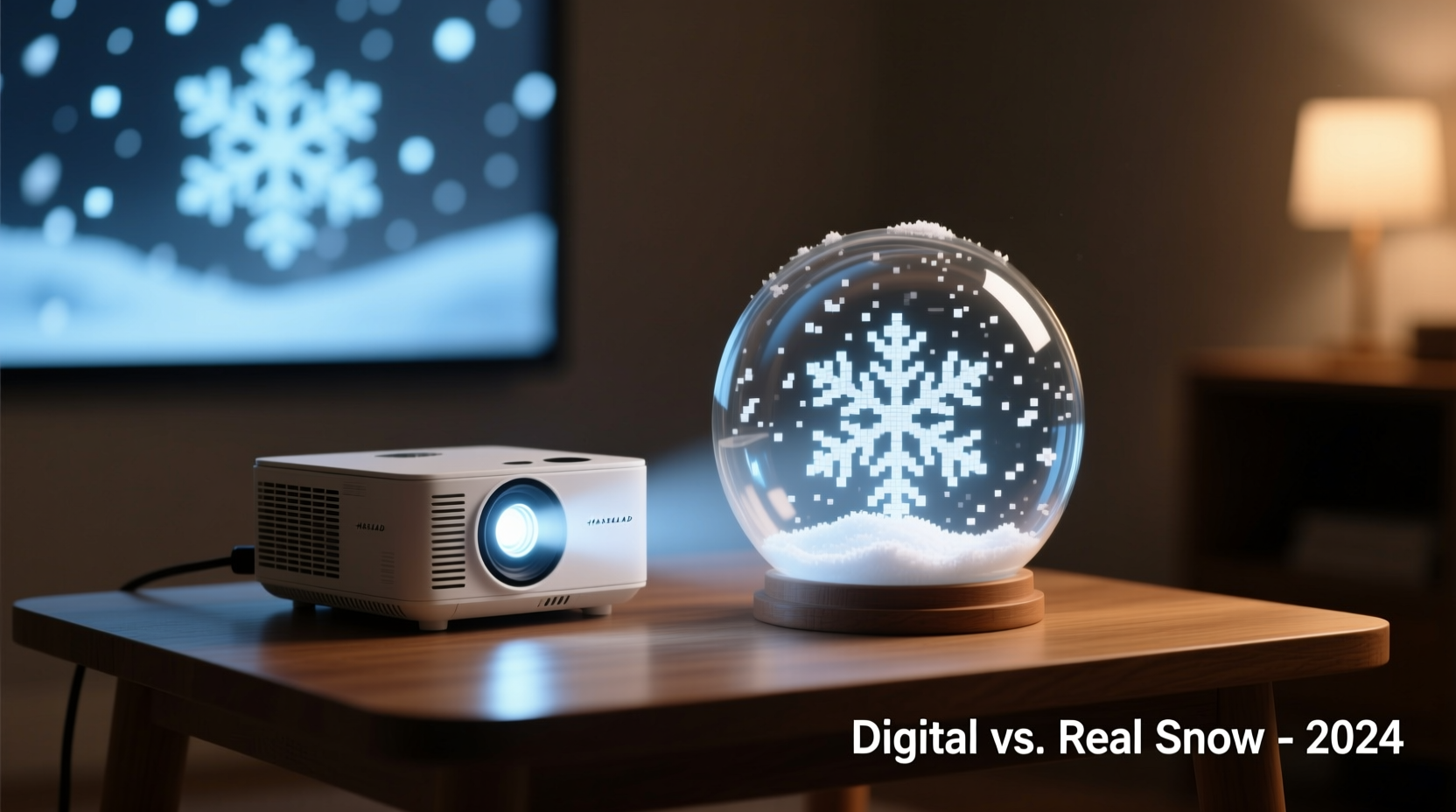
A traditional snow globe relies on fluid dynamics. Inside a sealed glass sphere filled with water (or glycol-based liquid), fine particles—historically ground porcelain, now often plastic or biodegradable glitter—float freely. When shaken, these particles rise and slowly settle, mimicking snowfall under gravity. The motion is organic, slightly unpredictable, and influenced by viscosity, temperature, and particle density.
In contrast, a mini snowfall projector uses digital projection. A small LED light source passes through a rotating disc etched with snowflake patterns or a digital micro-mirror device (DMD) chip programmed with animated sequences. The result is a dynamic display of moving lights that resemble snow drifting across surfaces. Some models include color-changing LEDs, adjustable speed controls, and soundscapes like soft music or crackling fireplaces.
While both create visual movement, their physics are fundamentally different—one governed by liquid resistance and real particulates, the other by optics and programmed algorithms.
Visual Realism and Emotional Impact
The authenticity of snowfall plays a major role in how effective each option feels. Physical snow globes offer tactile authenticity. You can see individual flakes collide, rotate, and settle unevenly. There’s weight to the motion—a slight lag as the last particles sink—and a subtle shimmer when light catches them just right. This imperfection contributes to its charm.
Projectors, while capable of stunning coverage, often lack microscopic detail. Projected “snowflakes” are typically uniform in size and shape due to limitations in lens clarity and animation resolution. However, they excel in scale. A single device can transform an entire bedroom ceiling into a winter sky, creating immersion that no tabletop globe can match.
Psychologically, studies on environmental aesthetics suggest that naturalistic movement promotes relaxation. Dr. Lena Petrova, an environmental psychologist at the University of Helsinki, notes:
“Objects with irregular, slow-moving elements—like real snowfall—trigger parasympathetic nervous system responses more effectively than repetitive digital patterns. That said, projected environments still reduce stress when used intentionally.” — Dr. Lena Petrova, Environmental Psychologist
This means that while physical snow globes may have an edge in inducing calm, projectors compensate with expansive atmosphere and sensory layering.
Practical Comparison: Features, Maintenance, and Use Cases
Choosing between these two options depends not only on preference but also on practical considerations such as space, durability, and intended use.
| Feature | Snow Globe (Physical) | Mini Projector (Digital) |
|---|---|---|
| Realism | High – actual particles move unpredictably | Moderate – uniform, repeatable patterns |
| Coverage Area | Localized – visible within ~3 feet | Large – up to 100 sq ft depending on model |
| Maintenance | Low – avoid tipping; replace if leaks | Low – clean lens periodically; update firmware |
| Durability | Fragile – glass, liquid-filled | Robust – plastic housing, no liquids |
| Portability | Limited – risk of spillage during transport | High – compact, lightweight, USB-powered |
| Customization | None – fixed scene and flake type | High – speed, color, sound, animation modes |
| Lifespan | Indefinite if undamaged | 3–5 years average (LED degradation) |
| Child Safety | Risk if broken (glass, ingestion) | Safer – no small parts or liquids |
This table illustrates a clear trade-off: tradition versus versatility. Those seeking heirloom quality or sentimental value will lean toward physical globes. Users prioritizing flexibility, safety, and immersive experience often prefer projectors.
Real-World Scenario: A Cozy Reading Nook Transformation
Consider Sarah, a freelance writer living in Portland, Oregon. Her home office doubles as a reading nook, but she found it too sterile during winter months. She initially purchased a vintage-style snow globe featuring a cabin scene. While charming on her desk, its effect was limited—only visible when seated directly in front.
After researching alternatives, she invested in a mini projector with remote control and warm-white snowfall mode. Placed on a shelf behind her armchair, it cast swirling flakes across the ceiling and adjacent wall. Combined with dimmable lighting and ambient jazz, the space transformed into a personal retreat. Within weeks, she reported improved focus during evening writing sessions and deeper relaxation before bed.
What changed wasn’t just appearance—it was spatial engagement. The projector didn’t sit *in* the room; it became part of the environment. Meanwhile, she kept the original snow globe on a side table as a decorative accent, proving both technologies can coexist meaningfully.
Step-by-Step Guide: Choosing and Setting Up Your Winter Display
Whether you're decorating for the holidays, enhancing a meditation corner, or gifting a calming device, follow this sequence to make an informed decision and optimize results.
- Assess your space: Measure the area you want to cover. If targeting a large wall or ceiling, a projector is likely better suited.
- Determine primary purpose: Is it for decoration, sleep aid, child comfort, or photo backdrop? Projectors work well for functional ambiance; globes suit symbolic or nostalgic displays.
- Check power access: Most projectors require constant power. Ensure outlets are nearby or consider battery-powered models for portability.
- Select based on user needs: Families with young children may prioritize shatterproof design (favoring projectors). Collectors might value craftsmanship and detail (favoring artisan globes).
- Test placement: For projectors, aim for a flat, light-colored surface. Angle slightly upward for ceiling projection. Avoid reflective or textured walls.
- Adjust settings gradually: Start with slow snowfall speed and neutral white light. Add color or music only if they enhance rather than distract.
- Evaluate long-term satisfaction: After one week, ask: Does it still feel soothing? Has novelty worn off? Reassess positioning or consider switching modes or devices.
Expert Insight: The Role of Sensory Design in Modern Living
As homes become multifunctional spaces, designers increasingly emphasize sensory modulation—using light, sound, and texture to influence mood. According to interior designer Marcus Lin, who specializes in wellness-centric environments:
“The shift from object-based decor to immersive experiences reflects a broader trend: people don’t just want to look at beauty—they want to live inside it. A snow globe is a momentary glance. A well-placed projector becomes part of the room’s breath.” — Marcus Lin, Interior Designer & Wellness Space Consultant
This perspective underscores why projectors are gaining traction beyond seasonal use. Used year-round with different themes (stars, auroras, rain), they serve as tools for circadian rhythm support, anxiety reduction, and creative inspiration.
FAQ Section
Can a mini projector replace a snow globe emotionally?
For some, yes—especially those who value atmosphere over tangibility. However, many find physical objects more emotionally resonant due to their permanence and sensory richness. It often comes down to personal attachment styles and aesthetic preferences.
Do snow globe flakes degrade over time?
Yes. Over years, particles may clump, liquid can cloud, or seals may weaken causing evaporation. High-quality globes use inert fluids and sealed construction to delay this, but eventual deterioration is common. Projectors avoid this issue but face LED dimming after prolonged use.
Are there hybrid models combining both technologies?
Emerging products do exist—some lamps combine a small internal snow globe with ambient projection. These remain niche due to complexity and cost, but represent a growing interest in blending analog charm with digital reach.
Final Checklist: Before You Buy
- ✅ Decide whether realism or scalability matters most
- ✅ Confirm safe placement (away from heat, moisture, high traffic)
- ✅ Check noise level—some projectors emit faint motor hum
- ✅ Review return policy—especially for online purchases
- ✅ Consider multi-season utility (e.g., star projections in summer)
- ✅ Evaluate energy consumption—most projectors use 2–5 watts
- ✅ Think about gifting context—packaging, sentiment, ease of use
Conclusion: Finding Peace in the Fall of Snow
The choice between a mini projector displaying falling snow and a classic snow globe isn't about superiority—it's about alignment. Alignment with your space, your lifestyle, and your inner sense of peace. One carries the quiet dignity of tradition, the other the quiet glow of innovation. Both invite stillness in a noisy world.
If you seek intimacy and heirloom beauty, let the snow globe take its place on the mantel. If you crave transformation and enveloping calm, let the projector turn your ceiling into a silent blizzard. Or embrace both, letting old and new coexist in harmony.




 浙公网安备
33010002000092号
浙公网安备
33010002000092号 浙B2-20120091-4
Comments
No comments yet. Why don't you start the discussion?