
When it comes to creating a cinematic experience at home, two options dominate the conversation: the modern large-screen TV and the increasingly popular mini projector. Both promise immersive entertainment, but they deliver it in fundamentally different ways. One fills your living room with crisp, bright visuals on a massive flat panel; the other transforms any blank wall into a theater-sized screen with ambient light and portability. But are these experiences truly comparable? The answer depends on what you value most—image precision or atmosphere, convenience or immersion.
The rise of compact projectors has blurred the line between casual viewing and true home cinema. With models now fitting in the palm of your hand and capable of projecting 100-inch images, many consumers wonder if they can simply replace their 75-inch OLED TVs. However, while mini projectors offer flexibility and novelty, they face inherent limitations in brightness, contrast, and audio that affect overall quality. Conversely, large TVs excel in consistency and clarity but lack the spatial freedom and theatrical feel of projected imagery.
Brightness and Image Quality: A Fundamental Divide
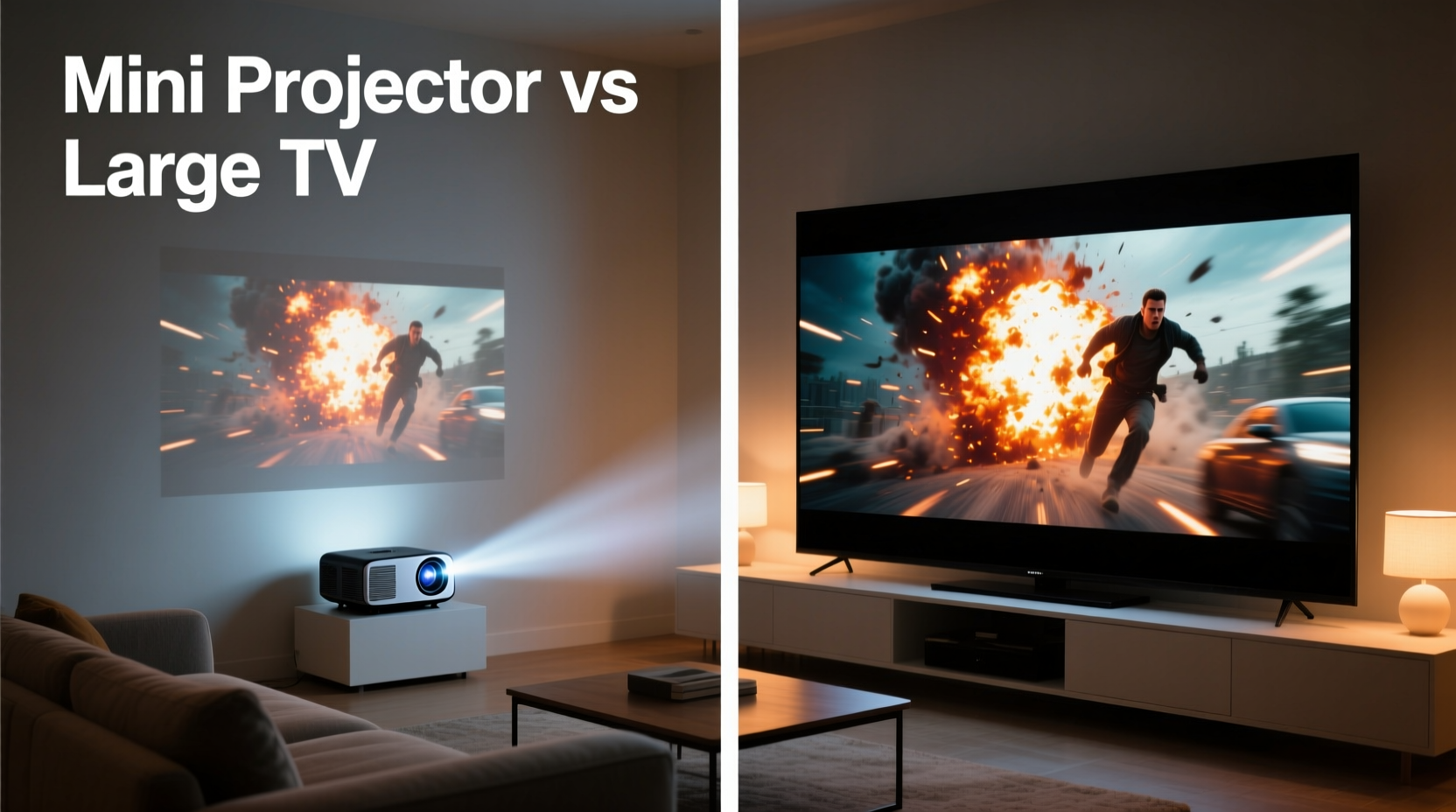
One of the most critical differences between a mini projector and a large TV lies in luminance and image fidelity. Modern 4K OLED and QLED TVs routinely deliver peak brightness levels of 1000 nits or more, with perfect black levels and near-instant pixel response times. This ensures vibrant colors, deep contrast, and excellent visibility even in well-lit rooms. Mini projectors, by comparison, typically range from 200 to 1000 ANSI lumens—often insufficient to compete with ambient light.
In a daylight-lit living room, a mini projector’s image will appear washed out unless curtains are drawn and lights dimmed. Even in a darkened space, most compact models struggle to match the color accuracy and dynamic range of high-end televisions. Their smaller chips and compressed optics limit resolution sharpness, especially when projecting beyond 100 inches.
Moreover, focus and keystone correction can introduce softness or distortion. While some mini projectors feature autofocus and auto-trapezoid correction, these digital adjustments often degrade image quality slightly. TVs, on the other hand, render pixels directly on a fixed display surface, eliminating projection artifacts entirely.
Screen Size and Immersion: The Theater Advantage
Where mini projectors shine is in scale. Even budget-friendly models can project 120-inch diagonal images with ease—far larger than most households can accommodate with flat-panel TVs. This expansive canvas creates a sense of immersion that mimics commercial cinemas. When properly calibrated in a dark environment, a projected image envelops your peripheral vision, drawing you deeper into the action.
Large TVs have made impressive strides in size, with 85-inch and 98-inch models now available. However, they remain constrained by physical dimensions, weight, and installation requirements. Mounting a 98-inch TV demands structural reinforcement and careful planning. A mini projector, meanwhile, can be placed on a shelf, tripod, or even carried to a backyard for outdoor movie nights.
“Size matters in cinematic perception. Once you’ve watched a film on a 120-inch screen in total darkness, returning to a 75-inch TV feels like stepping back into a box.” — Daniel Reyes, Home Theater Designer
This scalability gives projectors a unique edge for experiential viewing. Whether hosting friends for a sports final or watching a sci-fi epic under the stars, the ability to transform any wall into a giant screen adds a layer of versatility no TV can replicate.
Sound and Audio Integration
Audio performance is another area where large TVs generally outperform mini projectors. Most modern TVs include advanced speaker systems with Dolby Atmos support, AI-enhanced sound fields, and tight integration with streaming platforms. Even mid-range models produce clear dialogue and decent bass without external speakers.
Mini projectors, due to their compact design, rely on tiny built-in drivers. These often deliver thin, tinny audio with limited volume and poor bass response. While some higher-end models include Bluetooth output for connecting soundbars or wireless speakers, this adds complexity and cost. True cinematic sound requires additional investment in external audio gear—a factor often overlooked by first-time projector buyers.
If immersive audio is a priority, pairing a mini projector with a surround sound system or high-quality soundbar becomes essential. In contrast, a large TV may only need minor audio enhancement to achieve balanced room-filling sound.
Portability and Setup Flexibility
The portability of mini projectors is unmatched. Weighing as little as one to two pounds, devices like the Anker Nebula Capsule or XGIMI MoGo Pro can fit in a backpack and run on internal batteries for hours. This makes them ideal for travel, camping, dorm rooms, or impromptu gatherings.
Setting up a temporary theater takes minutes: place the projector, connect via HDMI or Wi-Fi, adjust focus, and start playing. There’s no drilling, no mounting, and no permanent footprint. Compare that to a large TV, which requires wall space, power outlets, AV furniture, and careful cable management.
However, this convenience comes with trade-offs. Projectors demand careful placement to avoid obstructions and maintain image alignment. People walking between the device and the wall cast shadows. Ceiling mounts help but reduce the “grab-and-go” advantage. TVs, once installed, operate consistently with zero setup required.
Checklist: Choosing Between a Mini Projector and Large TV
- ✅ Do you prioritize screen size over absolute image clarity?
- ✅ Will you watch mostly in dark or low-light environments?
- ✅ Do you value portability or multi-room usage?
- ✅ Is ambient light difficult to control in your viewing space?
- ✅ Are you willing to invest in external speakers for better sound?
- ✅ Do you already own a media player or streaming stick?
- ✅ Is long-term durability and consistent performance a top concern?
Real-World Example: Sarah’s Weekend Movie Nights
Sarah lives in a mid-sized apartment with a flexible living space she uses for work during the day and entertainment at night. She wanted a cinematic experience without committing wall space to a massive TV. After researching options, she purchased a 1080p mini projector with 800 ANSI lumens and Bluetooth audio support.
She sets it up weekly on a foldable table, projects onto a white pull-down screen, and connects it to her Roku Streaming Stick. For sound, she pairs it with a compact soundbar. The result? A 110-inch picture that fills her field of view and transforms her living room into a mini-theater every Friday.
But there are compromises. On weekends when sunlight streams in, she must close blinds completely. Occasionally, her dog walks through the beam, casting comical interruptions. And while the image looks stunning in darkness, fast-action scenes sometimes show motion blur compared to her friend’s OLED TV.
Still, Sarah loves the ritual of setting up her projector—it feels intentional, like going to the movies. For her, the experience outweighs the technical shortcomings.
Comparison Table: Mini Projector vs Large TV (65–85 inch)
| Feature | Mini Projector | Large TV |
|---|---|---|
| Average Screen Size | 80–150 inches | 65–98 inches |
| Brightness (Typical) | 200–1000 ANSI lumens | 500–1500 nits |
| Best Viewing Environment | Dark or dimly lit rooms | All lighting conditions |
| Portability | High – battery-powered options available | None – fixed installation |
| Image Consistency | Varies with focus, distance, surface | Stable, pixel-perfect |
| Audio Quality (Built-in) | Poor to fair | Fair to excellent |
| Lifespan (Lamp/LED) | 15,000–30,000 hours | 60,000+ hours (OLED/QLED) |
| Initial Cost | $300–$1,200 | $800–$3,000+ |
| Maintenance Needs | Dust filters, lens cleaning | Screen cleaning only |
Frequently Asked Questions
Can a mini projector replace my large TV completely?
For some users, yes—but with caveats. If you primarily watch content in controlled lighting and don’t mind occasional setup, a mini projector can serve as a primary display. However, for daytime viewing, gaming with low input lag, or consistent reliability, a large TV remains superior. Most experts recommend using a projector as a secondary or supplemental system rather than a full replacement.
Do mini projectors support 4K streaming?
Some high-end mini projectors support 4K input and use pixel-shifting technology to simulate ultra-high definition. However, native 4K microprojectors are rare and expensive. Most “4K-compatible” models upscale HD content rather than rendering true 4K resolution. True visual benefits are often subtle, especially on smaller throws. For authentic 4K detail, large TVs still lead decisively.
Which is better for gaming: projector or TV?
Large TVs are generally better for gaming due to lower input lag (as low as 5ms), higher refresh rates (up to 144Hz), and HDR optimization. While some mini projectors now offer “game mode,” input lag often exceeds 100ms, making fast-paced titles feel sluggish. Additionally, HDR performance on projectors is limited by brightness and contrast. Competitive gamers should stick with large TVs.
Final Verdict: Complementary, Not Comparable
The cinematic experience offered by a mini projector and a large TV isn’t truly comparable—they are different expressions of home entertainment. A large TV delivers polished, reliable, high-fidelity visuals suitable for all-day use. A mini projector offers spectacle, ambiance, and adaptability, transforming ordinary spaces into theaters on demand.
Rather than asking which is better, consider how each fits your lifestyle. If you crave consistency, vivid colors, and seamless integration, a large TV is the smarter choice. If you value flexibility, massive screen size, and the romance of projected light, a mini projector brings magic that no flat panel can replicate.
Many enthusiasts now adopt a hybrid approach: using a large TV for daily viewing and a mini projector for special movie nights. This combination leverages the strengths of both technologies, offering the best of precision and immersion.




 浙公网安备
33010002000092号
浙公网安备
33010002000092号 浙B2-20120091-4
Comments
No comments yet. Why don't you start the discussion?