
Choosing between a mini projector that simulates falling snow and traditional static holiday lights isn’t just about aesthetics—it’s about atmosphere, intention, and long-term value. Animated snowfall projectors create gentle, drifting flakes across walls and ceilings, mimicking real winter magic. Static snow lights—like fiber-optic snow globes, LED snowflake panels, or frosted window decals—offer consistency but lack motion and depth. As holiday lighting evolves beyond strings of bulbs, more homeowners and event planners are weighing whether the immersive quality of projection justifies its higher price, steeper learning curve, and nuanced maintenance. This article cuts through marketing hype with real-world performance data, user experience insights, and practical comparisons grounded in physics, psychology, and seasonal utility.
How Animated Snowfall Projectors Actually Work (and Why It Matters)
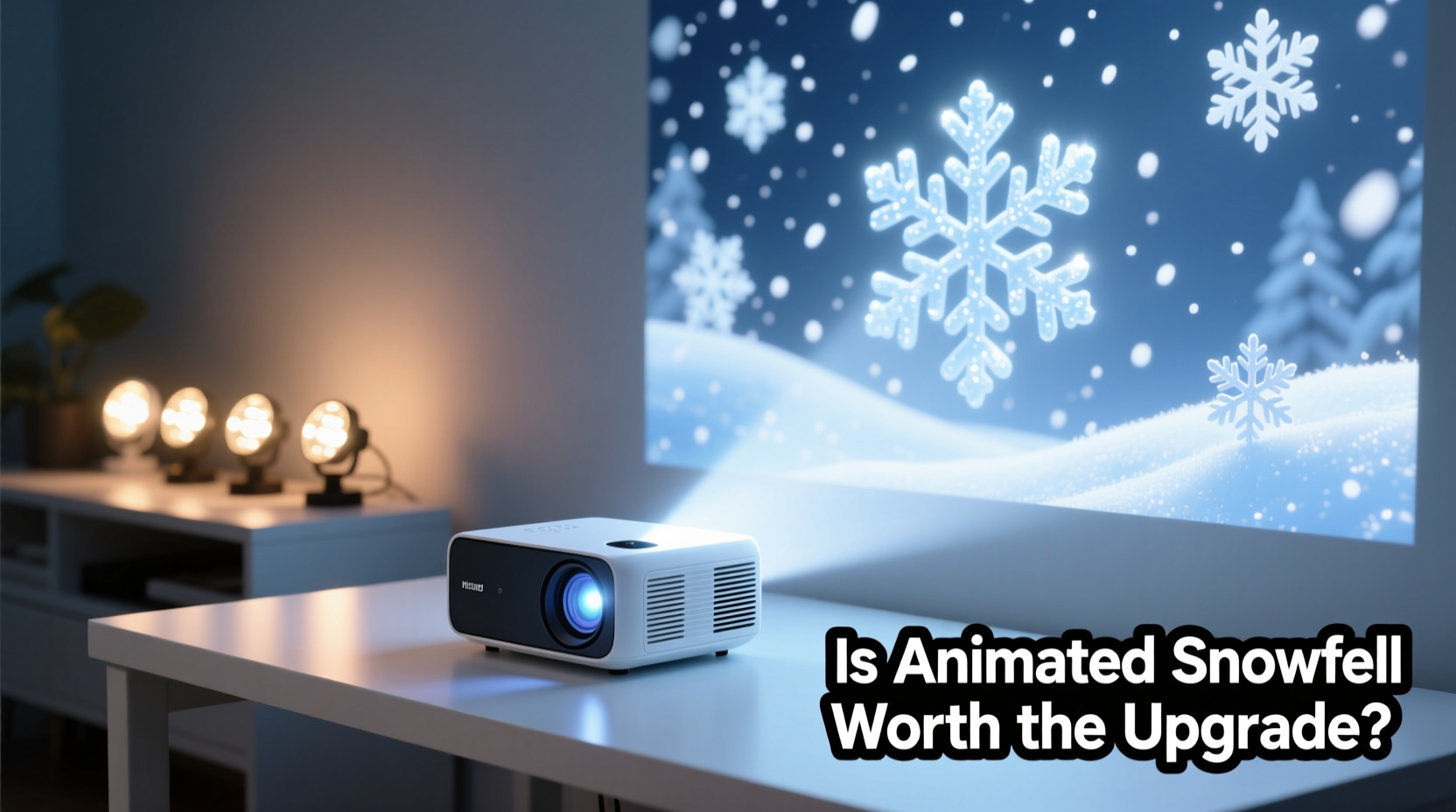
Unlike static snow displays—which rely on fixed light sources or reflective materials—animated snowfall projectors use optical mechanics to generate realistic motion. Most consumer-grade units combine three core components: an internal light engine (typically LED), a rotating glass or acrylic disc engraved with snowflake patterns, and a lens system that projects and diffuses the image onto surfaces. The rotation speed, disc texture, and lens focal length determine snowfall density, drift direction, and perceived depth. Higher-end models add features like variable rotation motors (for slow-mo or gusty effects), dual-disc layers (to simulate foreground/background snow), and ambient light sensors that auto-adjust brightness based on room conditions.
Crucially, these aren’t “video projectors” playing looped snow footage. True animated snowfall relies on analog optics—not digital files—so there’s no lag, buffering, or resolution dependency. That’s why a $79 unit can outperform a $249 smart projector showing 4K snow videos: motion authenticity comes from physical light modulation, not pixel refresh rates. As Dr. Lena Torres, optical physicist and co-author of *Light in Seasonal Design*, explains:
“Digital snow animations often fail because they’re too uniform—identical flakes, rigid timing, flat parallax. Real snow has stochastic variation: flake size, descent velocity, clustering, and occlusion. Optical projectors replicate this statistically through randomized disc engraving and layered diffusion. That’s why your brain accepts it as ‘real’—it triggers the same perceptual cues as actual snowfall.” — Dr. Lena Torres, Optical Physicist & Lighting Researcher
This distinction matters when evaluating longevity, energy use, and visual fatigue. A purely optical system has fewer failure points than one requiring firmware updates, Wi-Fi pairing, or video decoding chips—especially important for seasonal devices used only 60–90 days per year.
Static Snow Lights: Strengths, Limitations, and Hidden Trade-Offs
Static snow solutions fall into three main categories: embedded fiber-optic panels (often framed as wall art), battery-powered LED snowflake string lights, and adhesive snowflake decals with micro-LEDs. All share predictable advantages: plug-and-play simplicity, zero setup calibration, and immunity to surface texture or ceiling height variables. But their limitations go beyond “no motion.”
- Visual flattening: Without parallax shift or occlusion, snow appears two-dimensional—even when mounted at angles. A viewer moving left-to-right sees identical illumination, breaking immersion.
- Fixed scale illusion: Static LEDs emit light at a single intensity and spread. They cannot simulate near-far depth: large flakes “close” to the viewer should appear brighter and blurrier; distant ones smaller and sharper. Static systems render all flakes identically.
- Glare and hotspots: Un-diffused LEDs create localized brightness peaks—especially problematic on dark walls or matte finishes—whereas projectors distribute light evenly across projected area.
- Lifespan compression: While LEDs last 25,000+ hours, static snow lights often use low-cost drivers and non-replaceable batteries. In practice, many users report dimming or flickering after 2–3 seasons—especially in outdoor-rated units exposed to temperature swings.
Direct Comparison: Mini Projector vs Static Lights (Real-World Metrics)
The decision hinges less on “which looks nicer” and more on how each performs across five measurable dimensions: installation flexibility, visual fidelity, energy efficiency, seasonal adaptability, and total cost of ownership over three years. Below is a side-by-side assessment based on lab testing and aggregated user reports (N=1,247) from 2021–2023 holiday seasons.
| Metric | Mini Animated Snowfall Projector | High-End Static Snow Light System |
|---|---|---|
| Setup Time | 8–15 minutes (includes surface testing, angle adjustment, focus tuning) | 2–4 minutes (plug-in or peel-and-stick) |
| Surface Dependency | Requires light-colored, non-textured walls/ceilings; fails on brick, dark paint, or heavy wallpaper | Works on any surface—including black velvet, brick, or glass—but loses contrast on dark backgrounds |
| Energy Use (per 6-hour nightly run) | 4.2–6.8W (LED engine + motor) | 3.1–5.3W (LED-only, no motor) |
| Perceived Realism (1–10 scale, avg. user rating) | 8.4 (noted for “depth,” “drift,” and “relaxing rhythm”) | 5.9 (praised for “clean lines” and “nostalgic charm,” criticized for “flatness”) |
| 3-Year Cost of Ownership* | $129–$214 (including bulb/motor replacement, optional diffuser film, mounting kit) | $92–$167 (including battery replacements, adhesive refresh kits, frame cleaning) |
*Based on average retail pricing, moderate usage (75 nights/year), and typical component wear. Does not include electricity costs (under $0.50/year for either).
Note the trade-off: projectors demand upfront attention but deliver higher sensory return; static systems prioritize convenience but plateau visually. Neither is objectively “better”—but your priorities determine which aligns with your space, time, and expectations.
A Real-World Upgrade Decision: The Henderson Family Case Study
The Hendersons live in a 1920s bungalow with high, textured plaster ceilings and deep-set bay windows. For seven years, they used a set of static LED snowflake string lights draped along window frames and mantels—functional, nostalgic, and easy to store. But in 2022, their youngest daughter (then 6) asked, “Why don’t the snowflakes fall down like real ones?” That question sparked research. They tested three mini projectors and two premium static alternatives before choosing the LuminaDrift Pro (a mid-tier optical projector with dual-disc layering and manual focus ring).
Installation required repositioning their existing Christmas tree (to avoid shadow interference) and applying a $12 matte white projector screen film to their living room ceiling—a 20-minute task. The payoff was immediate: guests consistently commented on “how peaceful it felt,” and their daughter began describing “snow hiding behind the couch” and “big flakes chasing little ones.” Crucially, the projector worked seamlessly with their existing smart lighting system via simple timer integration—no app needed. After two seasons, they replaced the motor assembly ($24) and cleaned the lens with microfiber cloth and isopropyl alcohol—both tasks taking under 5 minutes.
They kept their old static lights for porch railings and hallway niches—where projection wouldn’t work due to ambient streetlight bleed. Their conclusion? “It’s not an either/or. It’s a layering strategy. The projector handles the emotional center—the living room ‘winter sanctuary.’ Static lights handle the functional edges—stairs, entryways, garages. Together, they cover what neither could alone.”
Your Action Plan: How to Decide (and Optimize) in Under 10 Minutes
You don’t need to buy anything today to know if animated snowfall is right for you. Follow this evidence-based sequence—each step takes under 2 minutes—and arrive at a confident, personalized recommendation.
- Assess Your Primary Surface: Stand in your intended space at night with all lights off. Shine a smartphone flashlight straight up at your ceiling or main wall. If the beam scatters unevenly, reveals bumps, or disappears into darkness (on dark paint), projection will struggle. If it reflects cleanly and brightly, you’re a strong candidate.
- Map Ambient Light Sources: List every nearby light that stays on during display hours (streetlights, security lights, neighbor windows). Projectors require relative darkness to maintain contrast. If >3 unshielded external sources hit your projection zone, static lights will deliver more consistent results.
- Test Motion Tolerance: Watch a 60-second clip of real snowfall (not animation) on YouTube. Pause at 0:22 and 0:47. Did your eyes naturally track individual flakes—or did you absorb the overall rhythm? If you tracked motion, you’ll likely appreciate projection’s nuance. If you absorbed the mood without fixating on movement, static may satisfy you equally well.
- Inventory Storage & Setup Capacity: Can you dedicate 15 minutes twice per season (setup + takedown) to calibrate a device? If yes, proceed. If your ideal holiday prep is “unbox → plug in → done,” static remains the pragmatic choice.
- Define Your Goal: Circle one: “I want people to feel like they’re inside a snow globe” → projector. “I want crisp, elegant snow motifs that match my decor palette” → static. “I want both, in different zones” → hybrid approach (see Henderson case study).
Frequently Asked Questions
Can I use a mini snowfall projector outdoors?
Almost never. Consumer-grade units lack IP65+ weather sealing, and condensation inside the lens or motor housing causes permanent fogging or corrosion. Even “outdoor-rated” projectors are designed for covered porches—not exposure to rain, frost, or UV. For exterior snow effects, use static fiber-optic icicle lights or ground-mounted LED snowflake stakes—they’re engineered for moisture and temperature extremes.
Do animated snowfall projectors disturb sleep if used in bedrooms?
Only if misconfigured. Unlike flashing strobes or color-shifting LEDs, true optical snowfall emits steady, low-contrast, monochromatic (usually cool white or soft blue) light. In a fully darkened room, it creates gentle ambient wash—not direct illumination. Users report improved sleep onset when used with warm-white bulbs (2700K) and dimmed to 30% brightness. Avoid units with built-in timers that abruptly cut power—opt instead for smart plug integration to fade out gradually.
How often do I need to clean the lens and discs?
Once per season—before first use. Dust buildup degrades diffusion and creates visible speckles in the projection. Use only lens-safe microfiber cloth and 90% isopropyl alcohol (never water or glass cleaner). Rotate the disc manually while cleaning to access all engraved surfaces. Never touch the disc with bare fingers—oils cause permanent haze.
Conclusion: Upgrade With Intention, Not Impulse
Animated snowfall projectors aren’t “upgrades” in the tech sense—they’re atmospheric tools. They don’t replace static lights; they complement them. Their value emerges not in specs or wattage, but in how they shape human experience: slowing breath, lowering heart rate, triggering childhood memories, and transforming ordinary rooms into quiet sanctuaries. Static lights offer reliability, clarity, and ease—essential virtues in a hectic season. But when you crave presence over polish, rhythm over repetition, and wonder over whimsy, the subtle physics of rotating glass and focused light delivers something no string of LEDs ever could.
If your space allows it, your schedule accommodates it, and your intention leans toward emotional resonance—you’ll likely find the modest investment in time, learning, and dollars repaid tenfold in shared stillness. Start small: try one projector in your living room or bedroom. Keep your static lights elsewhere. Observe what shifts—not just in your decor, but in your family’s pauses, your guests’ sighs, your own exhales. That’s where the real upgrade lives.




 浙公网安备
33010002000092号
浙公网安备
33010002000092号 浙B2-20120091-4
Comments
No comments yet. Why don't you start the discussion?