
When it comes to illuminating garden bushes, shrubs, or hedges, choosing the right type of outdoor lighting can make all the difference in visual impact and ease of installation. Two popular options—mini string lights and net lights—are frequently used by homeowners and landscapers alike. While both deliver charm and ambiance, they differ significantly in how evenly they cover foliage. Understanding these differences helps ensure your landscape lighting achieves a natural, glowing effect without patchy dark spots or excessive clustering.
Coverage Patterns: The Core Difference
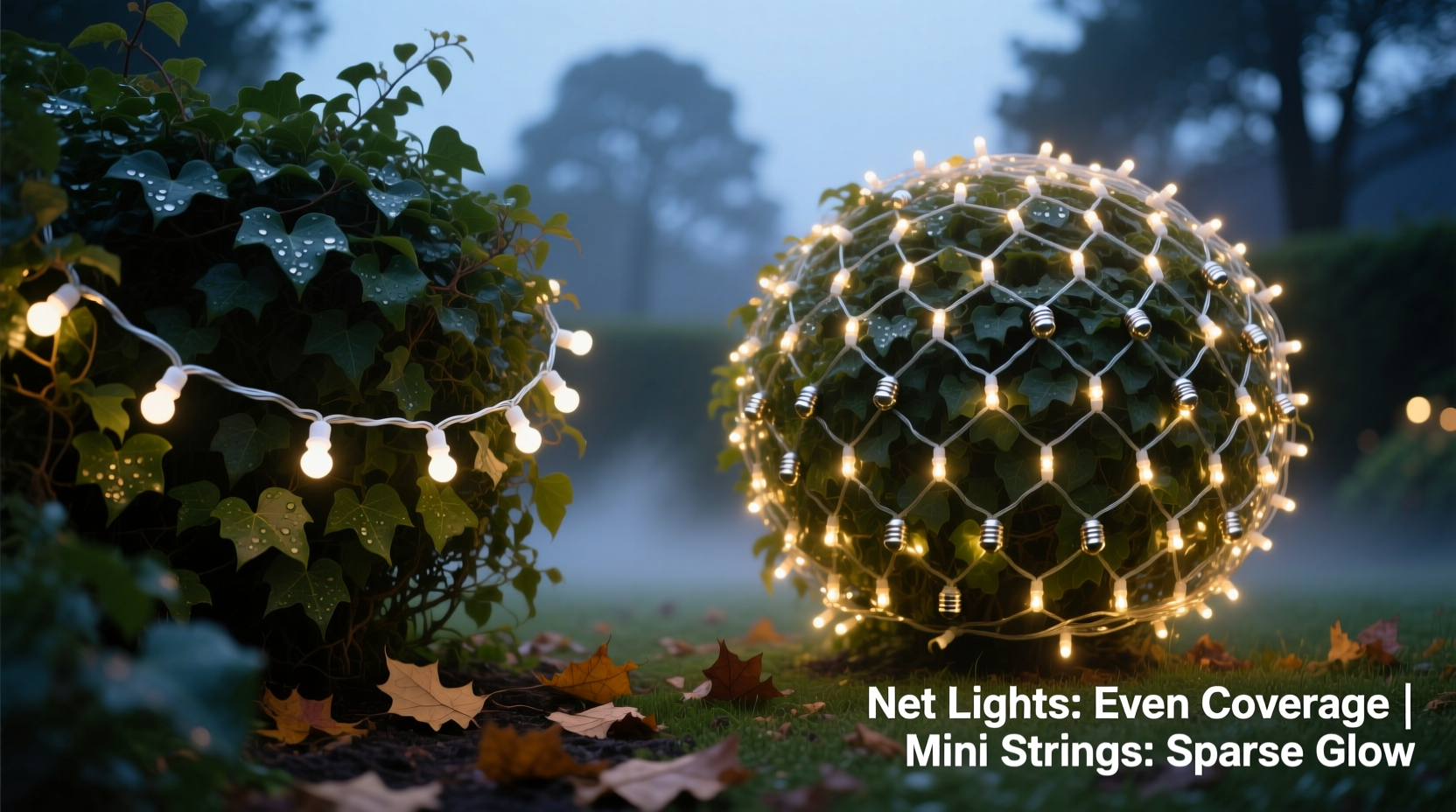
The primary distinction between mini string lights and net lights lies in their structural design, which directly affects how light is distributed across bushes.
Mini string lights consist of individual bulbs spaced at regular intervals along a single wire—typically 10 to 12 inches apart. This linear arrangement means that when draped over a bush, only specific points receive direct illumination. Gaps between bulbs often result in uneven lighting, especially on dense or irregularly shaped foliage. Without careful placement, large sections of the bush may remain in shadow.
In contrast, net lights are constructed in a grid-like pattern, with bulbs attached at the intersections of horizontal and vertical wires. This creates a webbed structure resembling fishing netting, where each bulb is positioned to fill adjacent gaps. When laid over a bush, the net conforms more uniformly to the surface, distributing light across a broader area with minimal blind spots.
Installation Efficiency and Foliage Compatibility
How easily lights install—and stay—in place plays a major role in achieving consistent coverage. Mini string lights require manual wrapping around branches, often demanding multiple passes to simulate fullness. This process is time-consuming and prone to human error; overlapping too much in one area leaves another underlit. Additionally, wind or weather can loosen strands, creating sagging or exposed sections.
Net lights, however, are designed for quick deployment. Their mesh layout allows them to be simply draped over the top of a bush and gently tucked into the sides. Because the entire surface is pre-lit, there's less need for adjustment. On rounded or box-shaped shrubs like boxwoods or yews, net lights follow the contours naturally, maintaining uniform spacing across the plant’s face.
For irregularly shaped or sparse bushes, though, net lights can pose challenges. If the bush has deep recesses or thin outer layers, parts of the net may hang loosely or fail to make contact with foliage, causing unnatural \"floating\" bulbs. In such cases, mini string lights offer greater flexibility, allowing precise targeting of thicker branches where light support is needed.
“Net lights excel in even coverage on compact, full bushes, while string lights give you artistic control over lighting emphasis.” — Daniel Reeves, Landscape Lighting Designer
Comparison Table: Key Features at a Glance
| Feature | Mini String Lights | Net Lights |
|---|---|---|
| Bulb Spacing | 10–12 inches (linear) | 6x6, 8x8, or 12x12 inch grid |
| Coverage Evenness | Moderate – depends on wrapping technique | High – uniform grid distribution |
| Installation Time | Longer – requires wrapping | Faster – drapes like a blanket |
| Best Bush Shape | Irregular, tall, or sparse | Round, boxy, full-bodied |
| Adjustability | High – customizable path | Low – fixed grid limits repositioning |
| Wind Resistance | Good – secured at multiple points | Fair – may shift if not anchored |
Step-by-Step Guide: Achieving Even Coverage on Bushes
Regardless of which light type you choose, proper technique ensures optimal results. Follow this sequence for professional-grade illumination:
- Assess the bush shape and density. Measure height, width, and depth. Note any bare spots or protruding limbs.
- Select the appropriate light type. Use net lights for full, rounded bushes; opt for mini string lights on tall, narrow, or irregular forms.
- Determine wattage and length. For net lights, match the grid size to the bush dimensions. For strings, calculate total length needed (at least 1.5x the bush perimeter).
- Test placement before securing. Drape or wrap lights loosely to preview brightness and shadow areas. Adjust as needed.
- Secure with landscape-safe clips. Avoid puncturing wires. Use plastic-coated hooks or twist ties for delicate branches.
- Plug in and evaluate after dark. Walk around the bush from multiple angles. Fill dark zones with additional strands or reposition net panels.
- Weatherproof connections. Elevate plug ends and use outdoor-rated enclosures to prevent moisture damage.
Real Example: Front Yard Boxwood Transformation
A homeowner in Portland, Oregon, wanted to highlight six mature boxwood bushes flanking her front walkway. Initially, she installed warm-white mini string lights, wrapping each bush individually. Despite three hours of work, the result was inconsistent—some areas glowed brightly while others looked dull due to uneven spacing.
She replaced them the following season with 24\"x36\" warm-white net lights, one per bush. Installation took less than 20 minutes total. By draping each net over the top and tucking the edges into the sides, she achieved balanced, twinkling coverage across all six plants. Neighbors commented on the “professional” look, and the lights stayed secure through winter storms thanks to added corner anchors.
This case illustrates how matching the lighting format to the plant structure improves both efficiency and aesthetic outcome.
Energy Use, Durability, and Aesthetic Options
Both light types are available in LED versions, offering long lifespans (up to 40,000 hours) and low energy consumption. However, net lights typically contain more bulbs per foot, so a fully lit net panel may draw slightly more power than an equivalent-length string. For example, a 4'x6' net with 200 bulbs uses about 20 watts, while a 50-bulb string light uses around 5 watts. Consider this when planning circuits or using timers.
In terms of durability, net lights have more wire junctions, increasing potential failure points. High-quality models use sealed sockets and reinforced wiring to mitigate this. Look for IP44 or higher ratings for outdoor resilience. String lights, with fewer connection nodes, tend to be more robust over time but are vulnerable to breakage at bend points if wrapped too tightly.
Aesthetically, net lights create a field of stars, ideal for magical, festive effects. They’re commonly used during holidays or in gardens aiming for a whimsical glow. Mini string lights offer a more organic, hand-decorated appearance—perfect for rustic patios or accent lighting. Bulb styles vary: clear, frosted, colored, or even faceted for added sparkle.
Checklist: Choosing Between Mini String and Net Lights
- ☐ Measure your bush dimensions (height, width, depth)
- ☐ Determine whether the bush is full/rounded or tall/irregular
- ☐ Decide on desired effect: uniform glow (net) vs. directional accent (string)
- ☐ Check available power outlets and extension cord reach
- ☐ Choose LED for longevity and efficiency
- ☐ Verify weather resistance rating (IP44 or higher recommended)
- ☐ Plan for anchoring method—clips, ties, or stakes
- ☐ Buy a sample first to test coverage before full purchase
Frequently Asked Questions
Can I connect multiple net lights together?
Yes, many net lights are designed with end-to-end connectors, allowing daisy-chaining. Always check the manufacturer’s limit—usually 4 to 6 sets—to avoid overloading the circuit.
Are mini string lights better for large hedges?
For very long, linear hedges, mini string lights offer more flexibility. You can weave them horizontally or vertically to follow the hedge line. However, achieving even density requires meticulous spacing. For thick hedges, consider combining both: net lights for the face and strings for depth.
Do net lights work on conical evergreens?
They can, but standard rectangular nets may not conform well to tapering shapes. Instead, use triangular or tiered net designs, or opt for string lights wrapped in ascending spirals for better fit and coverage.
Final Recommendation: Which Covers Bushes More Evenly?
For sheer evenness of coverage, net lights are the superior choice—especially on medium to large, densely foliaged bushes with rounded or geometric shapes. Their grid-based layout eliminates guesswork and delivers a consistent, sparkling finish with minimal effort.
Mini string lights shine in scenarios requiring customization—such as highlighting specific branches, covering vertical shrubs, or blending into complex landscapes. They demand more labor but reward with precision and creative freedom.
In most residential settings where symmetry and balance matter—like foundation plantings, border shrubs, or holiday displays—net lights provide the most reliable path to an evenly lit, professionally enhanced yard.




 浙公网安备
33010002000092号
浙公网安备
33010002000092号 浙B2-20120091-4
Comments
No comments yet. Why don't you start the discussion?