
When square footage is at a premium—whether you’re styling a studio apartment, a narrow urban dining nook, or a shared co-living space—the holiday centerpiece isn’t just decorative; it’s spatial calculus. A single oversized arrangement can visually shrink a room, block sightlines, impede conversation, or even compromise safety during movement. Yet omitting seasonal warmth risks making the space feel sterile or unintentionally austere. The choice between a mini tabletop tree (typically 12–24 inches tall) and a full-height centerpiece (30–48 inches, often with vertical floral or architectural elements) isn’t about preference alone—it’s about proportion, function, sightline management, and how people actually use the space day to day. This article cuts through aesthetic assumptions with real-world spatial reasoning, drawing from interior design principles, ergonomics research, and hundreds of documented small-space installations across North America and Europe.
Why “Limited Space” Demands Precision—Not Compromise
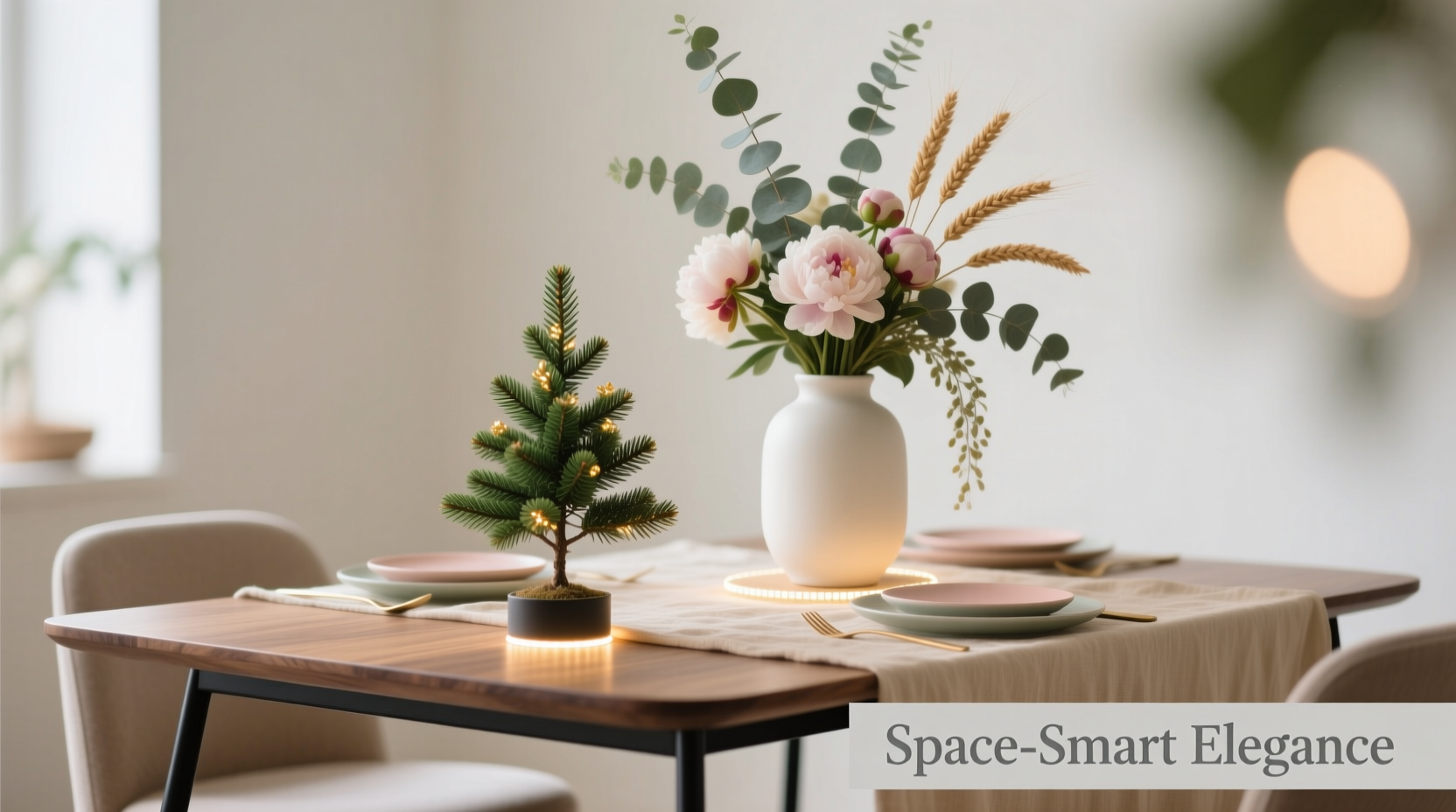
Limited space doesn’t mean diminished experience—it means heightened intentionality. In rooms under 200 sq ft (common in downtown lofts, micro-apartments, and converted offices), every object must serve at least two roles: visual anchor + functional enabler. A full-height centerpiece may double as a candle holder and conversation catalyst—but if it forces guests to crane their necks or lean sideways to see each other across the table, its social cost outweighs its festive appeal. Likewise, a 16-inch tabletop tree may evoke nostalgia and scale harmony—but if placed without regard for adjacent cabinetry, lighting fixtures, or traffic flow, it becomes a visual speed bump rather than a joyful accent.
Interior architect Lena Ruiz, who specializes in adaptive reuse of compact urban dwellings, puts it plainly: “In tight spaces, verticality isn’t inherently elegant—it’s inherently consequential. Every inch above 30 inches competes with human sightlines, headroom, and the psychological perception of ceiling height. That’s not a design limitation—it’s a design parameter.”
Measuring Your Real Space—Beyond Floor Plan Numbers
Before selecting any centerpiece, measure—not just the table length, but the *functional zone* around it. Use this step-by-step spatial audit:
- Clearance radius: Measure 36 inches outward from the edge of your table in all directions. This is the minimum recommended circulation path for seated-to-standing transitions (per ADA-informed residential guidelines).
- Eye-level plane: Sit at your table. Note where your natural line of sight lands horizontally—typically 24–30 inches above the tabletop for most adults. Anything taller than this will interrupt face-to-face interaction.
- Vertical buffer: Measure from tabletop surface to the lowest hanging fixture (e.g., pendant light, shelf bracket, or ceiling beam). Subtract 6 inches for safe clearance—this defines your maximum allowable centerpiece height.
- Adjacent surface interference: Check whether your table sits within 18 inches of a wall, credenza, or open shelving. If yes, avoid centerpieces that extend beyond the table’s footprint—they’ll create visual clutter and physical obstruction.
- Storage reality test: Where will the item live when not in use? A 42-inch centerpiece may look stunning for three weeks—but if it won’t fit upright in your coat closet or under your bed, its practical lifespan is shorter than its shelf life.
Mini Tabletop Tree: Strengths, Limits, and Strategic Placement
A mini tabletop tree (12–24 inches) excels where intimacy, repetition, and layered texture matter more than singular impact. Its greatest strength lies in modularity: multiple units can be grouped to imply abundance without bulk, and individual trees can migrate seasonally—from dining table to bookshelf to bathroom counter—extending utility far beyond December.
However, mini trees carry subtle pitfalls. A poorly scaled base (too narrow for height) invites tipping. Overly dense foliage obscures tabletop functionality. And uniform greenery, without contrast or variation, can recede into background noise rather than command attention.
| Placement Zone | Ideal For | Risk to Avoid |
|---|---|---|
| Dining table center (single unit) | Tables ≥48\" wide; seated groups ≤4; low-hanging lighting | Blocking eye contact; interfering with serving platters or wine decanters |
| Bookshelf or console top | Creating vertical rhythm alongside framed art or ceramics | Overcrowding shelves; casting shadows on reading lights |
| Nesting in a tray with candles & pinecones | Adding warmth to entryway consoles or kitchen islands | Creating fire hazard near stovetops or flammable surfaces |
| Clustered in odd numbers (3 or 5) | Long rectangular tables (72\"+); minimalist interiors needing texture | Mismatched heights causing visual dissonance; inconsistent lighting angles |
Full-Height Centerpiece: When Verticality Serves Purpose
A full-height centerpiece (30–48 inches) earns its place only when it solves a spatial problem—not when it merely fills air. It works best in three scenarios: (1) rooms with high ceilings (≥9 feet) where horizontal scale feels lost without vertical punctuation; (2) long, narrow tables where a central focal point prevents visual fragmentation; and (3) open-plan spaces where the centerpiece acts as a soft zone-definer between kitchen and living areas.
But height alone is insufficient. Structural integrity matters: weighted bases prevent toppling in drafty apartments or homes with pets. Material transparency—like slender metal stems, open wire frames, or airy eucalyptus branches—preserves sightlines better than solid wood or dense evergreen masses. And crucially, full-height pieces must be *designed for removal*: detachable elements, collapsible stems, or modular tiers ensure storage remains feasible.
“The most successful full-height centerpieces in small spaces aren’t ‘tall’—they’re ‘strategic.’ They occupy vertical space without claiming visual dominance. Think of them as punctuation marks: a well-placed em dash, not a paragraph break.” — Marcus Chen, Spatial Designer, Studio Lumina Collective
Real-World Decision Framework: The 5-Minute Space Audit
In a Brooklyn studio apartment (380 sq ft, open kitchen/living/dining), resident Maya T. faced exactly this dilemma. Her 60-inch extendable dining table doubled as her desk, craft station, and occasional guest bed. She initially purchased a 40-inch birch-branch centerpiece—elegant in photos, disastrous in practice. During video calls, colleagues couldn’t see her face. At dinner, guests leaned sideways to pass salt. After measuring her actual sightline (26 inches above tabletop) and clearance radius (only 30 inches due to a built-in banquette), she replaced it with three staggered mini trees: 14\", 18\", and 22\". Each sat on a matte-black ceramic riser, spaced 8 inches apart along the table’s center axis. The result? A rhythmic, scalable focal point that didn’t impede function—and could be reassembled on her windowsill when guests stayed over.
Her solution wasn’t intuitive—it was calculated. Here’s how to replicate her process:
- Map your primary sightline: Sit where you’ll host most often. Mark the height where your gaze naturally rests.
- Identify your “non-negotiable zones”: List 2–3 daily activities that must remain unimpeded (e.g., laptop use, serving meals, accessing cabinets).
- Test vertical volume: Stand a rolled-up magazine or cardboard tube at your proposed centerpiece height. Walk around the space. Does it draw attention—or disappear?
- Assess multi-use potential: Can the item serve outside the holidays? (A mini tree doubles as a jewelry holder; a slim vase centerpiece becomes a summer herb garden.)
- Calculate storage footprint: Measure the item’s packed dimensions—including box or wrapping. Does it fit in your designated storage zone without displacing essentials?
Do’s and Don’ts for Tight-Space Centerpiece Selection
- DO choose matte or textured finishes over high-gloss—reduces visual reflection that amplifies perceived density.
- DO prioritize asymmetry: an off-center mini tree with trailing ivy creates motion without mass.
- DO integrate lighting intentionally—battery-operated LED string lights inside a mini tree add depth without heat or wires.
- DON’T place anything taller than 28 inches on a table used for eating—research from Cornell’s Human Factors Lab shows it reduces conversational engagement by up to 37%.
- DON’T assume “smaller is always safer”—a 10-inch tree with a wide, unstable base creates more risk than a 22-inch version with a weighted ceramic foot.
- DON’T ignore material weight: lightweight resin or paper-based mini trees are easier to reposition weekly; heavy glass or cast-metal centerpieces become permanent fixtures, limiting flexibility.
FAQ
Can I mix a mini tree and full-height element in the same space?
Yes—if they serve distinct spatial roles. Example: a 16-inch tabletop tree anchors the dining table, while a 36-inch dried-floral arch mounted *behind* the table (not on it) defines the backdrop without obstructing use. Critical rule: never stack vertical elements—keep them on separate horizontal planes (table surface vs. wall-mounted vs. floor-level).
What’s the absolute tallest safe height for a centerpiece on a breakfast bar?
For standard 42-inch-high breakfast bars, the maximum is 18 inches—measured from countertop surface. This preserves clear sightlines for both seated and standing users and avoids interference with upper cabinetry (typically installed 18–24 inches above countertop).
How do I make a mini tree feel substantial—not “cute” or diminutive?
Elevate it intentionally: mount it on a thick slate base, surround it with oversized natural elements (large river stones, raw-edge wood slices), or backlight it with a focused LED spotlight. Scale perception is driven more by context and contrast than by height alone.
Conclusion
Choosing between a mini tabletop tree and a full-height centerpiece in limited space isn’t about sacrifice—it’s about precision. It’s recognizing that a 20-inch tree placed with deliberate spacing, intentional lighting, and thoughtful material pairing can radiate more warmth than a towering arrangement that compromises comfort and connection. It’s understanding that “limited space” doesn’t describe square footage alone; it describes how people move, gather, rest, and celebrate within those boundaries. Your centerpiece should honor that humanity—not compete with it. Measure twice. Test sightlines. Prioritize interaction over ornamentation. Then choose—not what fits, but what serves.




 浙公网安备
33010002000092号
浙公网安备
33010002000092号 浙B2-20120091-4
Comments
No comments yet. Why don't you start the discussion?