
When decorating a Christmas tree—especially one with thick, closely packed foliage—the choice between mini and macro lights can dramatically affect the final look. While both types serve the same purpose, their size, spacing, and light distribution behave very differently when woven through dense pine, spruce, or fir. For decorators aiming to achieve full, even illumination without dark pockets or excessive glare, understanding how each type interacts with branch density is essential.
The goal isn’t just to make the tree visible—it’s to create depth, warmth, and a sense of magical saturation. Whether you're working with a real tree fresh from the farm or a high-end artificial model designed for maximum realism, selecting the right bulb size impacts not only coverage but also safety, energy use, and ease of installation.
Understanding Mini and Macro Lights
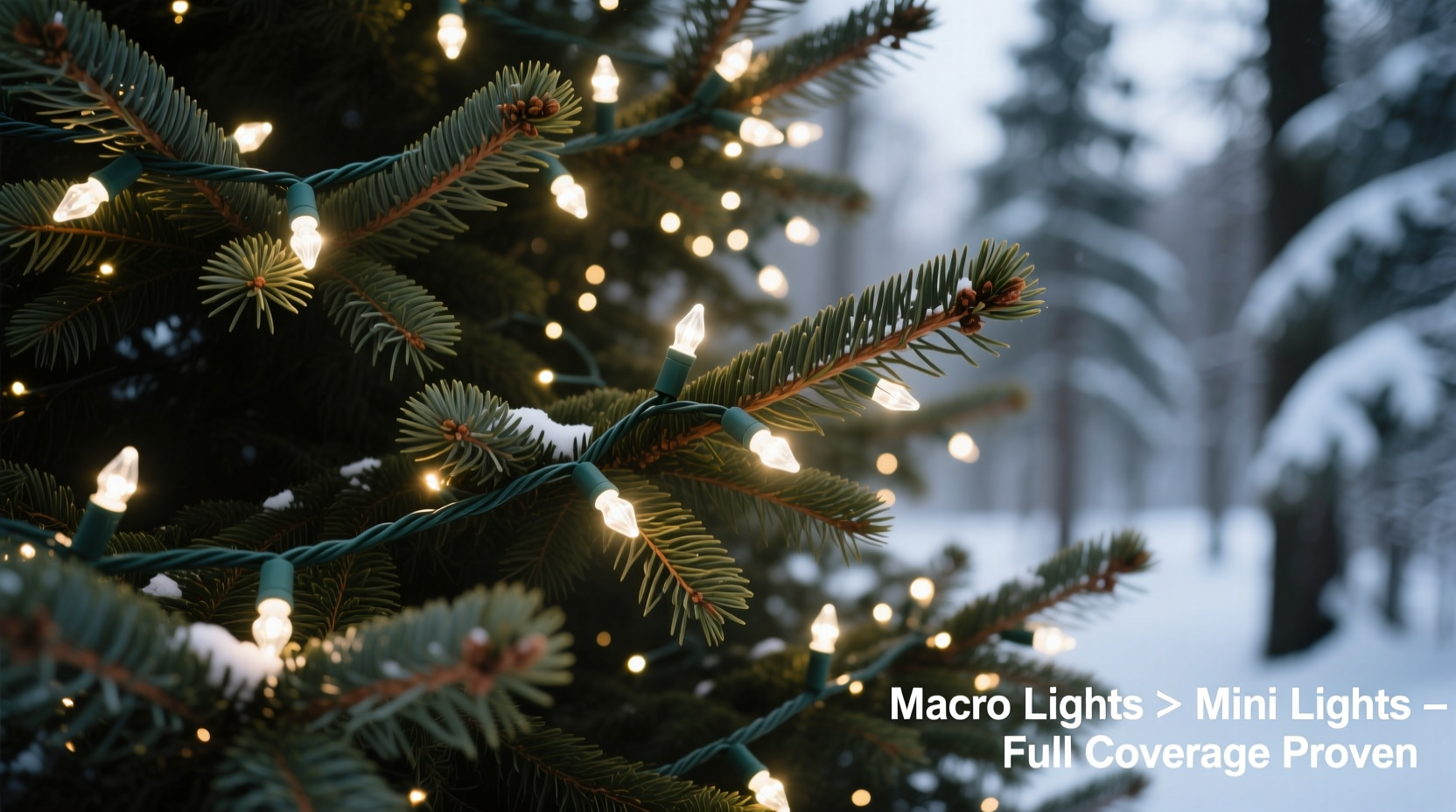
Before comparing performance, it's important to define what \"mini\" and \"macro\" actually mean in the context of Christmas lighting.
- Mini lights typically refer to bulbs that are around 5mm to 8mm in diameter, often called “C6” or “C7” depending on base type. They’re commonly used in strings of 50 to 100 bulbs and operate at lower wattage.
- Macro lights, sometimes labeled as “large” or “commercial” bulbs, range from 10mm to over 25mm in size (like C9s). These produce significantly more lumens per bulb and are frequently seen on outdoor displays or commercial installations.
Mini lights have long been the standard for indoor trees due to their subtlety and ability to mimic twinkling stars among needles. Macro lights, by contrast, are bolder—each bulb acts as a distinct point of light, capable of cutting through shadows but risking an uneven or sparse appearance if not properly spaced.
Coverage Performance in Dense Foliage
Dense-branched trees present a unique challenge: light must penetrate multiple layers of greenery without being completely obscured. How do mini and macro lights fare under these conditions?
Mini Lights: Precision and Uniformity
Miniature bulbs excel in tight spaces. Their small profile allows them to nestle deep into branch crotches where larger bulbs simply wouldn’t fit. Because they’re less obtrusive, decorators can place them closer together—often every 4 to 6 inches along a strand—creating a continuous glow throughout the interior structure.
This proximity enables what designers call “layered lighting”: illuminating not just the outer surface but also the inner framework of the tree. When viewed from any angle, especially under dim room lighting, mini lights give the illusion that the entire tree is glowing from within.
Moreover, because individual mini bulbs emit softer light, there’s less risk of creating harsh contrasts between lit and unlit areas. This diffused quality helps maintain visual harmony across thick clusters of branches.
Macro Lights: Power Over Penetration
Macro bulbs, while impressive in output, struggle with consistency in dense settings. A single C9 bulb might emit 2–3 times more light than a mini, but its physical size limits how deeply it can be placed into the canopy. Most end up resting on the outermost layer, acting more like spotlight markers than ambient sources.
Additionally, macro light strings usually have wider spacing—often 12 inches or more—due to higher heat output and power requirements. On a sparse tree, this spacing may suffice. But on a full-bodied Fraser fir or a premium artificial with 1,500+ tips, gaps between bulbs become noticeable, leaving shadowed voids between illuminated points.
“With dense trees, coverage matters more than raw brightness. You want light everywhere—not just where the big bulbs happen to land.” — Daniel Reyes, Professional Holiday Lighting Designer
Comparative Analysis: Key Factors
| Factor | Mini Lights | Macro Lights |
|---|---|---|
| Bulb Spacing | 4–6 inches (ideal for layering) | 10–12 inches (can leave gaps) |
| Foliage Penetration | High – fits deep into branches | Low – sits on outer surface |
| Light Distribution | Even, soft glow throughout | Spotty; bright spots with shadows |
| Heat Output | Low – safe for close contact | Moderate to high – caution near dry foliage |
| Energy Efficiency | Higher – LED versions draw ~0.04W/bulb | Lower – LEDs still use ~0.08–0.1W/bulb |
| Aesthetic Suitability | Ideal for traditional, cozy, or elegant themes | Better for modern, bold, or outdoor displays |
The data shows a clear advantage for mini lights when the priority is uniform coverage in densely foliated trees. Their design supports high-density placement, deeper integration, and safer operation—all critical for achieving professional-level results indoors.
Real-World Example: The Urban Apartment Tree
Sarah M., a decorator in Chicago, faced a challenge every holiday season: her 7.5-foot pre-lit artificial tree looked flat despite having 800 built-in clear lights. After consulting a lighting specialist, she realized the issue wasn’t quantity—but placement. The factory-installed macro-style bulbs were spaced too far apart and positioned only on the outer tips.
For the next holiday, she added two strands of warm-white LED mini lights (100 bulbs each), weaving them inward toward the trunk and focusing on mid-layer branches. She followed a spiral pattern from bottom to top, ensuring each strand crossed behind major limb groupings.
The result was transformative. Instead of isolated bright spots, the tree now glowed cohesively. Neighbors remarked that it looked “like it had its own atmosphere.” Sarah noted that the extra effort took about 25 minutes but made a dramatic difference in perceived fullness and warmth.
Her experience underscores a key principle: even a well-made tree can benefit from supplemental lighting tailored to its structure—and mini lights proved far more effective than adding another string of large bulbs would have been.
Step-by-Step Guide to Maximizing Coverage
If you're determined to get the best possible illumination for a dense tree, follow this proven method:
- Assess your tree’s density. Run your hand through the branches. If you encounter resistance and see limited visibility through the center, plan for internal lighting.
- Choose warm-white LED mini lights. Aim for 50–100 bulbs per foot of tree height (e.g., 350–700 total for a 7-footer).
- Start at the base. Attach the plug end securely near the stand, hidden from view.
- Weave inward, not just outward. Push each bulb several inches into the branch cluster, aiming toward the trunk. Avoid skimming the surface.
- Use a spiral pattern. Move upward in a helix, maintaining consistent spacing. Overlap strands slightly if using multiple sets.
- Test frequently. Plug in the strand after every few feet to catch broken bulbs or tangles early.
- Add vertical accents (optional). Run a single strand vertically from top to bottom along the back for added depth.
Common Misconceptions Debunked
Several myths persist about Christmas light performance that can mislead even experienced decorators.
- Myth: Bigger bulbs = better visibility. In reality, visibility depends on distribution, not size. A well-placed mini light seen through translucent needles often appears brighter than a macro bulb hidden behind overlapping branches.
- Myth: More strings solve coverage issues. Adding more macro-light strands usually increases glare without improving shadow fill. It’s better to use fewer, strategically placed mini strands.
- Myth: All LED lights are equal. There’s significant variation in color temperature and beam angle. Look for LEDs labeled “diffused” or “warm white (2700K)” for a softer, more natural glow.
FAQ
Can I mix mini and macro lights on the same tree?
Yes, but with caution. Mixing can work if macro lights are used sparingly as accent pieces (e.g., outlining the perimeter) while mini lights handle general coverage. However, mismatched color temperatures or blinking patterns can create visual chaos. Stick to one dominant type for cohesion.
How many lights do I need for a dense 6-foot tree?
A good rule of thumb is 100 mini lights per foot of tree height, so 600 total. For dense trees, increase to 700–800. If using macro lights, double the number of strands to compensate for wider spacing, though results may still lack uniformity.
Are macro lights unsafe for real trees?
Incandescent macro lights generate more heat and should be used cautiously on dry real trees. LED versions are much safer and cooler, making them acceptable with proper monitoring. Still, mini LEDs remain the safest option due to minimal heat and greater flexibility in placement.
Checklist: Choosing the Right Lights for Dense Branches
- ☐ Prioritize mini lights (C6/C7) over macro (C9) for dense trees
- ☐ Select LED bulbs for lower heat and energy use
- ☐ Choose warm white (2700K–3000K) for a natural, inviting glow
- ☐ Ensure bulb spacing is 6 inches or less
- ☐ Plan for 100 bulbs per foot of tree height (more for dense foliage)
- ☐ Test all strands before installation
- ☐ Weave lights inward toward the trunk, not just along outer edges
Final Recommendation
For dense-branched Christmas trees—whether real or artificial—mini lights consistently outperform macro lights in coverage, safety, and aesthetic appeal. Their compact size allows for deeper placement, tighter spacing enables even distribution, and modern LED options offer excellent efficiency and longevity.
While macro lights have their place in bold exterior displays or minimalist interior designs, they fall short when the goal is full, immersive illumination within a lush canopy. Decorators seeking that classic, candlelit-tree effect should invest time in thoughtful mini-light placement rather than relying on sheer brightness.
The magic of a beautifully lit Christmas tree doesn’t come from how many watts it uses, but from how evenly the light embraces every curve of its form. With mini lights and intentional application, even the fullest tree can shine with balanced, radiant warmth.




 浙公网安备
33010002000092号
浙公网安备
33010002000092号 浙B2-20120091-4
Comments
No comments yet. Why don't you start the discussion?