
When decorating a large Christmas tree—whether it’s a 9-foot spruce in the living room or an outdoor evergreen reaching toward the sky—the choice of lighting can make or break the visual impact. Among the most debated decisions is whether to use mini LED or macro LED Christmas lights. Both have loyal followings, but when it comes to achieving full, even coverage on large trees, the differences matter more than you might think.
The goal isn’t just to illuminate—it’s to create depth, warmth, and a sense of magic. The wrong choice can leave your tree looking sparse or overly bright, while the right one enhances its natural shape and scale. This guide dives into the structural, aesthetic, and practical distinctions between mini and macro LEDs, helping you determine which delivers superior coverage for large-format trees.
Brightness and Light Density: What Matters Most for Large Trees
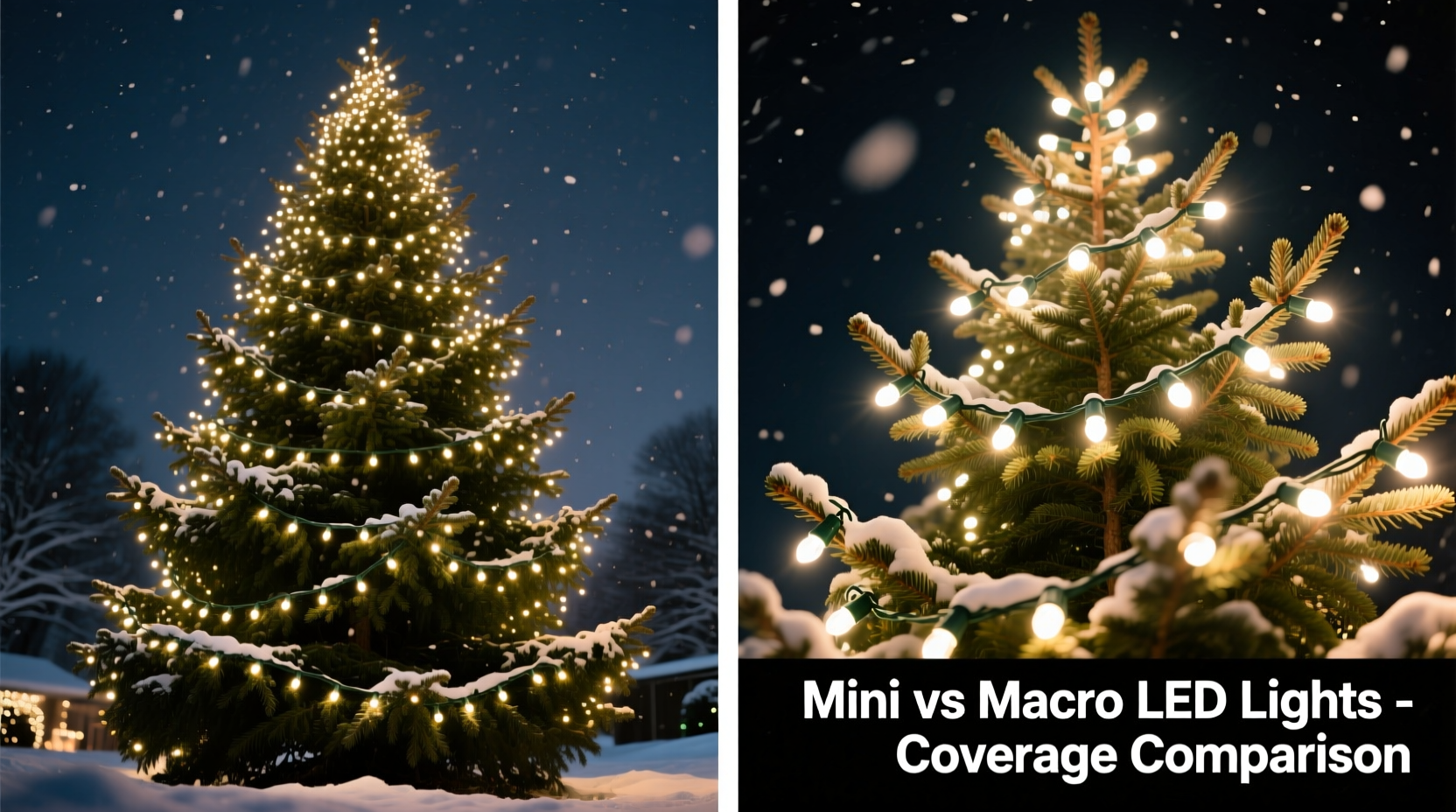
Large trees demand high light density to avoid patchy areas and maintain consistent glow from base to tip. Mini LED lights, typically measuring 5mm or less in bulb size, are known for their compact profile and tight spacing—often as close as 4 inches apart on the wire. This allows decorators to wrap strands densely around thick branches, creating a \"glittering blanket\" effect that mimics snowfall.
In contrast, macro LEDs (also called “jumbo” or “large” LEDs) feature bulbs ranging from 8mm to over 12mm. While they emit more lumens per bulb, their spacing is usually wider—6 to 12 inches apart—due to higher power draw and heat dispersion needs. This means fewer points of light along the same length of wire.
For a 7-foot or taller tree, this difference becomes critical. A macro string may require twice as many strands to match the visual density of mini LEDs. However, each macro bulb produces a stronger focal point, which can be desirable if you're aiming for a bold, retro-inspired look reminiscent of vintage C7 or C9 bulbs.
Visual Coverage: How Each Type Fills Space
Coverage isn't just about numbers—it's about perception. Mini LEDs excel in creating a soft, diffused glow due to their sheer quantity and smaller emission points. When layered correctly, they produce what designers call “ambient saturation,” where individual bulbs blur into a continuous field of light. This works especially well on full-bodied trees with dense foliage, allowing light to filter through multiple layers.
Macro LEDs, by nature, draw attention to themselves. Their larger lenses capture and reflect more ambient light, making them stand out even in well-lit rooms. On a large tree, this creates a dramatic silhouette effect—particularly effective when used on outer branches or for outlining the tree’s shape. But because they’re spaced farther apart, interior sections may appear dimmer unless supplemented with additional lighting.
One real-world example illustrates this clearly: A homeowner in Denver used only macro LEDs on a 10-foot Fraser fir. Despite using 800 bulbs, guests reported the tree looked “spotty” from certain angles. After adding two strands of mini LEDs wrapped tightly around mid-level limbs, the depth improved dramatically—proving that hybrid approaches can offer the best of both worlds.
“For tall trees, uniformity trumps raw brightness. You want the eye to travel smoothly across the surface—not jump from hotspot to hotspot.” — Lena Torres, Professional Holiday Lighting Designer
Energy Efficiency and Heat Output Comparison
LED technology is inherently energy-efficient, but there are nuances between mini and macro variants. Mini LEDs generally consume between 0.04W and 0.08W per bulb, meaning a 100-light strand uses roughly 4–8 watts. Macro LEDs, due to larger diodes and brighter output, often range from 0.1W to 0.15W per bulb, pushing a similar strand into the 10–15W range.
This becomes significant when covering large trees requiring hundreds or thousands of bulbs. Using all macro LEDs could double or triple your total power load compared to minis. Additionally, while both types run cooler than incandescent bulbs, macro LEDs generate more localized heat due to higher wattage concentration. This is rarely a fire hazard with modern UL-listed products, but it can affect placement near delicate materials like dried pinecones or silk ornaments.
| Feature | Mini LED Lights | Macro LED Lights |
|---|---|---|
| Bulb Size | 3–5mm | 8–12mm+ |
| Spacing Between Bulbs | 4–6 inches | 6–12 inches |
| Wattage Per Bulb | 0.04–0.08W | 0.10–0.15W |
| Typical Strand Length (100 lights) | 20–25 feet | 30–50 feet |
| Ideal Use Case | Dense coverage, indoor trees, layered effects | Accent lighting, outdoor silhouettes, retro styles |
Installation Practicality and Durability
Wrapping a large tree takes time, effort, and planning. Mini LED strands, being lighter and more flexible, conform easily to curved branches. Their thin copper wire resists kinking and can be tucked into foliage without snagging needles. Because they’re designed for high-volume wrapping, manufacturers often sell them in bulk spools (e.g., 300 or 500 lights per roll), reducing connector clutter.
Macro LEDs, while durable, are heavier per foot. Their thicker insulation and larger sockets make them stiffer to maneuver, particularly on tight turns or narrow limbs. Connectors are also bulkier, increasing the risk of visible junctions on large installations. However, their rugged build makes them better suited for outdoor use in harsh weather, where wind, moisture, and temperature swings are factors.
Another consideration is repairability. If a single macro bulb fails, it can sometimes darken an entire section depending on circuit design. Many newer models use shunt-wired systems that bypass dead bulbs, but older or budget versions do not. Mini LEDs tend to fail more gracefully—one dark bulb among hundreds has minimal visual impact.
Step-by-Step Guide: Choosing and Installing Lights for Maximum Coverage
Follow this proven sequence to achieve professional-grade results on large trees:
- Measure your tree. Calculate approximate surface area by multiplying height by average diameter. Use this to estimate total bulb count needed.
- Determine your style goal. Do you want subtle sparkle (mini) or bold presence (macro)? Consider existing décor and room lighting.
- Select strand specifications. Choose warm white (2700K–3000K) for classic warmth; cool white for modern clarity. Ensure all strands are connectable and same-voltage.
- Start from the inside. Begin wrapping near the trunk, spiraling outward. This ensures inner layers contribute to overall glow rather than staying hidden.
- Layer strategically. Use mini LEDs for base coverage, then add macro strings along outer edges for accentuation. Avoid overlapping wires excessively.
- Test incrementally. Plug in every 2–3 strands during installation to check brightness balance and detect issues.
- Adjust and refine. Step back frequently to assess coverage from multiple angles. Add supplemental strands to shadowed zones.
Hybrid Approach: Combining Mini and Macro for Best Results
Many top-tier holiday displays don’t rely on one type alone. A growing trend among professionals is combining both mini and macro LEDs to leverage their strengths. Minis provide background illumination, filling gaps and enhancing depth. Macros serve as highlighters, emphasizing tips, contours, and ornament clusters.
This dual-layer method requires careful planning but pays off in visual richness. For instance, a commercial display in Portland used 4,000 mini LEDs for foundational coverage on a 15-foot tree, then added 600 warm amber macro LEDs along upper branches to simulate candlelight. The result was widely praised for its dimensionality and nostalgic charm.
To implement this approach:
- Use mini LEDs at a rate of 100–150 per foot of tree height.
- Add macro LEDs at 20–30 per foot, focusing on outer limbs and vertical lines.
- Choose complementary color temperatures—avoid mixing cool and warm whites unless intentional.
- Keep wiring organized; use twist ties or insulated clips to prevent tangling.
Frequently Asked Questions
Can I mix mini and macro LED lights on the same tree?
Yes, but ensure both types operate on the same voltage and are rated for connection together. Mixing incompatible strands can cause overload or failure. Also, match color temperature (e.g., both warm white) to maintain visual harmony.
Which lasts longer—mini or macro LEDs?
Both typically last 25,000 to 50,000 hours when properly maintained. However, macro LEDs may degrade slightly faster outdoors due to greater exposure stress and thermal cycling. Indoor usage shows little difference in lifespan.
Are macro LEDs better for outdoor trees?
They can be, thanks to their durability and visibility in open spaces. However, for full coverage on large outdoor trees, consider using mini LEDs in combination with macros. Minis fill in gaps that larger bulbs might miss due to spacing limitations.
Final Recommendation: What Gives Better Coverage?
For pure, unbroken coverage on large Christmas trees, **mini LED lights are superior**. Their small size, tight spacing, and ability to blend into foliage allow for seamless illumination across vast surfaces. They deliver the kind of even, radiant glow that defines professionally decorated trees.
That said, macro LEDs have undeniable appeal—they command attention and work beautifully as accents or standalone features on minimalist designs. But when coverage is the priority, mini LEDs consistently outperform their larger counterparts.
If you're committed to maximum visual impact, consider starting with mini LEDs as your base layer. Then, selectively enhance with macro strings where you want drama or emphasis. This balanced strategy honors tradition while embracing modern versatility.




 浙公网安备
33010002000092号
浙公网安备
33010002000092号 浙B2-20120091-4
Comments
No comments yet. Why don't you start the discussion?