
Choosing between mini and macro LED Christmas lights isn’t just about aesthetics—it’s about how light interacts with scale, texture, distance, and environment. Mini lights (typically 2–5 mm bulbs) have long dominated residential displays, while macro LEDs (8–12 mm or larger) are gaining rapid traction among designers, municipalities, and homeowners seeking bolder presence. But “better” depends entirely on context: a dense evergreen tree demands different optical behavior than a wrought-iron railing viewed from across a driveway. This article cuts through marketing hype to examine light diffusion, viewing distance, material compatibility, energy efficiency, and long-term durability—not as abstract specs, but as tangible outcomes you’ll see and feel when your display is lit at dusk.
How Light Physics Shapes Your Display
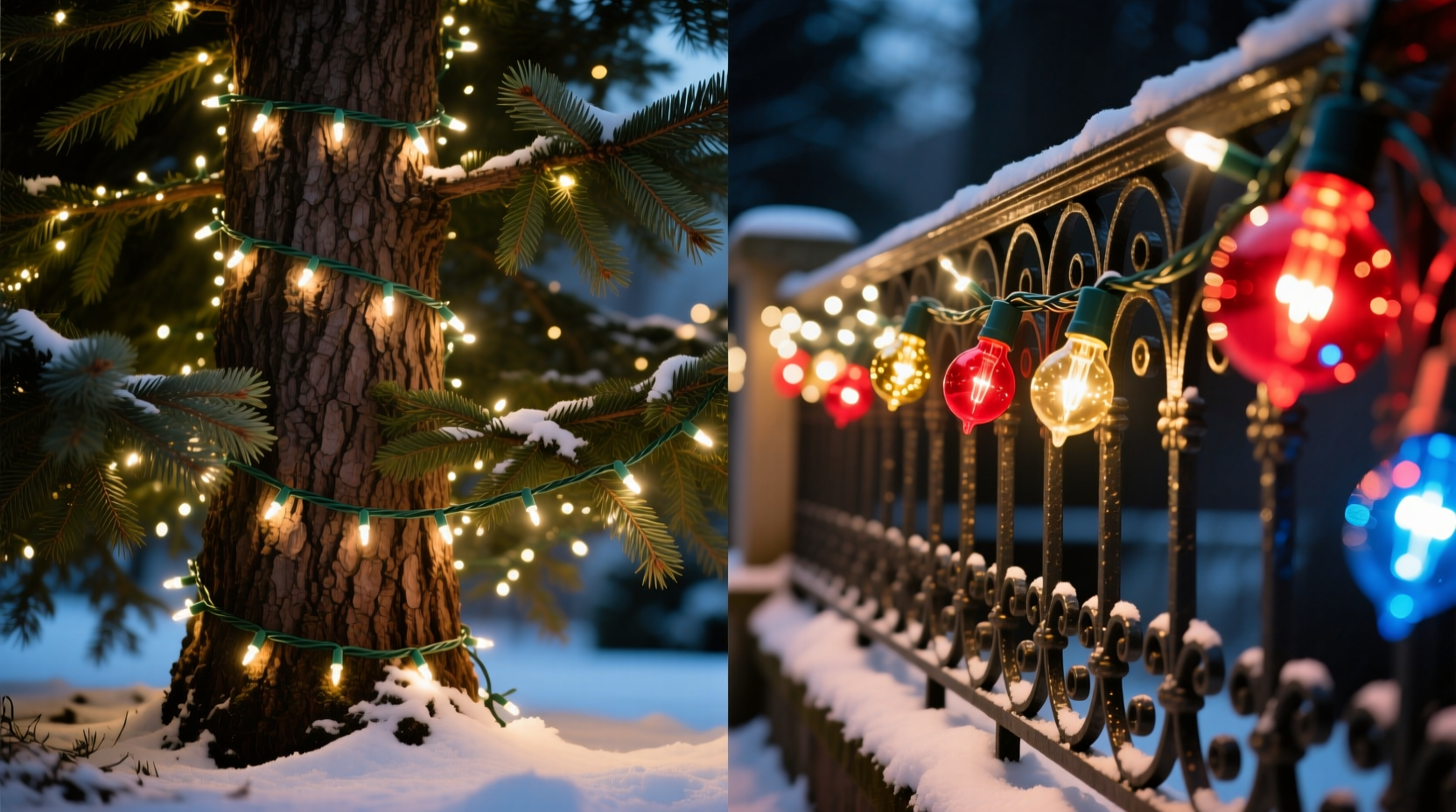
Light doesn’t just illuminate—it sculpts. Mini LEDs emit focused, pinpoint illumination. Their small surface area creates high luminance per square millimeter, resulting in sharp, glittering highlights. When strung densely on a full Fraser fir, they mimic the effect of frost crystals catching sunlight: bright, abundant, and delicate. Macro LEDs, by contrast, project broader, softer beams. Their larger diode surface diffuses light more evenly, reducing hot spots and casting gentle ambient glow. This matters because human vision perceives brightness logarithmically: at 10 feet, a macro bulb appears comfortably radiant; at 30 feet, it reads as warm and cohesive, while a mini bulb may vanish into visual noise unless installed at triple density.
Professional lighting designer Lena Ruiz, who has specified holiday displays for 14 municipal parks and three botanical gardens, confirms this perceptual shift: “On a 25-foot Norway spruce, I use macros only on the outer third of branches—where viewers stand—and reserve minis for inner layers, where detail matters up close. It’s not ‘either/or’—it’s layering light like a painter uses glazes.” Her approach reveals a key truth: neither type is universally superior. The optimal choice emerges from understanding the interplay of object geometry, viewer proximity, and ambient conditions.
Tree Applications: Density, Depth, and Dimension
Trees vary dramatically in needle density, branch structure, and silhouette. A tightly foliated Colorado blue spruce holds light differently than an open-branched white pine or a slender Italian cypress. Mini lights excel where fine articulation is desired: winding them along individual branches reveals texture, emphasizes taper, and creates depth through rhythmic repetition. Their low profile allows tight coiling without bulk, making them ideal for narrow conifers or young saplings under 6 feet tall.
Macro LEDs shine on mature, broad-canopied trees—especially those with sparse foliage or wide branch spacing. On a 30-year-old white oak draped with garlands, macro bulbs act as focal points: each light becomes a deliberate accent, guiding the eye along major limbs rather than dissolving into background shimmer. Their higher lumen output (often 8–12 lumens per bulb vs. 2–4 for minis) compensates for light absorption by thick bark and overlapping leaves.
Railing & Architectural Applications: Scale, Safety, and Sightlines
Railings present unique challenges: narrow mounting surfaces, frequent physical contact, variable heights, and often, long sightlines. Mini lights work well on ornate ironwork or wooden balusters under 3 feet tall—especially when wrapped tightly around spindles. Their low voltage (typically 2.5–3.5V per bulb) and flexible wire gauge make them easy to route through tight curves. However, their subtlety becomes a liability on wider decks or staircases viewed from below or across a yard. At distances over 15 feet, mini strings risk looking like faint, disconnected dots rather than a continuous line of light.
Macro LEDs solve this problem decisively. Their larger size ensures legibility at range, and many models feature built-in diffusers that soften glare—a critical safety factor on stairs. Professional installer Marcus Bell, who has wired over 2,100 residential railings since 2016, notes: “I default to macro for anything over 4 feet long or viewed from >10 feet away. Clients consistently report fewer complaints about ‘not seeing the lights’—and zero incidents of tripping related to poorly lit steps.” He adds that macro bulbs’ wider spacing (often 6–12 inches vs. mini’s 2–4 inches) also reduces installation time by 30–40% on linear runs.
| Application | Mini LED Strengths | Macro LED Strengths | Key Limitation |
|---|---|---|---|
| Mature evergreen tree (20+ ft) | Highlights needle texture; subtle depth | Defines outer silhouette; visible from street | Minis fade at distance; macros can overwhelm fine detail |
| Young deciduous tree (under 10 ft) | Complements delicate branching; lightweight | May appear oversized; less natural | Macros dominate small forms; minis offer proportion |
| Wrought-iron railing (long, open) | Follows intricate curves easily | High visibility at range; glare control | Minis lack presence on wide spans; macros need straighter runs |
| Wood deck railing (low, wide) | Discreet; blends with wood grain | Strong visual anchor; weather-resistant housings | Minis vulnerable to foot traffic; macros require secure mounting |
| Indoor mantel or staircase | Intimate scale; no glare | Too bold; risks visual fatigue | Macros rarely appropriate indoors unless scaled down to 6mm |
A Real Installation: The Henderson Family’s Dual-Approach Backyard
The Hendersons live in Portland, Oregon, with a 28-foot Douglas fir dominating their backyard and a 42-foot cedar deck railing wrapping their second-story porch. In 2022, they used only mini lights: 1,200-count warm-white sets on the tree and 300-count cool-white on the railing. Neighbors praised the “cozy, nostalgic feel,” but the family noticed two issues: from their kitchen window (35 feet away), the tree looked softly blurred, and guests frequently missed the railing lights entirely when descending stairs after dark.
In 2023, they adopted a hybrid strategy. They kept 800 mini lights on the fir’s inner and mid-canopy—wound along secondary branches—but added 300 macro LEDs (10mm, warm white, 6-inch spacing) along the outer perimeter. For the railing, they replaced the minis with 150 macro bulbs (8mm, amber, 8-inch spacing), mounted using heavy-duty UV-resistant clips. The result? “The tree now has *presence*,” says Sarah Henderson. “You see its shape first—then the texture. And the railing? My mother, who’s 78, said, ‘Finally, I can tell where the edge is.’ We didn’t change the wattage—just the optics.” Their electricity usage increased by just 8% despite adding macros, thanks to modern drivers with 92% efficiency.
Practical Selection Checklist
- Measure viewing distance: If primary vantage point is >20 feet, lean toward macro (8mm+).
- Assess surface texture: Tight curves or intricate metalwork favor mini; straight rails or broad trunks suit macro.
- Check bulb spacing: Mini sets average 2.5–4 inches; macro sets run 6–12 inches. Calculate total bulbs needed—macros often require fewer strings for equivalent visual impact.
- Evaluate weather exposure: Macro LEDs typically feature thicker silicone housings and IP65+ ratings; minis may require supplemental conduit in coastal or high-wind zones.
- Confirm dimming compatibility: Not all macro strings support standard PWM dimmers. Verify driver specifications before pairing with smart home systems.
- Test color temperature consistency: Batch variations are more visible with macros. Buy all lights for one project from the same lot number.
Step-by-Step: Choosing & Installing Based on Your Structure
- Step 1 – Map Your Space: Sketch your tree or railing. Note height, width, branch/rail density, and primary viewing angles (e.g., “front porch view at 12 ft,” “street view at 35 ft”).
- Step 2 – Determine Dominant Distance: Identify the farthest regular viewing point. Under 15 ft → mini viable. 15–25 ft → consider hybrid. Over 25 ft → macro strongly recommended.
- Step 3 – Assess Texture & Detail: Run your hand along a section. If you feel distinct ridges, spindles, or needles, minis will articulate them. If surfaces are broad and smooth (e.g., cedar cap rail), macros define form better.
- Step 4 – Calculate Coverage: For trees: multiply height × circumference × 0.7 (for medium density). For railings: measure linear feet × 1.2 (adds 20% for corners/ends). Then divide by bulb spacing (e.g., 30 ft railing ÷ 0.5 ft spacing = 60 bulbs).
- Step 5 – Prioritize Safety & Serviceability: Choose macro for stairs, decks, or areas with children/pets. Select minis only where wiring paths are protected and bulbs won’t be brushed against.
- Step 6 – Install in Layers: Begin with structural lights (macro on tree perimeter/railing length), then add detail lights (mini on inner branches or spindle tops). Test each layer before proceeding.
FAQ
Can I mix mini and macro lights on the same tree?
Yes—and professionals recommend it. Use macro LEDs to establish the tree’s outer contour and mini lights to fill interior volume and highlight texture. Ensure both types share the same voltage (e.g., 120V AC or 24V DC) and controller compatibility. Avoid mixing warm-white macros with cool-white minis unless intentional for artistic effect.
Do macro lights use significantly more energy than mini lights?
Not necessarily. A typical 10mm macro LED consumes 0.08–0.12 watts; a standard 3mm mini uses 0.04–0.06 watts. But because macros require 40–60% fewer bulbs to achieve visual impact, total string wattage is often comparable. A 100-bulb macro string (10W) may replace three 100-bulb mini strings (15W), yielding net energy savings.
Are macro lights harder to store and handle?
Marginally. Their larger size means slightly bulkier coils, but most quality macro strings use memory-free copper-clad aluminum wire that resists kinking. Store them on flat reels or wide-diameter spools—not tight cardboard tubes—to preserve wire integrity. Minis tangle more easily due to finer gauge, so macro storage is often simpler long-term.
Conclusion
“Which looks better?” isn’t answered by bulb size alone—it’s revealed in how light behaves on your specific tree, how safely it guides footsteps along your railing, and how clearly it communicates joy from the sidewalk or across the garden. Mini LEDs reward close attention and intimate spaces; macro LEDs command attention and clarify form at a distance. The most compelling displays don’t choose sides—they orchestrate both. Whether you’re outlining a century-old oak or defining the curve of a modern balcony, let physics, not packaging, guide your choice. Measure your space, observe your sightlines, and prioritize human experience over spec sheets. Then hang the lights—not as decoration, but as intention made visible.




 浙公网安备
33010002000092号
浙公网安备
33010002000092号 浙B2-20120091-4
Comments
No comments yet. Why don't you start the discussion?