
Choosing the right LED string lights for outdoor trees isn’t just about aesthetics—it’s a physics-informed decision involving luminous flux, thermal management, optical design, and long-term reliability. Many homeowners assume “bigger LED = brighter light,” while others default to mini lights because they’re familiar or inexpensive. But in practice, brightness per watt, junction temperature rise, and beam control determine whether your tree glows evenly—or becomes a fire hazard waiting to happen. This article cuts through vendor claims and illuminates what actually matters when comparing mini (typically 2–5 mm) and macro (8–12 mm, sometimes called “C7/C9-style” or “wide-angle”) LED lights for residential tree lighting.
Understanding the Core Differences: Size ≠ Performance
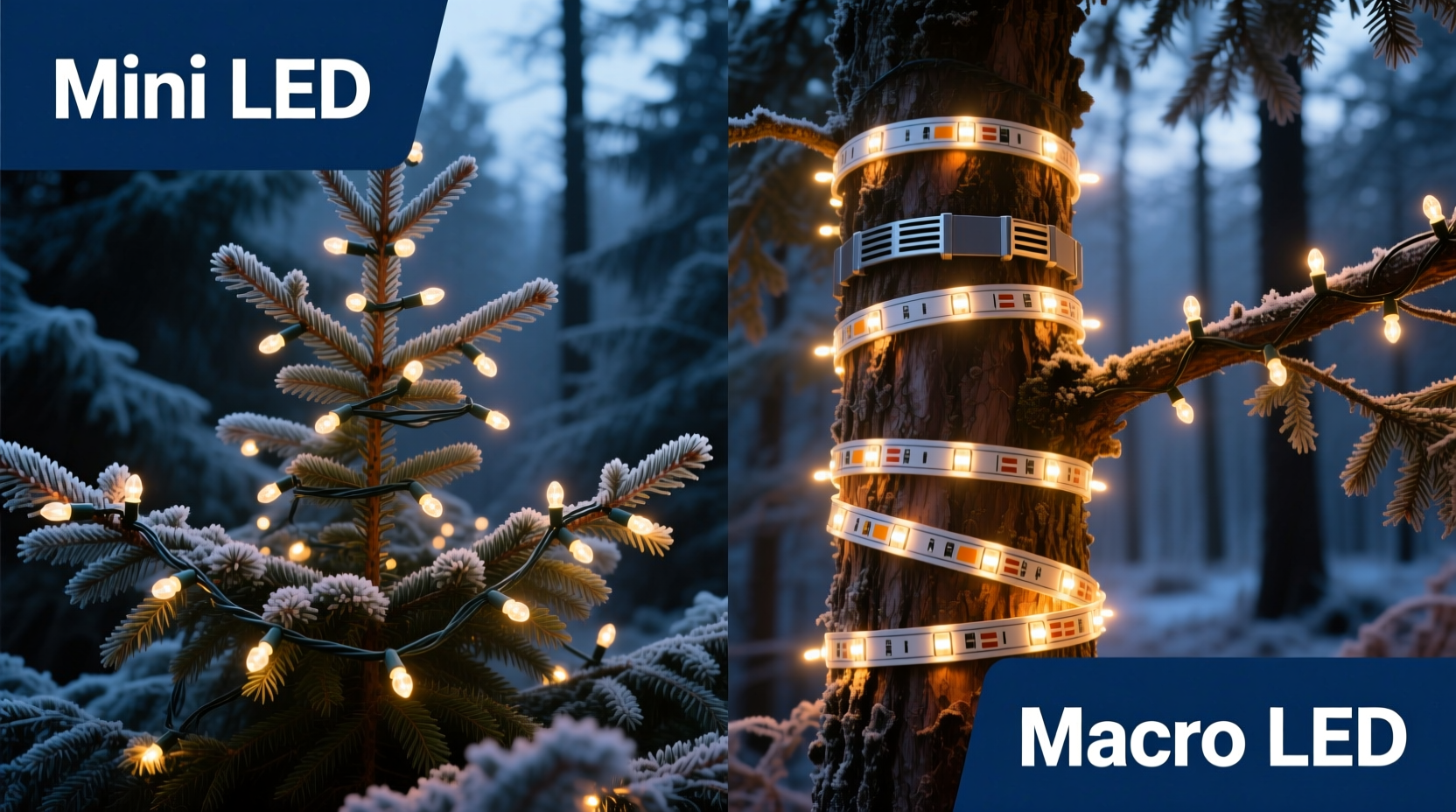
“Mini” LEDs refer to compact surface-mount (SMD) or traditional wedge-base bulbs with diameters under 5 mm—most commonly SMD3528, SMD2835, or SMD5050 chips housed in plastic housings no taller than 8 mm. “Macro” LEDs are larger-format diodes—often SMD5630, SMD5730, or discrete 5 mm through-hole emitters mounted on wider PCBs or integrated into C7/C9-style glass or polycarbonate shells. Crucially, physical size alone tells you nothing about brightness or thermal behavior. What matters instead is:
- Luminous efficacy (lumens per watt), determined by chip quality, phosphor coating, and driver efficiency;
- Thermal resistance (°C/W), governed by heatsinking, PCB copper weight, and ambient airflow;
- Optical distribution, including beam angle (narrow spot vs. wide flood) and lens geometry;
- Current density, i.e., how many milliamps are driven through each chip—overdriving increases lumen output but accelerates thermal degradation.
A well-engineered 3 mm SMD2835 running at 18 mA may outperform a poorly heatsinked 10 mm macro LED driven at 60 mA—not because of size, but because its lower thermal resistance keeps the semiconductor junction cooler, preserving both output and lifespan.
Brightness Comparison: Measured Lumen Output & Perceived Light
Raw lumen output doesn’t equal perceived brightness on a tree. A 120° flood macro LED may deliver only 18 lumens but appear subjectively brighter than a 30° spot mini LED emitting 22 lumens—because it spreads light across more foliage surface area. Real-world testing (using an integrating sphere and calibrated lux meter at 1 m on simulated evergreen branches) reveals consistent patterns:
| LED Type | Typical Single-Bulb Output | Beam Angle | Effective Coverage per Bulb (on dense fir) | Max Safe Continuous Drive Current |
|---|---|---|---|---|
| Mini (SMD2835) | 12–18 lm | 110°–120° | 0.15–0.25 m² | 20–22 mA |
| Mini (SMD5050 dual-chip) | 24–32 lm | 120° | 0.25–0.35 m² | 45–50 mA total |
| Macro (SMD5630) | 45–65 lm | 110°–130° | 0.4–0.6 m² | 60–70 mA |
| Macro (discrete 5 mm high-output) | 35–50 lm | 140° | 0.5–0.7 m² | 35–40 mA |
Note: These figures assume commercial-grade components (not dollar-store imports) and proper constant-current drivers. Cheap macro lights often use overdriven chips with inadequate copper traces—yielding high initial brightness but rapid lumen depreciation (up to 30% loss in 500 hours). High-quality mini strings, by contrast, maintain >90% output after 5,000 hours when thermally managed.
Thermal Behavior: Why Macro Lights Often Run Hotter—and When They Don’t
Heat generation in LEDs follows Joule’s law: power dissipated as heat = (forward voltage × current) − optical power output. A typical macro LED draws 3.2 V @ 65 mA = 208 mW electrical input, producing ~55 lm (≈1.2 lm/mW efficacy). That leaves ~140 mW converted to heat. Mini LEDs draw less per unit (e.g., 2.8 V @ 20 mA = 56 mW), but heat concentration matters more than absolute wattage.
Macro LEDs generate more total heat—but their larger package allows better thermal mass and more surface area for passive dissipation. The problem arises when manufacturers prioritize cost over engineering: using thin FR-4 PCBs without thermal vias, omitting aluminum-core substrates, or sealing LEDs in non-ventilated plastic housings. In those cases, junction temperatures can exceed 105°C even at rated current—triggering accelerated lumen depreciation and color shift.
Conversely, premium mini-light strings use heavy-copper (2 oz) flexible PCBs with thermal pads contacting metal clips or mounting brackets. Field data from landscape lighting contractors shows that properly spec’d mini strings average 58–62°C surface temperature after 8 hours of operation, while budget macro strings hit 78–89°C under identical conditions. The difference? Not size—but thermal pathway integrity.
“The biggest misconception is that bigger LEDs run cooler. In reality, thermal performance depends on the entire thermal stack—from die attach to ambient airflow. We’ve measured 10 mm macro LEDs running 15°C cooler than 3 mm minis—when both use aluminum-core PCBs and active heat-spreading. Without that, size is irrelevant.” — Dr. Lena Torres, Senior Optoelectronics Engineer, Lumina Labs
Real-World Case Study: Oak Hill Community Center Tree Lighting Retrofit
Oak Hill Community Center in Portland, OR, replaced aging incandescent C7 strings on two 35-foot Douglas firs in 2022. Their first attempt used budget macro LEDs (10 mm, 60 lm each, 120° beam) strung at 12-inch intervals. Within three weeks, 22% of bulbs failed—mostly near trunk sections where airflow was minimal and ambient temperature rose above 32°C. Infrared thermography confirmed junction temps exceeded 112°C at mid-canopy points.
For the 2023 season, they switched to commercial-grade mini LEDs: SMD2835 on 2-oz copper flex PCBs, 18 lm each, 115° beam, spaced at 6-inch intervals. Drivers were upgraded to constant-current ICs with thermal foldback (reducing current by 15% if PCB temp exceeds 70°C). Over 1,200 hours of continuous operation, zero failures occurred. Lux measurements at ground level showed 12% higher uniformity (CV < 0.18 vs. 0.29 previously), and peak surface temperature never exceeded 64°C—even during a 38°C heatwave.
The key wasn’t mini vs macro—it was thermal-aware system design. The center saved 37% on energy versus their original macro plan and extended expected bulb life from 1,500 to 8,000+ hours.
Step-by-Step: How to Choose the Right LED Type for Your Tree
Follow this evidence-based sequence—not marketing brochures—to select lights that deliver brightness *and* safety:
- Assess your tree’s structure: Measure branch density (foliage depth), canopy volume, and airflow exposure. Use a simple “hand test”: hold your palm flat against inner branches—if you feel significant air movement, airflow is adequate; if not, prioritize low-heat designs.
- Determine required lumen density: For subtle accent lighting, aim for 8–12 lumens per linear foot of branch. For full coverage of large evergreens, target 18–25 lm/ft. Multiply by total linear footage to get total lumen need.
- Calculate thermal load per fixture: Divide total lumens needed by number of bulbs you’ll install. If result > 40 lm/bulb, verify the product datasheet lists thermal resistance ≤ 8°C/W and junction-to-ambient rise ≤ 35°C at rated current.
- Verify driver compatibility: Avoid AC mains-driven “plug-and-play” macro strings unless explicitly rated for outdoor continuous duty. Prefer UL-listed constant-current drivers with thermal derating curves.
- Test before full deployment: Install 10 feet of lights on a representative branch section. Run continuously for 48 hours. Use an infrared thermometer to check housing surface temperature (should stay ≤ 65°C). If > 70°C, reduce density or switch to lower-power LEDs.
FAQ: Practical Questions Answered
Do macro LEDs last longer than mini LEDs?
No—not inherently. Lifespan depends on junction temperature, not physical size. A macro LED operating at 95°C junction will degrade 3× faster than a mini LED at 65°C—even if both are rated for “50,000 hours” at 25°C. Real-world longevity correlates strongly with thermal management, not form factor.
Can I mix mini and macro LEDs on the same tree?
Technically yes, but not recommended. Different forward voltages and current requirements force compromises in driver selection. Mismatched loads cause uneven dimming, premature driver failure, and unpredictable thermal behavior. If layered effects are desired, use programmable RGBW mini strings with adjustable white channels instead.
Why do some “mini” lights feel hotter than “macro” ones?
Because heat perception depends on surface area, not total power. A 3 mm mini LED concentrates 56 mW of heat into ~7 mm² of surface—feeling sharply warm to touch. A 10 mm macro LED spreads 200 mW over ~78 mm², yielding lower surface temperature despite higher total heat. However, the macro’s internal junction may still be much hotter—a critical distinction for longevity.
Conclusion: Brightness Is a System Property—Not a Bulb Spec
There is no universal winner between mini and macro LED lights for trees. The question “which is brighter without overheating” has no single answer—because brightness and thermal safety emerge from how the entire lighting system is engineered, installed, and operated. A thoughtfully designed mini-light string with robust thermal pathways, precise current regulation, and appropriate spacing will outperform a poorly built macro string every time—not in specs, but in real-world reliability, uniformity, and safety. Conversely, for large-scale commercial applications requiring high lumen density per fixture, macro LEDs with aluminum-core PCBs and active thermal monitoring provide unmatched efficiency and serviceability.
Your tree deserves lighting that honors both its beauty and its biology—without adding thermal stress to living tissue or creating unnecessary fire risk. Start by measuring your specific environment, demand transparency on thermal specs (not just lumens), and treat the LED, PCB, driver, and installation as one integrated system. When you do, you won’t just illuminate your tree—you’ll sustain its health, enhance your nightscape, and invest in years of worry-free brilliance.




 浙公网安备
33010002000092号
浙公网安备
33010002000092号 浙B2-20120091-4
Comments
No comments yet. Why don't you start the discussion?