
When it comes to holiday lighting—especially for outdoor trees—the visual impact of “sparkle” isn’t just about brightness. It’s about how light interacts with bark texture, branch density, leaf retention (or lack thereof), wind movement, and ambient darkness. Mini and macro LED lights are the two dominant categories used on residential trees, yet they produce fundamentally different optical effects. Choosing between them isn’t a matter of “better” or “worse” in absolute terms—it’s about matching the light’s physical properties to your tree’s structure, your viewing distance, your aesthetic goal, and your installation practicality. This article cuts through marketing hype and vendor bias to examine how each type delivers *actual sparkle*: that dynamic, eye-catching interplay of point-source brilliance, reflection, and subtle motion.
What “Sparkle” Really Means on Tree Branches
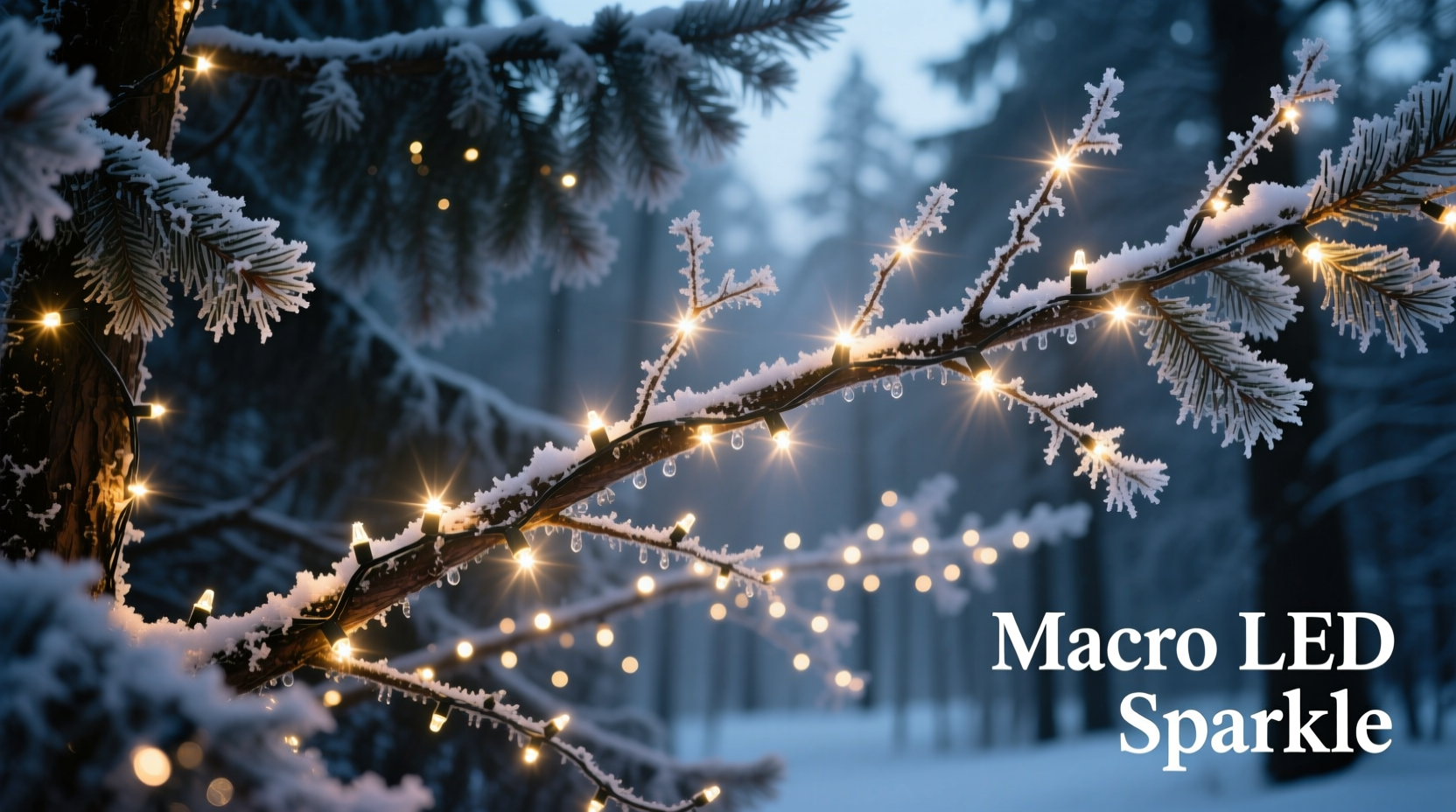
True sparkle on tree branches is not uniform glow. It’s the perception of discrete, high-contrast points of light that catch the eye—like tiny stars suspended in silhouette. This effect relies on three interdependent factors: luminance density (brightness per unit area), angular intensity (how tightly light is focused), and visual isolation (how well individual bulbs stand out against background darkness and surrounding foliage). A 50-light string with wide-beam, diffused LEDs may emit more total lumens than a 100-light mini set—but if those lumens are scattered across broad cones, they wash out rather than sparkle. Conversely, a pinpoint source—even at lower wattage—can create intense local contrast when viewed against deep shadow.
Tree branches compound this complexity. Rough bark scatters light unpredictably. Thin twigs reflect less and absorb more. Dense evergreen needles diffuse and soften light; bare deciduous limbs offer minimal diffusion but also little surface for reflection—so light must be precisely positioned to catch edge highlights. Sparkle emerges where light meets geometry: at the tip of a branch, along a ridge of bark, or where a twig bends toward the viewer.
Mini LED Lights: Precision, Density, and Controlled Brilliance
Mini LEDs—typically 2–5 mm in diameter, often using 5050 or 3528 SMD chips—are engineered for tight spacing and directional output. Most quality mini strings feature lenses or built-in reflectors that concentrate 70–85% of emitted light into a 120° or narrower beam angle. This creates higher luminance per square millimeter at the source and allows tighter placement without visual bleed.
Their small size enables dense wrapping: 100 lights can span 16.4 feet (5 meters) with 2–3 inches between bulbs. That density means multiple points of light fall across even short branch segments, increasing the chance that at least one will align perfectly with a reflective surface or viewing angle. Because each bulb is physically isolated, wind-induced movement causes individual twinkles—not a wave-like shimmer—enhancing perceived dynamism.
Mini lights excel on trees with fine branching structure—Japanese maples, birches, or young conifers—where subtlety and precision matter. They’re also far easier to conceal within foliage without overwhelming the form of the branch. Their lower power draw (typically 0.07–0.12W per bulb) means longer strings can run on standard 120V circuits without voltage drop issues that dim end bulbs—a critical factor for consistent sparkle from base to crown.
Macro LED Lights: Presence, Projection, and Atmospheric Impact
Macro LEDs—often called “C7”, “C9”, or “G12” equivalents—range from 12 mm to over 25 mm in diameter. They use larger SMD chips (e.g., 5730 or 2835) or integrated COB (Chip-on-Board) modules, delivering significantly higher lumen output per bulb (6–15+ lumens vs. 1–3 for most minis). Their optics are designed for projection: wider beam angles (150°–180°), broader dispersion, and often frosted or opal lenses that soften edges.
This design prioritizes visibility at distance and atmospheric fill over pinpoint definition. A single macro bulb can illuminate an entire 6-inch section of branch, casting soft shadows and highlighting texture—but rarely producing the sharp, star-like “pop” of a mini. Their sparkle is slower, warmer, and more volumetric: think candlelight in a lantern rather than a diamond facet catching sun.
Macro lights shine on large-scale applications: mature oaks, tall spruces, or multi-trunked trees viewed from 15+ feet away. Their physical presence anchors the lighting scheme visually. However, their size makes precise placement difficult on narrow limbs, and their higher wattage (0.3–0.8W per bulb) limits string length before voltage drop degrades consistency—especially problematic on tall trees where the topmost bulbs may appear noticeably dimmer and less sparkly.
Direct Comparison: Key Performance Metrics
| Feature | Mini LED Lights | Macro LED Lights |
|---|---|---|
| Average Bulb Size | 2.5–4.5 mm | 12–28 mm |
| Typical Beam Angle | 90°–120° | 150°–180° |
| Lumens per Bulb | 1.0–3.2 lm | 6.5–18.0 lm |
| Power per Bulb | 0.07–0.12 W | 0.3–0.8 W |
| Max String Length (120V) | 500–1,000 ft (with proper gauge) | 250–500 ft (voltage drop sensitive) |
| Ideal Viewing Distance | 3–12 ft | 10–30+ ft |
| Best Tree Types | Small/midsize, fine-branched, ornamental, potted | Large, mature, open-canopy, street-side |
| Wind Response | Sharp, rapid individual twinkles | Subtle, slow-motion shimmer |
Note the trade-offs: macro lights deliver more raw light energy, but mini lights channel that energy more efficiently into the visual parameters that define sparkle. As lighting designer Lena Torres explains after installing over 200 residential tree displays: “People ask for ‘more sparkle,’ but what they really want is *more noticeable light events*. A macro bulb is like a spotlight on a stage—impressive, but static. A mini bulb is like a thousand fireflies—each tiny, but collectively impossible to ignore. The brain registers density and contrast faster than sheer brightness.”
“True sparkle isn’t about lumens—it’s about photon density per visual degree. Mini LEDs win on trees because they pack more contrast-generating events into the same angular field of view.” — Lena Torres, Certified Lighting Designer & Founder, ArborLume Studios
Real-World Case Study: The Maple vs. Oak Dilemma
In Portland, Oregon, homeowner David R. faced a classic dilemma: his front yard featured a 25-foot Japanese maple (delicate, feathery branches, no leaves in winter) and a 40-foot English oak (massive, gnarled limbs, sparse evergreen foliage). He wanted cohesive sparkle—but knew one solution wouldn’t fit both.
He tested identical warm-white LED strings (2700K CCT, 90 CRI) on adjacent 8-foot sections of each tree. On the maple, the macro lights overwhelmed the fine structure—bulbs appeared as blurred halos, and gaps between branches looked dark and empty. The mini lights, spaced 2.5 inches apart and wrapped tightly around secondary twigs, created hundreds of distinct points that caught wind movement and reflected off wet bark after rain. Neighbors described it as “like looking into a starfield.”
On the oak, however, the mini lights vanished. At 25 feet away, individual bulbs were indistinguishable; only clusters registered as soft glows. Switching to macro lights transformed the impression: each 22-mm bulb became a clear, warm beacon at major limb junctions and trunk forks. From the sidewalk, the tree read as sculptural and stately—not busy or fussy. David ultimately used mini lights on the maple and macro on the oak, connecting both to a single smart controller with synchronized fade patterns. The result wasn’t uniformity—it was intentional hierarchy.
Step-by-Step: Choosing & Installing for Maximum Sparkle
- Assess Your Tree’s Architecture: Identify primary limbs (thick, structural), secondary branches (medium, horizontal), and tertiary twigs (fine, vertical). Sparkle works best on secondary and tertiary levels.
- Determine Primary Viewing Distance: Measure from your main vantage point (porch, driveway, window) to the tree’s outer canopy. Under 10 ft? Prioritize mini. Over 15 ft? Macro gains advantage.
- Evaluate Branch Density & Texture: Run your hand along a representative branch. Is the surface rough (good for micro-reflections) or smooth? Are twigs densely packed or widely spaced? Rough + dense = mini. Smooth + open = macro.
- Calculate Coverage Needs: For mini lights, allow 100–150 bulbs per 6-ft-tall tree; for macro, 30–50 bulbs per 6-ft-tall tree. Never force more bulbs than the branch structure can support visually.
- Install with Intentional Asymmetry: Avoid perfect spirals. Wrap lights in gentle figure-eights around key branch junctions. Place bulbs slightly offset—not aligned—to create irregular rhythm. Leave 10–15% of branch tips unlit to preserve depth and avoid “cotton candy” effect.
FAQ
Can I mix mini and macro lights on the same tree?
Yes—but only with discipline. Use macro lights exclusively on major structural limbs (trunk, primary forks) for anchoring presence, and mini lights on secondary/tertiary branches for detail and movement. Avoid mixing within the same visual plane, and ensure color temperature (CCT) and CRI match exactly—or the contrast will look jarring, not layered.
Do flicker-free or “warm-dim” macros improve sparkle?
Not inherently. Flicker-free operation eliminates visible strobing (a plus for comfort), and warm-dim mimics candlelight ambiance—but neither increases luminance density or angular intensity. They enhance mood, not sparkle physics. Save premium features for mini strings where subtle variations in timing and hue have greater perceptual impact.
Why do some “mini” lights look dull while others pop?
It’s almost always lens quality and binning. Cheap minis use flat, uncoated plastic lenses that scatter light broadly. Premium minis use precision-molded silicone or acrylic lenses with internal micro-prisms that collimate output. Also check lumen binning: reputable brands sort LEDs by output (e.g., “Bin B2”) so brightness is consistent across the string. Mixed bins cause uneven sparkle—some bulbs blaze, others fade into shadow.
Conclusion: Sparkle Is a Dialogue Between Light and Form
Mini and macro LED lights aren’t competitors—they’re complementary tools in the arborist’s lighting palette. Mini LEDs deliver sparkle through precision: high-density, high-contrast, movement-responsive points that celebrate the intricate architecture of smaller or more delicate trees. Macro LEDs deliver presence through projection: bold, atmospheric illumination that honors scale, structure, and distance. Neither “wins” universally. The better choice emerges only when you observe your tree—not as a blank canvas, but as a living system of surfaces, angles, textures, and rhythms—and select the light that converses with it most honestly.
Your next step isn’t to buy more lights—it’s to stand beneath your tree at dusk, watch how light already falls across its limbs, and ask: *Where does it catch? Where does it disappear? What would make that moment more alive?* Then choose the tool that answers that question—not the one with the highest wattage or longest string.




 浙公网安备
33010002000092号
浙公网安备
33010002000092号 浙B2-20120091-4
Comments
No comments yet. Why don't you start the discussion?