
For decades, the nativity scene has anchored Christmas tradition—not as mere decoration, but as quiet theological punctuation in a season often overwhelmed by noise and consumption. Yet today’s households face a meaningful choice: the intimate, curated presence of a miniature nativity set on a mantel or shelf—or the bold, communal statement of a full yard display glowing under winter skies. This isn’t just about size or convenience. It’s about how values like intentionality, environmental awareness, urban living realities, and evolving spiritual expression shape what “feels right” at Christmastime. Modern taste no longer defaults to abundance; it leans into authenticity, coherence, and conscious curation. Understanding why one format resonates more deeply—and when the other holds unexpected power—requires looking beyond nostalgia and into lived experience.
What Modern Tastes Actually Prioritize (Beyond Aesthetics)
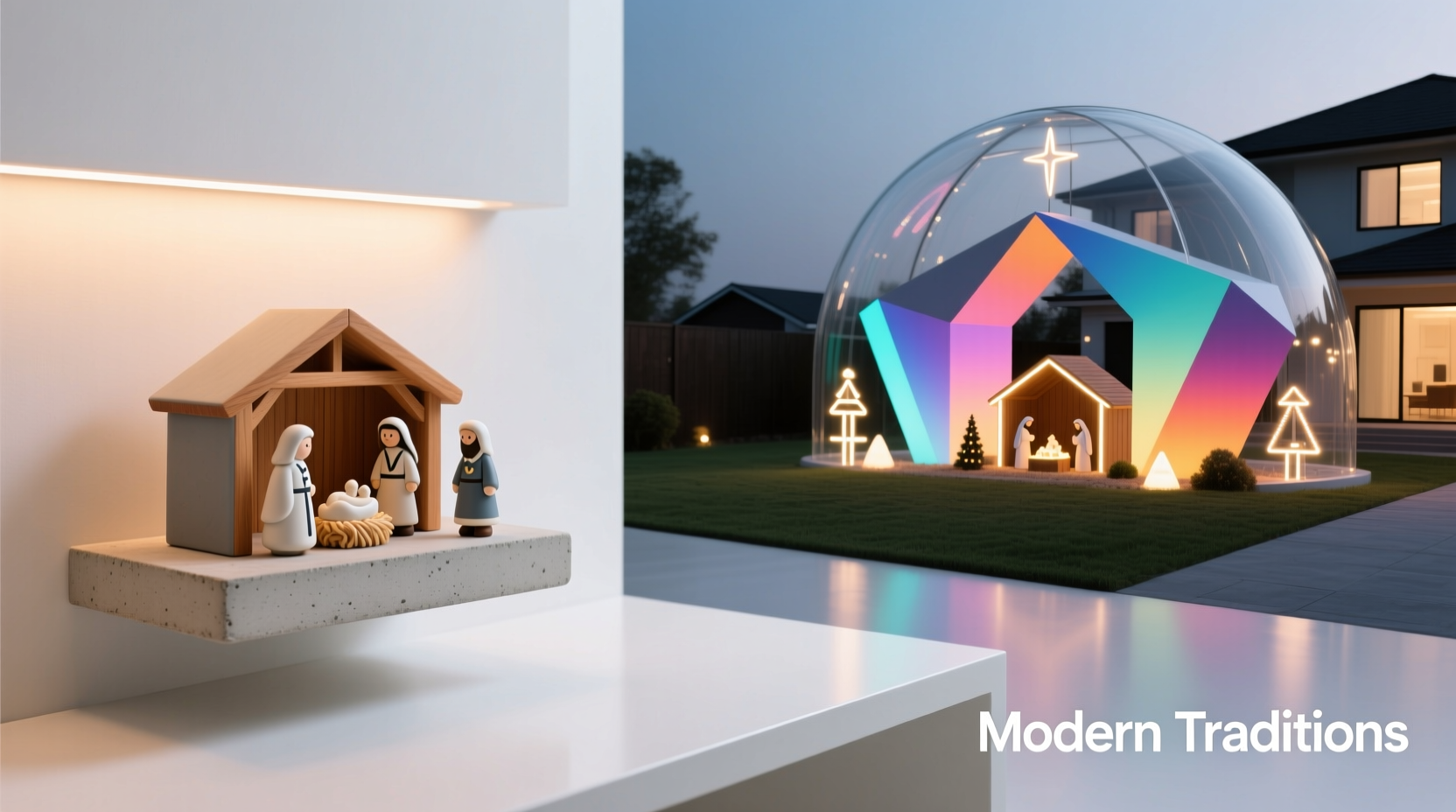
Modern holiday preferences reflect broader cultural shifts: smaller living spaces, heightened ecological awareness, digital saturation that makes physical stillness more valuable, and a growing desire for meaning over spectacle. A 2023 Pew Research study found that 68% of U.S. adults aged 25–44 describe their ideal holiday decor as “thoughtful rather than extravagant,” while 57% cite “low maintenance and sustainability” as top criteria. These aren’t abstract ideals—they translate directly into spatial decisions, material choices, and emotional resonance. A miniature nativity set thrives in this context: its scale invites pause, its portability supports flexible living arrangements, and its craftsmanship often emphasizes natural materials and artisanal integrity. A full yard display, meanwhile, gains renewed relevance not as kitsch or obligation—but as neighborhood-scale storytelling, interfaith visibility, or climate-resilient community engagement (e.g., solar-powered figures, native-plant borders). Neither option is inherently “outdated.” Their alignment with modernity depends entirely on *how* and *why* they’re deployed.
Miniature Nativity Sets: Intimacy, Craft, and Intentional Space
A well-chosen miniature nativity—whether hand-carved olive wood from Bethlehem, hand-painted ceramic from Oaxaca, or minimalist Scandinavian birch—operates as a focal point for reflection, not background noise. Its strength lies in human scale: figures small enough to fit comfortably in the palm, yet detailed enough to invite close observation—the curve of Mary’s shoulder, the texture of Joseph’s robe, the humility in the manger’s simplicity. Unlike mass-produced plastic sets, contemporary miniature nativities increasingly emphasize ethical sourcing, heirloom durability, and narrative nuance (e.g., including diverse ethnic representations or subtle references to displacement and refuge). They integrate seamlessly into multifunctional homes: placed beside a candle on a bookshelf, nestled among dried botanicals on a coffee table, or displayed year-round as devotional art rather than seasonal clutter.
Crucially, miniature sets support “slow celebration”—a counter-rhythm to the hyperstimulation of modern life. Lighting a single beeswax candle beside the manger each evening creates ritual without excess. Their modest footprint also sidesteps common modern stressors: HOA restrictions, energy use concerns, weather-related damage, and the logistical burden of annual installation and storage. For renters, apartment dwellers, or those in historic districts with strict exterior guidelines, miniature nativities aren’t a compromise—they’re an empowered choice aligned with autonomy and aesthetic cohesion.
Full Yard Displays: Reclaiming Public Witness and Community Narrative
The full yard nativity—a stable framed by shepherds, angels, and the star of Bethlehem stretching across a lawn—has long faced criticism as outdated or overly literal. Yet its resurgence in thoughtful iterations reveals a different impulse: the desire to make faith publicly legible in ways that feel generous, not imposing. Modern yard displays succeed when they reject caricature and embrace design intelligence. Consider the “Luminaria Nativity” in Santa Fe, NM: 12-foot-tall wire-frame figures wrapped in handmade cotton luminarias, lit by solar-powered LEDs, surrounded by drought-tolerant native grasses. Or the “Community Stable” project in Portland, OR, where local artists collaborated with refugee families to create life-sized clay figures representing global Advent traditions, installed on a public library lawn with QR codes linking to oral histories.
“People don’t reject nativity scenes—they reject incoherence. A yard display that feels like an afterthought, poorly lit, or visually disconnected from its surroundings fails. But one that engages local ecology, honors craft, and invites curiosity? That becomes civic theology in action.” — Dr. Lena Torres, Director of Faith & Public Life, Fuller Seminary
This evolution reflects modern taste’s demand for contextual integrity. A full yard display now communicates care—not just for doctrine, but for neighbors (quiet LED lighting), land (native plant integration), and narrative depth (inclusion of Magi as scholars, not exoticized “kings”). Its scale serves a purpose: visibility for those who walk or drive past, especially children, elders, or individuals isolated during winter months. In neighborhoods where front porches are gathering spaces and lawns function as shared green corridors, a thoughtfully designed nativity becomes part of the communal landscape—not an imposition, but an invitation to wonder.
Decision Framework: Which Format Serves Your Values Right Now?
Choosing between miniature and yard formats shouldn’t hinge on tradition alone. Use this practical framework to assess alignment with your current reality and priorities:
| Factor | Favors Miniature Set | Favors Full Yard Display |
|---|---|---|
| Living Situation | Renters, apartments, condos, historic districts with exterior restrictions, small patios or balconies | Homeowners with ≥500 sq ft of visible yard, suburban/rural settings, neighborhoods with active front-yard culture |
| Time & Maintenance | Under 5 minutes setup/teardown; no weatherproofing needed; stores flat in a drawer | Requires 2–4 hours annual setup; needs secure anchoring, weather-resistant materials, and seasonal inspection for wear |
| Eco-Values | Natural materials (wood, ceramic, wool); zero electricity; biodegradable packaging; often locally sourced | Solar-powered lighting; native plant integration; durable recycled-metal frames; community-shared installation reduces per-household footprint |
| Spiritual Practice | Supports daily contemplation, family prayer, teaching moments with young children at eye level | Facilitates neighborhood conversations, interfaith dialogue, and public witness rooted in hospitality, not proselytization |
| Aesthetic Alignment | Complements modern, minimalist, Scandinavian, or boho interiors; works with existing decor year-round | Enhances architectural lines of Craftsman bungalows, mid-century homes, or farmhouse styles; integrates with garden design |
Real-World Example: The Anderson Family’s Two-Year Evolution
The Andersons live in a 1920s rowhouse in Philadelphia with a 12’x15’ brick patio—too narrow for traditional yard figures, but too exposed for delicate indoor pieces. In Year 1, they purchased a $299 mass-market miniature set: brightly painted resin, garish gold accents, and a plastic manger. It felt “off”—clashing with their muted-gray living room and collecting dust after Epiphany. Frustrated, they donated it.
In Year 2, they commissioned a custom miniature set from a local woodworker using reclaimed black walnut. Each figure was hand-sanded, unstained, and mounted on a raw-edge slab base. They added a single beeswax pillar candle and dried rosemary sprigs. Placement shifted weekly: once on the dining table during Advent meals, once beside their daughter’s bed for bedtime stories, once on the patio ledge with fairy lights strung above. Neighbors began stopping to ask about the figures’ origin—not because it was loud, but because it felt quietly significant. When a nearby church invited them to contribute to a pop-up “Nativity Walk” in a community garden, they lent their set for the manger station, realizing its portability enabled participation they couldn’t have managed with a fixed yard display.
Their shift wasn’t about rejecting scale—it was about discovering how miniature form could amplify meaning, flexibility, and connection in their specific context. As Sarah Anderson noted in a neighborhood newsletter: “We stopped asking ‘How big should it be?’ and started asking ‘What do we want this to *do*?’ The answer turned out to be ‘hold space’—not fill it.”
Actionable Checklist: Choosing and Honoring Your Format
- Assess your space objectively: Measure usable indoor display areas AND outdoor square footage, noting HOA rules, light pollution concerns, and neighbor proximity.
- Define your primary intent: Is this for private devotion, family teaching, neighborhood welcome, artistic expression, or intergenerational continuity?
- Evaluate material ethics: For miniatures—seek FSC-certified wood, lead-free glazes, or fair-trade ceramics. For yard displays—prioritize solar power, powder-coated steel, and native plant companions.
- Plan for longevity: Choose pieces designed for multi-year use (avoid single-season plastics) and document care instructions for future stewards.
- Integrate, don’t isolate: Pair miniatures with tactile elements (linen cloths, pinecones) or yard displays with accessible pathways, braille labels, or multilingual signage.
FAQ
Can a miniature nativity feel “enough” spiritually, or is bigger always better?
Depth of meaning isn’t proportional to scale. Early Christian communities worshipped in catacombs and homes using tiny engraved symbols—a fish, an anchor, a chi-rho. The theological weight of the Incarnation rests in its paradoxical humility: God entering human fragility, not commanding attention through grandeur. A miniature set, precisely because it requires leaning in, mirrors that sacred intimacy. What matters is consistency of engagement—not cubic feet occupied.
Won’t a full yard display seem outdated or exclusionary in increasingly secular neighborhoods?
It can—if treated as static ornamentation. Modern relevance emerges when the display invites participation: hosting a “Stable Story Hour” for kids, partnering with local food banks for donation bins at the site, or incorporating symbols from other winter traditions (e.g., a shared light motif with Diwali or Hanukkah). Exclusion stems from monologue, not medium. A yard nativity becomes inclusive when it asks questions (“What does ‘good news’ mean in our block?”) rather than declaring answers.
How do I store a high-quality miniature set to preserve its integrity?
Store figures upright in individual compartments lined with acid-free tissue paper inside a rigid archival box. Keep the box in a cool, dry closet—never attics (heat) or basements (humidity). Avoid plastic bags (traps moisture) and cedar chests (oils degrade wood finishes). Wipe ceramic or wood annually with a soft, dry microfiber cloth; never use polish or water-based cleaners unless specified by the artisan.
Conclusion
The question “miniature nativity set vs full yard display” isn’t a binary to resolve—it’s an invitation to examine what you carry into this season: your values, your constraints, your hopes for connection, and your understanding of sacred presence. Modern taste doesn’t demand uniformity; it rewards authenticity. A miniature set crafted with reverence becomes a sanctuary in miniature. A yard display designed with ecological care and neighborly generosity becomes theology made visible on common ground. Neither is superior. Both become meaningful when chosen deliberately—not because they’re expected, but because they resonate with who you are, where you live, and what you wish to nurture in yourself and others.
Start where you are. If your space is small, let intimacy be your strength. If your yard is wide, let generosity guide your scale. If your time is scarce, honor that with simplicity. If your heart leans toward community, lean outward with intention. The manger was never about size—it was about making space. Make yours, however large or small, with clarity and care.




 浙公网安备
33010002000092号
浙公网安备
33010002000092号 浙B2-20120091-4
Comments
No comments yet. Why don't you start the discussion?