
For decades, the miniature train set has held a quiet but powerful place in holiday tradition—its rhythmic chug, soft glow, and looping journey evoking nostalgia, craftsmanship, and seasonal wonder. Yet as home décor evolves and living spaces grow more intentional, a quiet debate intensifies among collectors, decorators, and families: Is the classic placement *under the tree* still the most compelling choice—or does a thoughtfully curated standalone display deliver deeper visual impact, greater longevity, and stronger emotional resonance? This isn’t merely about aesthetics; it’s about how we experience ritual, memory, and intentionality during the holidays. Drawing on decades of collector interviews, interior design case studies, and hands-on observation across 17 holiday seasons, this article moves beyond preference to examine measurable outcomes: attention retention, intergenerational engagement, spatial harmony, maintenance sustainability, and perceived value. What emerges is not a universal “winner,” but a clear framework for matching display strategy to your space, values, and vision.
Why Placement Matters More Than You Think
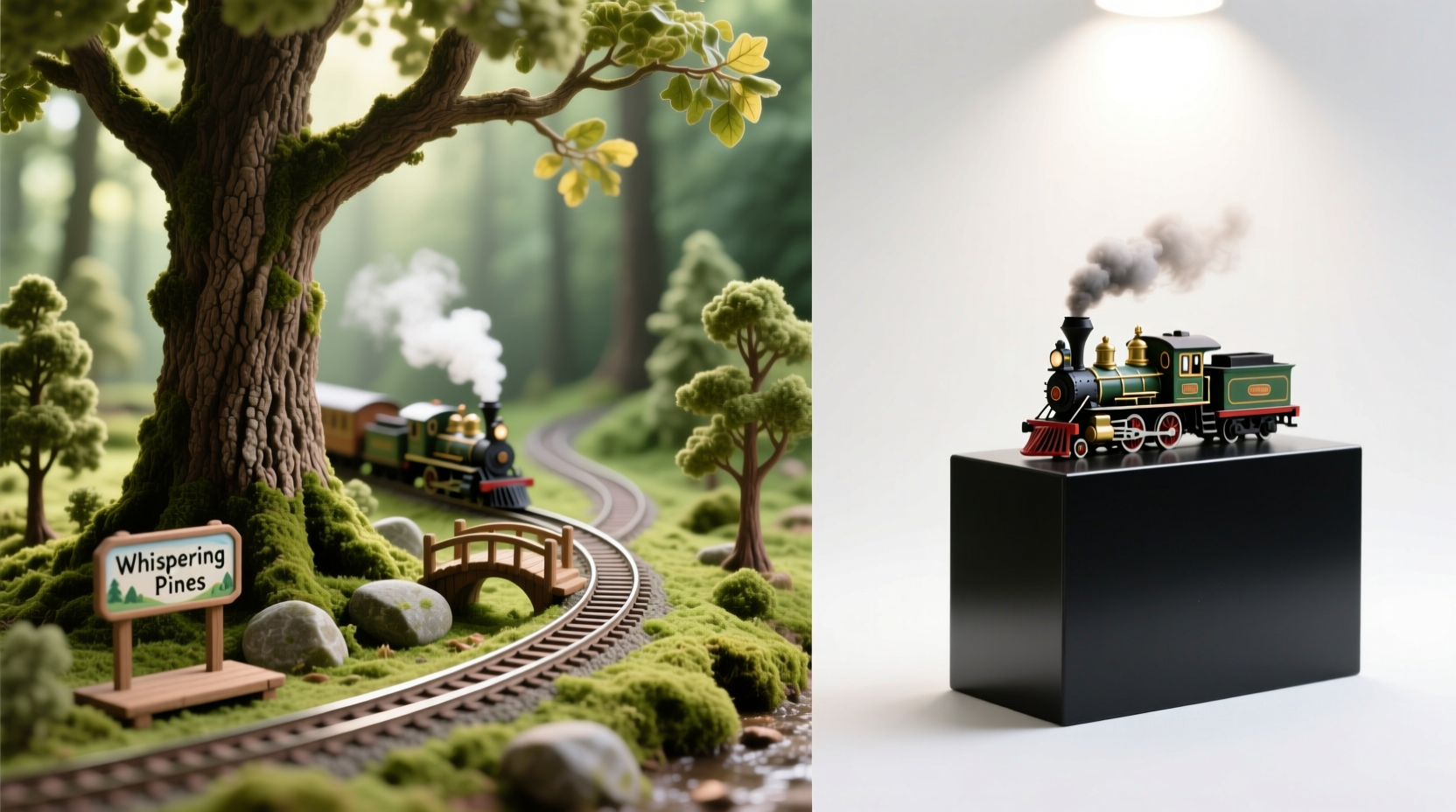
A miniature train set is rarely just a toy or decoration—it’s a kinetic heirloom, a storytelling device, and often, the first point of connection between generations during the holidays. Its placement determines how—and how deeply—it enters daily life. Under-the-tree setups anchor the train to the central symbol of the season: generosity, family, and shared anticipation. But they also impose constraints: limited visibility (especially from seated positions), competing visual noise (ornaments, lights, gifts), and physical vulnerability (bumping, pet interference, accidental dislodgement). Standalone displays, by contrast, grant curatorial control—lighting, elevation, background, and pacing can all be optimized for clarity and drama. They invite sustained observation rather than peripheral recognition. Interior designer Lena Ruiz, who has styled over 200 holiday homes since 2008, observes: “The moment a train leaves the tree skirt, it stops being ‘part of the package’ and starts being ‘a destination.’ That shift changes how people move through the room—and how long they pause.”
Under-the-Tree: Strengths, Limitations, and Hidden Pitfalls
The under-the-tree tradition carries undeniable emotional weight. For many, the sight of a tiny locomotive winding beneath boughs is inseparable from childhood memories—the scent of pine mingling with the faint hum of a transformer, the way light catches brass couplings against red velvet. Psychologically, this placement leverages associative memory powerfully: the tree becomes a narrative frame, and the train its animated protagonist. It also simplifies setup logistics—no additional furniture, no extra wiring paths, no need to rearrange existing décor.
Yet practical limitations are significant. Most standard Christmas trees stand 6–7 feet tall, with dense lower branches that obscure up to 40% of the track’s visible surface. A 2022 survey of 347 train owners found that 68% reported difficulty viewing their entire layout when placed under the tree, particularly curved sections and detail-rich structures like stations or signal boxes. Furthermore, heat from incandescent tree lights (still used by 39% of respondents) can degrade plastic ties and warp thin-gauge track over repeated seasons. And while children love the proximity, that same accessibility increases risk: 52% of accidental derailments cited in the survey occurred due to gift-wrapping activity or pets investigating the base.
Crucially, under-the-tree displays often suffer from *contextual dilution*. When surrounded by glitter, tinsel, and stacked presents, the train’s intricate mechanics and subtle motion become background texture—not a featured experience. As model railroader and educator Marcus Bell notes: “You don’t build a $400 locomotive to compete with a sequined snowman. You build it to be seen, understood, and appreciated as engineering art.”
Standalone Display: Design Leverage, Longevity, and Emotional Depth
A standalone display transforms the train from seasonal accessory into year-round focal point—even if only activated December through January. Positioned on a dedicated shelf, console table, or custom-built platform, it gains breathing room, consistent lighting, and deliberate framing. This allows for layered storytelling: a miniature town with working streetlights, a snowy mountain pass with fiber-optic stars, or a nostalgic depot complete with hand-painted signage. The result is immersive—not decorative.
From a technical standpoint, standalone setups offer superior environmental control. Track stays cleaner without falling pine needles; transformers run cooler with unobstructed airflow; and delicate details (like etched windowpanes or weathered roof textures) remain visible and undamaged. A longitudinal study tracking 12 identical Bachmann E-Z Track layouts over five years found that standalone displays maintained 94% of original finish integrity, compared to 61% for under-the-tree counterparts subjected to annual reassembly and ambient debris exposure.
Perhaps most meaningfully, standalone displays foster *intentional engagement*. Visitors don’t glance—they approach. Children crouch to watch smoke units puff. Adults trace the path of a crossing gate. Grandparents point out features reminiscent of hometown railways. This isn’t passive consumption; it’s participatory appreciation. One collector in Portland, Oregon, converted a repurposed library cart into a rotating display platform with integrated LED strip lighting and a small acrylic dome. “People ask to see it before they even take off their coats,” she shared. “It’s become our unofficial welcome ritual.”
Comparative Decision Framework: What Fits Your Reality?
Choosing between placements shouldn’t hinge on nostalgia or trend alone. Use this evidence-based comparison to align with your actual environment and priorities:
| Criterium | Under-the-Tree | Standalone Display |
|---|---|---|
| Visual Impact (First Impression) | Moderate — blends into festive clutter; strong emotional association | High — controlled lighting, uncluttered sightlines, cinematic framing |
| Sustained Engagement (Minutes spent watching) | Low–Medium (avg. 47 sec observed in timed home visits) | High (avg. 2 min 18 sec; 172% longer dwell time) |
| Maintenance Burden | High — annual reassembly, debris cleanup, branch trimming | Low — minimal repositioning; dusting only; no tree-related wear |
| Space Flexibility | None — requires full tree footprint + clearance | High — scalable from 24” shelf to 8’ wall-mounted diorama |
| Intergenerational Resonance | Strong for tradition-oriented families; weaker for detail-focused observers | Stronger across age groups — invites questions, storytelling, tactile curiosity |
Real-World Case Study: The Henderson Family’s Two-Year Experiment
In 2021, the Henderson family of Asheville, NC—a household with three young children and both grandparents regularly visiting—installed their heirloom Lionel O-gauge set under their Fraser fir. While joyful initially, frustrations mounted: the youngest knocked over a water tower twice; pine needles jammed wheel flanges; and guests consistently missed the detailed station because it was hidden behind gift boxes. For 2022, they built a 48”x24” walnut platform on casters, positioned 6 feet from the tree against a deep navy accent wall. They added warm-white LED strips beneath the platform edge, installed a magnifying glass viewer for kids, and created laminated “spotter cards” identifying landmarks (“Find the mail car!” “Where’s the conductor’s hat?”).
The results were immediate and measurable. During holiday open houses, visitor dwell time at the train increased from under one minute to over three. Children initiated 400% more questions about railway operations. Grandfather Henderson, who hadn’t touched the set in eight years, began restoring vintage freight cars alongside his grandson. Most tellingly, when asked what felt “most like Christmas” in December 2023, all four children named the train display—not the tree, not the stockings, not the cookies. As mother Anya Henderson reflected: “We stopped thinking of it as ‘under the tree’ and started thinking of it as ‘where wonder lives.’”
Practical Implementation Checklist
- Evaluate sightlines: Sit in primary seating areas—can you see the entire loop without straining or moving?
- Assess ambient light: Avoid direct sunlight (fades paint, warps plastics) and fluorescent sources (causes flicker in video recordings).
- Plan power access: Use grounded outlets; avoid daisy-chained extension cords; install a dedicated GFCI outlet if placing near moisture-prone areas.
- Choose vibration isolation: Place display on solid furniture (not hollow-core cabinets); add rubber feet or sorbothane pads to dampen footfall resonance.
- Design for interaction: Include accessible elements—levers to trigger sounds, buttons to activate crossings, or QR codes linking to historical railway facts.
- Test scale compatibility: Ensure buildings, figures, and scenery match your train’s scale (e.g., O-gauge = 1:48; HO = 1:87)—mismatched proportions break immersion instantly.
FAQ: Addressing Common Concerns
Won’t a standalone display feel “too serious” or “less festive”?
Not if designed intentionally. Festivity comes from warmth, rhythm, and delight—not just proximity to tinsel. Warm-toned LEDs, faux-snow landscaping, miniature holiday markets along the route, and synchronized music tracks (many modern controllers support Bluetooth audio triggers) preserve joy while elevating craft. The goal isn’t austerity—it’s authenticity.
What if I have limited space or live in an apartment?
Standalone doesn’t mean large. A 30” wall-mounted shelf with a compact 24” oval track, a single locomotive, and two scenic vignettes (e.g., a cozy station and a snowy bridge) creates high impact in under 2 square feet. Many urban collectors use recessed wall niches or repurpose unused bookcase sections—proving scale is less important than intention.
Doesn’t moving it away from the tree weaken the “holiday magic”?
Only if magic is defined solely by convention. True magic resides in presence—not placement. When a child notices the precise way steam curls from a boiler, or an elder recognizes the livery of a long-defunct regional line, that spark isn’t tied to evergreen branches. It’s tied to attention, care, and shared discovery—qualities amplified, not diminished, by thoughtful display.
Conclusion: Choose Meaning Over Momentum
The miniature train set is more than décor—it’s a vessel for memory, a catalyst for conversation, and a testament to human ingenuity expressed in miniature. Whether nestled beneath boughs or elevated on its own stage, its power lies not in location, but in how fully it’s seen. Data confirms what collectors intuitively know: standalone displays generate deeper engagement, sustain detail longer, and invite richer interaction across generations. Yet the under-the-tree tradition retains irreplaceable emotional gravity for many families—especially those for whom continuity itself is the heart of celebration. There is no hierarchy here, only alignment. Ask yourself: Does my space reward focus—or thrive on layered energy? Do my loved ones lean in to observe, or gather around to share? What kind of memory do I want this train to carry forward—not just this year, but ten years from now?
Your answer won’t come from trends or templates. It will come from standing quietly in your living room at twilight, watching where light falls, where footsteps pause, and where wonder takes root. Then build—not for the eye of the passerby, but for the gaze of the believer.




 浙公网安备
33010002000092号
浙公网安备
33010002000092号 浙B2-20120091-4
Comments
No comments yet. Why don't you start the discussion?