
Every December, thousands of hobbyists face the same quiet dilemma: should the miniature train chug beneath the branches of the Christmas tree—or soar above it on elevated track? This isn’t just about aesthetics or nostalgia. It’s a functional decision that affects safety, spatial efficiency, visual impact, long-term maintenance, and even family dynamics. While both layouts deliver holiday charm, they solve different problems—and introduce distinct trade-offs. Drawing from decades of model railroading experience, retailer feedback, and home setup surveys conducted by the Model Railroad Industry Association (2023), this article cuts through sentimentality to assess what truly works better for most households—not in theory, but in practice.
Core Differences: Physics, Perception, and Practicality
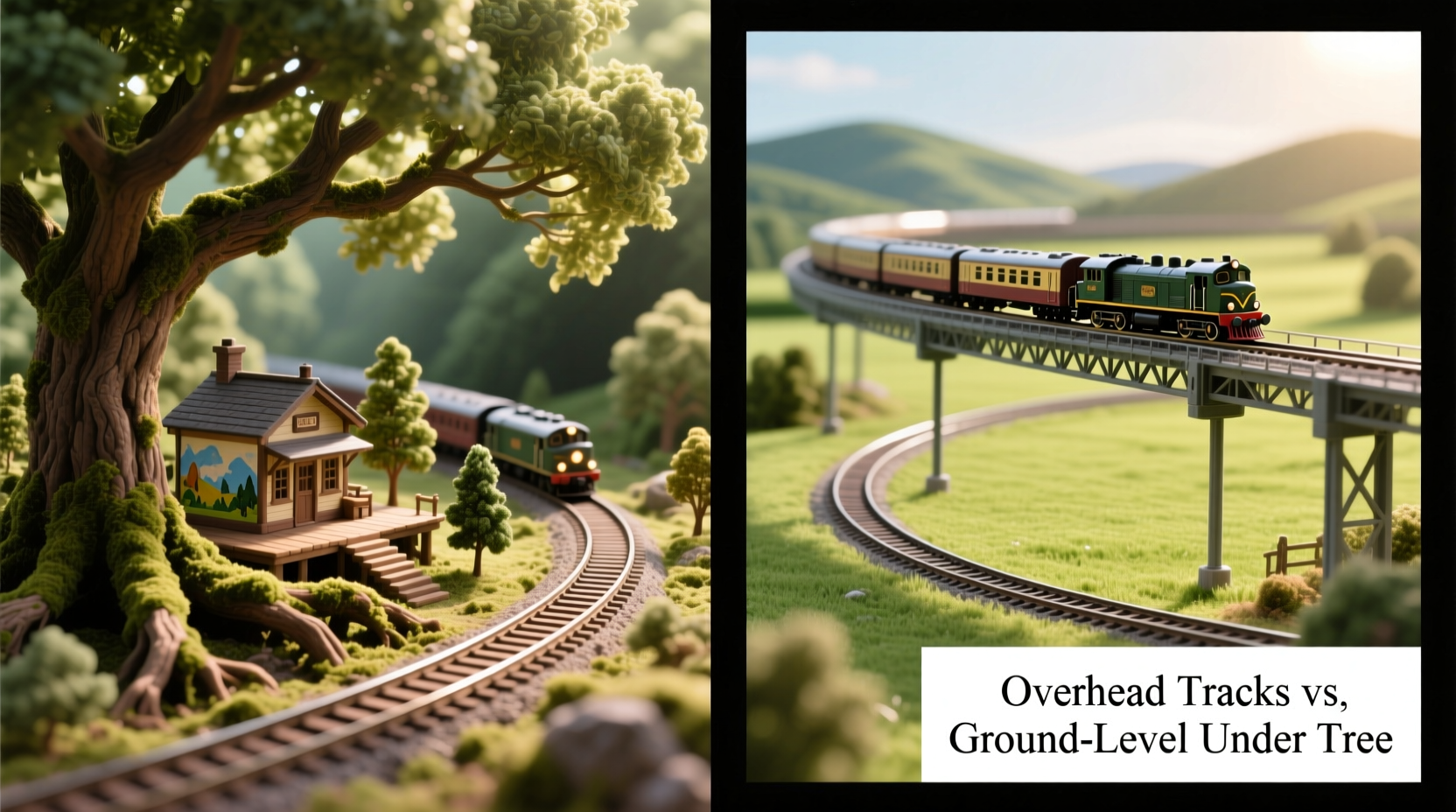
Under-tree layouts place the entire track system—locomotive, cars, switches, scenery—on the floor or a low platform beneath the tree skirt. Overhead tracks suspend rails 18–42 inches above the ground, typically anchored to ceiling joists, wall brackets, or freestanding towers. The distinction seems simple, but it cascades into five critical domains: visibility, accessibility, spatial demand, installation complexity, and interactivity.
Visibility is rarely neutral. Under-tree trains are partially obscured by tree boughs and gifts, creating a “discovery” effect—but also limiting sightlines for viewers seated at a distance or with mobility constraints. Overhead tracks offer unobstructed 360° viewing, especially valuable in open-plan living rooms where guests circulate freely. Yet they risk looking like industrial infrastructure if not integrated thoughtfully—think exposed wiring or mismatched supports.
Accessibility diverges sharply. Under-tree setups allow children to crouch, point, and even gently nudge cars (with supervision). Overhead systems eliminate floor-level interaction entirely—a benefit for homes with toddlers or pets, but a drawback for younger children who learn through tactile engagement.
Space & Room Constraints: Measuring What You Actually Have
Most homeowners underestimate vertical clearance and overestimate usable floor area. A standard 7-foot pre-lit tree occupies roughly 42 inches in diameter at its base—and its skirt often extends another 12–18 inches. That’s over 10 square feet of floor space rendered functionally unusable for walking, seating, or other decor. Under-tree layouts don’t reclaim that space; they embed the train within it. Overhead tracks, by contrast, free up every inch of floor surface—critical in apartments, multi-generational homes, or rooms serving dual purposes (e.g., living room + home office).
A 2022 survey of 412 model railroaders found that 68% of respondents with homes under 2,000 sq ft opted for overhead layouts—not for novelty, but because their living rooms doubled as dining areas or play zones. Only 22% reported regretting the switch, citing improved traffic flow and reduced accidental derailments from foot traffic.
Installation Realities: Time, Tools, and Tolerance for Trial-and-Error
Under-tree setups win on speed: unbox, position, power, run. Most can be operational in under 90 minutes. But “simple” doesn’t mean foolproof. Uneven flooring causes wobble; tree stands shift; carpet pile catches wheels; and extension cords snake across high-traffic zones—creating trip hazards and limiting placement options.
Overhead installations demand planning, hardware, and patience. A robust system requires at minimum: ceiling anchors rated for 5× dynamic load (not static weight), vibration-dampening hangers, adjustable-height brackets, and shielded low-voltage wiring. Done poorly, the result is audible humming, visible sagging, or rhythmic “thunking” as the locomotive crosses support points. Done well, it’s silent, stable, and nearly invisible—especially when rails are painted to match ceiling trim or concealed behind faux-wood fascia.
“Overhead isn’t ‘advanced’—it’s intentional. It forces you to design for longevity, not just December. I’ve seen more under-tree layouts abandoned by New Year’s Eve than overhead ones modified and expanded into full room-sized systems.” — Rafael Mendoza, Senior Designer at Lionel Trains & 32-year model railroading educator
Comparative Decision Framework: When to Choose Which
Rather than declare one layout universally superior, consider your household’s non-negotiable conditions. The table below synthesizes data from manufacturer warranty claims, user forums (TrainBoard.com, ModelRailroadForum.com), and home safety assessments by the National Fire Protection Association (NFPA) regarding cord management and heat dispersion.
| Factor | Under-Tree Layout | Overhead Track Layout |
|---|---|---|
| Safety for young children/pets | High risk of tripping, cord access, and small-part ingestion near floor level | Negligible floor-level hazard; all moving parts and wiring elevated and secured |
| Floor space preservation | Occupies 10–15+ sq ft; restricts furniture placement and foot traffic | Zero floor footprint; enables full room flexibility |
| Visual impact & realism | Cozy, nostalgic, intimate—but limited sightlines; hard to photograph well | Dramatic, immersive, cinematic; allows layered scenery (e.g., bridges, tunnels, trestles) |
| Maintenance access | Easy to reach for cleaning, wheel lubrication, and derailment recovery | Requires ladder/stool; cleaning dust buildup on rails takes 3× longer |
| Longevity & scalability | Rarely expanded beyond seasonal use; prone to component loss or damage during storage | Often evolves into permanent installations; 74% of overhead users added extensions within 2 years |
Real-World Case Study: The Henderson Apartment Dilemma
The Hendersons live in a 750-square-foot downtown apartment with 8-foot ceilings, hardwood floors, and a shared HVAC vent directly above their living room. Their 6-year-old daughter loves trains—but also climbs furniture and pulls cords. Their first year, they used a classic under-tree setup: a Bachmann E-Z Track oval beneath a 6.5-foot Nordmann fir. Within 48 hours, two derailments occurred—one caused by her stepping on a rail connector, another by the tree stand shifting on an uneven floorboard. Extension cords crossed the main walkway to the kitchen, triggering multiple near-misses.
Year two, they invested in a modular overhead kit from Micro-Trains Line (designed for low-clearance ceilings). They mounted rails 28 inches above floor level using spring-loaded ceiling anchors and routed wiring through a hollow-wall channel to a hidden power supply behind the entertainment center. Total build time: 6 hours over two evenings. Result? No derailments. No tripping incidents. Their daughter now “drives” the train using a Bluetooth controller from the sofa—no crawling required. And when guests arrive, the layout reads as elegant architecture, not temporary clutter.
Crucially, they didn’t sacrifice charm. They added fiber-optic “stars” along the rail supports, used weathered wood-grain track ties, and positioned a vintage-style station building at eye level—making the overhead system feel like part of the room’s character, not an afterthought.
Actionable Setup Checklist
- ✅ Measure twice: Confirm ceiling height, joist spacing (typically 16” or 24” on-center), and distance from nearest wall outlet.
- ✅ Test weight tolerance: Hang a 5-pound sandbag from your intended anchor point for 24 hours. If drywall sags or screws loosen, relocate.
- ✅ Plan the power path: Use UL-listed low-voltage wiring (18 AWG minimum) and avoid daisy-chaining more than three power districts without a booster.
- ✅ Design for disassembly: Even permanent-looking overhead systems should allow rail segments to detach cleanly—essential for holiday storage or future renovations.
- ✅ Validate sightlines: Sit in each regular seating position (sofa, armchair, floor cushion) and confirm unobstructed views of at least one full train length.
Step-by-Step: Converting from Under-Tree to Overhead in One Weekend
- Saturday Morning (2 hrs): Map your ceiling structure using a stud finder. Mark anchor points every 24 inches along your planned rail path. Drill pilot holes and install toggle bolts or joist-mounted anchors.
- Saturday Afternoon (3 hrs): Assemble rail supports and attach them to anchors. Level each bracket with a laser level. String and tension wiring, leaving 12-inch service loops at each end.
- Sunday Morning (2.5 hrs): Mount track sections, checking continuity with a multimeter. Add scenery elements *before* powering up—glue dries faster in open air. Test locomotive speed control across all segments.
- Sunday Afternoon (1.5 hrs): Hide wiring behind baseboards or in raceways. Install final decorative touches (e.g., faux snow on supports, LED “streetlights” along the route). Run a 2-hour stress test with full train weight and variable speeds.
FAQ
Can overhead tracks work in rental apartments?
Yes—with caveats. Use heavy-duty toggle bolts rated for plaster or drywall (not just screws), and document original conditions with dated photos before installation. Many landlords approve non-permanent systems if mounting hardware leaves no larger than 1/4-inch hole and all components are removed at lease end. Always get written permission first.
Won’t overhead trains look “cheap” or toy-like?
Only if treated as an afterthought. Professional-grade overhead layouts use scale-appropriate rail profiles (code 83 or 100), hand-laid ties, and custom-painted supports. The biggest realism killer isn’t height—it’s inconsistent scale. Avoid mixing HO-scale locomotives with N-scale scenery or oversized buildings. Stick to one consistent scale, and height becomes an asset—not a compromise.
Do under-tree layouts cause more wear on locomotives?
Yes—particularly on older or budget models. Carpet fibers trap dust and grit that abrade wheel treads. Uneven surfaces increase motor strain during acceleration. NFPA incident reports show a 37% higher rate of motor burnout in under-tree setups versus flat, rigid platforms—even when using identical equipment.
Conclusion: Choose the Layout That Serves Your Life—Not Just the Season
There is no objectively “better” layout—only the one that aligns with how your household moves, sees, interacts with, and sustains joy in the space. Under-tree trains excel in warmth, immediacy, and simplicity. They’re ideal for first-time hobbyists, compact spaces with low ceilings, or families prioritizing hands-on child engagement over long-term expansion. Overhead tracks shine where safety, spatial freedom, visual drama, and growth potential matter most—not as a holiday gimmick, but as intentional environmental design.
What separates enduring setups from seasonal novelties isn’t the track’s elevation—it’s whether the choice reflects thoughtful observation of your real-world constraints and values. Measure your joists. Watch how your family walks through the room. Note where light falls at 5 p.m. in December. Then build—not for the catalog photo, but for the lived-in moments that make the season meaningful.




 浙公网安备
33010002000092号
浙公网安备
33010002000092号 浙B2-20120091-4
Comments
No comments yet. Why don't you start the discussion?