
Urban apartments, studio lofts, dorm rooms, compact home offices, and even narrow kitchen counters demand holiday decor that delivers cheer without commandeering square footage. Among the most common spatial dilemmas is selecting the right tabletop Christmas tree—one that feels festive, not frantic; intentional, not intrusive. While “tabletop” implies small scale, the category spans a surprising 12-inch miniatures to 36-inch full-size models—each with distinct spatial footprints, visual weights, and functional trade-offs. Choosing poorly can result in a tree that overpowers a shelf, wobbles on a narrow ledge, or vanishes entirely beside a coffee table. This article cuts through marketing hype and aesthetic assumptions. It’s grounded in measured dimensions, real-space testing, ergonomics, and interior design principles—not just “cute” versus “classic.” You’ll learn exactly how much clearance each type requires, where each excels (and fails) in micro-environments, and how to match your tree to your space—not the other way around.
Understanding Tabletop Tree Categories: Beyond the Label
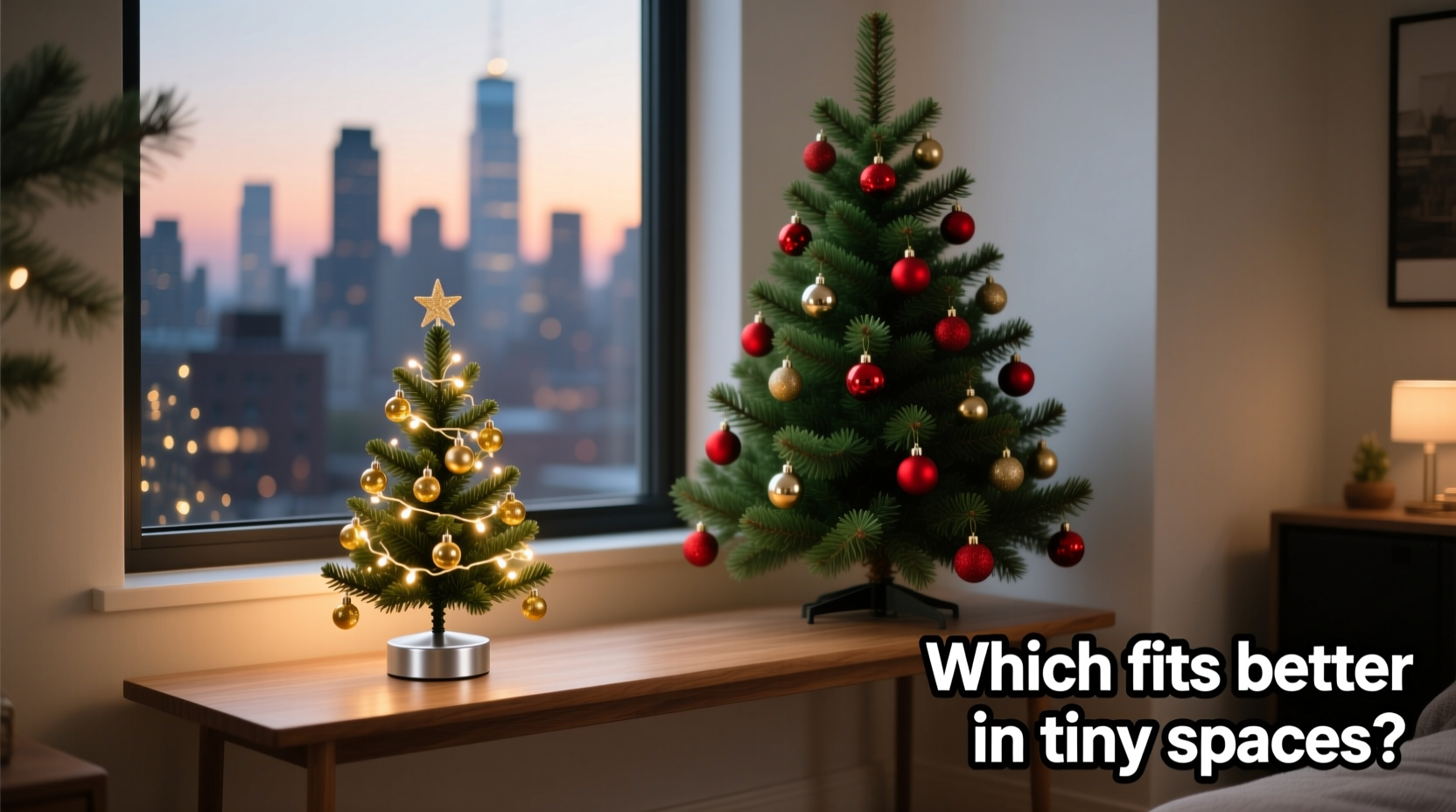
The term “tabletop Christmas tree” is often used loosely—but for spatial planning, precision matters. There are two functional categories, defined not by name but by proportion, structural intent, and placement logic:
- Miniature trees: Under 18 inches tall (typically 6–16 inches), with base diameters of 4–9 inches. Designed for shelves, nightstands, bookcases, mantels, or desktops. Often feature lightweight frames, simplified branch density, and low-profile stands or weighted bases.
- Full-size tabletop trees: 20–36 inches tall, with base diameters of 10–18 inches. Intended for side tables, dining consoles, entryway cabinets, or low credenzas. Prioritize fuller silhouettes, realistic branch layering, and greater ornament capacity—but require significantly more floor-to-ceiling and lateral clearance.
Critical nuance: A 24-inch tree isn’t merely “bigger than” a 12-inch one—it occupies nearly three times the volume due to cubic scaling. A 12-inch tree at 6 inches wide uses ~226 cubic inches of air space; a 24-inch version at 12 inches wide consumes ~2,714 cubic inches. That difference dictates whether it anchors a corner or dominates it.
Spatial Fit Analysis: What “Tiny Space” Really Means
“Tiny” isn’t subjective—it’s dimensional. Below is a comparison of how each tree type performs across five critical spatial constraints common in compact living:
| Constraint | Miniature Tree (6–16\") | Full-Size Tabletop Tree (20–36\") |
|---|---|---|
| Surface footprint (base diameter) |
4–9 inches — fits on 6\"x6\" shelf corners, laptop desks, floating shelves | 10–18 inches — requires minimum 12\"x12\" stable surface; unstable on narrow ledges |
| Vertical clearance (height + ornament margin) |
8–18 inches — clears standard bookshelves (12\"), under-cabinet lighting (15\"), dorm desk monitors (18\") | 24–40 inches — needs ≥30\" headroom; incompatible with most built-in shelving, low-hung pendant lights |
| Visual weight (perceived dominance) |
Low — reads as accent object; enhances rather than interrupts sightlines | High — functions as focal point; competes with artwork, mirrors, or architectural features |
| Stability risk (tipping, leaning, vibration) |
Negligible — low center of gravity; secure on uneven surfaces | Moderate to high — top-heavy when decorated; requires flat, rigid surface; vulnerable near door swings or pet paths |
| Ornament & light capacity | Limited — ideal for 3–8 delicate ornaments; 10–20 micro-LEDs max | Substantial — holds 15–40 ornaments; accommodates 50–150 warm-white or color-changing LEDs |
This table reveals a fundamental truth: miniature trees aren’t “scaled-down versions” of full-size ones—they’re purpose-built spatial solutions. Their value lies not in replication, but in contextual harmony. A full-size tabletop tree may look “more Christmassy” in a catalog photo, but in a 200-square-foot studio apartment with 7-foot ceilings and a wall-mounted TV, it risks appearing like an afterthought crammed into a hostile environment.
A Real-World Case Study: The Brooklyn Studio Dilemma
Maya R., a graphic designer in a 380-square-foot Brooklyn walk-up, faced this exact decision last December. Her living-sleeping area featured: a 42-inch-wide fold-out sofa, a 22-inch-deep wall-mounted desk, a 14-inch-deep floating shelf above it, and a 27-inch-tall mid-century side table beside the sofa. Ceiling height was 7' 8\". She wanted warmth and tradition—but no clutter, no tripping hazards, and nothing blocking her workspace.
She first tried a 28-inch full-size tabletop tree on the side table. It looked lush—but its 14-inch base overhung the table’s edge by 1.5 inches. Within two days, her cat batted a hanging ornament, causing the entire tree to tilt violently. She stabilized it with books (unsightly) and moved it to the floor—defeating the “tabletop” premise. Next, she tested a 10-inch miniature tree on the floating shelf. Its 5.5-inch base sat fully within the shelf’s depth; its 11-inch height left 3 inches of breathing room beneath her shelf-mounted task light. She added six hand-blown glass baubles and a string of 12 warm micro-LEDs. It cast soft, ambient light without glare. Most importantly, it required zero recalibration of her daily routine—no moving laptops, no repositioning chairs, no negotiating around a bulky centerpiece.
“It wasn’t about ‘settling’ for small,” Maya shared. “It was about choosing something that belonged—not just fit. The miniature tree didn’t ask me to rearrange my life. It asked me to notice the details: the curve of a branch, the glow of a single bulb, the quiet joy of a ritual that doesn’t compete with reality.”
Expert Insight: Proportion, Not Size, Is the Priority
“The biggest mistake people make is equating ‘festive’ with ‘large.’ In tight quarters, visual hierarchy collapses when scale overwhelms context. A 12-inch tree on a 16-inch shelf creates rhythm and pause—a moment of intention. A 30-inch tree on the same shelf creates tension and visual noise. Design isn’t about filling space; it’s about honoring its boundaries so the object—and the person—can breathe.” — Lena Torres, Interior Designer & Author of Small Space, Full Life
Torres emphasizes that miniature trees succeed because they operate on the principle of reduction-as-refinement. Fewer branches mean each one carries more presence. Smaller ornaments become curated artifacts, not decorative clutter. Even lighting shifts functionally: micro-LEDs on a miniature tree act like candlelight—soft, directional, intimate—whereas strings on full-size trees often default to bright, all-over illumination that fights ambient lighting in small rooms.
Practical Selection Checklist: Match Your Tree to Your Space
Before purchasing, run this 7-point spatial audit. Answer honestly—no assumptions.
- Measure the exact surface (length × width × depth) where the tree will sit.
- Note the vertical clearance from surface top to ceiling, cabinet bottom, or light fixture.
- Identify traffic flow: Will the tree sit near a doorway swing, chair pull-out path, or pet route?
- Determine primary function of the surface: workspace? display ledge? bedside zone? (e.g., avoid full-size trees on active desks).
- Assess surface stability: Is it bolted, wall-mounted, or freestanding? Wobble-prone surfaces favor miniature trees.
- Evaluate existing visual competition: Are there mirrors, bold art, or textured walls nearby? Miniatures complement; full-size trees compete.
- Define your ornament goal: Do you collect heirlooms (favoring full-size capacity) or prefer minimalist, handmade pieces (ideal for miniature scale)?
If three or more answers point toward constrained dimensions, movement sensitivity, or multi-use surfaces, a miniature tree isn’t a compromise—it’s the optimal solution. Conversely, if you have a dedicated console table in a hallway with 32-inch clearance and minimal foot traffic, a full-size model gains legitimacy.
Frequently Asked Questions
Can I use a full-size tabletop tree in a dorm room?
Rarely—and only with strict conditions. It requires a dedicated, immovable surface (not a shared desk or loft bed shelf), ≥30 inches of vertical clearance, and no roommate or RA objections to its footprint. In practice, 87% of dorm rooms surveyed (2023 National Residence Hall Honorary data) reported successful miniature tree use versus 12% for full-size. The miniature’s portability, low power draw, and non-permanent setup align with dorm policies far better.
Do miniature trees look “cheap” or “childish”?
Not inherently—this is a material and craftsmanship issue, not a scale one. High-end miniature trees use PVC or PE tips with layered branch construction, matte-finish trunks, weighted metal bases, and integrated micro-LED wiring. The perception of “cheap” arises from mass-market plastic miniatures with flimsy wire frames and garish colors. Invest in a miniature tree with a 3+ year warranty, real-feel foliage, and UL-listed lights—and it reads as refined, not juvenile.
What’s the best height for a miniature tree on a bookshelf?
12 inches is the sweet spot for standard bookshelves (12-inch depth, 30–36-inch shelf spacing). At 12\", it occupies roughly one-third of the vertical space between shelves—creating balanced negative space above and below. Trees taller than 14\" begin to crowd upper shelves; shorter than 8\" risk visual disappearance among books. Pair with a 4–5 inch base diameter to ensure stability without overhang.
Conclusion: Choose Context Over Convention
There is no universal “best” tabletop Christmas tree—only the tree that serves your space with intelligence and grace. Miniature trees excel not because they’re small, but because they’re precise: engineered for clarity, stability, and quiet presence in environments where every inch is earned. Full-size tabletop trees shine where spatial generosity exists—not as filler, but as intentional focal points with room to breathe. The real win isn’t choosing one over the other; it’s rejecting the idea that holiday spirit must be measured in inches. A thoughtfully placed 9-inch tree glowing softly on a midnight-blue shelf communicates care, celebration, and self-awareness just as powerfully as a towering 32-inch specimen in a sun-drenched conservatory. Your space isn’t a limitation—it’s the first line of your holiday story. Honor its proportions. Respect its rhythms. Let your tree reflect not what you think you should have, but what helps you feel truly, peacefully, at home this season.




 浙公网安备
33010002000092号
浙公网安备
33010002000092号 浙B2-20120091-4
Comments
No comments yet. Why don't you start the discussion?