
Minimalism in holiday decor has evolved far beyond a passing aesthetic—it’s become a deliberate response to cultural fatigue with excess, rising sustainability awareness, and a growing desire for spaces that feel calm, grounded, and deeply personal. In 2025, the question isn’t whether minimalism is relevant, but how it’s maturing: shedding austerity for warmth, rejecting emptiness for intentionality, and redefining “bare” as a canvas—not an absence. Bare-branch trees—those unadorned or lightly dressed silhouettes of real or high-fidelity faux firs—remain central to this movement, but their role has shifted. They’re no longer just a statement of restraint; they’re the quiet anchor in a more nuanced, layered, and human-centered approach to Christmas. This article examines what’s genuinely new in 2025, separates myth from momentum, and gives you concrete, tested strategies to make minimalist trees feel rich—not spare.
The Evolution: From “Bare” to “Breathing”
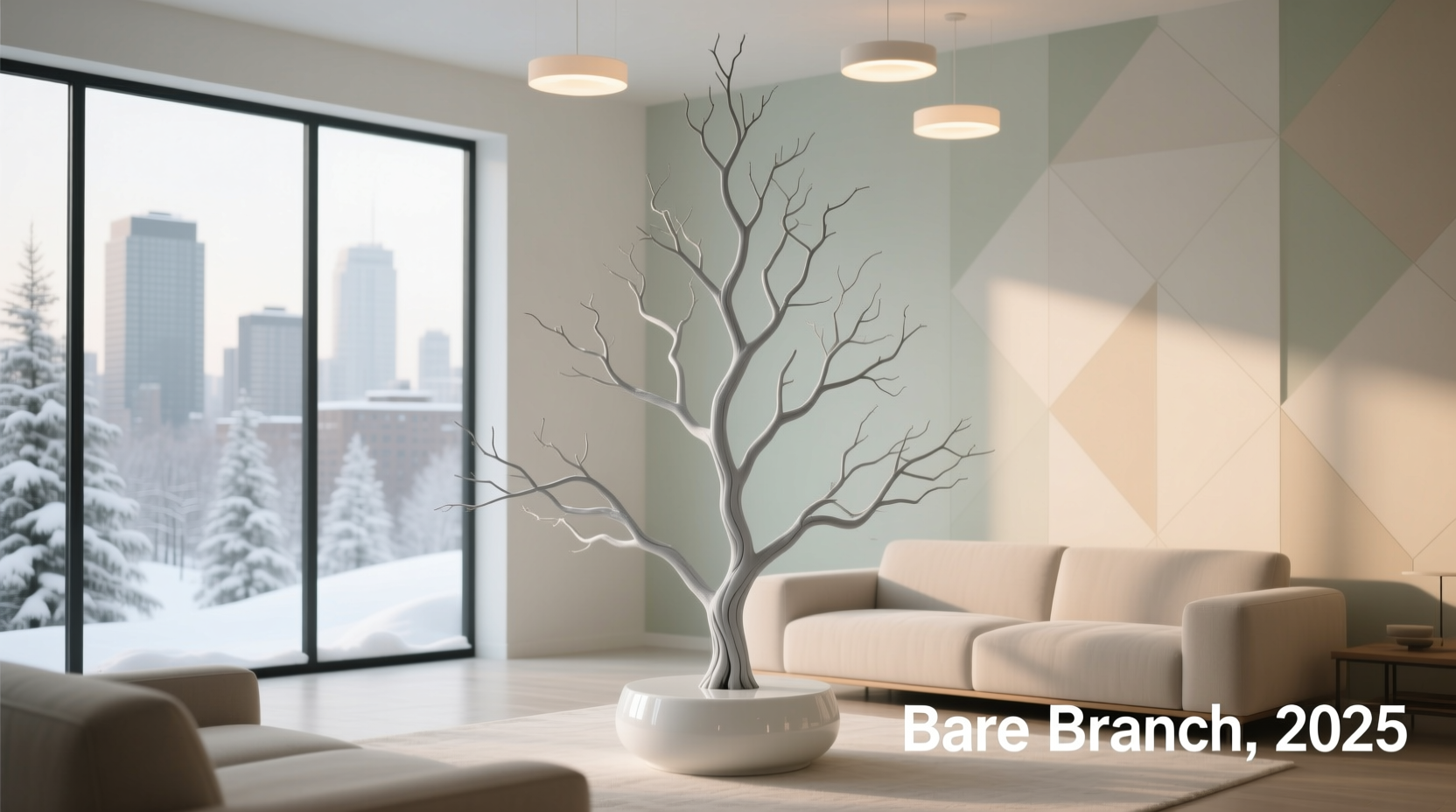
In 2022 and 2023, the bare-branch tree often signaled radical simplicity: a single species (usually Nordmann fir or noble fir), no ornaments, maybe one ribbon at the base. It was elegant, yes—but sometimes read as clinical or emotionally distant. By 2025, designers and homeowners alike are embracing what interior architect Lena Torres calls the “breathing tree.” This concept retains the clean silhouette and structural honesty of bare branches but invites subtle, meaningful presence: a single hand-thrown ceramic ornament hung at eye level; dried botanicals wired discreetly into lower boughs; or a custom-wrapped trunk using undyed linen twine. The shift reflects broader design currents—Japandi’s emphasis on texture and quiet luxury, biophilic design’s focus on natural materiality, and Gen Z and Millennial homeowners prioritizing authenticity over perfection.
This evolution is data-backed. A 2024 survey by the Sustainable Holiday Institute found that 68% of respondents who chose a minimalist tree cited “reducing decision fatigue during the holidays” as a top motivator—up from 41% in 2021. Simultaneously, sales of artisanal, small-batch ornaments (think hand-blown glass baubles, foraged pinecone clusters, or recycled-paper stars) rose 34% year-over-year among minimalist-leaning shoppers. The message is clear: people want less clutter, not less meaning.
What’s In, What’s Out: The 2025 Minimalist Tree Checklist
Staying current isn’t about chasing novelty—it’s about aligning choices with enduring values. Here’s what defines authentic 2025 minimalism, distilled into actionable criteria:
- In: Real or ultra-realistic faux trees with visible branch structure (no dense, “fluffy” tips)
- In: Monochromatic or tonal ornament palettes (e.g., ivory, oat, charcoal, and warm taupe)
- In: Textural contrast over color contrast (e.g., matte ceramic + nubby wool + smooth river stone)
- In: Asymmetrical placement—ornaments clustered loosely on one side or concentrated near the base
- Out: Uniform spacing (“evenly spaced every 6 inches”)—it reads as algorithmic, not human
- Out: Plastic or metallic finishes unless intentionally patinated or matte
- Out: Themed sets (e.g., full “vintage Santa” or “candy cane” collections)—they undermine individuality
- Out: Trees hidden behind oversized stands or bases—structure should be visible and celebrated
Real-World Example: Maya’s Portland Living Room
Maya Chen, a graphic designer and mother of two in Portland, Oregon, switched to a minimalist tree in 2023 after feeling overwhelmed by holiday prep. Her first attempt—a completely bare, 7-foot Fraser fir—felt peaceful but impersonal. “It looked like a prop,” she says. “Not like something my kids would want to sit beside.” For 2025, she collaborated with a local ceramicist to create five irregular, hand-glazed ornaments in muted sage and clay tones—each slightly different in size and surface texture. She hung them asymmetrically on the lower third of the tree, using undyed hemp cord. At the base, she arranged foraged Douglas fir cones, river stones collected from the Columbia River, and a single, oversized linen sack holding her children’s handmade cards. No lights. No tinsel. No tree skirt. “The difference is in the weight of attention,” Maya explains. “We spend time placing each ornament, choosing each stone. The tree isn’t decoration—it’s a ritual object. My six-year-old now asks, ‘Where’s the special rock?’ before bedtime. That’s the point.” Her tree isn’t bare. It’s held.
2025 Ornament & Material Trends: A Comparative Guide
Choosing materials matters more than ever—not just for aesthetics, but for longevity, ethics, and emotional resonance. Below is a comparison of key options, evaluated across four critical 2025 priorities: sustainability, tactile richness, visual longevity, and ease of storage.
| Material | Sustainability Score (1–5) | Tactile Richness | Visual Longevity* | Storage Ease |
|---|---|---|---|---|
| Hand-thrown stoneware | 5 | ★★★★★ (weight, grain, subtle glaze variation) | Exceptional — ages beautifully, develops patina | Moderate (needs padded stacking) |
| Dried native botanicals (e.g., cedar, yarrow, milkweed pods) | 5 | ★★★★☆ (fragile but deeply textural) | Seasonal — intended to fade or crumble gracefully | Easy (flat, lightweight) |
| Recycled glass (matte finish) | 4 | ★★★☆☆ (cool, smooth, slight irregularity) | High — resists scratches and yellowing | Easy (nestable shapes) |
| FSC-certified wood (unfinished or oil-rubbed) | 5 | ★★★★☆ (warm, porous, grain visible) | High — improves with age and handling | Moderate (needs airflow to prevent warping) |
| Plastic (even “eco” variants) | 1 | ★☆☆☆☆ (uniform, synthetic feel) | Low — yellows, scratches, feels dated quickly | Easy (but ethically costly) |
*Visual Longevity = How well the material maintains its aesthetic integrity and emotional resonance over multiple seasons, not just physical durability.
Expert Insight: Why Structure Trumps Surface
Interior stylist and sustainable design educator Aris Thorne has curated over 200 minimalist holiday installations since 2020. His work consistently centers on architectural integrity—not ornamentation—as the foundation of impact. In his latest book, *The Uncluttered Hearth*, he writes:
“The most powerful minimalist trees aren’t defined by what’s missing—they’re defined by what’s revealed. When you remove visual noise, the tree’s inherent architecture emerges: the sweep of a branch, the density gradient from trunk to tip, the way light catches a needle’s edge. That’s where meaning lives—in the honest shape of the thing itself. Adding three carefully chosen elements doesn’t contradict that. It converses with it. But adding thirty? That’s not conversation. That’s interruption.” — Aris Thorne, author of The Uncluttered Hearth (2024)
Thorne’s principle explains why the bare-branch trend endures: it’s not about deprivation, but about honoring the tree as a living form—even when artificial. A high-quality faux tree designed with realistic branch taper, varied needle lengths, and a visible, sculptural trunk satisfies the same psychological need for authenticity that drives real-tree buyers. In 2025, the distinction between “real” and “faux” matters less than fidelity to structure.
Your 2025 Minimalist Tree: A Step-by-Step Styling Timeline
Building a meaningful minimalist tree isn’t spontaneous—it’s a considered sequence. Follow this timeline for best results, starting 10 days before your main holiday gathering:
- Day 10–8: Select & Position Your Tree — Choose based on branch articulation, not height alone. Place it where natural light falls across its profile (not directly behind it). Ensure the stand is low-profile and matte-finish (black iron or unlacquered brass).
- Day 7: Curate Your Elements — Gather no more than 5–7 total items: 3–5 ornaments, 1–2 textural accents (e.g., a wool loop, a single dried branch), and 1 base element (stone, linen sack, woven basket). Prioritize pieces with history or craft origin.
- Day 5: Dry-Fit & Refine — Hang ornaments without tying. Step back. Take a photo. Ask: Does the weight feel balanced? Does one element dominate unintentionally? Adjust until the composition feels settled, not staged.
- Day 3: Final Installation — Use natural fiber cord (hemp, linen, or cotton) for hanging. Tie knots loosely enough to adjust position later. Place base elements with intention—not symmetry, but resonance (e.g., a smooth stone opposite a rough-textured ornament).
- Day 1: Live With It — Sit with the tree for 20 minutes. Observe how light shifts across it at different times. Note where your eye lingers. Make one final micro-adjustment if needed—then stop. Perfection is the enemy of presence.
FAQ: Addressing Common Concerns
“Isn’t a bare tree too cold or unwelcoming for guests?”
Not inherently—and certainly not in 2025. Warmth comes from materiality and context, not ornament count. A bare-branch tree paired with a deep-toned wool rug, low-slung seating, and ambient candlelight (no electric lights needed) creates profound coziness. The perceived “coldness” usually stems from surrounding elements—like glossy surfaces or stark white walls—that haven’t been softened. Add one tactile throw blanket nearby, and the entire space recalibrates.
“Can I mix minimalist and traditional elements—like one vintage ornament on an otherwise bare tree?”
Absolutely—if it carries narrative weight. A single inherited glass ball, a child’s first clay ornament, or a piece from a meaningful trip transforms the tree from aesthetic exercise to family archive. The key is singularity and significance. Don’t add “one vintage piece” as a token. Add *the* vintage piece—the one that sparks a story, a memory, or a shared laugh. That’s how minimalism becomes deeply personal.
“What if I live in a small apartment? Do minimalist trees work in tight spaces?”
They excel there. A 4–5 foot bare-branch tree (real or high-quality faux) placed in a corner with a simple floor cushion and a single pillar candle creates a powerful focal point without consuming square footage. Avoid tall, narrow trees—they emphasize vertical confinement. Instead, choose a fuller, lower-profile shape (like a Balsam Fir or a tapered faux model) that expands visually outward, creating breathing room rather than height pressure.
Conclusion: Embrace the Space Between
Bare branches are still in style in 2025—not as a trend, but as a timeless truth. They remind us that beauty resides in structure, meaning in restraint, and joy in the space between things. The minimalist Christmas tree isn’t about having less. It’s about making room—for breath, for memory, for the quiet awe of a well-shaped branch catching winter light. It’s about choosing depth over density, resonance over repetition, and presence over production. As you prepare your tree this season, ask not “How little can I use?” but “What one thing, placed with care, will make this tree unmistakably yours?” That question, answered honestly, is where true minimalism begins—and where the most memorable holidays take root.




 浙公网安备
33010002000092号
浙公网安备
33010002000092号 浙B2-20120091-4
Comments
No comments yet. Why don't you start the discussion?