
In recent years, two opposing interior design philosophies have gained widespread attention: minimalist living and cluttercore. On one side, minimalism champions clean lines, open spaces, and the elimination of excess. On the other, cluttercore embraces maximalism—layered textures, vibrant colors, and an abundance of personal items on full display. While both styles are celebrated in design circles, a deeper question lingers: Is a tidy space actually essential for mental clarity?
This isn't just about aesthetics. It's about how our surroundings influence cognition, emotional regulation, and daily functioning. Research has long linked physical environments to psychological states, but as lifestyles diversify, so do the ways people find peace and productivity. For some, serenity lies in simplicity. For others, comfort emerges from curated chaos.
The answer isn’t universal. What works for one mind may overwhelm another. To understand the real impact of environment on mental clarity, we must examine both philosophies—not to declare a winner, but to help individuals align their spaces with their inner rhythms.
The Psychology of Minimalism: Order and Cognitive Ease
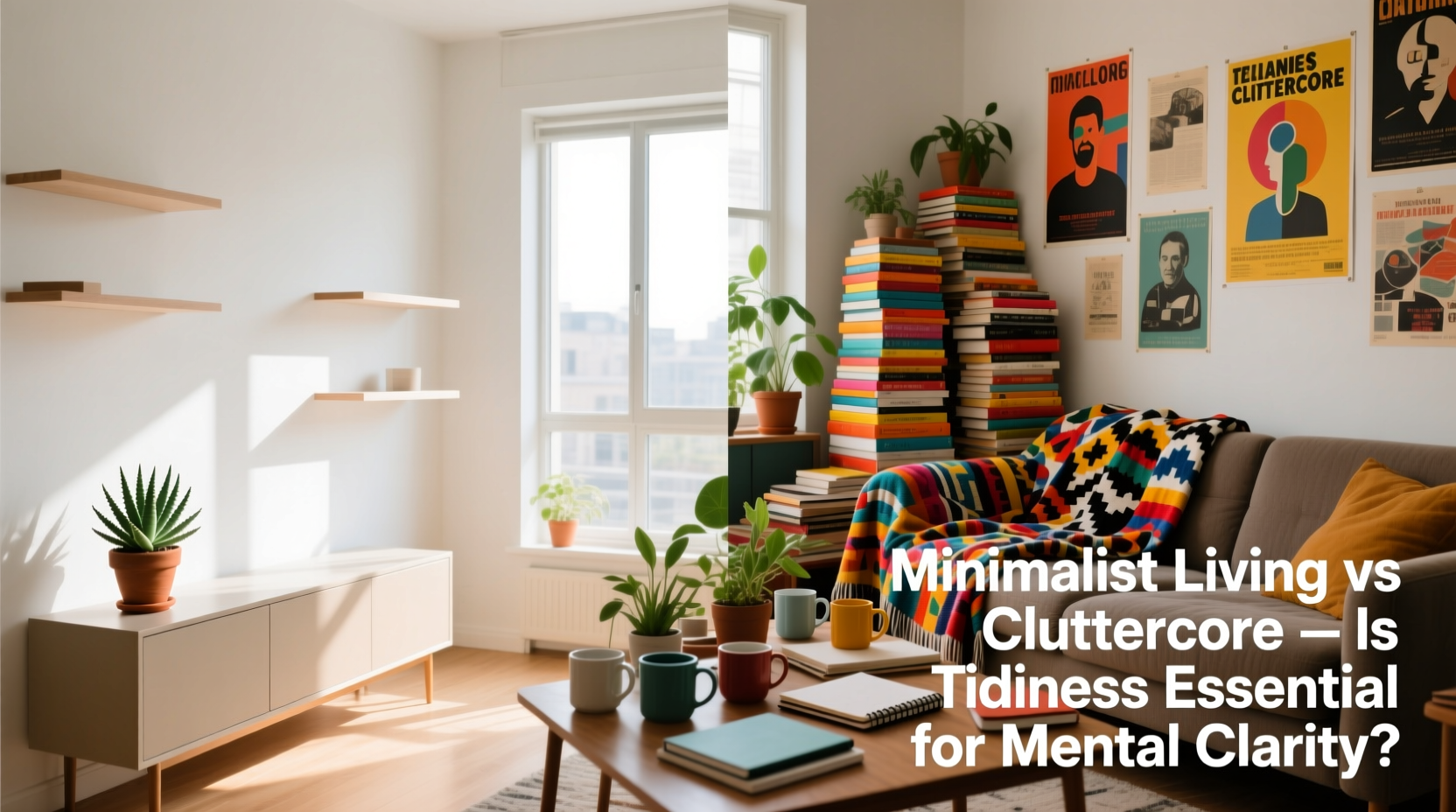
Minimalist living is rooted in intentionality. It involves reducing possessions to only those that serve a purpose or bring joy, often resulting in uncluttered surfaces, neutral palettes, and functional furniture. Proponents argue that this approach reduces decision fatigue, enhances focus, and promotes mindfulness.
Psychologically, minimalism aligns with cognitive load theory—the idea that our brains have limited capacity for processing information. A visually busy environment can overload sensory input, making it harder to concentrate or relax. Studies from Princeton University’s Neuroscience Institute show that physical clutter competes for attention, reducing the brain’s ability to process information efficiently.
“An organized environment supports an organized mind. When visual distractions are minimized, the brain can allocate more resources to tasks at hand.” — Dr. Sabine Kastner, Cognitive Neuroscientist, Princeton University
For individuals with anxiety, ADHD, or high-stress jobs, a minimalist space can act as a sanctuary. The absence of visual noise allows for mental reset and improved executive function. Daily routines become smoother when objects have designated places, and there’s less time spent searching for lost items.
The Allure of Cluttercore: Emotional Richness and Identity Expression
In contrast, cluttercore celebrates abundance. Think shelves overflowing with books, walls covered in art and photos, collections displayed proudly rather than stored away. This aesthetic thrives on personality, nostalgia, and sensory engagement. Far from being disorganized, many cluttercore enthusiasts practice “curated chaos”—a deliberate arrangement of meaningful objects.
To critics, cluttercore may appear overwhelming. But for its adherents, these spaces are emotionally nourishing. Objects aren’t just stuff—they’re memory anchors. A vintage teacup might recall a grandmother’s kitchen; concert posters tell the story of formative experiences. These tangible reminders foster continuity and identity, especially during times of stress or transition.
Dr. Ruth Colter, an environmental psychologist at the University of Melbourne, notes that “meaningful clutter” can enhance well-being. Her research suggests that personal artifacts in living spaces increase feelings of belonging and reduce loneliness. In one study, participants who surrounded themselves with personally significant objects reported higher levels of emotional resilience during periods of isolation.
Moreover, cluttercore challenges the assumption that cleanliness equals control. Creatives, artists, and writers often thrive in environments rich with stimuli. Inspiration doesn’t always come from emptiness—it can spark from the juxtaposition of old notebooks, fabric swatches, or half-finished projects lying within reach.
Case Study: Maya, the Illustrator Who Thrives in Chaos
Maya, a freelance illustrator based in Portland, lives in a small apartment bursting with color and texture. Her desk is piled with sketchbooks, paint tubes, fabric samples, and inspirational quotes taped haphazardly to the wall. Visitors often describe her space as “busy,” but Maya says it’s the only place where she feels fully present.
“When I try to clean everything up, I lose momentum,” she explains. “Seeing all my materials out reminds me of what I’m working on. A blank desk makes me feel blank too.”
Her workflow relies on associative thinking—connecting ideas across mediums. A scrap of patterned paper might inspire a character’s outfit; a childhood photo sparks a new narrative. For Maya, mental clarity isn’t found in silence, but in the hum of creative energy that her environment sustains.
Comparing Philosophies: Function, Emotion, and Individual Needs
Rather than framing minimalist living and cluttercore as opposites, it’s more accurate to see them as responses to different psychological needs. Below is a comparison highlighting key aspects of each approach:
| Aspect | Minimalist Living | Cluttercore |
|---|---|---|
| Primary Goal | Reduce distraction, increase focus | Express identity, evoke emotion |
| Mental Impact | Lowers anxiety, supports clarity | Boosts comfort, fosters creativity |
| Best For | People seeking calm, structure, or simplicity | Artists, collectors, nostalgic personalities |
| Potential Drawback | Can feel sterile or impersonal | May overwhelm sensitive individuals |
| Maintenance Level | Low (fewer items to manage) | High (requires curation and organization) |
The key insight is not which style is objectively better, but which one aligns with an individual’s cognitive style, emotional needs, and lifestyle. Some people recharge in quiet, open spaces. Others draw energy from immersive, textured environments.
Finding Your Balance: A Step-by-Step Guide to Environment Alignment
You don’t have to choose between minimalism and cluttercore. Many people benefit from a hybrid approach—creating zones within their homes that serve different psychological functions. Follow this step-by-step guide to design a space that supports your mental clarity without sacrificing authenticity.
- Assess Your Daily Routines: Track how you use each room. Do you read, work, create, or rest? Identify which activities require focus and which thrive on inspiration.
- Map Your Emotional Triggers: Note which objects bring comfort, joy, or motivation. Are they hidden away or easily visible? Consider relocating meaningful items to high-impact areas.
- Create Functional Zones: Designate a minimalist workspace for deep focus and a cluttercore-inspired lounge for relaxation and creativity. Use furniture or rugs to define boundaries.
- Edit with Intention: Remove items that no longer serve you—but only if their absence doesn’t create emotional voids. Replace guilt-driven decluttering with mindful selection.
- Test and Adjust: Live in your redesigned space for two weeks. Journal your mood, focus, and energy levels. Make tweaks based on real-world feedback, not trends.
Expert Insight: It’s Not About Cleanliness—It’s About Control
Dr. Elena Torres, a clinical psychologist specializing in environmental wellness, emphasizes that the core issue isn’t mess versus order, but perceived control.
“What matters most is whether a person feels in charge of their environment. A minimalist might feel anxious if a single book is out of place. A cluttercore enthusiast might feel distressed if something meaningful is put away. Mental clarity comes from alignment, not appearance.” — Dr. Elena Torres, PhD, Environmental Wellness Lab
This reframing shifts the conversation from moral judgments (“messy = lazy”) to functional assessment (“does this space support me?”). A room doesn’t need to be spotless to be healthy. What matters is that the inhabitant feels grounded, capable, and at ease within it.
Checklist: Is Your Space Supporting Your Mental Clarity?
- ☑ I can easily access items I use daily without frustration.
- ☑ My environment reflects who I am—not just how I think I should appear.
- ☑ There are areas where I can focus without visual distractions.
- ☑ I feel emotionally comforted when I enter my home.
- ☑ I have systems in place to manage clutter if it starts to feel overwhelming.
- ☑ I don’t feel guilty about my space when others see it.
- ☑ My environment adapts to my changing needs, not rigid ideals.
FAQ: Common Questions About Minimalism, Cluttercore, and Mental Health
Does clutter cause anxiety?
Not necessarily. While chronic disorganization can contribute to stress—especially if it interferes with daily functioning—research shows that *meaningful* clutter does not have the same effect. Anxiety arises more from feeling out of control than from the presence of objects. If someone feels at peace in their space, clutter alone is not a mental health risk.
Can I be both minimalist and sentimental?
Absolutely. Minimalism is about intention, not deprivation. You can keep cherished items while letting go of duplicates or things that no longer resonate. The key is curating with purpose. Display one favorite photo instead of ten, or rotate keepsakes seasonally to maintain emotional connection without overcrowding.
How do I know which style suits me?
Pay attention to how you feel in different environments. Visit a minimalist showroom and a bohemian boutique. Notice your breathing, heart rate, and thoughts. Do you feel calm and focused, or detached and cold? Energized and inspired, or overwhelmed and distracted? Your body often knows before your mind does.
Conclusion: Reclaiming Agency Over Your Environment
The debate between minimalist living and cluttercore isn’t really about interior design. It’s about autonomy—the right to shape your space in a way that nurtures your mind. A tidy space is not inherently superior to a lively one. What matters is whether your surroundings reflect your inner world and support your well-being.
Mental clarity doesn’t come from empty countertops or perfectly folded clothes. It comes from alignment—between your values, your habits, and your habitat. Whether you’re drawn to serene minimalism or expressive cluttercore, the goal is the same: to create a space where you can think clearly, feel safe, and live authentically.




 浙公网安备
33010002000092号
浙公网安备
33010002000092号 浙B2-20120091-4
Comments
No comments yet. Why don't you start the discussion?