
Touching up your appearance while navigating a busy day—whether after a commute, before a meeting, or during a lunch break—has become an essential part of modern personal care. The challenge lies in doing it efficiently and discreetly. Two popular tools dominate this space: the compact mirror keychain and the standalone vanity mirror. Both promise convenience, but they deliver very different experiences. Choosing between them isn’t just about size—it’s about function, clarity, durability, and how well each fits into your daily rhythm.
This comparison dives deep into the practical realities of using each type, evaluating everything from visibility and lighting to pocket space and long-term usability. Whether you're a minimalist commuter, a makeup enthusiast, or someone who just wants to check their hair after the wind hits, understanding the strengths and limitations of each option will help you make a smarter, more confident decision.
Portability and Convenience
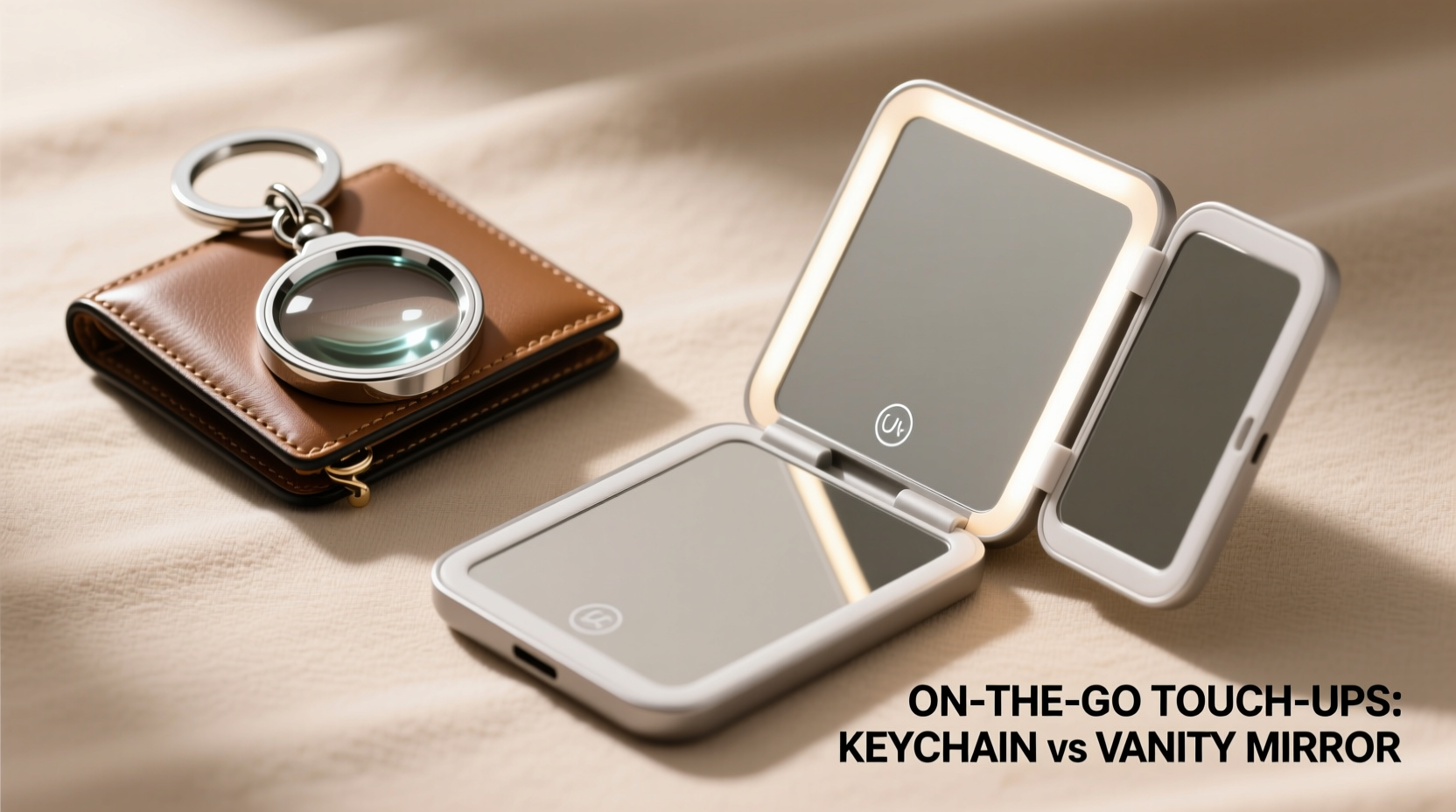
The most obvious advantage of a mirror keychain is its integration into your existing carry routine. Attached directly to your keys, it’s always within reach—no need to dig through a bag or worry about forgetting it. This seamless accessibility makes it ideal for quick checks: Is my lipstick smudged? Did my glasses fog up? Do I have something in my teeth?
Vanity mirrors, on the other hand, are typically larger and require dedicated storage. Most fit comfortably in a purse or large pocket but rarely attach to anything. Their size allows for a broader field of view, but that also means they take up more space. For those carrying only a small clutch or relying on pockets, a vanity mirror may be impractical.
However, portability isn’t just about where it fits—it’s about when and how easily you can use it. A keychain mirror often requires two hands: one to hold your keys steady, another to adjust angles. In contrast, many vanity mirrors come with stands or fold-out supports, allowing hands-free use on a flat surface like a car dashboard or bathroom counter.
Visibility and Functionality
Size matters when you’re assessing your appearance. Mirror keychains usually range from 1 to 1.5 inches in diameter. That’s enough to see your lips or eyes up close, but not sufficient for checking overall symmetry, hairstyle framing, or outfit coordination. You’ll likely miss details like uneven blush application or a crooked collar.
Vanity mirrors typically measure between 2.5 and 4 inches, offering a significantly wider view. Many include dual-sided designs—one side standard, the other magnified (usually 3x to 5x)—allowing users to toggle between broad overview and detailed inspection. This versatility makes them far more functional for full-face makeup corrections or skincare checks.
“Magnification changes everything. Without it, people miss subtle flaws that become obvious under natural light.” — Lena Park, Professional Makeup Artist
Lighting compatibility is another critical factor. While neither tool usually includes built-in illumination, some high-end vanity mirrors now feature LED rings powered by button batteries. These dramatically improve accuracy in low-light environments like restrooms or dimly lit restaurants. Keychain mirrors almost never include lighting, limiting their usefulness after dark.
Comparison Table: Key Features at a Glance
| Feature | Mirror Keychain | Vanity Mirror |
|---|---|---|
| Average Size | 1–1.5 inches | 2.5–4 inches |
| Magnification | Rarely available | Common (3x–5x) |
| Hands-Free Use | No | Yes (with stand) |
| Built-in Lighting | No | Sometimes (LED models) |
| Durability | High (metal frames common) | Variable (plastic hinges may wear) |
| Pocket-Friendly | Yes (attached to keys) | Depends on size |
| Best For | Quick checks, minimalists | Detailed touch-ups, makeup users |
Real-World Usage: A Mini Case Study
Consider Sarah, a sales representative who travels between client meetings across the city. Her morning starts with a flawless makeup application, but by noon, humidity has taken its toll. She steps into a café restroom for a quick refresh.
With her mirror keychain, she manages to reapply lip gloss and wipe away smudges under her eyes. However, she misses a streak of foundation along her hairline—a flaw noticed by her next client. Later, she switches to a compact vanity mirror with 5x magnification and a small LED ring. Now, she catches imperfections instantly: stray mascara, uneven brows, and shine on her T-zone. Over time, she reports feeling more confident and receiving more positive feedback on her professional appearance.
The difference wasn’t just the mirror—it was the ability to see clearly and correct thoroughly. For professionals, performers, or anyone whose image impacts their interactions, that level of detail matters.
When Each Option Shines
Mirror keychains excel in situations where speed and simplicity are paramount. They’re perfect for:
- Checking teeth after eating
- Adjusting eyewear or hair clips
- Emergency eyebrow grooming
- Situations where you carry nothing but keys and phone
They’re also ideal for children, teens, or older adults who want a no-fuss way to stay presentable without managing extra items.
Vanity mirrors are superior when precision is needed. They work best for:
- Full-face makeup application or correction
- Skincare routines (spot treatment, acne monitoring)
- Hair styling adjustments (bangs, parting, flyaways)
- Anyone wearing complex makeup, false lashes, or bold looks
If you rely on makeup as part of your identity or profession, skipping a proper mirror is like trying to paint a portrait with a toothpick.
Step-by-Step Guide: Choosing the Right Tool for Your Lifestyle
- Assess your daily routine. Do you commute via bike or foot with minimal carry? A keychain mirror integrates effortlessly.
- Evaluate your grooming needs. If you wear full makeup regularly, prioritize a vanity mirror with magnification.
- Test real-world usability. Try using a small mirror in your car, at a coffee shop, or in a public restroom. Can you get a clear view?
- Consider durability. Metal-framed keychain mirrors resist drops better than plastic compacts with fragile hinges.
- Decide on budget. Basic keychain mirrors cost $3–$8; quality vanity mirrors range from $10–$25. LED models may exceed $30.
- Make your choice—or carry both. Some people keep a keychain mirror for emergencies and a vanity mirror in their main bag for detailed work.
Frequently Asked Questions
Can a mirror keychain replace a vanity mirror?
Only for very basic checks. If you need to apply or fix makeup, a vanity mirror is far more effective due to its larger size and frequent inclusion of magnification.
Are vanity mirrors worth the extra space?
For frequent travelers, office workers, or makeup wearers, yes. The improved visibility pays off in confidence and appearance control. For others, a keychain may suffice.
Do mirrored keychains scratch easily?
Many do, especially cheaper models with plastic covers. Opt for metal-framed versions with protective backing or recessed surfaces to minimize damage.
Final Verdict: It Depends on Your Definition of \"Better\"
\"Better\" isn't universal—it depends on what you value most. If your priority is always having *some* reflective surface, no matter the setting, then the mirror keychain wins by default. Its genius lies in forced consistency: because it’s attached to something you never leave behind, it’s always there when you need a glance.
But if “better” means accuracy, detail, and the ability to truly refine your look, then the vanity mirror is objectively superior. It offers clarity, flexibility, and functionality that a tiny circular mirror simply can’t match.
The smartest approach? Understand your needs and plan accordingly. Carry a mirror keychain as a reliable backup, but invest in a quality vanity mirror if you care about looking polished throughout the day. In many cases, carrying both isn’t overkill—it’s strategic layering.




 浙公网安备
33010002000092号
浙公网安备
33010002000092号 浙B2-20120091-4
Comments
No comments yet. Why don't you start the discussion?