
Choosing your first camera can be overwhelming. With mirrorless and DSLR models dominating the market, many beginners wonder which system offers a smoother entry into photography. While both types produce excellent image quality, their design, interface, and handling differ significantly—factors that directly impact how quickly and comfortably you’ll learn.
The core difference lies in their internal mechanics. DSLRs use a mirror and optical viewfinder, while mirrorless cameras rely on electronic systems and digital displays. This distinction affects size, weight, autofocus behavior, battery life, and even the way you compose your shots. For someone just starting out, these differences aren’t just technical—they shape the entire learning experience.
Understanding the Core Differences
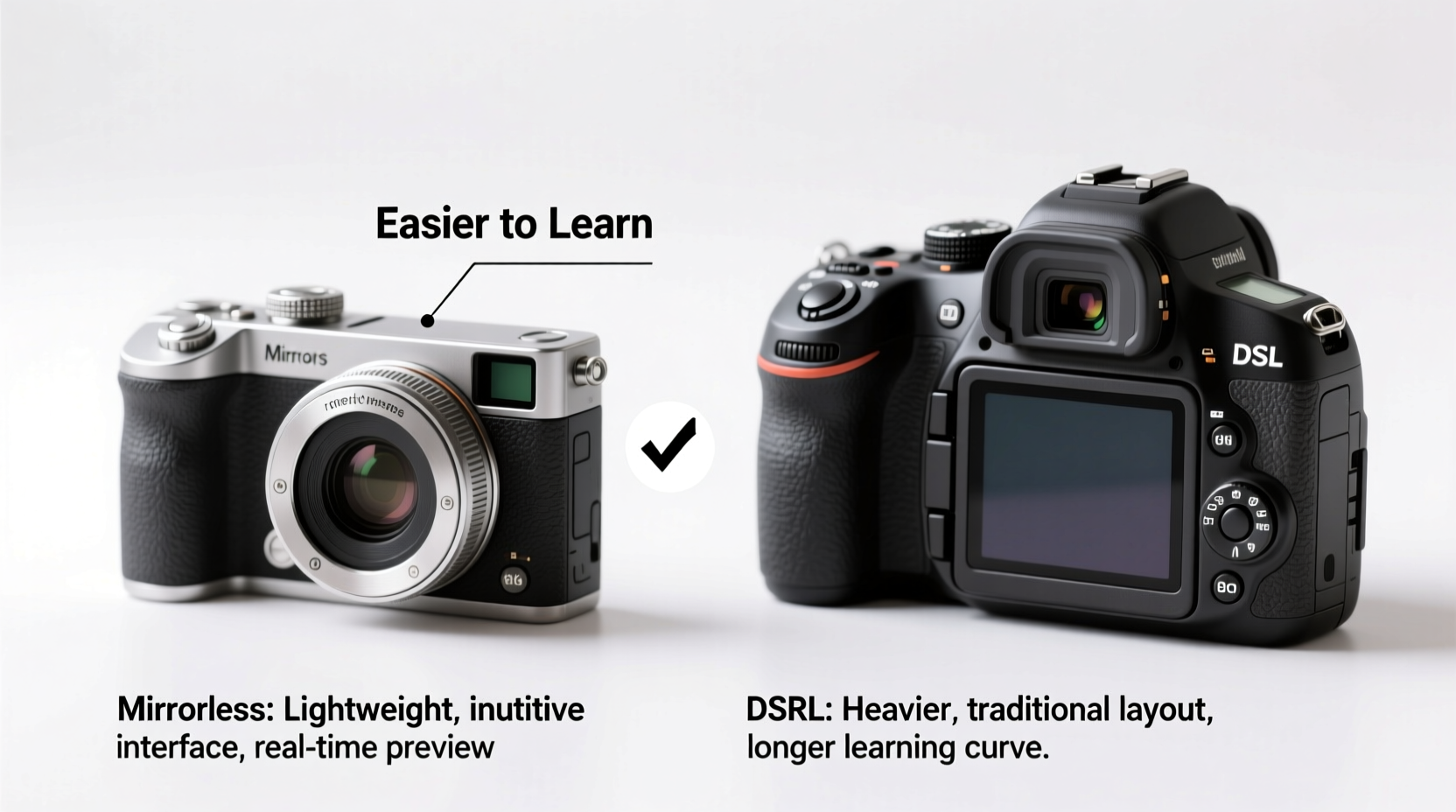
Before evaluating ease of learning, it’s essential to understand what sets mirrorless and DSLR cameras apart at a fundamental level.
DSLR (Digital Single-Lens Reflex) cameras use a physical mirror inside the body that reflects light from the lens up into an optical viewfinder. When you press the shutter, the mirror flips up, allowing light to hit the sensor and capture the image. This optical system gives you a direct, real-time view of the scene without any digital processing.
Mirrorless cameras, as the name suggests, eliminate the mirror mechanism. Instead, light passes directly onto the image sensor, which sends a live feed to either the rear LCD screen or an electronic viewfinder (EVF). This allows for a more compact design and enables features like real-time exposure preview and focus peaking.
These structural differences influence not only the physical feel of the camera but also how intuitive certain functions are for beginners.
Learning Curve: Interface and Feedback
One of the most critical aspects for beginners is immediate feedback. How quickly can you understand what went right—or wrong—with your photo?
Mirrorless cameras have a distinct advantage here. Because they display a live preview of your settings (exposure, white balance, depth of field), you see exactly how changes affect the final image before pressing the shutter. This real-time feedback helps reinforce key concepts like aperture, shutter speed, and ISO far faster than trial-and-error shooting.
DSLRs, especially when using the optical viewfinder, show you the scene as your eye sees it—not how the camera will record it. You won’t see overexposure warnings, color shifts, or shallow depth of field until after reviewing the image on the LCD. This delay can slow down the learning process, particularly when mastering manual settings.
That said, DSLRs often feature more dedicated physical dials and buttons, which some beginners find easier to navigate once they memorize layout patterns. The tactile feedback of turning a shutter speed dial or adjusting aperture with a ring on the lens can build muscle memory more intuitively than navigating touchscreen menus.
“Beginners benefit from seeing the consequences of their settings instantly. Mirrorless cameras act like visual tutors.” — David Lin, Photography Educator and Workshop Leader
Size, Weight, and Handling Comfort
Ease of learning isn’t just about technical features—it’s also about comfort and consistency. A camera that feels awkward or heavy may discourage regular practice, slowing skill development.
Mirrorless cameras are generally smaller and lighter due to the absence of a mirror box and pentaprism. This makes them ideal for travel, street photography, and daily carry. For younger users or those with smaller hands, this reduced bulk can make handling much more natural.
However, DSLRs tend to have deeper grips and better balance with larger lenses, offering a sturdier feel that some beginners find reassuring. The heft can reduce camera shake, and the larger body often accommodates bigger batteries and dual control dials—features that support more advanced techniques later on.
Ultimately, ergonomics play a major role. A beginner who finds their camera uncomfortable is less likely to pick it up regularly, regardless of its technical merits.
Autofocus and Shooting Experience
Fast, accurate autofocus is crucial for capturing sharp images—especially when photographing people, pets, or moving subjects. Here, modern mirrorless systems hold a clear edge.
Most mirrorless cameras use contrast-detection and phase-detection autofocus directly on the sensor, covering nearly the entire frame. Features like eye-tracking, animal detection, and subject recognition work seamlessly and reliably, even in low light. For a beginner trying to capture a child’s smile or a pet mid-leap, this kind of automation reduces frustration and increases success rate.
DSLRs traditionally relied on a separate autofocus module located at the bottom of the camera, which limited coverage to the center area. While high-end DSLRs offer robust AF performance, entry-level models often struggle with off-center focusing and continuous tracking. Some require you to half-press the shutter to lock focus, then recompose—a technique that introduces parallax error and slows down shooting.
For learners, consistent autofocus means fewer blurry disappointments and more confidence to experiment.
Comparative Overview: Mirrorless vs DSLR for Beginners
| Feature | Mirrorless | DSLR |
|---|---|---|
| Viewfinder Type | Electronic (shows exposure preview) | Optical (real scene, no preview) |
| Size & Weight | Smaller, lighter | Larger, heavier |
| Autofocus Performance | Fast, full-frame coverage, subject tracking | Center-focused, slower tracking |
| Battery Life | Shorter (due to constant sensor/EVF use) | Longer (optical viewfinder saves power) |
| Learning Feedback | Real-time exposure and color preview | No preview; review after shot |
| Lens Selection | Expanding rapidly, but newer systems | Vast selection, including older lenses |
| Price (Entry-Level) | Competitive, often bundled with kit lenses | Slightly lower entry cost in some cases |
Real-World Learning Scenario: A Beginner’s Journey
Consider Maya, a college student picking up photography for the first time. She wants to document campus life, friends, and weekend trips. She starts with a mid-range mirrorless camera equipped with an APS-C sensor and a standard zoom lens.
On her first outing, she switches to manual mode. As she adjusts the aperture, she immediately sees the background blur change in the electronic viewfinder. When she underexposes, the preview darkens—prompting her to slow the shutter speed. Within 20 minutes, she captures a well-exposed portrait with pleasing bokeh.
She shares the photo online and receives positive feedback. Encouraged, she explores video mode next, using the flip-out screen to record vlogs. The camera’s autofocus locks onto her face automatically, keeping her sharp even as she moves.
Compare this to Alex, who chose a beginner DSLR. He enjoys the solid grip and optical clarity but struggles to understand why his indoor photos are consistently dark. It takes several attempts—and multiple reviews on the LCD—before he realizes he needs to increase ISO. Without real-time feedback, each mistake feels like a setback rather than a lesson.
Both eventually learn, but Maya’s early wins build momentum. Her camera supports her curiosity, turning theory into visible results almost instantly.
Step-by-Step Guide: Choosing Your First Camera
If you’re still deciding, follow this practical sequence to make an informed choice:
- Define your primary use: Will you shoot portraits, landscapes, events, or videos? Mirrorless excels in hybrid use.
- Try both types in-store: Hold them, look through the viewfinders, and simulate shooting motions.
- Check the lens ecosystem: Ensure there are affordable, versatile lenses available for your chosen system.
- Test the menu system: Navigate settings without guidance. Is it intuitive? Can you find ISO or white balance quickly?
- Consider future growth: Does the brand offer higher-end models you might upgrade to later?
- Set a realistic budget: Include costs for extra batteries (especially for mirrorless), memory cards, and a basic bag.
- Read beginner-focused reviews: Look for user experiences that match your skill level and interests.
Frequently Asked Questions
Can I use old DSLR lenses on a mirrorless camera?
Yes, in many cases—but you’ll need a lens adapter. Brands like Canon, Nikon, and Sony offer official adapters that maintain autofocus and image stabilization. Third-party options exist but may limit functionality.
Do mirrorless cameras have worse battery life?
Generally, yes. Because the sensor and EVF are always active, mirrorless cameras consume more power. However, carrying spare batteries is common practice and solves the issue. Many models now support USB charging, adding convenience.
Is optical viewfinder better than electronic?
It depends. Optical viewfinders provide zero-lag, true-color viewing and work well in bright sunlight. Electronic viewfinders show exposure previews, focus magnification, histograms, and digital overlays—making them more educational for beginners. High-resolution EVFs in modern cameras rival optical clarity in most conditions.
Essential Checklist for New Photographers
- ✅ Choose a camera with real-time exposure preview (favor mirrorless for this)
- ✅ Start with a versatile kit lens (e.g., 18-55mm or 24-70mm equivalent)
- ✅ Enable grid lines and focus peaking in settings
- ✅ Shoot in RAW format to allow greater editing flexibility
- ✅ Use automatic modes initially, then transition to aperture priority and manual
- ✅ Practice daily—even 10 minutes helps build familiarity
- ✅ Join a photography community or challenge to stay motivated
Final Verdict: Which Is Easier to Learn?
For most beginners, mirrorless cameras are easier to learn with. Their real-time feedback, advanced autofocus, compact size, and intuitive interfaces lower the barrier to entry. Seeing the effect of your settings before taking the shot transforms abstract concepts into tangible outcomes, accelerating understanding.
DSLRs remain viable, especially if you find a good deal on a used model or inherit lenses from a family member. They teach discipline through manual operation and offer excellent battery life. But their delayed feedback loop and limited autofocus coverage can make early progress feel slower.
The best camera is the one you enjoy using enough to pick up every day. Given today’s technology, mirrorless systems align more closely with how beginners naturally learn—visually, interactively, and immediately.
“The best beginner camera doesn’t just take great photos—it makes you want to keep taking them.” — Lena Torres, Author of *Start Shooting: A Beginner’s Path to Better Photos*
Take the Next Step
You don’t need the perfect camera to start learning. What matters is starting. Whether you choose mirrorless or DSLR, commit to using it consistently, experimenting fearlessly, and reviewing your work critically. Sign up for a local workshop, follow a 30-day photo challenge, or simply set a goal to capture one meaningful image each week.




 浙公网安备
33010002000092号
浙公网安备
33010002000092号 浙B2-20120091-4
Comments
No comments yet. Why don't you start the discussion?