
In 2025, the photography world has undergone a quiet but decisive shift. Mirrorless cameras now dominate new product lines, professional workflows, and consumer preferences. Major manufacturers like Canon, Nikon, and Sony have redirected their R&D budgets almost entirely toward mirrorless systems. Yet, despite this momentum, DSLRs still linger—particularly among legacy users, budget-conscious photographers, and niche professionals. The question remains: with all the advantages of mirrorless technology, is there any compelling reason to hold onto a camera that uses a physical mirror?
The answer isn’t as simple as “mirrorless wins.” While mirrorless systems offer undeniable benefits in speed, video performance, and compact design, certain practical and economic factors still make DSLRs relevant for specific use cases. This article examines the current state of both technologies, evaluates their strengths and weaknesses, and explores whether the mirror still holds any meaningful place in modern photography.
The Evolution: From DSLR Dominance to Mirrorless Takeover
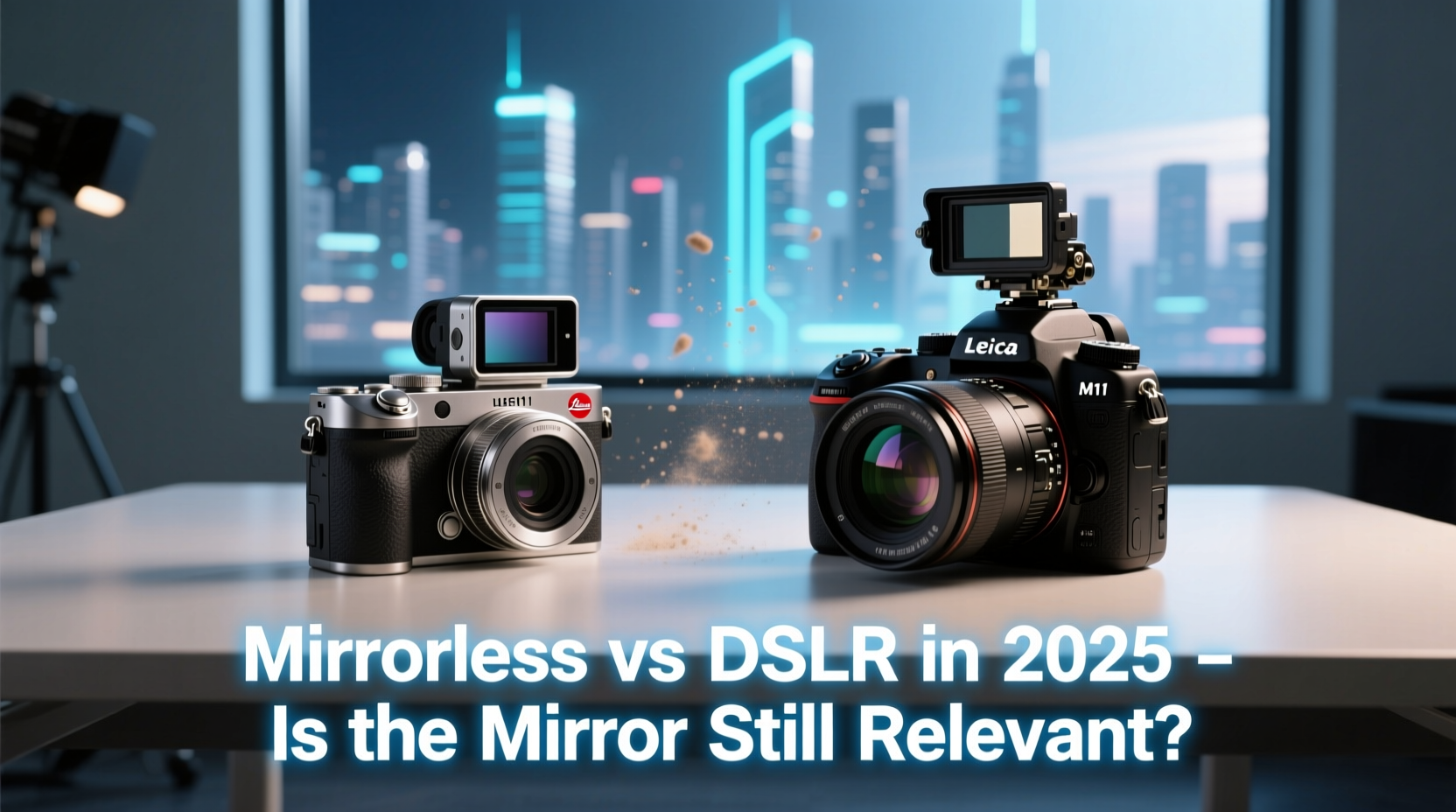
For over two decades, DSLRs were the gold standard. Their optical viewfinders, robust build quality, and extensive lens ecosystems made them indispensable for professionals and enthusiasts alike. The mirror mechanism allowed light to bounce from the lens up into an optical viewfinder, providing a direct, real-time view of the scene. This system was reliable, fast, and required no power to operate the viewfinder.
Mirrorless cameras, by contrast, eliminate the mirror and prism assembly. Light hits the sensor directly, and the image is displayed on an electronic viewfinder (EVF) or rear screen. Initially criticized for laggy EVFs and poor battery life, mirrorless systems have evolved rapidly. By 2025, high-end models boast EVFs with near-zero latency, resolution surpassing human eye acuity, and dynamic range that rivals or exceeds DSLRs.
The transition wasn’t just about removing a mirror—it was a complete reimagining of camera architecture. Shorter flange distances allow for smaller bodies and better lens designs. On-sensor phase detection enables faster, more accurate autofocus. And integrated video features make mirrorless the default choice for hybrid shooters.
Performance Comparison: Key Areas Evaluated
To understand where each system stands today, it's essential to break down performance across several critical categories.
Autofocus and Tracking
Mirrorless cameras have pulled far ahead in autofocus performance. With on-sensor phase detection covering nearly the entire frame, they offer superior subject tracking—especially for moving subjects like wildlife, sports, or children. Eye-AF (eye autofocus) is now standard and remarkably accurate, even in low light.
DSLRs rely on a separate phase-detection module beneath the mirror, which limits coverage and responsiveness. While mid-to-high-end DSLRs still perform well in good lighting, they struggle in dim conditions and lack the intelligent tracking algorithms found in mirrorless systems.
Battery Life
This remains one of the few areas where DSLRs still lead. Because optical viewfinders don’t require power, DSLRs consume significantly less energy during extended shooting sessions. A typical DSLR can last 800–1,200 shots per charge, while most mirrorless cameras manage 300–600.
However, improvements in battery efficiency and larger-capacity cells are narrowing this gap. Some 2025 mirrorless models now support USB-C charging and power banks, allowing for continuous operation in the field—a feature DSLRs can't easily replicate.
Image Quality
At the sensor level, there’s little difference between similarly specced DSLR and mirrorless models. Image quality depends more on sensor size, pixel count, and processing engine than on the presence of a mirror.
That said, mirrorless systems benefit from real-time exposure simulation, focus peaking, and zebra patterns—all of which help achieve optimal exposure and sharpness in-camera. These tools are especially valuable for videographers and manual shooters.
Durability and Ergonomics
DSLRs are often praised for their ruggedness. Their mechanical shutters, weather-sealed magnesium alloy bodies, and proven track records in extreme conditions make them favorites among photojournalists and outdoor photographers.
Mirrorless cameras have caught up in build quality, but the reliance on electronic components introduces new failure points. However, many flagship mirrorless models now exceed DSLRs in dust and moisture resistance ratings. Additionally, the lighter weight of mirrorless bodies reduces fatigue during long shoots.
“By 2025, mirrorless isn’t just the future—it’s the present. The only photographers still choosing DSLRs are those with very specific needs or significant investment in legacy gear.” — David Lin, Senior Camera Analyst at Imaging Review
Comparison Table: Mirrorless vs DSLR in 2025
| Feature | Mirrorless (2025) | DSLR (Current Models) |
|---|---|---|
| Autofocus Speed & Coverage | Near-full-frame coverage, AI-powered subject tracking | Limited to center area, slower in low light |
| Battery Life (CIPA rating) | 300–600 shots | 800–1,200 shots |
| Video Capabilities | 8K internal, 10-bit 4:2:2, advanced stabilization | Max 4K, limited bit depth, minimal stabilization |
| Size & Weight | Compact, lightweight, ideal for travel | Bulkier, heavier due to mirror box |
| Lens Ecosystem | Expanding rapidly; native lenses optimized for short flange | Mature, wide selection; third-party support strong |
| Viewfinder Type | Electronic (EVF), real-time preview | Optical (OVF), no lag, no power needed |
| Shutter Mechanism | Hybrid (mechanical + electronic), silent shooting | Mechanical only, audible shutter sound |
Real-World Example: A Wildlife Photographer’s Dilemma
Consider Sarah Kim, a freelance wildlife photographer based in Montana. For years, she relied on a Nikon D850 DSLR paired with a 500mm f/4 lens. The combination delivered exceptional image quality and long battery life during multi-day treks into remote areas. But when she started incorporating video into her storytelling, she hit limitations—4K recording with heavy crop, no log profiles, and poor autofocus during video capture.
In 2024, she transitioned to the Nikon Z9. Despite the higher cost and initial learning curve with the EVF, the benefits were immediate. Real-time animal eye tracking kept birds in sharp focus even during erratic flight. In-body stabilization allowed handheld shooting at dawn without a tripod. And 8K video gave her flexibility in post-production.
Her only regret? Battery life. She now carries four batteries and a solar charger—but acknowledges that the trade-off is worth it for the creative freedom the mirrorless system provides.
Is There Any Reason to Keep the Mirror?
Yes—but only under specific circumstances.
1. Budget Constraints: Used DSLRs remain highly affordable. A Canon EOS 5D Mark IV or Nikon D7500 can be purchased for under $800 with a kit lens, offering excellent image quality for beginners or hobbyists. For someone not planning to shoot video or need cutting-edge AF, a DSLR is still a capable tool.
2. Legacy Lens Investment: Photographers with extensive collections of high-quality DSLR lenses may find it costly or impractical to switch. While adapters exist, they can introduce compatibility issues, reduce autofocus speed, or negate size advantages of mirrorless bodies.
3. Optical Viewfinder Preference: Some photographers, particularly in street or documentary genres, prefer the zero-lag, natural feel of an optical viewfinder. They argue that EVFs, despite improvements, still introduce a slight delay and alter perception of motion and light.
4. Reliability in Extreme Conditions: Though rare, some users report that older DSLRs continue functioning after severe drops or water exposure where mirrorless units failed. The simpler mechanical design may contribute to this resilience.
Yet, these reasons are becoming increasingly situational. As mirrorless prices drop and second-hand markets flood with used DSLRs, even budget buyers are opting for newer technology. Canon has ceased development of new EF-mount lenses, and Nikon’s F-mount DSLR production is limited to a few models. Third-party support for DSLR systems is also waning.
Actionable Checklist: Should You Switch to Mirrorless?
Use this checklist to evaluate your personal needs:
- ✅ Do you shoot video regularly or plan to incorporate it?
- ✅ Do you value fast, accurate autofocus—especially for moving subjects?
- ✅ Are you frustrated by the size or weight of your current DSLR setup?
- ✅ Do you want access to the latest features (e.g., AI tracking, focus stacking, in-body stabilization)?
- ✅ Are you willing to adapt to an electronic viewfinder?
- ✅ Can you afford the upgrade, including potential lens replacements or adapters?
If you answered “yes” to three or more, transitioning to mirrorless is likely the right move. If not, your DSLR may still serve you well—for now.
Frequently Asked Questions
Will DSLRs become obsolete by 2025?
Not immediately, but functionally yes. No major manufacturer is developing new DSLR models. Support will continue for years, but firmware updates, accessories, and repair services will gradually decline. Think of DSLRs like film cameras—usable, but no longer evolving.
Can I use my old DSLR lenses on a mirrorless camera?
Yes, via adapters. Most brands offer official adapters (e.g., Canon EF-EOS R, Nikon FTZ). Third-party options like Metabones also exist. However, autofocus performance may vary, and some functions like image stabilization might not work optimally.
Is the electronic viewfinder really better than optical?
It depends on your priorities. EVFs show real-time exposure, white balance, and depth of field—huge advantages for precision. They also enable features like focus magnification and histograms in the viewfinder. However, in bright sunlight, some EVFs can appear washed out, and battery drain remains a concern.
Conclusion: The Mirror’s Last Stand
The mirror served photography well for generations. It enabled precise optical viewing, reliable metering, and mechanical simplicity. But technology marches forward. In 2025, the advantages of mirrorless—superior autofocus, seamless hybrid shooting, compact design, and continuous innovation—far outweigh the diminishing benefits of a mirror-based system.
There are still niches where DSLRs make sense: budget learners, legacy lens owners, and purists who cherish the tactile experience of optical viewing. But for the vast majority of photographers, clinging to the mirror means missing out on tools that enhance creativity, efficiency, and image quality.
The mirror isn’t dead yet—but it’s no longer the heart of the camera. The future belongs to systems that embrace digital integration, intelligence, and versatility. Whether you’re a hobbyist or a pro, now is the time to evaluate your gear not by what it preserves from the past, but by how well it empowers your vision for the future.




 浙公网安备
33010002000092号
浙公网安备
33010002000092号 浙B2-20120091-4
Comments
No comments yet. Why don't you start the discussion?