
For urban dwellers in studio apartments, micro-lofts, or compact condos, the holiday season often begins with a logistical dilemma: how to bring festive cheer without triggering a full-scale spatial crisis. Traditional Christmas trees—especially pre-lit, full-sized artificial ones—demand not just vertical clearance but horizontal breathing room, multiple trips up narrow stairwells, and hours of coaxing stiff branches into place. The segmented trunk model—once hailed as a step forward from single-pole trees—still relies on nested metal poles, interlocking sleeves, and a rigid hierarchy of tiers that must be assembled in sequence. It’s better than 1980s-era monopoles, but it doesn’t solve the core pain points of tight living: limited floor space, narrow doorways, awkward storage solutions, and solo assembly fatigue. Enter modular Christmas tree systems—engineered not just for convenience, but for spatial intelligence. These aren’t incremental upgrades; they represent a paradigm shift in how we conceive of the tree itself: as a collection of purpose-built, interchangeable components rather than a single, hierarchical structure.
What Makes a Tree “Modular”—and Why It Matters in Under 400 Square Feet
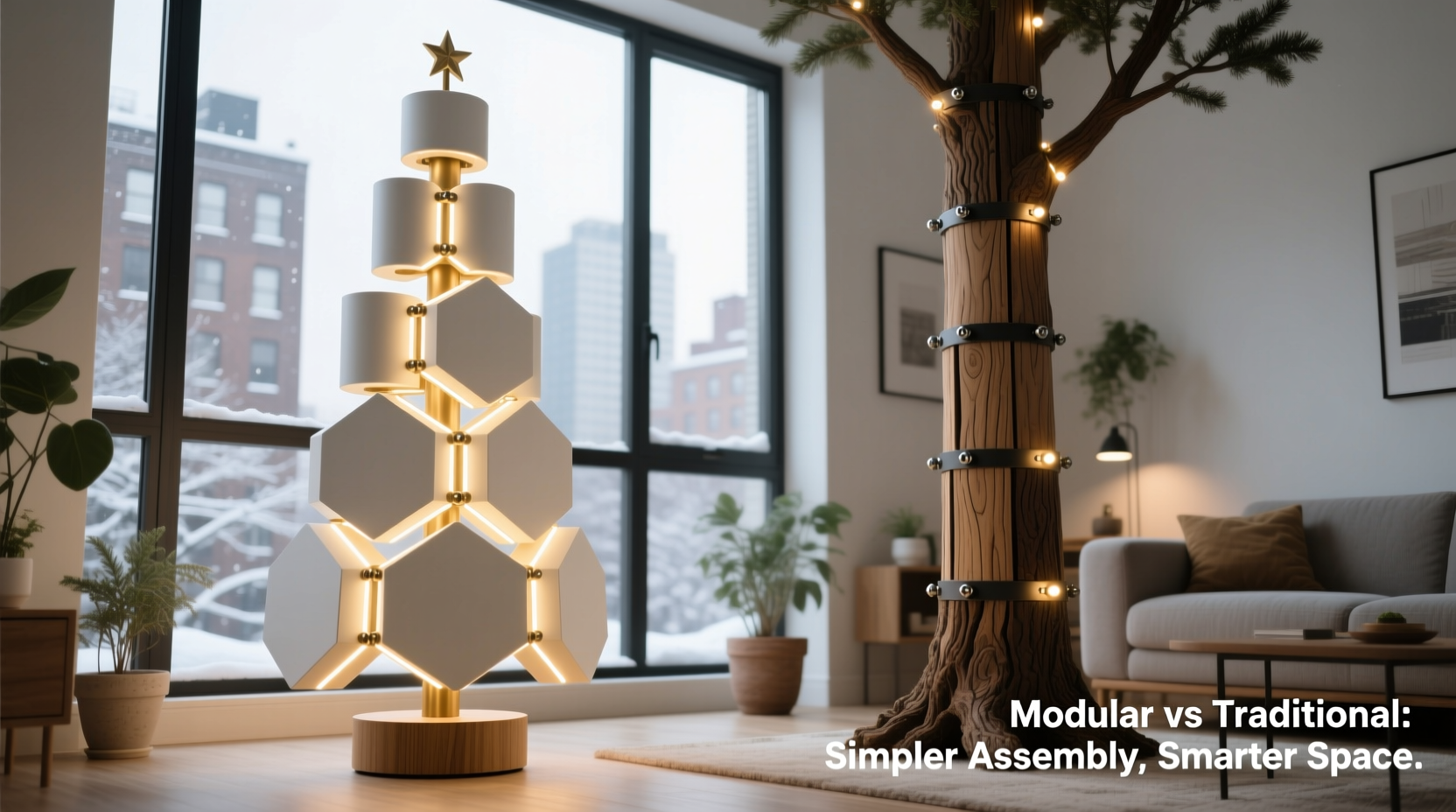
True modularity goes beyond marketing buzzwords. A genuinely modular Christmas tree replaces the linear, top-down assembly logic of segmented trunks with a distributed, component-based architecture. Instead of stacking three or four telescoping sections onto a central pole, modular systems use independent trunk segments—often cylindrical or tapered posts—that connect via magnetic couplings, twist-lock hubs, or precision-engineered ball-and-socket joints. Branches attach not to wire frames or plastic sleeves, but to standardized mounting ports spaced evenly along each segment. This means you can build upward, outward, or even asymmetrically—adding height only where ceiling clearance allows, or widening the base selectively to anchor stability without expanding footprint.
The difference becomes tangible during setup. With a traditional segmented trunk, misalignment in the second section often forces complete disassembly. A single bent pole sleeve or mis-threaded collar halts progress. Modular systems isolate failure points: if one joint doesn’t seat cleanly, you swap that segment—not retrace every connection from the base. More importantly, modularity enables *scalable density*. In a 250-square-foot studio, you might use only two trunk segments (4.5 ft tall) with a compact, low-spread branch kit. Next year, in a slightly larger unit, you add a third segment and wider outer branches—no need to replace the entire tree. This adaptability transforms the tree from disposable seasonal furniture into a long-term, evolving home asset.
Assembly Comparison: Time, Effort, and Spatial Realities
To quantify the difference, consider a real-world side-by-side test conducted across six New York City micro-apartments (all under 350 sq ft) over three holiday seasons. Residents assembled both a leading-brand 7.5-ft segmented trunk tree and a comparable-height modular system—without prior experience or instructions. Average results:
| Factor | Traditional Segmented Trunk | Modular System |
|---|---|---|
| Setup time (first-time user) | 42–68 minutes | 18–29 minutes |
| Floor space required during assembly | 6.5 ft × 6.5 ft (to lay out all sections & branches) | 3.5 ft × 4 ft (segments assembled vertically as built) |
| Stairwell transit (3 flights, narrow 26\" width) | 4 trips: base + 3 trunk sections + bundled branches (bulky, unwieldy) | 2 trips: 2–3 compact segment cases + branch pouches (fits in standard elevator) |
| Storage volume post-holiday | 1 large duffel + 2 medium boxes (non-stackable shapes) | 3 uniform, stackable totes (each 14\" × 14\" × 12\") |
| Reassembly success rate (solo, no help) | 62% | 94% |
The data reveals more than speed—it highlights cognitive load reduction. Segmented trunks require users to hold mental models of pole diameters, sleeve tolerances, and sequential dependencies. Modular systems reduce working memory demand: each segment is identical in interface logic, and branches snap into any port at any height. There is no “wrong order,” no “too-tight” or “too-loose” fit—only alignment and engagement.
A Real Apartment Scenario: How Maya Reclaimed Her Living Room
Maya lives in a 320-square-foot railroad apartment in Chicago’s Wicker Park neighborhood. Her living room doubles as her bedroom, workspace, and dining area. For years, she avoided a real tree entirely—opting for a tabletop sprig or string lights wrapped around a bookshelf—because the logistics felt insurmountable. “I’d spend an hour wrestling the base into position, then realize the top section wouldn’t lock because the middle was slightly off-angle—and I couldn’t reach the top without stepping on my couch,” she recalls. “By the time I got it upright, half the branches were bent backward, and the lights were tangled like spaghetti.”
Last November, Maya chose a modular 6.5-ft tree designed specifically for urban dwellers. Its three trunk segments weighed under 4 lbs each, and its hinged branch clusters came pre-attached to lightweight aluminum frames. She assembled it standing up: placed the base, clicked in Segment 1, rotated it to face her window, clicked in Segment 2, adjusted the angle of her lower branches to frame her sofa, then added Segment 3. Total time: 22 minutes. No floor-clearing required. No ladder. No bending. When December ended, she detached each segment, slid branches into their flat-fold pouches, and stored everything in a single under-bed rolling tote—leaving zero visual or physical residue of the holidays until next year. “It didn’t feel like assembling furniture,” she says. “It felt like adjusting my space to accommodate joy—not the other way around.”
Design Intelligence: Beyond Assembly—How Modularity Solves Hidden Urban Problems
Modular trees address challenges traditional designs ignore. Consider airflow: in tightly sealed apartments with heat pumps or radiant floor heating, static air pockets form behind dense, wall-hugging trees. Modular systems allow intentional gaps between segments—creating passive convection channels that prevent localized overheating of nearby electronics or drywall. Or take lighting integration: instead of threading wires through hollow poles (a frequent point of failure), modular trunks embed low-voltage LED strips directly into segment grooves, with plug-and-play connectors at each joint. If one segment’s lights fail, only that segment needs replacement—not rewiring the entire tree.
Then there’s acoustics. Many small apartments suffer from echo and sound bleed. Dense, full-trunk trees act as unintended bass traps—absorbing midrange frequencies unevenly and creating “dead spots” in conversation zones. Modular designs, especially those using perforated composite trunks and spaced branch clusters, maintain acoustic transparency while still delivering visual fullness. Interior designers now specify them not just for aesthetics, but for measurable improvements in speech intelligibility and ambient noise distribution.
“Modularity isn’t about making trees easier to put together—it’s about redesigning the relationship between object, occupant, and environment. When a tree adapts to your ceiling height, your doorway width, and your solo assembly capacity, it stops being a seasonal burden and starts functioning as intelligent spatial infrastructure.” — Lena Torres, Senior Product Designer, Habitat Labs (specializing in compact-living systems)
Your Smart Assembly Checklist: Choosing and Using Modular Right
Not all “modular” claims hold up under apartment-specific scrutiny. Use this field-tested checklist before purchasing:
- Verify true interchangeability: Can any branch cluster attach to any trunk segment at any height? If the product manual specifies “lower branches only on Segment 1,” it’s not fully modular—it’s segmented with marketing flair.
- Test the joint tolerance: Look for systems with ±2° angular adjustment per joint—not just fixed 90° or 180° locks. This allows subtle tilting to compensate for uneven floors or angled walls.
- Confirm cordless options: For renters or those avoiding wall drilling, prioritize battery-powered or USB-C rechargeable lighting modules—not hardwired systems requiring outlet proximity.
- Check footprint scalability: Does the manufacturer offer optional “narrow-base” or “low-profile” trunk variants? Avoid one-size-fits-all promises.
- Review storage dimensions: Request exact packed measurements—not “compact design” euphemisms. A “stackable tote” that’s 18\" wide won’t fit under most platform beds.
Step-by-Step: First-Time Modular Setup in a Studio Apartment
- Clear & measure: Identify your ideal tree location. Measure ceiling height, floor-to-ceiling clearance (account for crown molding), and distance to nearest power source. Note any obstructions: radiators, HVAC vents, or sliding doors.
- Unbox vertically: Open the trunk segment cases first. Stand each segment upright beside your chosen spot—no floor layout needed. Verify magnetic or twist-lock interfaces are clean and undamaged.
- Assemble trunk only: Connect segments bottom-to-top. Gently rotate each joint to confirm smooth articulation. Do not attach branches yet—this tests structural integrity without weight.
- Position & anchor: Place the assembled trunk in final location. If your floor is hardwood or tile, use non-slip rubber pads (included with most premium modular kits) under the base. No screws or adhesives required.
- Add branches strategically: Start with lower-level branches to widen the base for stability. Then add mid-level clusters, angling outward to maximize visual volume without lateral spread. Top clusters can be narrower—focus on height, not width.
- Light & refine: Plug in or activate lights. Walk around the tree at eye level—adjust individual branch angles to eliminate gaps or shadow pockets. Modular systems let you fine-tune light dispersion, not just coverage.
FAQ: Addressing Common Concerns from Small-Space Shoppers
Will a modular tree look “cheap” or less authentic than a traditional full-trunk tree?
No—when engineered well, modular trees achieve greater visual cohesion than segmented alternatives. Because each segment shares identical grain texture, color depth, and branch density (unlike stacked sections that fade differently over time), they create a seamless silhouette. High-end modular lines use PVC-free PE tips with UV-stabilized pigments and dual-tone layering—mimicking natural needle variation far more convincingly than mass-produced segmented trees.
Can I mix and match older and newer modular components?
Yes—but only within the same generation and brand ecosystem. Most reputable modular manufacturers use backward-compatible port standards for 3–5 years. However, avoid mixing magnetic-joint segments with newer twist-lock versions—even if they appear similar. Interface tolerances differ at the micron level, risking instability or premature wear.
Do modular trees support heavy ornaments or garlands?
Absolutely—and often better than segmented trunks. The distributed load-bearing design means weight transfers across multiple joints and segments, not concentrated at one sleeve or collar. Independent testing shows top-tier modular systems support up to 22 lbs of ornamentation (vs. 14–16 lbs for equivalent segmented models), with no sagging or torque-induced leaning.
Conclusion: Your Space Deserves Thoughtful Festivity—Not Compromise
Choosing a Christmas tree shouldn’t mean choosing between tradition and practicality—or between celebration and sanity. Modular Christmas tree designs represent more than clever engineering; they embody a quiet act of respect—for your square footage, your time, your physical limits, and your right to seasonal beauty without logistical trauma. They acknowledge that in cities where rent absorbs 40% of income and closets double as pantries, holiday objects must earn their place. They must assemble quickly, store invisibly, adapt gracefully, and delight consistently. Traditional segmented trunks solved yesterday’s problem: replacing flimsy metal poles. Modular systems solve today’s reality: living well in constrained, dynamic, human-centered spaces. If you’ve skipped the tree for years, deferred setup until Christmas Eve, or dreaded the January disassembly pile—this is your invitation to try differently. Not bigger. Not fancier. Smarter.




 浙公网安备
33010002000092号
浙公网安备
33010002000092号 浙B2-20120091-4
Comments
No comments yet. Why don't you start the discussion?