
Every holiday season, millions of households unpack their artificial Christmas trees, hoping for a seamless setup and a picture-perfect centerpiece. But when the lights dim and the ornaments come down, the real challenge begins: storing the tree without damaging it or sacrificing precious space. The choice between modular (sectional) designs and single-trunk models plays a crucial role in how easy — or difficult — that storage process becomes. While both types serve the same purpose, their structural differences lead to significant variations in storage efficiency, durability, and seasonal convenience.
For families living in apartments, urban condos, or homes with limited attic or basement access, efficient storage isn’t just a preference — it’s a necessity. This article dives deep into the practical realities of both tree types, comparing their storage profiles, longevity, setup demands, and real-world usability. By the end, you’ll have a clear understanding of which design better suits your lifestyle and storage constraints.
Understanding the Structural Differences
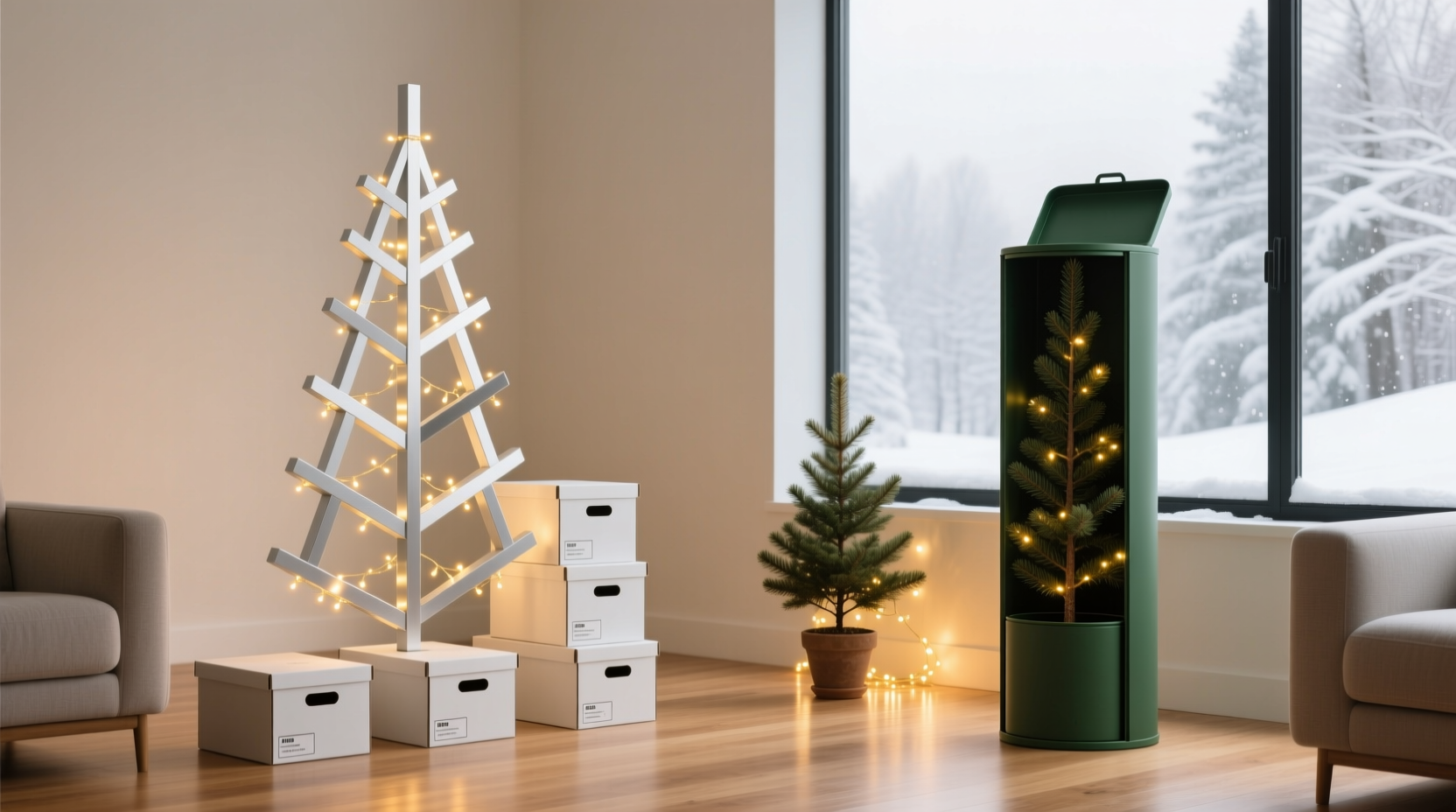
The fundamental distinction lies in construction. A **single-trunk artificial tree** features a central metal pole with branches pre-attached at various levels. When assembled, the entire structure unfolds from one core support, mimicking the natural form of a live tree. In contrast, a **modular (or sectional) Christmas tree** is built in tiers — typically three to five separate segments — each with its own internal frame and branch clusters. These sections stack vertically like layers of a cake, secured together with pins or locking mechanisms.
This architectural difference directly affects not only how quickly the tree goes up and comes down but also how compactly it can be stored. Single-trunk trees collapse into a single tall unit, while modular trees disassemble into shorter, flatter components. That seemingly small variation has major implications for storage logistics.
Space Efficiency: Dimensions and Footprint
Storage ease hinges on two factors: volume and shape. A 7-foot single-trunk tree folds into a cylindrical bag measuring roughly 60–70 inches in length. Even when compressed, it remains unwieldy — too tall for most closets, under-bed spaces, or low-clearance shelves. Many owners resort to leaning it against a wall or storing it in a garage, where temperature fluctuations and pests can degrade materials over time.
Modular trees, by comparison, break down into segments averaging 18–24 inches in height. Each section fits neatly into a smaller box or duffel-style bag. Instead of one long container, you get multiple compact units that can be stacked horizontally or tucked into tight spaces. This modularity allows for far greater flexibility in storage location.
Setup and Breakdown: Time vs. Effort Trade-Off
One common argument in favor of single-trunk trees is faster assembly. With all branches attached to a single pole, users simply lift, extend, and fluff. Setup times average 10–15 minutes for a medium-sized tree. However, this speed comes at a cost: breakdown requires compressing the entire structure back into its original form, often involving bending stubborn branches and wrestling with tangled tips.
Modular trees take slightly longer to assemble — typically 20–30 minutes — because each section must be individually unfolded, aligned, and locked into place. But the breakdown process is more methodical and less physically demanding. Sections are detached one at a time, allowing for controlled disassembly and immediate packing. There’s no need to force-flex metal supports or risk snapping brittle PVC needles.
Over multiple seasons, this incremental approach reduces wear and tear. According to interior designer and holiday stylist Mara Thompson, “Sectional trees encourage mindful handling. You’re not cramming everything into one motion — you’re managing each part with care, which preserves the tree’s appearance year after year.”
“Frequent compression of single-trunk trees leads to permanent branch deformation. Modular systems distribute stress across segments, reducing long-term damage.” — Dr. Alan Zhou, Materials Engineer specializing in consumer decor
Durability and Longevity Considerations
The repeated folding and unfolding of a single-trunk tree places continuous strain on hinge points and wire frames. Over time, this leads to sagging limbs, uneven silhouettes, and broken branch connectors. Once damaged, these flaws are difficult to repair and often result in visible gaps or lopsided shapes.
Modular designs avoid this issue by eliminating the folding mechanism altogether. Each segment maintains a fixed shape, so there’s no bending or compression during storage. Branches remain in their natural orientation, minimizing creasing and material fatigue. As a result, modular trees tend to retain their fullness and symmetry over many years.
Additionally, if one section does sustain damage — say, from accidental impact during storage — it can often be replaced independently. Some manufacturers sell replacement tiers, allowing owners to swap out a compromised base or midsection without buying an entirely new tree.
Storage Practicality: Real-World Scenarios
To illustrate how these differences play out in actual homes, consider two realistic examples:
Mini Case Study: Urban Apartment Living
Lena Kim lives in a 650-square-foot Brooklyn apartment with no closet taller than 78 inches. Her previous 7.5-foot single-trunk tree barely fit upright in a hallway storage bag, protruding into the living area every winter. She struggled to close the closet door and eventually resorted to leaving the tree in the hallway — a fire hazard and aesthetic eyesore.
After switching to a modular 7-foot tree, she now stores each of the four sections in flat rectangular bins under her bed. The total footprint is reduced by nearly 60%, and she gains back usable floor space. “It’s not just about convenience,” Lena says. “It’s about being able to enjoy the holidays without rearranging my entire home.”
Mini Case Study: Family Home with Seasonal Travel
The Reynolds family spends December in their mountain cabin, 120 miles from their primary residence. They used to transport their large single-trunk tree annually, struggling to fit it in their SUV. The constant loading and unloading led to bent branches and frayed tips within three years.
They upgraded to a modular tree designed for travel. Now, each section fits into a padded carry case that stacks securely in the trunk. Setup takes a bit longer, but the reduced physical strain and improved portability make the trade-off worthwhile. “We don’t dread taking it apart anymore,” says Mark Reynolds. “It actually feels manageable.”
Comparison Table: Key Features at a Glance
| Feature | Single-Trunk Tree | Modular Tree |
|---|---|---|
| Assembly Time | 10–15 minutes | 20–30 minutes |
| Breakdown Complexity | High (requires compression) | Low (section-by-section removal) |
| Storage Height | 60–80 inches (one piece) | 18–24 inches per section |
| Footprint Flexibility | Low (needs vertical space) | High (stackable, horizontal options) |
| Durability Over Time | Moderate (prone to branch fatigue) | High (fixed-shape segments) |
| Replacement Parts Available | Rare | Sometimes (by section) |
| Ideal For | Spacious homes, infrequent movers | Apartments, travelers, tight storage |
Step-by-Step Guide: Optimizing Your Tree Storage
No matter which type you own, proper storage extends lifespan and simplifies future setups. Follow this sequence to protect your investment:
- Disassemble completely: Remove all ornaments, lights, and stands. For modular trees, detach sections carefully.
- Inspect for damage: Check for broken branches, loose wires, or mold. Address minor repairs now to prevent worsening.
- Dust thoroughly: Use a microfiber cloth or soft brush to remove dust from needles and trunks. Avoid water unless specified by manufacturer.
- Compress gently: For single-trunk models, fold branches inward in the order they were extended. For modular, keep sections separated.
- Pack in proper containers: Use rigid plastic bins for modular trees; durable duffel bags with straps for single-trunk models. Avoid cardboard or thin fabric sacks.
- Store in climate-controlled area: Choose a dry, cool location away from sunlight, rodents, and humidity. Attics and garages are acceptable only if insulated.
- Label clearly: Mark containers with tree size, color, and year purchased to simplify selection next season.
Checklist: Choosing the Right Tree for Easy Storage
- ✅ Measure your storage space (height, width, depth)
- ✅ Prioritize modular designs if ceiling height is under 80 inches
- ✅ Look for hinged branch technology to reduce snagging
- ✅ Choose flat-pack compatible models with stackable cases
- ✅ Verify warranty coverage for branch integrity
- ✅ Consider weight — lighter sections are easier to handle
- ✅ Opt for color-matched connectors to hide seams between modules
Frequently Asked Questions
Can I convert a single-trunk tree into a modular one?
No — the structures are fundamentally different. Single-trunk trees are engineered as one unit and cannot be safely cut or segmented. Attempting to modify them will compromise stability and void warranties.
Do modular trees look less natural than single-trunk ones?
Not necessarily. High-end modular models use precision engineering to align sections seamlessly. From a distance of six feet or more, the difference is rarely noticeable. Some premium brands even offer “invisible seam” technology using tapered connectors and overlapping foliage.
Are modular trees more expensive?
Generally, yes — due to added hardware and manufacturing complexity. However, the long-term value often justifies the initial cost. With better durability and easier storage, modular trees may save money over five or more holiday seasons.
Conclusion: Making the Smart Choice for Long-Term Convenience
When evaluating which Christmas tree design stores more easily, the evidence strongly favors modular sections. Their ability to break down into compact, manageable units makes them ideal for modern living environments where space is limited and convenience matters. While single-trunk trees offer quicker setup, their bulky storage requirements and susceptibility to mechanical stress make them less sustainable over time.
The decision ultimately depends on your living situation, storage capacity, and how much value you place on seasonal ease. If you’re tired of battling with oversized bags, sagging branches, or last-minute reconfigurations just to find room for your tree, upgrading to a modular system could be the most practical holiday upgrade you make all year.




 浙公网安备
33010002000092号
浙公网安备
33010002000092号 浙B2-20120091-4
Comments
No comments yet. Why don't you start the discussion?