
Getting the right light density on a holiday tree isn’t just about aesthetics—it’s about balance, intention, and longevity. Too sparse, and the tree looks bare and underwhelming; too dense, and it overwhelms the branches, generates excess heat, or strains your circuit. Yet most consumers choose lights based on price or nostalgia—not on how well the system adapts to their specific tree shape, height, branch structure, or desired visual rhythm. That’s where the fundamental choice between modular light strips and traditional individual bulb strings becomes decisive. This isn’t a matter of “new vs. old.” It’s about matching physical architecture, electrical behavior, and user control to the three-dimensional reality of a living (or high-fidelity artificial) tree.
Understanding Light Density: More Than Just Bulbs Per Foot
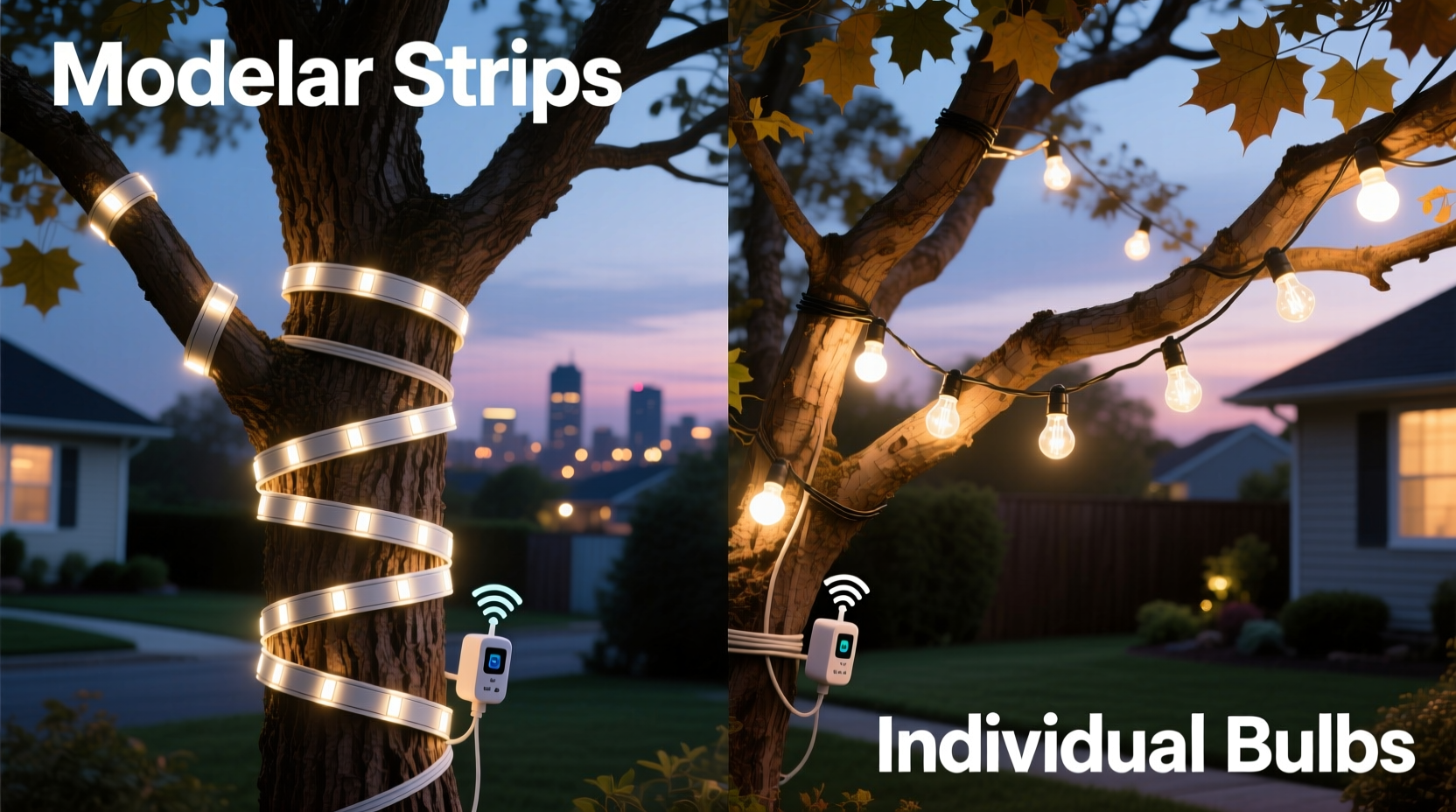
Light density refers to the number of luminous points per linear or surface unit—but on a conical, layered, asymmetrical object like a tree, linear measurements alone are misleading. A 6-foot tree with tight, horizontal tiers needs different spacing logic than a 9-foot slim-profile tree with vertical gaps. True density control requires adjusting not only *how many* lights appear along a given stretch but *where* they land relative to branch thickness, foliage volume, and viewing angle.
Individual bulb strings deliver fixed spacing—typically 4”, 6”, or 8” between sockets—dictated at the factory. Once manufactured, that interval is immutable. Modular light strips, by contrast, consist of segmented units (often 2–6 inches long) with integrated LEDs, connected via standardized snap-in or magnetic couplers. Each segment contains its own micro-LED array, and the spacing between segments is adjustable during installation. This distinction transforms density from a static specification into a dynamic parameter.
Installation Flexibility & Branch-Level Precision
Wrapping a string around a tree is intuitive—but rarely precise. Individual bulb strings force users to either over-wrap (creating clusters and hot spots) or under-wrap (leaving gaps), especially on irregular branches. Because each socket holds one bulb, and wires run continuously, you cannot insert, remove, or reposition a single light without cutting and rewiring—a nonstarter for seasonal decor.
Modular strips solve this through segmentation and directional mounting. Each strip segment has adhesive backing or flexible mounting clips, allowing placement *on top* of branches rather than wrapping *around* them. You can position a segment vertically on a thick trunk section, horizontally across a wide bough, or diagonally along a slender limb—all without tension or wire sag. More critically, you decide exactly how many segments go where—and skip sections entirely where density would overwhelm.
This matters most for trees with mixed foliage: real firs hold lights differently than pre-lit PVC pines, and older artificial trees often have uneven branch density. With modular strips, you place two segments on a heavy lower branch, leave a 10-inch gap on a thin upper one, then add a single segment near the tip for accentuation. With bulb strings, you’re locked into uniformity—even if it contradicts your tree’s natural form.
Electrical Behavior and Scalability
Density decisions carry electrical consequences. Individual bulb strings—especially incandescent ones—are wired in series or series-parallel configurations. Adding more strings increases total load and voltage drop, which dims bulbs toward the end of the chain. Most manufacturers cap daisy-chaining at 3–5 sets. LED strings improve efficiency but still impose hard limits: exceeding manufacturer-specified max length risks overheating, flickering, or controller failure.
Modular light strips use low-voltage DC power (typically 5V or 12V) with distributed power injection points. Instead of one long chain, you connect segments to a central hub or power rail, allowing localized power delivery. This eliminates voltage drop across distance and enables true scalability: a 7-foot tree may use 24 segments; a 12-foot tree may use 48—without redesigning the entire circuit. Many systems support optional repeaters or auxiliary injectors every 10–15 feet, ensuring consistent brightness regardless of layout complexity.
| Feature | Individual Bulb Strings | Modular Light Strips |
|---|---|---|
| Max Recommended Length | 21–35 ft (varies by voltage & bulb type) | No fixed limit—power injectors enable >100 ft coverage |
| Voltage Drop Impact | Significant beyond 25 ft; causes dimming/flicker | Negligible with proper injector placement |
| Branch-Level Adjustment | None—spacing fixed; placement limited to wrapping | Full control—add, omit, or reorient segments per branch |
| Circuit Load Management | Single load point; all strings share same outlet | Segmented loads; distribute across multiple outlets or USB-C PD sources |
| Lifespan Consistency | Bulbs age at different rates due to heat variance | Uniform thermal design; LEDs share identical drive conditions |
Real-World Application: The Case of the Heritage Spruce
Marisol manages holiday lighting for a historic botanical garden in Portland. Each year, she decorates a 32-year-old Douglas fir—28 feet tall, with dense lower boughs, an open midsection shaped by decades of wind pruning, and delicate, upward-sweeping tips. For years, she used premium LED bulb strings: 12 sets of 25-light strands, hand-wrapped over three days. Despite meticulous planning, the lower third always looked “blinding,” while the upper third appeared “skimpy.” Guests commented that the tree felt “top-heavy” visually—even though Marisol had added extra strings there.
In 2023, she switched to a modular strip system with 4-inch segments and programmable white+color tuning. She mapped the tree into six vertical zones, assigning segment counts based on branch mass and viewer sightlines. She placed 3 segments per foot on the lowest 6 feet, reduced to 1.5 per foot from 6–18 feet, and used only 1 segment every 18 inches above 18 feet—plus a single accent strip spiraling the very top. Installation took 3.5 hours—not less time, but far more intentional. Crucially, she could test density *in situ*: placing a segment, stepping back, adjusting, and repositioning within seconds. The result? A tree guests described as “luminous but breathing”—even lighting professionals asked how she achieved such natural gradation.
“Density isn’t about quantity—it’s about perceptual harmony. Modular systems let you treat light like pigment: apply where needed, dilute where appropriate, and leave space for the tree to speak.” — Javier Ruiz, Lighting Designer, Evergreen Collective
Step-by-Step: Optimizing Density for Your Tree
- Evaluate Your Tree’s Architecture: Stand 10 feet back. Note where branches cluster (e.g., lower third), where gaps occur (e.g., mid-trunk), and where tips taper. Sketch a simple vertical cross-section.
- Define Target Zones: Divide the tree into 3–5 vertical bands. Assign a target density to each (e.g., “High: 4 segments/ft,” “Medium: 2 segments/ft,” “Accent: 1 segment every 2 ft”).
- Calculate Segment Needs: Measure linear branch length in each zone (not trunk height). Multiply by target density. Add 10% buffer for adjustments.
- Choose Mounting Strategy: Use adhesive-backed segments for smooth branches or clips for textured bark. Avoid wrapping unless necessary—modular systems excel when mounted *on*, not *around*.
- Test & Refine Before Finalizing: Install 3–5 segments per zone first. Step back. Adjust spacing or count. Repeat until balance feels instinctive—not symmetrical, but harmonious.
Common Pitfalls & How to Avoid Them
- Mistaking “more lights” for “better density”: Overloading thin branches creates glare and shadows beneath. Prioritize even illumination over raw count.
- Ignoring power distribution: Even with modular strips, failing to inject power every 10–15 ft causes dimming. Map injector points during layout—not after installation.
- Using bulb strings for narrow profiles: Slim trees (e.g., pencil firs) look unnatural with 6”-spaced bulbs. Modular strips allow 2”–3” spacing without clustering.
- Assuming all modular systems are equal: Some use proprietary connectors or lack weather resistance. Verify IP65 rating for outdoor use and UL/ETL certification for safety.
- Forgetting thermal management: Incandescent strings generate significant heat on dense branches. Modular LED strips run cooler—but still require airflow on tightly packed sections.
FAQ
Can I mix modular strips and bulb strings on the same tree?
Technically yes—but not advised. They operate on different voltages, control protocols, and thermal profiles. Combining them complicates power management, creates inconsistent color temperature, and undermines the precision density control modular systems offer. Choose one philosophy and commit to it for coherent results.
Do modular strips work with standard light timers or smart home systems?
Most modern modular systems include 0–10V, DMX, or Wi-Fi-enabled controllers compatible with major smart platforms (Apple Home, Google Home, Alexa). Basic models accept standard AC timers, but advanced features like zone dimming or dynamic sequencing require dedicated controllers. Always verify compatibility before purchase.
How do I store modular strips for long-term durability?
Coil gently—not tightly—and store flat in original boxes or padded sleeves. Avoid stacking heavy objects on top. Keep away from UV exposure and humidity above 60%. Unlike brittle bulb-string wires, modular strips use flexible PCBs that degrade if bent repeatedly at the same point—so vary coil orientation seasonally.
Conclusion: Density as Design Language
Choosing between modular light strips and individual bulb strings isn’t about picking a product—it’s about choosing a design mindset. Bulb strings reflect a legacy approach: standardized, predictable, and rooted in mass production. Modular strips embody a contemporary one: responsive, adaptive, and deeply attentive to context. When your goal is customizing light density—not just covering branches—you’re no longer decorating a tree. You’re composing with light: shaping perception, guiding the eye, and honoring the tree’s unique presence. That level of intention demands tools that bend to your vision—not the other way around.
Start small: pick one tree this season. Map its zones. Calculate segment counts. Install deliberately. Notice how light interacts with texture, depth, and shadow—not just how many points glow. You’ll discover that density, when treated as a variable rather than a number, becomes the quietest, most powerful design decision you make.




 浙公网安备
33010002000092号
浙公网安备
33010002000092号 浙B2-20120091-4
Comments
No comments yet. Why don't you start the discussion?