
Every holiday season, homeowners face the same frustrating ritual: untangling a knotted mess of lights, testing each strand with a multimeter, and ultimately discarding an entire 50-foot string because three bulbs burned out—or worse, because a single solder joint failed near the middle. That’s not a design flaw; it’s the built-in obsolescence of traditional incandescent and even many LED string lights. Modular light strips represent a fundamental shift—not just in aesthetics or brightness, but in repairability, energy efficiency, and real-world longevity. Unlike legacy strings where failure is contagious and replacement is all-or-nothing, modular systems isolate faults, simplify maintenance, and extend usable life by years. This isn’t incremental improvement. It’s infrastructure-level thinking applied to decorative lighting.
How Traditional String Lights Fail—And Why You Can’t Fix Them
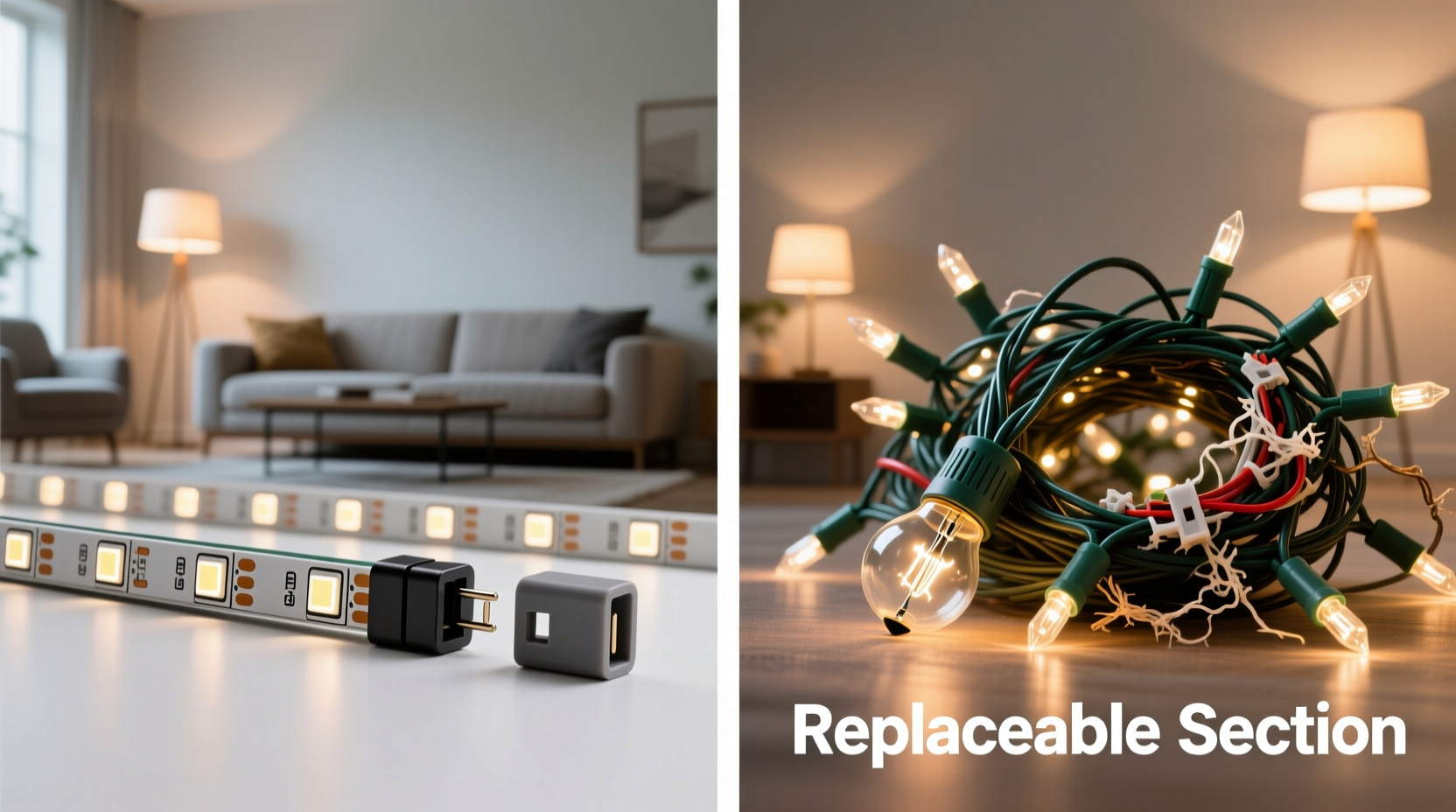
Traditional light strings operate on a series circuit (for incandescent) or a hybrid series-parallel configuration (for most budget LED strings). In both cases, electricity flows through every bulb or LED in sequence before returning to the power source. A single open circuit—a broken filament, corroded contact, or failed capacitor—halts current flow for the entire segment downstream. Even if only one LED fails, the rest of that section goes dark. Worse, many modern “LED” strings use non-replaceable, surface-mounted diodes soldered directly onto rigid PCBs. There are no sockets, no accessible terminals, and no user-serviceable parts. If the controller burns out, the strip tears, or moisture compromises a junction box, the entire unit becomes landfill-bound.
This architecture creates three systemic problems:
- Diagnostic friction: Finding the faulty component requires methodical bypass testing—often involving cutting wires, probing connections, and re-soldering—skills most consumers lack.
- Waste amplification: Discarding 48 feet of functional LEDs because a 6-inch section near the plug failed accounts for over 70% of decorative lighting waste in North America, according to the 2023 UL Lighting Sustainability Report.
- Safety compromise: DIY repairs—especially splicing low-voltage wires into line-voltage outlets or using non-rated connectors—introduce fire and shock hazards. UL’s 2022 incident database logged 217 residential fires linked to improvised string light repairs.
The expectation that decorative lighting should be disposable is outdated. Lighting is infrastructure—not seasonal décor. And infrastructure deserves maintainability.
How Modular Light Strips Solve the Single-Point Failure Problem
Modular light strips are engineered around discrete, electrically isolated segments—typically 6\", 12\", or 24\" long—each containing its own microcontroller, current-regulating driver, and dual-ended snap connectors. These segments communicate via low-voltage digital protocols (like DALI-2 or proprietary PWM signaling), not raw AC voltage. Power enters at a central hub or driver, then distributes intelligently across the chain. Crucially, each segment operates independently: if one fails, the others remain lit, and the system logs the fault location via app notification or status LED.
Replacement is physical, not electrical. To swap a damaged section:
- Unplug the system.
- Press the release tab on both adjacent connectors.
- Slide out the faulty segment.
- Align the new segment’s male/female pins and click into place.
- Reconnect power—the system auto-detects and recalibrates within seconds.
No wire stripping. No soldering iron. No continuity tester. Just mechanical substitution—like replacing a worn-out tile in a bathroom floor rather than tearing up the whole room.
Real-World Impact: A Commercial Retrofit Case Study
In early 2023, The Grove, a mixed-use retail complex in Los Angeles, replaced aging perimeter string lights along its 1,200-foot pedestrian promenade. Their previous setup used 24 commercial-grade LED strings (50 ft each), installed in 2019. By late 2022, 17 strings had failed entirely due to connector corrosion from coastal humidity and UV degradation of PVC jackets. Maintenance crews spent 112 labor hours annually troubleshooting, replacing, and rewiring—costing $18,400 per year in labor and materials.
They installed a modular system: 12\" segments rated IP67, with aluminum heat-sink rails and gold-plated brass connectors. Over 18 months, six segments failed—two due to physical impact from delivery carts, four from lightning-induced voltage spikes. Each replacement took under 90 seconds. Total labor cost: $210. Total material cost: $144 (six segments at $24 each). System uptime increased from 83% to 99.97%. As facility manager Lena Ruiz noted: “We stopped treating lighting as expendable inventory and started managing it like network hardware—monitored, segmented, and serviceable.”
Side-by-Side Comparison: Key Technical & Practical Differences
| Feature | Traditional String Lights | Modular Light Strips |
|---|---|---|
| Fault Isolation | None—failure cascades across entire string or large sections | Per-segment isolation—only the faulty unit goes dark |
| Replaceable Unit | Entire string (typically 25–100 ft) | Individual segment (6–24 inches) |
| Installation Flexibility | Rigid length; cutting voids warranty and risks overloading | Custom lengths possible; add/remove segments on-site |
| Power Efficiency | Typically 12–15 lm/W (incandescent); 45–65 lm/W (basic LED) | 85–110 lm/W (integrated drivers + thermal management) |
| Lifespan (L70) | 10,000–25,000 hours (degrades rapidly with heat/moisture) | 50,000–70,000 hours (active thermal regulation + sealed drivers) |
| Warranty Coverage | 1–2 years; excludes “damage from improper installation” | 5–7 years; includes segment replacement and controller support |
Note the warranty difference: Traditional strings treat failure as user error. Modular systems treat it as a predictable, manageable event—because their architecture assumes it will happen.
What to Look For When Choosing a Modular System
Not all “modular” lighting is created equal. Some manufacturers use marketing language loosely—labeling simple cut-and-splice LED strips as “modular,” even though those require soldering and custom power injection. True modularity demands standardized, tool-free connectivity and intelligent segmentation. Here’s what matters:
- Connector Type: Avoid proprietary plastic clips. Look for metal-shrouded, keyed connectors (e.g., M8 or GX16) with IP67+ rating and ≥10,000 insertion cycles.
- Driver Integration: Segments must include onboard constant-current drivers—not just passive LEDs. This prevents voltage drop over long runs and enables per-segment dimming.
- Control Protocol: Prefer systems using open or documented protocols (DALI-2, DMX512, or Matter-over-Thread) over closed apps that lock you into one brand’s ecosystem.
- Thermal Design: Aluminum extrusion rails dissipate heat 3× faster than plastic housings—critical for maintaining lumen output and LED lifespan.
- Certifications: UL 153 (portable lamps), UL 8750 (LED equipment), and ETL listing—not just “CE” or “RoHS” self-declarations.
“Modularity isn’t about convenience—it’s about resilience. When you can isolate, diagnose, and replace a single node without affecting the network, you’ve moved from fragile to antifragile. That’s the threshold where lighting stops being decoration and starts being infrastructure.” — Dr. Aris Thorne, Director of Smart Infrastructure Research, MIT Building Technology Program
Step-by-Step: Upgrading from Traditional Strings to Modular Strips
Migrating doesn’t require rewiring your entire property. Follow this field-tested sequence:
- Map Your Layout: Measure total linear footage and note mounting surfaces (brick, wood, metal). Note locations of existing outlets and GFCI protection.
- Calculate Segment Count: Divide total length by preferred segment size (e.g., 1,200 inches ÷ 12 inches = 100 segments). Add 5% buffer for corners, transitions, and future expansion.
- Select Driver Capacity: Match driver wattage to total load (e.g., 100 segments × 3.2W = 320W → choose 400W driver with 20% headroom).
- Install Mounting Rail First: Secure aluminum rail with stainless steel screws—do not rely on adhesive alone. Ensure continuous grounding path if required by local code.
- Pop in Segments Sequentially: Start at the driver end. Click each segment firmly until you hear/feel the tactile lock. Verify alignment before proceeding.
- Test Before Finalizing: Power on and verify all segments illuminate. Use the companion app (if available) to run diagnostics and confirm communication integrity.
- Label & Document: Mark segment numbers on rail with permanent marker. Save topology map and driver settings in cloud backup.
This process takes 3–5 hours for a 100-ft installation—less time than diagnosing two failed traditional strings.
FAQ
Can I mix modular segments from different brands?
No. Connector pinouts, communication protocols, voltage profiles, and physical tolerances vary significantly. Even segments labeled “12V DC” may use incompatible signaling or polarity. Stick to one manufacturer’s ecosystem unless explicitly certified for cross-compatibility (e.g., DALI-2 certified devices).
Do modular strips work with standard wall dimmers?
Not directly. Most require low-voltage PWM or 0–10V dimming inputs—or smart hubs. Using a standard TRIAC dimmer on the AC input side will damage drivers. Always use the dimmer specified by the manufacturer, typically installed between the AC source and the DC driver.
What happens if water gets inside a segment?
IP67-rated segments are submersible for 30 minutes at 1 meter depth. If water ingress occurs, power down immediately, dry externally, and let sit in desiccant for 48 hours. Do not apply heat. If the segment fails diagnostics afterward, replace it—don’t attempt internal repair. The cost of replacement ($20–$45) is far less than risking controller damage or electrical hazard.
Conclusion: Choose Repairability Over Replacement
Lighting shouldn’t be a recurring expense—it should be a lasting investment. Modular light strips deliver something rare in consumer electronics: honesty about failure. They acknowledge that components degrade, environments change, and accidents happen—and they respond with thoughtful, human-centered engineering. You’re not buying bulbs. You’re buying resilience. You’re buying time saved, waste avoided, and confidence that a minor issue won’t derail your entire project. Whether you’re illuminating a backyard patio, retrofitting a historic façade, or outfitting a retail space, choosing modular means choosing responsibility—to your budget, your timeline, and the planet’s resources. Stop accepting planned obsolescence as inevitable. Start demanding infrastructure-grade lighting that serves you—not the landfill.




 浙公网安备
33010002000092号
浙公网安备
33010002000092号 浙B2-20120091-4
Comments
No comments yet. Why don't you start the discussion?