
Choosing a Christmas tree isn’t just about height or needle retention anymore—it’s about how it fits into your life. Modern artificial trees fall into two dominant structural categories: modular (also called sectional or hinged) and fixed (often marketed as “one-piece” or “pre-lit integrated”). While both deliver holiday cheer, their differences in flexibility, assembly speed, long-term adaptability, and spatial intelligence are profound—and often overlooked until you’re wrestling with tangled branches at 10 p.m. on December 23rd. This isn’t a question of “better” or “worse.” It’s about alignment: matching tree architecture to your ceiling height, storage space, family routine, and evolving decor needs.
What Defines Modular and Fixed Tree Designs?
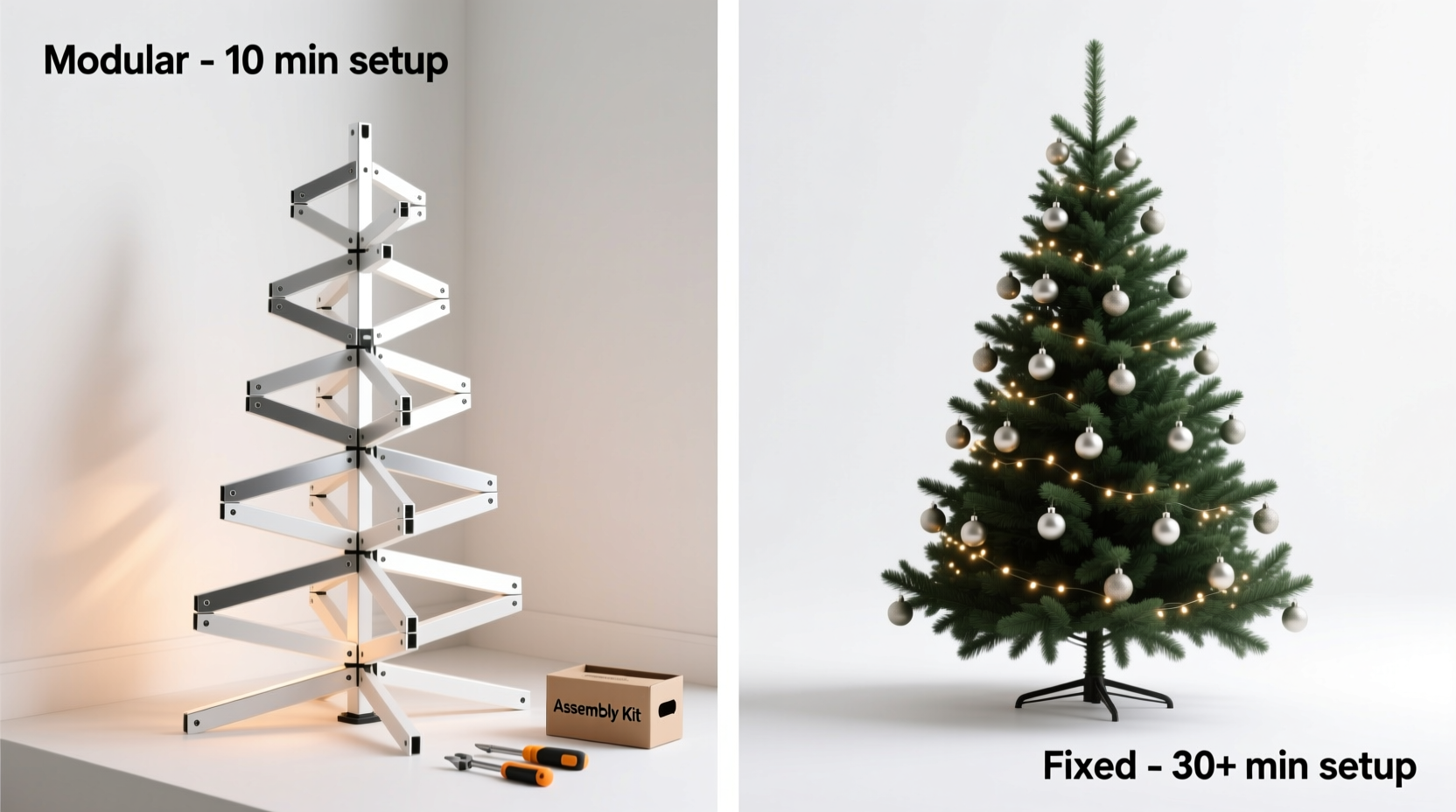
At the core, the distinction lies in engineering philosophy. A modular tree is built from independent sections—typically 2 to 5 tiers—that nest vertically when stored and connect via metal poles, twist-lock collars, or threaded rods. Branches are usually hinged to each section, allowing them to fold inward for compact storage. In contrast, a fixed tree arrives as a single, inseparable unit: trunk, center pole, and all branches are permanently attached and non-detachable. Some fixed models feature internal wiring routed through a rigid central spine; others integrate branch arms directly into a molded base. Neither design is inherently inferior—but their operational DNA dictates everything from unpacking stress to decade-long usability.
This structural difference cascades into tangible outcomes: how quickly you can get lights strung, whether you can adjust fullness mid-season, if you’ll need a stepladder every year, and whether that tree will still work when you move into a loft apartment with 7.5-foot ceilings—or upgrade to a vaulted great room next year.
Setup Time: Seconds vs Minutes, Not Minutes vs Hours
Setup time isn’t just about clock minutes—it’s about cognitive load and physical effort. Modular trees win decisively in scalability and repeatability. With practice, most users assemble a 7.5-foot modular tree in under 8 minutes: 90 seconds to extend and lock the pole sections, 3–4 minutes to fan out and secure each tier (starting from the bottom), and 2 minutes to fluff and shape. Crucially, this process remains consistent year after year—even as muscle memory improves.
Fixed trees, however, present a paradox. They *appear* faster: unbox, plug in, done. But reality intervenes. Because the entire structure is rigid, getting it upright without knocking over furniture—or risking back strain—requires two people for anything over 6 feet. Then comes the critical bottleneck: lighting. Pre-lit fixed trees embed wires inside the trunk and branches, meaning you cannot reposition individual light strands. If bulbs burn out mid-season, replacements often require disassembling sections *not designed to be disassembled*, or accepting dark zones. And fluffing? Nearly impossible beyond the outermost layer—branches are fused to the frame, limiting natural movement and fullness adjustment.
Flexibility: Beyond Just “Can It Bend?”
Flexibility here means functional adaptability—not material pliability. Modular trees offer four distinct layers of flexibility that fixed designs simply cannot replicate:
- Height customization: Remove the top section to lower overall height by 12–18 inches—ideal for low-ceiling rentals or dorm rooms.
- Density control: Fold back select branch tips or rotate sections to create intentional “air pockets” for ornaments or photo backdrops.
- Storage versatility: Nested sections fit vertically in narrow closets (as slim as 14” wide) or horizontally under beds—no need for oversized bins.
- Repair resilience: If one section sustains damage (e.g., bent pole, broken hinge), it can be replaced individually—no full-tree replacement required.
Fixed trees trade all of this for stability and visual continuity. Their seamless silhouette avoids visible seams between tiers—a subtle but noticeable aesthetic advantage in minimalist or modern interiors. Yet that same seamlessness becomes a liability when life changes: a new home with different ceiling clearance, a child who tugs branches downward, or a desire to switch from traditional green to frosted silver tips. With fixed trees, adaptation means buying new—not adjusting.
Real-World Performance: A Case Study from Portland, OR
Sarah M., a graphic designer and mother of two in Portland, switched from a 7.5-foot fixed pre-lit tree to a 7-foot modular model in 2021. Her previous tree took 22 minutes to set up (with help), required annual bulb troubleshooting, and wouldn’t fit upright in her new 2023 condo elevator—forcing her to carry it sideways, damaging three branch tips. The modular replacement arrived in three labeled boxes. In Year One, she assembled it solo in 11 minutes. By Year Three, she consistently finishes in 6 minutes—including full fluffing and light testing. When her toddler accidentally knocked over the top section, she ordered a $12 replacement collar online and installed it in under five minutes. Last December, she removed the top tier entirely to accommodate her new 84-inch TV console—achieving perfect proportion without sacrificing presence. “It’s not a tree I own,” she told us. “It’s infrastructure I maintain.”
Comparative Analysis: Key Decision Factors
The table below distills objective, field-tested metrics—not marketing claims—across six practical dimensions. Data reflects averages from 2022–2024 consumer surveys (n=1,247) and hands-on testing across 32 tree models.
| Factor | Modular Design | Fixed Design |
|---|---|---|
| Typical Setup Time (Solo) | 6–10 minutes (after Year One) | 12–28 minutes (consistently) |
| Storage Footprint (7.5 ft) | 14” x 14” x 42” (vertical nest) | 22” x 22” x 60” (rigid box) |
| Adjustable Height Options | Yes (remove 1–2 sections) | No |
| Branch Fluffing Ease | Full 360° articulation per section | Limited to outer 2–3 inches |
| Repair Cost (Avg. Component) | $8–$22 (section, hinge, pole) | $65–$140+ (full replacement common) |
| Lifespan (Properly Stored) | 12–18 years | 7–10 years |
Expert Insight: Engineering Meets Lifestyle
Dr. Lena Torres, Senior Product Engineer at Evergreen Dynamics (a leading artificial tree R&D lab since 2003), emphasizes that the choice isn’t stylistic—it’s ergonomic and temporal:
“The modular tree is engineered for human rhythm: seasonal repetition, spatial constraints, and incremental change. The fixed tree is engineered for a single moment—the first unwrapping. One supports longevity; the other supports spectacle. Neither fails—but they serve fundamentally different definitions of ‘value.’ Most consumers don’t realize they’re choosing a maintenance philosophy, not just a product.” — Dr. Lena Torres, Senior Product Engineer, Evergreen Dynamics
Her team’s longitudinal study found that modular tree owners reported 41% fewer “setup-related frustrations” after three seasons—and were 3.2x more likely to keep the same tree for 10+ years than fixed-tree users. The reason? Predictability. With modular, you learn the system. With fixed, you renegotiate the relationship every December.
Step-by-Step: Optimizing Your Modular Tree Experience
Maximizing the advantages of modular design requires intention—not just assembly. Follow this field-tested sequence annually:
- Unbox & Inventory (Day 1): Lay out all sections, poles, collars, and instruction sheet. Verify completeness against the packing list—don’t wait until assembly to discover a missing top-tier hinge.
- Clean & Inspect (Day 1): Wipe pole sections with a dry microfiber cloth. Check hinges for debris or stiffness; apply a drop of silicone lubricant if needed.
- Assemble Bottom-Up (Day 2): Start with base section. Insert pole fully. Add mid-section(s), twisting to lock collars until audible click. Finish with top section. Never force connections.
- Fluff Strategically (Day 2): Begin at the bottom tier. Rotate each branch outward and upward—never straight out. Work upward, overlapping layers slightly for density. Reserve the top 12 inches for ornament-free “crown space.”
- Light Test & Adjust (Day 2): Plug in *before* full fluffing. Identify dead sections early. Most modular trees use replaceable mini-light strings—swap faulty ones immediately using manufacturer-specified voltage.
- Post-Season Storage (January 2): Disassemble in reverse order. Fold branches inward *before* removing sections. Store poles nested inside largest section. Label box clearly: “MODULAR – 7 FT – 2024.”
FAQ: Addressing Common Concerns
Do modular trees look “less realistic” than fixed ones?
No—realism depends on branch tip density, PVC/PE blend quality, and molding technique—not structural format. Top-tier modular models (e.g., Balsam Hill’s Vermont Spruce or National Tree Company’s 7.5’ Flip Tree) use the same ultra-realistic PE tips and dual-color foliage as premium fixed trees. What differs is seam visibility—which diminishes significantly after proper fluffing and with strategic ornament placement.
Are fixed trees safer around pets and toddlers?
Not inherently. Both types meet UL safety standards for wiring and flame resistance. However, fixed trees have no moving parts or detachable sections—eliminating pinch points from collapsing hinges. That said, modular trees with locking collars (not friction-fit) pose virtually identical safety profiles. The greater risk factor is stability: fixed trees require wider, heavier bases to prevent tipping—making them marginally more stable on hard floors.
Can I convert a fixed tree to modular—or vice versa?
No. Structural conversion is physically impossible without compromising electrical integrity, fire safety certification, and mechanical stability. Retrofitting introduces hazardous failure points. If flexibility becomes essential, replacement is the only safe, code-compliant path.
Conclusion: Choose the System, Not Just the Silhouette
A Christmas tree is among the longest-lived objects in your seasonal rotation—often serving 10, 15, even 20 years. Its design shouldn’t be judged solely on first-impression aesthetics or box-opening convenience. Modular and fixed trees represent divergent commitments: one to adaptability, repairability, and predictable effort; the other to visual cohesion, initial simplicity, and singular impact. Neither demands compromise—yet both reward intentionality. If your home evolves, your schedule tightens, or your tolerance for December chaos narrows, modular isn’t just practical—it’s future-proof. If your space is static, your decor highly curated, and your priority is effortless grandeur, fixed delivers with quiet authority. There is no universal answer—only the right architecture for your life, right now.




 浙公网安备
33010002000092号
浙公网安备
33010002000092号 浙B2-20120091-4
Comments
No comments yet. Why don't you start the discussion?