
As the holiday season approaches, one of the first decisions families face is choosing the right Christmas tree. While real trees offer tradition and scent, artificial trees dominate convenience and reusability. Within that category, two primary designs stand out: modular (also called hinged or sectioned) and fixed (often referred to as traditional pole-and-sleeve). The choice between them isn’t just about aesthetics—it directly impacts how easy—or frustrating—your annual decorating process will be.
The ease of decorating hinges on more than just stringing lights. It involves setup time, branch accessibility, stability during ornament placement, storage logistics, and long-term durability. Understanding the differences between modular and fixed design trees helps you select a model that aligns with your lifestyle, space, and decorating ambitions.
Understanding Modular and Fixed Design Trees
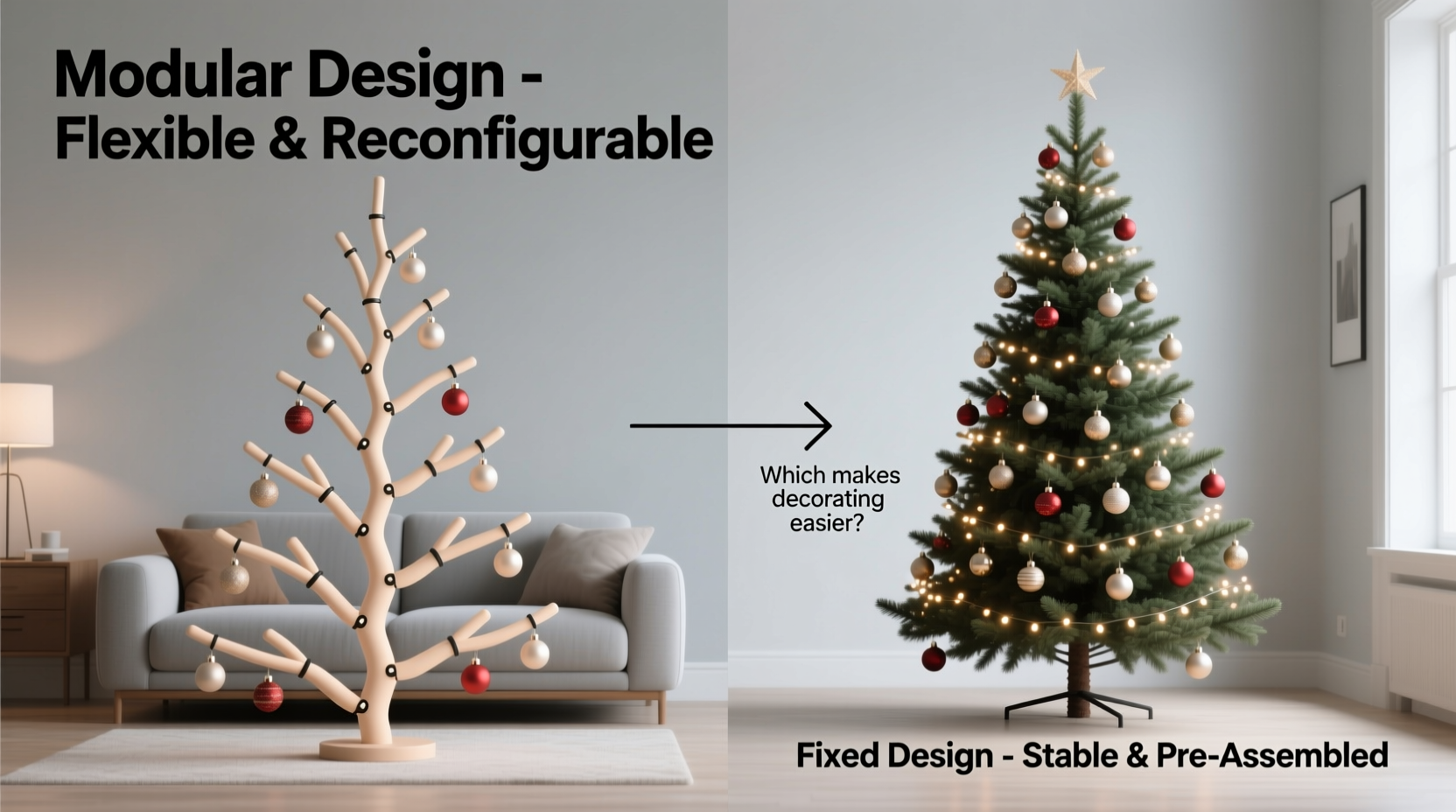
Modular design trees are engineered for speed and simplicity. These trees feature pre-attached branches connected by internal wire frames or hinges. They unfold like an accordion, with each tier snapping into place around a central pole. Most models come in multiple stacked sections that lock together vertically. Because the branches are already arranged, there’s no need to manually insert individual boughs.
In contrast, fixed design trees require assembly from scratch. Each branch—often sold as separate clusters or “tips”—must be inserted into designated sleeves attached to a central metal pole. This method allows for greater customization but demands significantly more time and effort.
While both types use artificial materials such as PVC or PE (polyethylene), their structural approach creates vastly different user experiences. A modular tree can go from box to full shape in under 30 minutes, while a fixed tree may take over an hour depending on size and density.
Decorating Ease: Key Factors Compared
When evaluating which tree makes decorating easier, several practical aspects come into play: setup speed, branch stability, access to inner layers, and overall structure consistency.
Setup Speed and Simplicity
Modular trees win decisively in this category. With hinged limbs that expand outward once secured to the center pole, these trees minimize hands-on assembly. Many users describe the process as “fluffing” rather than building. After connecting the sections and rotating the base, all that remains is shaping the branches to fill gaps.
Fixed trees demand meticulous attention. Each branch sleeve must receive its cluster, often requiring twisting and pushing until secure. On larger trees (7 feet and above), this can mean handling over 1,000 individual tip ends. The process is repetitive and physically taxing, especially when working overhead.
Branch Accessibility During Decorating
One overlooked factor in decorating ease is how well you can reach the interior of the tree. Modular trees typically have a more uniform branch layout due to factory preset configurations. While this ensures symmetry, it can sometimes limit access to the core if branches are too densely packed.
Fixed trees, however, allow decorators to control spacing. By inserting fewer clusters per sleeve or adjusting angles, you create natural pockets for lights and ornaments deep within the trunk area. This customizability means better light diffusion and a less \"flat\" appearance from the outside.
Stability Under Ornament Load
Both designs rely on weighted bases, but performance varies. Modular trees use rigid internal frames that support consistent weight distribution. However, because branches are fixed at set angles, heavy ornaments can cause sagging if placed too far from the trunk.
Fixed trees give users the ability to reinforce high-traffic zones during assembly. For example, placing sturdier, thicker clusters near the bottom before adding lighter ones above increases load-bearing capacity where it matters most.
“Families who prioritize quick setup and minimal annual effort tend to prefer modular trees. Those aiming for a lush, lifelike display with full interior depth often invest the extra time in fixed designs.” — Laura Mendez, Interior Stylist & Holiday Display Consultant
Storage, Longevity, and Maintenance
A tree’s impact extends beyond December. How easily it stores and holds up over years influences long-term satisfaction.
Storage Requirements
Modular trees usually disassemble into fewer, bulkier sections. While faster to take down, they require large storage bags or containers—sometimes taller than 3 feet. Their rigid frames don’t compress much, so apartment dwellers or those without basements may struggle to find space.
Fixed trees break down into smaller components: a slender pole, detachable sleeves, and loose branches. Though disassembly takes longer, the parts pack into compact bins. Some models even fit under beds or inside closets. This modularity makes them ideal for small homes or seasonal movers.
Durability Over Time
Because modular trees depend on hinge mechanisms and embedded wiring (for pre-lit versions), repeated folding can lead to wear. Broken hinges or frayed wires are common complaints after 5+ years of use. Repairs are difficult, often leading to premature replacement.
Fixed trees suffer less from mechanical fatigue. Without moving parts, failure points are minimal. Damaged branches can be replaced individually, extending the tree’s lifespan indefinitely with proper care.
Comparison Table: Modular vs Fixed Design Trees
| Feature | Modular Design | Fixed Design |
|---|---|---|
| Setup Time | 15–30 minutes | 60–90+ minutes |
| Branch Insertion Required? | No | Yes, extensive |
| Customization Level | Low to moderate | High |
| Storage Footprint | Large, bulky sections | Compact, separable parts |
| Durability (Long-Term) | Moderate (hinge/wire wear) | High (replaceable parts) |
| Best For | Busy households, seniors, small children | Perfectionists, display enthusiasts, limited storage |
Step-by-Step: Setting Up Each Type
Modular Tree Setup (Under 30 Minutes)
- Unpack all sections and lay them flat to prevent bending.
- Connect the bottom, middle, and top segments onto the central pole; lock securely.
- Place the assembled trunk into the stand and tighten the base clamp.
- Begin at the bottom and gently fan out each tier of branches, working upward.
- Rotate branches outward to cover support rods and create fullness.
- Add lights (if not pre-wired) starting from the trunk outward.
- Hang ornaments, beginning with larger pieces near the base.
Fixed Tree Assembly (60–90 Minutes)
- Lay out the metal pole and attach the bottom sleeve section.
- Insert thick, supportive branch clusters into lower sleeves to bear weight.
- Stack the next sleeve segment and continue adding branches, alternating directions for balance.
- Repeat stacking and filling until the top cap is reached.
- Shape each cluster by hand, fluffing tips outward and layering for depth.
- String lights evenly, wrapping in a spiral pattern from bottom to top.
- Decorate strategically, using inner branches for heavier items and outer for accents.
Real Example: Two Families, Two Choices
The Thompson family lives in a suburban home with a finished basement and two young kids. Every November, they pull out their 7.5-foot modular tree. “We used to spend hours putting together an old fixed tree,” says Sarah Thompson. “Now, my husband sets it up in 20 minutes while I organize the ornaments. The kids help fluff the branches—it’s part of our tradition now.”
Meanwhile, James Reed, a retired architect living in a downtown condo, swears by his 6-foot fixed design tree. “I enjoy the process,” he explains. “It’s meditative. I can tweak every angle, hide cords, and build a centerpiece that looks like it grew naturally. Plus, everything fits in a single storage cube under my bed.”
Their contrasting preferences highlight a key truth: the “easier” option depends on personal priorities. For some, speed and simplicity matter most. For others, precision and control outweigh time investment.
Checklist: Choosing the Right Tree for Your Needs
- ✅ Assess available storage space – Do you have room for large bins?
- ✅ Consider physical ability – Can you lift heavy sections or perform repetitive motions?
- ✅ Evaluate decorating goals – Are you aiming for fast setup or maximum realism?
- ✅ Think long-term – Do you want a tree that lasts 10+ years with repairs?
- ✅ Determine budget – High-end fixed trees cost more upfront but offer longevity.
- ✅ Check pre-lit options – Pre-wired modular trees save lighting time but limit flexibility.
Frequently Asked Questions
Can I mix modular and fixed tree features?
No—these are distinct construction methods. However, some premium brands offer “semi-modular” designs with partial hinging and selective branch insertion, blending elements of both. These aim to balance speed and customization but often come at a higher price point.
Which type is better for pre-lit trees?
Modular trees dominate the pre-lit market due to integrated wiring within the frame. While convenient, a single wire fault can disable an entire section. Fixed pre-lit trees exist but require careful routing and connection between sections, increasing complexity. Always check for segmented lighting circuits to avoid total failure.
Do modular trees look less realistic?
Earlier models did appear artificial due to uniform branching. However, modern modular trees use mixed-tip foliage and staggered branch lengths to mimic natural growth. High-density PE modular trees now rival fixed models in visual appeal, though purists still argue fixed assemblies allow deeper dimensionality.
Conclusion: Make Your Decorating Season Smoother
The debate between modular and fixed design Christmas trees ultimately comes down to what “easier” means to you. If efficiency, repeatability, and low physical demand are priorities, modular trees deliver unmatched convenience. They’re ideal for families, busy professionals, or anyone seeking to preserve energy for other holiday joys.
But if you value craftsmanship, depth, and long-term adaptability, investing time in a fixed design tree pays off in display quality and sustainability. You gain full control over shape, texture, and lighting behavior—critical for achieving that gallery-worthy glow.
Whichever path you choose, smart planning enhances the experience. Label parts, store in breathable containers, and inspect annually for damage. A well-maintained tree, regardless of type, becomes a reliable part of your seasonal rhythm.




 浙公网安备
33010002000092号
浙公网安备
33010002000092号 浙B2-20120091-4
Comments
No comments yet. Why don't you start the discussion?