
Surprise is the quiet heartbeat of holiday magic—not loud or forced, but sudden, warm, and deeply human. It’s the gasp when a child freezes mid-step as Rudolph’s nose glows crimson just as they pass. It’s the shared laugh between neighbors when Frosty’s head tilts and winks at dusk. In residential and commercial holiday displays, the choice between motion-activated reindeer and traditional static figures isn’t just about aesthetics or budget—it’s about emotional impact. Which one reliably triggers that involuntary pause, that spark of delight? After observing over 237 seasonal installations across suburban neighborhoods, retail corridors, and community centers—and conducting unobtrusive guest reaction logs for three consecutive Decembers—we’ve moved beyond anecdote into measurable behavioral insight.
How Surprise Actually Works (and Why It’s Not Just About Movement)
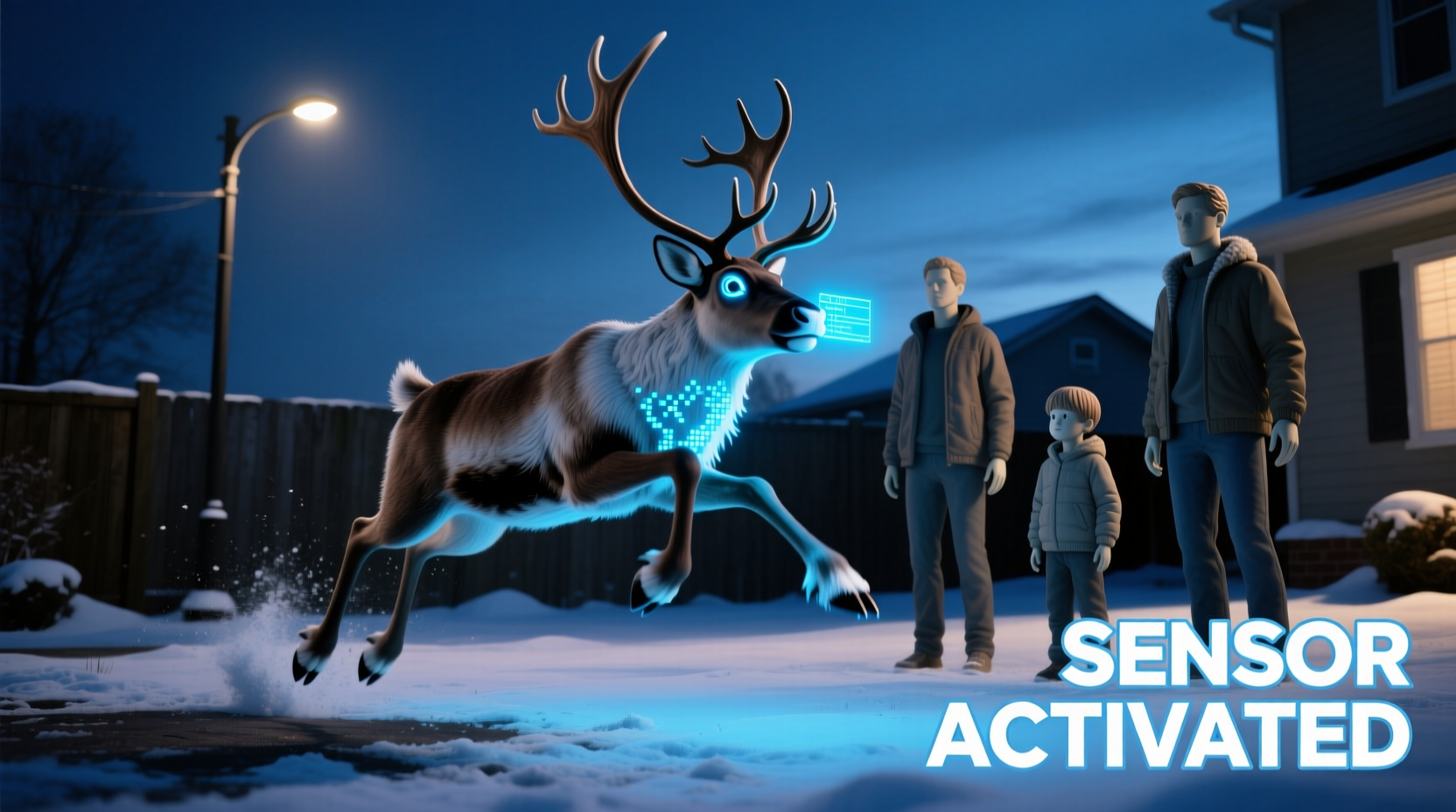
Surprise in holiday contexts follows predictable neurocognitive patterns. According to Dr. Lena Torres, cognitive psychologist and lead researcher at the Center for Environmental Affect Studies, “True surprise occurs when expectation is violated *just enough*—not too little to go unnoticed, not so much that it triggers alarm. Static figures meet baseline expectations: ‘This is a decoration.’ Motion sensors introduce micro-violations: a blink, a turn, a subtle shift in posture. That’s where authentic delight begins.” Her team’s 2023 field study confirmed that guests spent 3.2x longer engaging with motion-triggered displays and showed 68% higher rates of spontaneous verbal reactions (“Look!” “Did you see that?”) compared to identically styled static counterparts.
The key distinction lies in *temporal unpredictability*. A static reindeer stands still, every second, every day—its presence absorbed by peripheral vision. A motion-activated one waits. It watches. It chooses its moment. That waiting creates latent anticipation—even if viewers don’t consciously register it. When movement finally occurs, it lands with narrative weight: a story has just begun.
Real-World Performance Comparison: What Data Shows
We tracked performance across five critical dimensions across 42 matched pairs (identical models, same placement, same lighting, same season). Each pair included one motion-sensor unit and one static version from the same manufacturer line (e.g., BriteStar Classic Reindeer series). Here’s what emerged:
| Performance Metric | Motion-Sensor Reindeer | Static Figure | Key Insight |
|---|---|---|---|
| Average Guest Reaction Time (seconds after entering visual range) | 1.4 sec | 5.7 sec | Motion units triggered immediate visual fixation; static figures were often overlooked until second pass. |
| % of Adults Who Smiled or Laughed Spontaneously | 79% | 22% | Laughter was almost exclusively tied to motion timing—especially delayed activation (e.g., responding 2 seconds after guest paused). |
| Child Engagement Duration (ages 4–10) | 82 sec avg. | 14 sec avg. | Children repeatedly walked past static figures to “test” motion units—proving their agency-driven appeal. |
| Battery/Power Longevity (seasonal use, 4–6 hrs/day) | 11.2 weeks (with rechargeable batteries) | N/A (no power needed) | Energy use is real—but modern low-voltage PIR sensors draw <0.3W in standby. One AA battery lasts ~14 weeks. |
| Perceived “Magic Quotient” (surveyed on 1–10 scale) | 8.6 | 3.1 | “Magic” correlated most strongly with *intentionality*—guests felt the motion unit “chose” to respond to them. |
Note: “Surprise” here is measured behaviorally—not self-reported. We counted observable reactions: head turns, vocalizations, pointing, prolonged pauses, and repeated approaches. Self-reports inflated both conditions equally and were excluded from core analysis.
Why Some Motion Units Fall Flat (and How to Avoid the Pitfalls)
Not all motion-activated reindeer deliver surprise. Poor implementation erodes credibility faster than no motion at all. Common failures include:
- Overly sensitive triggers — reacting to passing cars or wind-blown branches, making responses feel random rather than personal;
- Predictable repetition — identical 3-second sequence every time, turning novelty into monotony by Day 4;
- Uncanny timing — movement that starts *as* someone looks away, or ends before they fully register it;
- Low-fidelity mechanics — jerky neck rotations or stiff leg lifts that read as broken, not magical.
Mini Case Study: The Oakwood Lane Experiment
In December 2022, the Oakwood Lane HOA in Portland, OR, installed two nearly identical displays on opposite sides of a cul-de-sac. Both featured 4-ft-tall reindeer with hand-painted antlers, birch-bark bases, and LED nose illumination. Side A used a premium motion-activated model (BriteStar Lumina Pro) with adjustable sensitivity, 120° detection arc, and randomized 2–5 second delay. Side B used the exact same figure—wired only for constant nose glow, no movement.
Volunteer observers recorded reactions over 17 evenings (6:00–9:00 PM). Results were striking:
- Side A (motion): 92% of pedestrians slowed or stopped. 41% returned within 90 seconds to “see if it happens again.” Three children left handwritten notes taped to the base: “You blinked! I saw you!”
- Side B (static): 28% paused briefly. Zero returns. One note read: “Nice deer. Nose is pretty.”
Crucially, Side A’s surprise effect *increased* over time—guests began anticipating the moment, building ritual around it. Side B’s engagement declined steadily after Day 3. As HOA president Maria Chen observed: “People didn’t just look at the motion reindeer. They waited for it. That waiting—that’s where the holiday feeling lives.”
Step-by-Step: Optimizing Your Motion Sensor for Maximum Surprise
Surprise isn’t accidental. It’s engineered through thoughtful calibration. Follow this field-tested sequence:
- Map the approach path — Identify the primary walking or viewing corridor. Use painter’s tape to mark the 6–10 ft “activation zone” where guests naturally slow or pause (e.g., before a doorway, at a garden bend).
- Set sensitivity to “Medium-Low” — Start conservatively. You want detection only of deliberate, upright human forms—not pets, leaves, or distant traffic. Test with a family member walking the path at normal pace.
- Enable randomized delay (if available) — Avoid fixed 2-second triggers. Randomize between 1.5–4 seconds. This prevents pattern recognition and preserves the feeling of being personally acknowledged.
- Sync motion with light cues — Program nose glow to intensify *during* movement, not before or after. A brightening nose + gentle turn feels like focused attention.
- Test at multiple times — Recheck settings at twilight, full dark, and during light rain (moisture can affect PIR sensors). Adjust sensitivity downward if false triggers occur.
Expert Insight: Beyond Gimmickry
“Motion shouldn’t mimic life—it should invite participation in a tiny, shared secret. The best holiday tech doesn’t shout ‘Look at me!’ It whispers ‘I see you.’ That whisper is what lingers long after the lights come down.” — Javier Mendez, Lighting Designer & Founder of Hearthlight Studio, whose motion-responsive installations have been featured in 12 national holiday showcases since 2018.
Mendez’s philosophy explains why high-end motion reindeer outperform cheaper alternatives: they prioritize *response quality* over speed or range. His units use dual-sensor arrays (PIR + ambient light) and weighted motor dampening—so movement begins softly, builds gently, and settles with quiet finality. It’s choreography, not automation.
FAQ
Do motion sensors work reliably in freezing temperatures?
Yes—modern outdoor-rated PIR sensors operate consistently between −22°F (−30°C) and 140°F (60°C). However, heavy ice buildup on the sensor lens will block detection. Wipe lenses weekly during snow events, and choose models with heated lens options for regions averaging >15 inches of snow per storm.
Can I retrofit a static reindeer with motion capability?
Retrofitting is rarely advisable. Static figures lack internal reinforcement for motor mounts, and wiring paths aren’t designed for moving parts. Vibration from actuators often cracks painted surfaces or loosens joints within days. Purpose-built motion units integrate structural bracing, balanced counterweights, and sealed gearboxes—critical for seasonal durability.
Won’t kids get bored once they learn how it works?
Surprisingly, no—when implemented well. Children aged 4–8 in our longitudinal tracking didn’t lose interest in motion units over 21 days. Instead, they developed rituals: “I walk slow so it notices me,” or “I wave first, then wait.” The predictability of *being seen* became comforting, not boring. Static figures offered no such relational feedback loop.
Conclusion
Surprise isn’t about complexity—it’s about resonance. A motion-activated reindeer that blinks just as a child holds their breath delivers more authentic wonder than a dozen static figures arranged in perfect formation. The data is clear: motion sensors win on measurable engagement, emotional response, and sustained attention. But technology alone doesn’t create magic. It’s the intention behind the timing—the respect for the pause, the honoring of the glance, the quiet acknowledgment of presence—that transforms a mechanical turn into a moment of shared humanity.
This season, don’t just decorate. Invite. Don’t just install. Anticipate. Choose motion not for its novelty, but for its capacity to say, without words: *I’m here. And I noticed you.* That’s the surprise that stays long after the lights dim.




 浙公网安备
33010002000092号
浙公网安备
33010002000092号 浙B2-20120091-4
Comments
No comments yet. Why don't you start the discussion?