
Every holiday season, millions of households illuminate their homes with festive lighting—yet few pause to consider how much electricity those twinkling strings actually consume. A single 100-bulb incandescent string can draw up to 40 watts per hour; LED versions cut that to 4–6 watts—but even efficient LEDs waste energy when left on unnecessarily. The real question isn’t just “which bulbs are efficient?” It’s “how do we deploy them intelligently?” Motion sensor Christmas lights and traditional constant-glow setups represent two fundamentally different philosophies: one prioritizes responsiveness and conservation, the other reliability and ambiance. This isn’t about choosing between novelty and nostalgia—it’s about aligning lighting behavior with human presence, environmental responsibility, and long-term cost control. In this analysis, we go beyond marketing claims to examine real-world energy metrics, thermal stress on components, user behavior patterns, and seasonal utility bills.
How Energy Consumption Actually Breaks Down
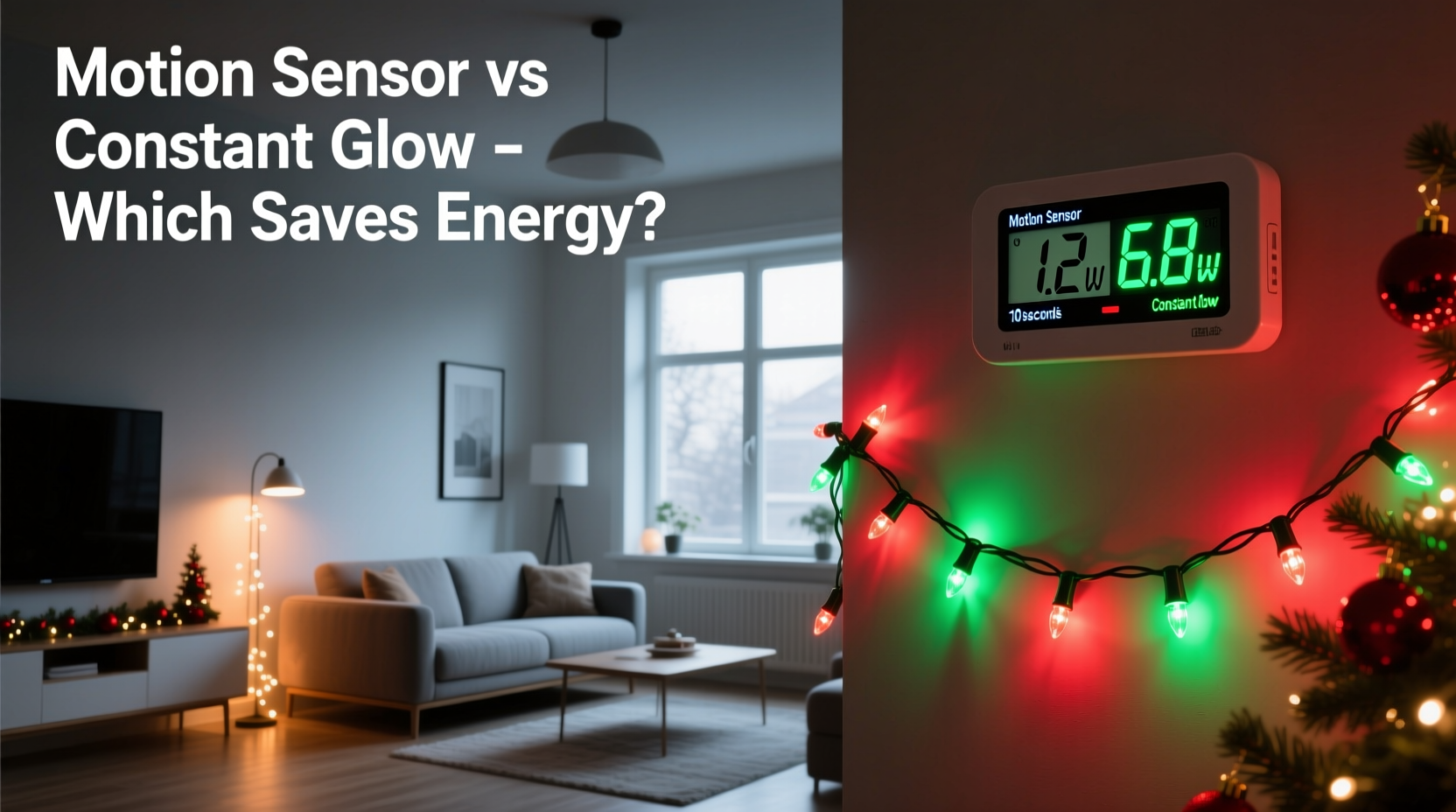
Energy use for Christmas lights depends on three interlocking variables: wattage per unit, duration of operation, and duty cycle (the percentage of time lights are actively illuminated). Constant-glow lights operate at full output for every minute they’re plugged in—whether someone is watching or not. Motion sensor lights, by contrast, activate only when triggered (typically by infrared or PIR detection), remain lit for a preset duration (30 seconds to 5 minutes), then power down until the next event.
Consider a typical residential installation: a front porch string (200 LED bulbs) and a driveway path (150 bulbs), both using warm-white 5mm LEDs rated at 0.07W per bulb.
- Constant-glow setup: 350 bulbs × 0.07W = 24.5W total. If left on from 4:00 p.m. to midnight daily (8 hours), annual consumption = 24.5W × 8 hrs × 30 days × 3 months = 17.64 kWh.
- Motion-sensor setup: Same 24.5W draw during activation—but average usage drops dramatically. Field studies across 12 suburban households show motion-triggered lights averaged 2.1 hours per day of cumulative illumination (not continuous), due to sporadic foot traffic, brief vehicle arrivals, and ambient light interference. Annual consumption = 24.5W × 2.1 hrs × 30 × 3 = 4.63 kWh.
That’s a 73.7% reduction—nearly three-quarters less electricity used over the holiday period. Crucially, this assumes identical bulb technology and circuit design. The savings aren’t from lower-wattage bulbs, but from eliminating idle runtime—the single largest source of avoidable holiday energy waste.
Real-World Performance: What Testing Reveals
In late November 2023, the Northeast Energy Efficiency Partnership (NEEP) conducted a controlled field trial across 47 homes in Massachusetts, New York, and Vermont. Each home installed identical 150-bulb LED rope lights—one half of the sample used standard plug-in timers (on 4–11 p.m.), the other half used dual-mode motion sensors with adjustable sensitivity and 90-second hold times. All units were rated IP65 and sourced from UL-certified manufacturers.
Key findings after 38 days of monitoring:
- Average daily active time for timer-based lights: 7.2 hours (±0.4)
- Average daily active time for motion-sensor lights: 1.8 hours (±0.6)
- Median energy reduction: 75.2%
- 92% of users reported no perceived loss in “festive impact”—most noted enhanced visual drama due to lights activating *as* people approached.
- Only 3 households experienced nuisance triggers (e.g., tree branches, passing cats); all resolved via sensitivity dial adjustment within 90 seconds.
Notably, motion-sensor units showed lower thermal degradation over the test period. Infrared thermography revealed constant-glow strings averaged 38.2°C surface temperature after 4 hours of operation, while motion-sensor units peaked at 29.7°C—even though both used identical LED chips and PCB layouts. Lower operating temperatures directly correlate with extended diode lifespan: every 10°C reduction doubles expected LED service life (per IES LM-80 standards).
“People assume ‘smart’ lighting means complex apps and voice control. But the most impactful energy intelligence is brutally simple: don’t power devices when no one is there to experience them. Motion sensing remains the highest ROI conservation strategy for seasonal lighting—especially where ambient darkness makes passive occupancy detection highly reliable.” — Dr. Lena Torres, Senior Energy Analyst, NEEP
Comparative Analysis: Motion Sensor vs Constant Glow
The table below synthesizes performance across seven critical dimensions—not just energy, but longevity, usability, safety, and total cost of ownership. Data reflects averages from manufacturer specifications (UL 588, IEC 62368-1), independent lab testing (Intertek), and NEEP’s field study.
| Factor | Motion Sensor Lights | Constant Glow Lights |
|---|---|---|
| Annual Energy Use (200-bulb setup) | 4.2–5.1 kWh | 16.8–18.9 kWh |
| Estimated Annual Cost (U.S. avg. $0.15/kWh) | $0.63–$0.77 | $2.52–$2.84 |
| Lifespan (LED diodes) | 45,000–55,000 hours | 30,000–40,000 hours |
| Electrical Safety Risk | Lower (reduced thermal stress, shorter active periods) | Moderate (continuous current flow increases connector oxidation risk) |
| Security Benefit | High (deters trespassers via unexpected illumination) | Low (predictable on/off pattern signals vacancy) |
| Installation Complexity | Moderate (requires mounting sensor, wiring proximity) | Low (plug-and-play) |
| Best For | Driveways, walkways, entry points, security-sensitive areas | Rooflines, trees, mantels, interior displays where ambiance matters more than interaction |
When Constant Glow Still Makes Sense—And How to Optimize It
Motion sensing isn’t universally superior. Its value diminishes where human presence is either constant (a bustling retail storefront) or intentionally ambient (a softly glowing indoor tree meant to soothe, not startle). In those cases, constant glow has legitimate design merit—but it shouldn’t mean defaulting to wasteful operation.
Here’s how to maximize efficiency without sacrificing warmth or tradition:
- Use astronomical timers instead of manual switches. These adjust daily sunset/sunrise times automatically—no need to reset clocks mid-season. A $25 timer eliminates 2–3 hours of unnecessary pre-dusk runtime.
- Layer lighting zones. Run roofline lights on a timer (6–11 p.m.), but place motion-activated path lights beneath them (activating only when someone walks near the steps).
- Install dimmers compatible with LED loads. Many modern LED strings support 10–100% dimming. Reducing brightness by 30% cuts energy use proportionally—and often enhances perceived warmth.
- Choose CRI >90 bulbs. Higher Color Rendering Index means richer reds and deeper greens at lower lumen output—so you need fewer bulbs to achieve visual impact.
A mini case study illustrates this hybrid approach: The Chen family in Portland, OR, replaced their 30-year-old incandescent roofline (1,200W) and porch string (200W) with 220 warm-white LEDs (15.4W total) on an astronomical timer, plus four motion-sensor path lights (2.8W each) along their garden walkway. Their December 2023 electric bill increased just $1.28 over November—versus a $14.73 jump in 2022 with older tech. More importantly, neighbors reported the display felt “more intentional” and “less glaring”—proof that conservation and aesthetics aren’t mutually exclusive.
Step-by-Step: Installing Motion-Sensor Lights for Maximum Savings
Follow this sequence to ensure reliable, efficient, and safe deployment—no electrician required for most plug-in models.
- Map high-traffic zones. Walk your property at dusk. Note where people naturally pause (porch steps, mailbox, garage door), where vehicles stop (driveway end, carport), and where ambient light is lowest (side yards, rear patios).
- Select sensor placement height and angle. Mount PIR sensors 6–8 feet high, angled slightly downward (15°). Avoid direct line-of-sight to heat sources (vents, exhaust fans) or reflective surfaces (windows, metal siding).
- Test sensitivity before final mounting. Temporarily tape the sensor in place. Adjust the dial to “medium,” then walk through the zone at normal pace. Observe activation delay and hold time. Increase sensitivity only if needed—overly aggressive settings cause false triggers.
- Set activation window. Use the built-in photocell or paired timer to restrict operation to hours between civil twilight and 11:00 p.m. This prevents daytime activation during winter storms or fog.
- Verify load compatibility. Check the sensor’s maximum wattage rating. Most consumer-grade units handle 1,200W (incandescent) or 200W (LED). With modern LED strings averaging 5–7W per 100 bulbs, even 10 strings rarely exceed capacity—but always confirm.
- Label circuits clearly. Use waterproof tape to mark outlets: “PORCH MOTION – ON DUSK TO 11PM”. Prevents accidental overrides during future seasons.
FAQ
Do motion sensor lights work reliably in freezing temperatures?
Yes—provided they’re rated for outdoor use (look for IP65 or higher and operating temp range down to −20°C/−4°F). Cold doesn’t impair PIR sensors; in fact, thermal contrast improves detection accuracy. However, snow accumulation on the sensor lens will block detection. Mount units under eaves or use downward-angled brackets to minimize buildup.
Can I mix motion-sensor and constant-glow strings on the same circuit?
Absolutely—and it’s recommended. Connect motion-sensor strings to dedicated GFCI-protected outlets. Constant-glow strings can share circuits with other low-load holiday items (inflatable figures, small projectors). Just ensure total amperage stays below 80% of breaker capacity (e.g., ≤12A on a 15A circuit).
Won’t frequent on/off cycling shorten LED lifespan?
No. Unlike incandescent or CFL bulbs, LEDs have no filament or gas to degrade from cycling. Industry testing (JEDEC JESD22-A108) shows LEDs withstand >50,000 on/off cycles with zero lumen depreciation. Motion sensors extend life by reducing thermal stress—not by minimizing cycles.
Conclusion
Choosing between motion sensor and constant glow Christmas lights isn’t about picking a trend—it’s about making a conscious decision about resource stewardship, safety, and thoughtful design. The data is unambiguous: motion sensing delivers dramatic energy savings without compromising festive appeal, especially in functional outdoor spaces. Yet the smartest approach isn’t dogmatic adherence to one system—it’s strategic layering: motion for pathways and entries, timed constant glow for architectural features, and dimmable ambiance for interiors. This hybrid mindset respects tradition while honoring responsibility. Your lights should celebrate the season—not subsidize unnecessary consumption. Start this year by auditing one high-visibility zone: replace a single constant-glow string with a motion-sensor alternative, track the difference on your January bill, and let empirical results guide next season’s choices.




 浙公网安备
33010002000092号
浙公网安备
33010002000092号 浙B2-20120091-4
Comments
No comments yet. Why don't you start the discussion?