
As the holiday season approaches, homes across neighborhoods light up with festive displays. Among the most popular decorations are Christmas lights—whether draped over rooftops, wrapped around trees, or lining walkways. But beyond their aesthetic appeal, many homeowners are now asking a more practical question: can these lights contribute to home security? Specifically, do motion sensor Christmas lights offer a meaningful advantage over traditional static ones when it comes to deterring intruders and enhancing safety?
The answer isn’t just about brightness or blinking patterns. It’s about timing, unpredictability, and perception—factors that influence how potential threats interpret your property’s vulnerability. While both types of lighting have their place, understanding their differences in behavior, energy efficiency, and psychological impact can help you make a smarter choice for both celebration and protection.
How Lighting Affects Home Security Perception
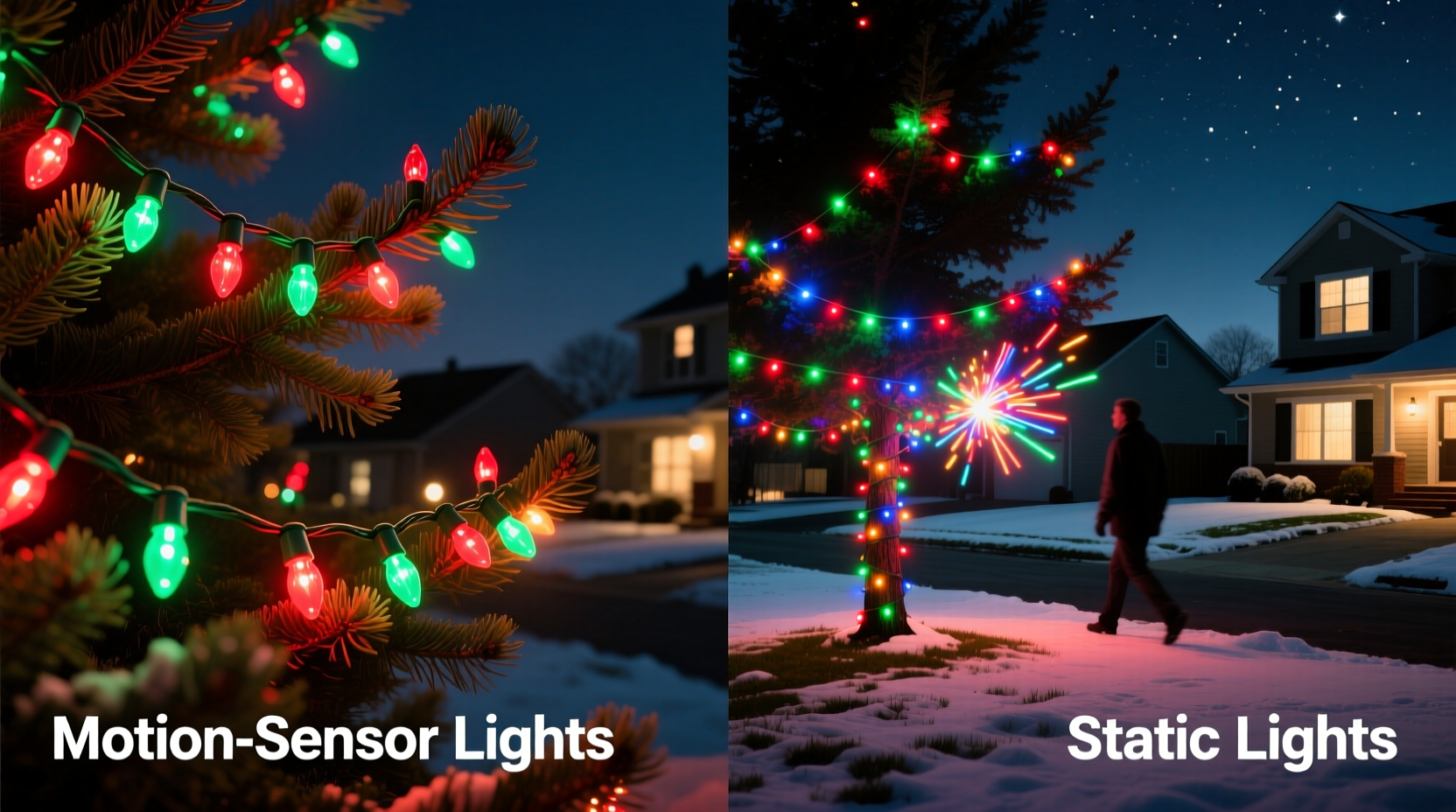
Lighting plays a critical role in shaping how secure a property appears. Studies from the Urban Institute and local law enforcement agencies consistently show that well-lit exteriors reduce opportunities for criminal activity. Darkness provides cover; light removes it.
However, not all light is equally effective. The human brain processes visual cues quickly, and experienced intruders can distinguish between passive illumination and active surveillance indicators. A house glowing steadily with static lights may signal occupancy, but it also signals predictability. In contrast, sudden bursts of light—especially those triggered by movement—suggest monitoring, responsiveness, and possible alarm integration.
This psychological edge is where motion sensor lights begin to outperform static setups. When an unexpected beam floods a dark corner as someone approaches, it startles not only animals but people too. That moment of surprise often forces hesitation—a crucial delay that could prevent a break-in attempt altogether.
“Sudden illumination is one of the most underutilized deterrents in residential security. It mimics surveillance without requiring cameras.” — Detective Mark Holloway, Crime Prevention Unit, Austin PD
Static Christmas Lights: Pros and Cons for Security
Traditional static Christmas lights remain the most common form of seasonal outdoor lighting. They operate on timers or manual switches, illuminating consistently during set hours (e.g., 5 PM to 11 PM). Their constant glow has several benefits:
- Create a welcoming atmosphere for guests and neighbors
- Signal regular activity and occupancy
- Improve visibility around entry points like doors and driveways
- Are widely available, easy to install, and affordable
From a security standpoint, consistent lighting helps establish a pattern of life. Burglars often scout neighborhoods days in advance, noting which homes appear vacant. A house lit every evening suggests someone is home—or at least maintaining the appearance of occupancy, which deters opportunistic crime.
Yet this same consistency becomes a weakness. Once a burglar recognizes the schedule, they know exactly when the lights come on and off. If your display runs nightly from dusk until midnight, a determined intruder might simply wait until 12:01 AM. There's no element of surprise, no indication that movement is being monitored.
Motion Sensor Christmas Lights: How They Work and Why They Matter
Motion sensor Christmas lights integrate passive infrared (PIR) sensors that detect heat and movement within a defined range—typically 10 to 30 feet. When activated, they illuminate instantly, often with bright white or multicolored patterns, before turning off after a preset duration (usually 15–60 seconds).
These lights serve dual purposes: decoration and defense. Unlike static sets, they don’t run continuously, conserving energy and reducing wear. More importantly, their reactive nature introduces uncertainty—an essential component of effective deterrence.
Imagine a person approaching your back gate. If nothing happens, they assume anonymity. But if the moment they step onto the path, your shrubbery erupts in colorful flashing lights, the reaction is instinctive: freeze, retreat, or reassess. That abrupt activation suggests something—or someone—is watching.
Modern versions allow customization: sensitivity adjustment, duration settings, daylight blocking (so they only work at night), and even sound synchronization. Some high-end models sync with home security systems, triggering alerts or recording footage upon activation.
Key Advantages of Motion-Activated Holiday Lighting
- Deterrence through unpredictability: Intruders can’t anticipate when or where light will appear.
- Energy efficiency: Lights consume power only when needed, reducing electricity costs.
- Extended bulb lifespan: Less runtime means fewer replacements.
- Targeted coverage: Focus light on vulnerable zones like side gates, basement windows, or detached garages.
- Integration potential: Can link with smart home ecosystems for enhanced monitoring.
Comparative Analysis: Static vs. Motion Sensor Lights
| Feature | Static Christmas Lights | Motion Sensor Christmas Lights |
|---|---|---|
| Security Deterrence | Moderate – indicates occupancy but predictable | High – creates surprise and perceived monitoring |
| Energy Use | Higher – runs continuously during set times | Lower – activates only when needed |
| Lifespan | Shorter due to prolonged usage | Longer due to intermittent operation |
| Installation Complexity | Simple – plug-and-play | Slightly more complex – positioning sensor correctly matters |
| Cost | Lower upfront cost | Higher initial investment |
| Customization | Limited to color and timer settings | Adjustable sensitivity, duration, and smart features |
| Best For | Festive ambiance, general visibility | Security-focused areas, high-risk zones |
Real-World Example: A Suburban Home’s Close Call
In December 2022, a homeowner in Columbus, Ohio installed motion-sensor Christmas lights along her backyard fence after noticing suspicious footprints in fresh snow near her garage. She positioned them to cover the blind spot between her house and a neighboring alley.
One night, around 1:30 AM, the lights flashed unexpectedly. She woke up, looked outside, and saw a figure scrambling over the fence. She called police immediately. Officers arrived minutes later but found no one—however, they discovered tool marks on the back door handle.
“The lights didn’t stop a break-in,” she said in a local news interview, “but they stopped it before it happened. I was awake because of the flash. Without that, I might have slept through the whole thing.”
Police credited the motion-triggered display with disrupting the attempt. No arrests were made, but the incident highlighted how reactive lighting can act as an early warning system—even without cameras or alarms.
Expert Tips for Maximizing Security with Holiday Lights
You don’t need to choose between beauty and safety. With strategic planning, you can achieve both. Here’s how to get the most out of your Christmas lighting setup:
- Mix both types: Use static lights for visible areas (front yard, roofline) and motion-activated ones for hidden access points.
- Avoid sensor obstruction: Don’t tuck sensors behind dense foliage where they won’t detect approach paths.
- Test angles regularly: Ensure sensors cover walkways, not just open lawn space.
- Use warm-white LEDs: These mimic indoor lighting better than cool blue tones, reinforcing the illusion of occupancy.
- Pair with timers and smart devices: Let static lights follow a daily cycle while motion units stay active all night.
Checklist: Optimizing Your Christmas Light Setup for Security
- ✅ Identify vulnerable entry points (basement windows, side doors, detached structures)
- ✅ Install motion sensor lights at each high-risk zone
- ✅ Set static lights on timers to turn on at dusk and off late at night
- ✅ Test sensor range and adjust angle for maximum coverage
- ✅ Combine with indoor smart bulbs on randomized schedules
- ✅ Inspect wiring and connections for weather resistance
- ✅ Consider solar-powered options for remote areas
Common Misconceptions About Decorative Lighting and Safety
Despite growing awareness, several myths persist about holiday lights and security:
- Myth: Any light deters crime equally.
Reality: Predictable lighting is easily exploited. Reactive lighting adds uncertainty. - Myth: Brighter is always better.
Reality: Overly bright static lighting can create harsh shadows, giving intruders places to hide. - Myth: Motion lights are only for utility, not decoration.
Reality: Modern designs include color-changing, musical, and programmable effects suitable for holidays. - Myth: Christmas lights are temporary, so security doesn’t matter.
Reality: Winter months see increased burglary rates due to earlier darkness and holiday travel.
FAQ: Your Questions Answered
Do motion sensor Christmas lights really prevent break-ins?
While no single measure guarantees absolute security, motion sensor lights significantly reduce the likelihood of attempted break-ins by startling intruders and signaling that the property is monitored. They work best as part of a layered security strategy that includes locks, visibility, and neighborhood awareness.
Can I use motion sensor lights for decorative purposes?
Absolutely. Many modern models are designed specifically for holidays, featuring multicolor LEDs, twinkling modes, and weather-resistant casings. Some even play short jingles or synchronize with music apps for festive flair.
Are static Christmas lights obsolete for security?
No. Static lights still play a valuable role in establishing routine occupancy signals. Used alongside motion-activated units, they enhance overall visibility and complement reactive systems. The key is combining both for maximum effect.
Conclusion: Balancing Festivity and Protection
When it comes to choosing between motion sensor and static Christmas lights for security, the evidence leans clearly toward integration rather than replacement. Static lights maintain the cheerful spirit of the season and communicate normalcy. Motion sensor lights add a dynamic layer of protection—introducing surprise, saving energy, and increasing perceived vigilance.
The smartest approach isn’t choosing one over the other, but deploying each where they perform best. Let static strings welcome guests on the porch, while motion-activated arrays guard the shadows. This hybrid strategy turns your holiday display into more than decoration—it becomes a subtle but effective part of your home’s defense system.




 浙公网安备
33010002000092号
浙公网安备
33010002000092号 浙B2-20120091-4
Comments
No comments yet. Why don't you start the discussion?