
As the holiday season approaches, one of the most common decisions homeowners face is how to manage their Christmas lighting display. While both motion sensor and timer-based Christmas lights offer automation and convenience, they serve different purposes and deliver varying levels of effectiveness depending on your goals—whether that’s energy savings, security, ambiance, or sheer festive impact.
Understanding the strengths and limitations of each system allows you to make an informed choice that aligns with your needs. This comprehensive guide breaks down performance across key categories, compares real-world applications, and provides actionable recommendations for choosing the best option—or combining both—for a smarter, more efficient holiday light setup.
How Motion Sensor Christmas Lights Work
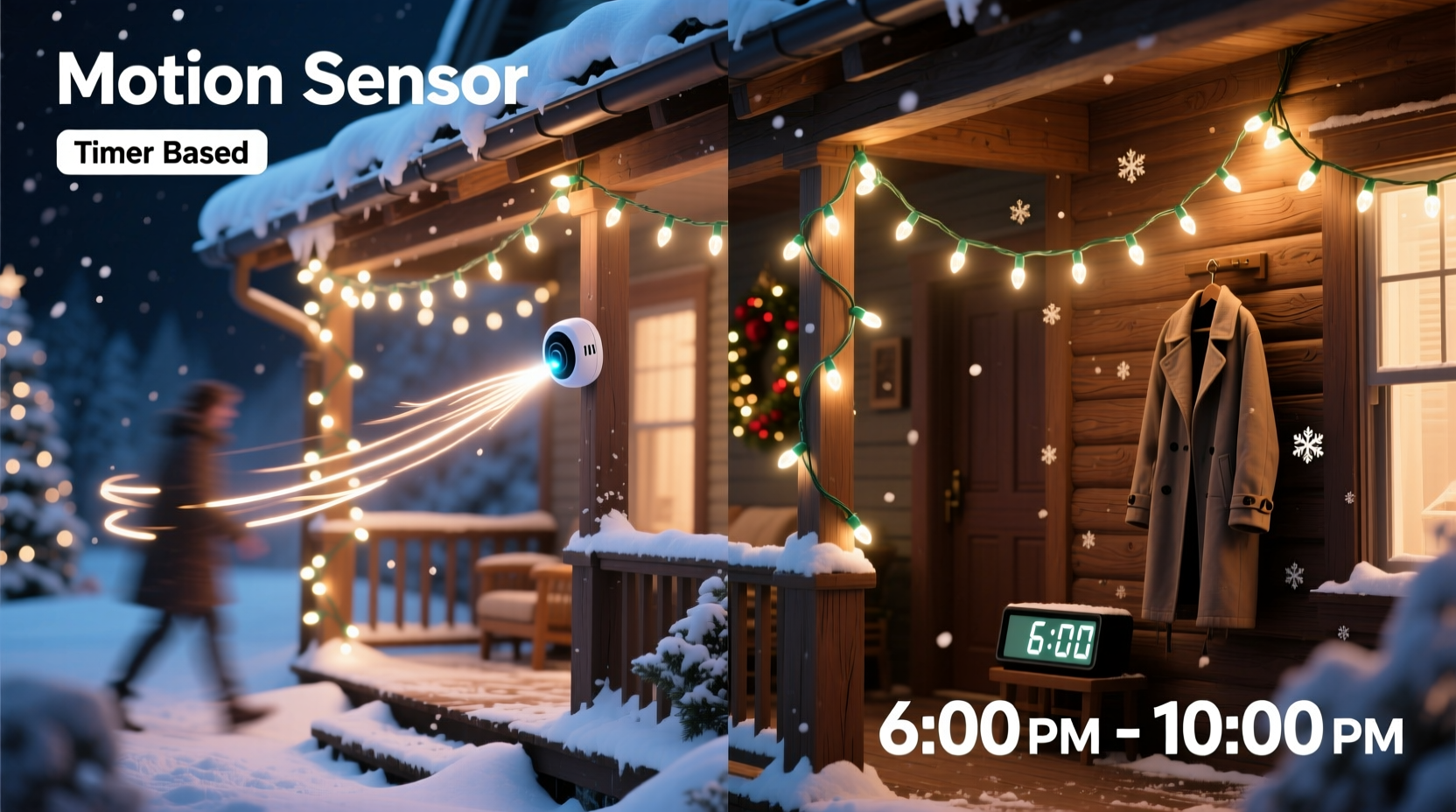
Motion sensor Christmas lights are equipped with passive infrared (PIR) sensors that detect heat and movement within a defined range, typically between 15 to 30 feet. When motion is detected—such as a person walking up the driveway or a pet moving near the yard—the lights activate automatically. Once motion ceases and no further activity is sensed, the lights turn off after a preset delay, usually between 30 seconds and 5 minutes.
These lights are often marketed as energy-efficient and security-enhancing because they remain dormant when not needed. They’re ideal for functional lighting in walkways, entryways, or around garages where illumination on demand improves safety without running all night.
The main advantage of motion sensor lights lies in their responsiveness. Unlike always-on systems, they eliminate unnecessary power consumption. However, this same feature can be a drawback during festive displays where continuous visual appeal is desired. A glowing nativity scene or twinkling rooftop lights that only blink on when someone walks by may disappoint guests expecting a traditional holiday glow.
How Timer-Based Christmas Lights Work
Timer-based Christmas lights operate on a pre-programmed schedule. Using either a mechanical dial or digital interface, users set specific on and off times—such as turning on at 5:00 PM and off at 11:00 PM daily. Many modern timers sync with smartphone apps or support seasonal adjustments based on sunset and sunrise times via built-in photocells or GPS data.
These systems provide consistency. If you want your home to sparkle every evening during the holidays, regardless of whether anyone is outside, timer-based controls ensure reliability. They're widely used for decorative lighting on rooftops, trees, porches, and lawn displays where visibility and atmosphere are top priorities.
Digital programmable timers often allow multiple settings per day, enabling effects like “twinkle mode” in the early evening followed by steady glow later. Some advanced models even integrate with smart home ecosystems like Alexa or Google Home, allowing voice control and remote adjustments.
“Timer-based lighting gives homeowners creative control over ambiance while still offering energy savings compared to leaving lights on all night.” — Daniel Reeves, Residential Lighting Designer
Comparative Analysis: Key Performance Factors
To determine which system is more effective, it's essential to evaluate both options across several practical dimensions. The following table summarizes a side-by-side comparison:
| Factor | Motion Sensor Lights | Timer-Based Lights |
|---|---|---|
| Energy Efficiency | High – Only active when triggered | Moderate to High – Depends on scheduled duration |
| Festive Appeal | Low to Moderate – Intermittent activation disrupts visual continuity | High – Consistent illumination enhances curb appeal |
| Security Benefit | High – Deters intruders with sudden light | Low – Predictable patterns are easier to exploit |
| Convenience | Moderate – Requires proper placement and sensitivity tuning | High – Set once, forget until next year |
| Installation Complexity | Moderate – Needs correct alignment and field testing | Low – Plug-and-play with basic setup |
| Lifespan Impact | Higher – Less runtime reduces wear | Varies – Longer cycles may shorten LED life slightly |
From this analysis, it's clear that neither option is universally superior. Effectiveness depends entirely on context. For example, if your goal is to welcome guests safely to your front door, motion sensors excel. But if you're aiming to win the neighborhood decorating contest, timer-based lights are far more effective at delivering the expected holiday experience.
Real-World Application: A Suburban Home Case Study
Consider the Johnson family in suburban Denver. Each December, they decorate their two-story home with over 2,000 LED lights, including roofline strings, inflatable figures, and pathway markers. In previous years, they simply plugged everything into one outlet and left it on from dusk till dawn—resulting in high electricity bills and frequent bulb burnouts.
Last year, they redesigned their lighting strategy using a hybrid approach. Decorative elements—like the rooftop icicles and front-yard tree—were connected to a smart timer programmed to turn on at sunset (around 4:30 PM) and off at 10:30 PM. Meanwhile, motion-sensor floodlights were installed near the garage and side entrance to illuminate dark areas only when needed.
The result? Their energy consumption dropped by 42% compared to the prior year, according to their utility bill analysis. Neighbors complimented the consistent display, while the family appreciated enhanced safety when arriving home late. Additionally, the reduced operating time extended the lifespan of their lights, reducing replacement costs.
This case illustrates how combining both technologies maximizes benefits: aesthetic continuity through timed lighting and targeted functionality through motion detection.
When to Choose Motion Sensor Lights
Motion sensor Christmas lights are most effective in scenarios where function outweighs constant decoration. Consider using them if:
- You have walkways, stairs, or driveways that need safe illumination at night.
- Security is a concern, especially in low-traffic or isolated areas of your property.
- You want to minimize energy usage and reduce environmental impact.
- Your display includes interactive elements (e.g., a “haunted house” effect that surprises visitors).
- You live in an area with strict outdoor lighting ordinances or noise/light pollution regulations.
They also work well for renters or those with temporary setups who don’t want to manually control lights every evening.
When to Choose Timer-Based Lights
Timer-based systems shine when aesthetics, tradition, and predictability matter most. Opt for these if:
- You maintain a large, visible holiday display intended to impress neighbors or passersby.
- You participate in community light contests or charity viewing events.
- You prefer automated control without dependency on external triggers.
- You want synchronized lighting effects (e.g., pulsing or color-changing sequences).
- You value peace of mind knowing your home looks welcoming even when you're away.
Smart timers add another layer of convenience, allowing adjustments via phone—even if you're on vacation. Some models send alerts if a circuit fails or a strand goes out, helping maintain display integrity throughout the season.
Step-by-Step: Building an Optimized Holiday Lighting Plan
Follow this timeline to design a balanced, effective lighting system before the holidays begin:
- Week 1: Assess Your Space – Walk around your property at dusk. Identify zones needing safety lighting (paths, steps) versus decorative emphasis (porch, roof, tree).
- Week 2: Categorize Light Functions – Label each light string or fixture as “decorative,” “security,” or “functional.” This determines control method.
- Week 3: Purchase Controls – Buy outdoor-rated timers for decorative zones and motion-sensor outlets or integrated lights for functional areas. Consider smart plugs for remote access.
- Week 4: Install & Test – Set up lights and connect to controllers. Test motion sensors with various movement speeds and angles. Program timers using local sunset data.
- Ongoing: Monitor & Adjust – Check weekly for malfunctions. Update timer schedules biweekly to match changing daylight hours.
Expert Recommendations: Combining Both Systems
Lighting professionals increasingly recommend a layered approach. As noted by interior designer and holiday specialist Lena Torres:
“The most effective holiday lighting isn't about choosing one technology—it's about strategic integration. Use timers for beauty, motion sensors for brains.” — Lena Torres, Holiday Lighting Consultant
For instance, keep your iconic reindeer display on a timer from 5 PM to 10 PM, but install motion-activated path lights leading to it. That way, visitors enjoy the full spectacle, while you save energy on ancillary lighting.
Additionally, some newer products combine both features. Dual-mode LED strings can run on a timer but brighten or change pattern when motion is detected—an innovative middle ground gaining popularity in 2024.
FAQ
Can I use motion sensor lights for my main Christmas display?
Possibly, but not ideally. While technically feasible, relying solely on motion sensors means your display remains dark most of the time. This can frustrate neighbors, disappoint trick-or-treaters or carolers, and undermine the joyful intent of holiday lighting. Reserve motion activation for secondary or functional areas.
Do timer-based lights increase my electric bill significantly?
Not if you use LED lights and reasonable schedules. Modern LED Christmas lights consume as little as 0.07 watts per bulb. Running 500 bulbs for 6 hours a night costs less than $2 per month. Pairing LEDs with a timer keeps energy use minimal while maintaining visual impact.
Are motion sensors reliable in cold weather?
Most modern PIR sensors are designed to operate in temperatures as low as -20°C (-4°F). However, snow buildup on the sensor lens or extreme wind-blown debris can interfere with detection. Regular inspection during winter ensures continued performance.
Conclusion: Which Is More Effective?
The question isn’t which system is better overall—but which is more effective for your specific purpose. Motion sensor Christmas lights win in energy efficiency, security, and functional lighting. Timer-based lights dominate in festive appeal, reliability, and decorative consistency.
Ultimately, the most effective solution blends both. Use timers to create a warm, predictable holiday atmosphere and reserve motion sensors for areas where on-demand lighting adds safety and surprise. With thoughtful planning, you can achieve a display that’s beautiful, efficient, and intelligent—all at once.




 浙公网安备
33010002000092号
浙公网安备
33010002000092号 浙B2-20120091-4
Comments
No comments yet. Why don't you start the discussion?