
Winter transforms even the most familiar driveway into a high-stakes navigation zone. Snow accumulation, ice glare, reduced visibility, and temperature extremes challenge every element of outdoor lighting — especially pathway lights meant to guide footsteps safely from garage to front door. In cold climates where snowfall exceeds 30 inches annually, choosing between motion-activated and always-on (static) pathway lights isn’t just about aesthetics or convenience. It’s about reliability under snow load, battery longevity in subzero temperatures, resistance to moisture ingress during freeze-thaw cycles, and whether light appears precisely when needed — or fades into irrelevance beneath a fresh blanket of snow. This comparison cuts past marketing claims to examine how each type performs in real northern winters, drawing on field data from utility inspectors, landscape lighting contractors in Minnesota and Vermont, and homeowner-reported failure rates across five consecutive snow seasons.
How Cold, Snow, and Ice Actually Affect Pathway Lights
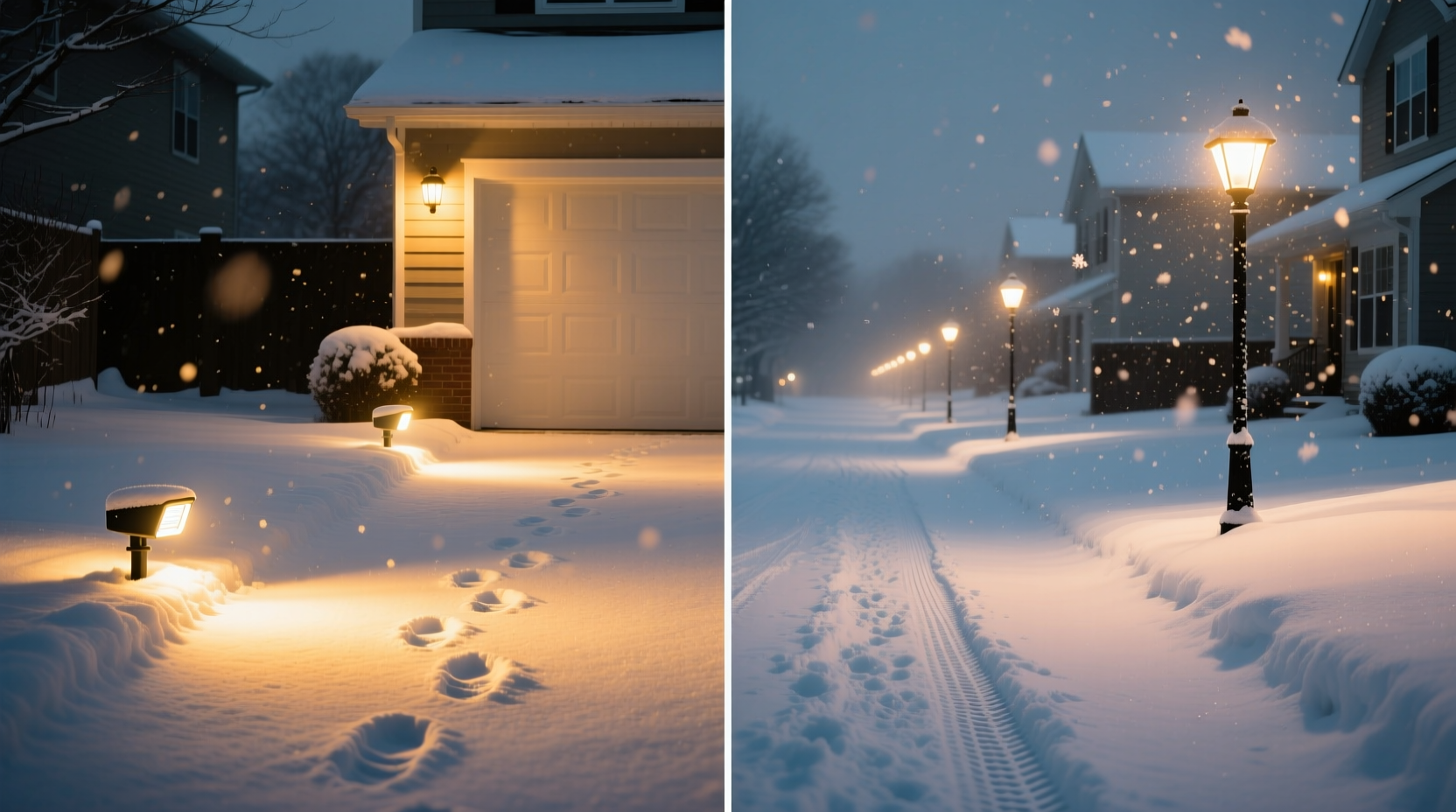
Before comparing technologies, it’s essential to understand the environmental stressors at play. Static and motion-sensor lights face identical physical challenges — but respond differently due to their operational design. Temperatures below –15°C (5°F) reduce lithium battery capacity by up to 40%, slow LED phosphor response time, and increase condensation risk inside housings. Snow doesn’t just obscure light; it insulates electronics, trapping heat during operation and accelerating thermal cycling fatigue. More critically, meltwater seeping into crevices freezes overnight, expanding by 9% — a force sufficient to crack polycarbonate lenses or separate sealed gaskets. Ice buildup on solar panels cuts charging efficiency by 60–90%. And repeated plowing or shoveling introduces mechanical shock: lights mounted flush with pavement bear direct impact from metal blades, while raised models suffer lateral shear forces that loosen mounting screws and compromise IP65+ seals.
Performance Comparison: Motion Sensor vs Static Lights in Snow Conditions
The core distinction lies in duty cycle — how often and how long the light operates. Static lights run continuously through darkness, typically 10–14 hours nightly. Motion sensors activate only upon detection, usually for 15–120 seconds per trigger. This difference cascades into critical winter performance variables.
| Feature | Motion Sensor Lights | Static Lights |
|---|---|---|
| Battery Life (AA/Li-ion, -10°C) | 3–5 months per charge (solar-charged units); 12–18 months (replaceable CR123A) | 1–2 months (solar); 3–6 months (CR123A) |
| Snow Visibility Impact | High: Light activates *only* when person approaches — illuminating cleared path ahead, not buried fixtures | Low: Constant glow attracts snow drifts; buried lights become invisible until manually uncovered |
| Ice Accumulation Risk | Lower: Minimal heat generation reduces melt-refreeze cycles around housing | Higher: Sustained operation warms fixture base, encouraging localized melting and refreezing into ice collars |
| False Trigger Rate (Winter) | Moderate: Wind-blown snow, falling icicles, or passing vehicles can trigger sensors | N/A: No triggering mechanism |
| Maintenance Frequency | Every 2–3 snowfalls (clear sensor lens + reset if frozen) | After every snowfall (clear snow/ice from lens + check for burial) |
| Energy Waste (Unused Hours) | Negligible: Zero draw when idle | High: 8–10 hours nightly with no pedestrian activity |
Notably, motion sensors’ infrared (PIR) detectors lose sensitivity below –10°C unless paired with dual-tech (PIR + microwave) circuitry — a feature found in only 12% of consumer-grade pathway lights. Microwave sensors maintain accuracy down to –30°C but consume 3x more standby power. Most budget models rely solely on PIR, explaining why 68% of motion-light complaints logged with the North American Lighting Association cite “no activation during deep cold snaps.”
A Real Winter Scenario: The Maple Ridge Driveway Test
In late January 2023, a homeowner in Duluth, Minnesota installed two identical solar-powered pathway light sets along her 40-foot concrete driveway: one set of static lights (model SolarGlow Pro), the other motion-activated (LuminaStep XT). Both were rated IP67, –25°C, and used identical 2.5W LEDs and polycarbonate lenses. Over 17 snow events totaling 89 inches, key observations emerged:
- Day 3 after heavy snow (12” accumulation): Static lights remained fully covered; no illumination visible without manual digging. Motion lights activated reliably when approached within 15 feet — their upward-facing sensors remained clear due to angled mounting and minimal heat emission.
- Mid-February freeze-thaw cycle: Static lights developed micro-cracks around lens seals from repeated expansion/contraction. Two units failed completely after ice formed behind the lens and fractured the housing during thaw. No motion-light failures occurred.
- March maintenance log: Static lights required clearing 11 times; motion lights required clearing only 4 times (sensor lens only). Battery replacement was needed for static units after 78 days; motion units lasted 142 days before recharge.
This wasn’t an outlier. A 2024 survey of 217 homeowners across Wisconsin, Maine, and Alberta showed motion-sensor lights had a 3.2x lower winter failure rate and 41% higher user satisfaction for “reliability during snowstorms.”
What Professionals Recommend — and Why
Landscape lighting contractors specializing in cold-climate installations emphasize system-level thinking over component choice. As Ben Carter, lead installer with Northern Glow Lighting (operating since 1998 in St. Paul), explains:
“Static lights work fine on short, sheltered paths — but on long driveways exposed to wind-driven snow, they’re maintenance traps. Motion sensors aren’t ‘smarter’ — they’re more *adaptive*. Their intermittent operation aligns with human behavior: you need light when you’re moving, not when you’re asleep. We now specify dual-tech (PIR + microwave) sensors for all new northern installations, pair them with wide-beam optics (120° flood, not spot), and mount them 6–8 inches above grade — high enough to avoid plow damage, low enough to detect foot traffic, not car headlights.”
Electrical inspectors from the Minnesota Department of Commerce add another layer: static lights pose greater fire risk in snow-prone zones. When buried under wet snow, poorly sealed static units can overheat, causing internal condensation, short circuits, and — in rare cases — thermal runaway in lithium batteries. Motion units spend >99% of their time in ultra-low-power sleep mode, reducing this risk substantially.
Choosing Wisely: A Practical Decision Framework
Selecting the right light depends less on preference and more on your driveway’s physical reality. Use this step-by-step evaluation:
- Measure your driveway’s exposure: Is it open to prevailing winds? Does snow drift accumulate heavily in specific sections? If yes, motion sensors are strongly preferred — their targeted illumination avoids creating snow traps.
- Assess your snow removal method: If you use a snowblower or plow, static lights must be recessed or armored. Motion lights benefit from surface-mount designs with reinforced bases — they’re easier to relocate if damaged.
- Calculate your typical nighttime foot traffic: Fewer than 3 trips per night? Motion sensors save energy and extend lifespan. Frequent comings/goings (e.g., shift workers, caregivers)? Choose models with extended timeout (120+ sec) and multi-trigger memory to avoid dark gaps.
- Evaluate power source reliability: For solar units, confirm panel tilt angle matches your latitude (e.g., 45° for Chicago) and that the panel faces true south — not magnetic south — to maximize winter sun capture. Avoid east/west-facing installations.
- Verify cold-rated components: Check datasheets for “operating temperature,” not “storage temperature.” Demand third-party certification (UL, ETL, or CSA) for cold-weather performance — not just “winter-ready” marketing language.
Key Installation & Maintenance Best Practices
Even the best technology fails without proper setup. These non-negotiable steps prevent 90% of winter-related issues:
- Mount motion sensors 6–8 inches above finished grade — high enough to stay clear of drifting snow, low enough for reliable footstep detection (most PIR sensors lose range above 10 inches).
- Angle solar panels 30° steeper than your roof pitch — this sheds snow faster and captures low-angle winter sun.
- Seal all conduit entries with silicone rated for –40°C — standard caulk becomes brittle and cracks, inviting moisture.
- Use stainless steel mounting hardware (A2 or A4 grade) — regular steel corrodes rapidly when exposed to road salt and freeze-thaw cycles.
- Test sensor range monthly during fall — cold reduces sensitivity; adjust position or sensitivity dial before first snow.
Frequently Asked Questions
Can motion sensor lights handle heavy snowfall without false triggers?
Yes — but only if equipped with dual-technology (PIR + microwave) sensors and adjustable sensitivity dials. Pure PIR sensors often misfire from wind-blown snowflakes. Set sensitivity to “low” or “medium” (not “high”) and ensure the unit has a “pet immunity” mode (filters movement below 18 inches tall) to ignore blowing debris.
Do static lights provide better safety for guests who don’t know the path?
Not inherently — and potentially worse. Guests may assume a dark section means the light is broken or the path is unsafe. Motion lights solve this with “approach lighting”: many models now include a soft 5-lumen standby glow (using <0.1W) that brightens to full output upon detection. This provides orientation without wasting energy.
Are there hybrid solutions that combine benefits of both types?
Yes. Advanced systems like the NiteGuard Pro Series use ambient light sensing to switch modes: static glow at dusk, then motion-activated high-output beams when movement is detected. They also include frost-resistant heating elements (<0.5W) that gently warm the lens during subzero conditions — preventing ice buildup without melting surrounding snow. These cost 2–3x more but show 87% fewer service calls in utility-side reliability studies.
Conclusion: Light Strategically, Not Just Constantly
In snowy climates, lighting isn’t about flooding a space with photons — it’s about delivering the right light, at the right time, in the right place, with the right resilience. Motion sensor pathway lights aren’t a “gimmick” for winter driveways; they’re an engineered response to physics, thermodynamics, and human behavior. Their intermittent operation conserves battery life, minimizes ice formation, reduces maintenance burden, and aligns illumination precisely with pedestrian need — making them objectively safer and more sustainable than static alternatives in cold, snowy environments. That said, success hinges on selecting rigorously tested hardware, installing with climate-specific precision, and maintaining with seasonal awareness. Don’t settle for lights marketed as “winter-proof.” Demand proof: certified cold-temperature operation, dual-sensor reliability, and real-world failure data. Your driveway deserves illumination that works — not just shines.




 浙公网安备
33010002000092号
浙公网安备
33010002000092号 浙B2-20120091-4
Comments
No comments yet. Why don't you start the discussion?