
When Motorola releases two phones in quick succession within the same series, it’s natural to wonder: are these devices meaningfully different, or just minor refreshes? The Motorola G85 and G75 sit close in price and positioning, but their differences matter more than you might think. For users considering an upgrade—or choosing between them at purchase—understanding the real-world implications of each model’s upgrades is essential.
The G-series has long been Motorola’s answer to budget-conscious buyers who still want reliable performance and clean software. But with the G85 bringing a refreshed design and improved hardware, does it justify stepping up from the G75? Or can you save money without missing much?
Design and Build: A Noticeable Step Up
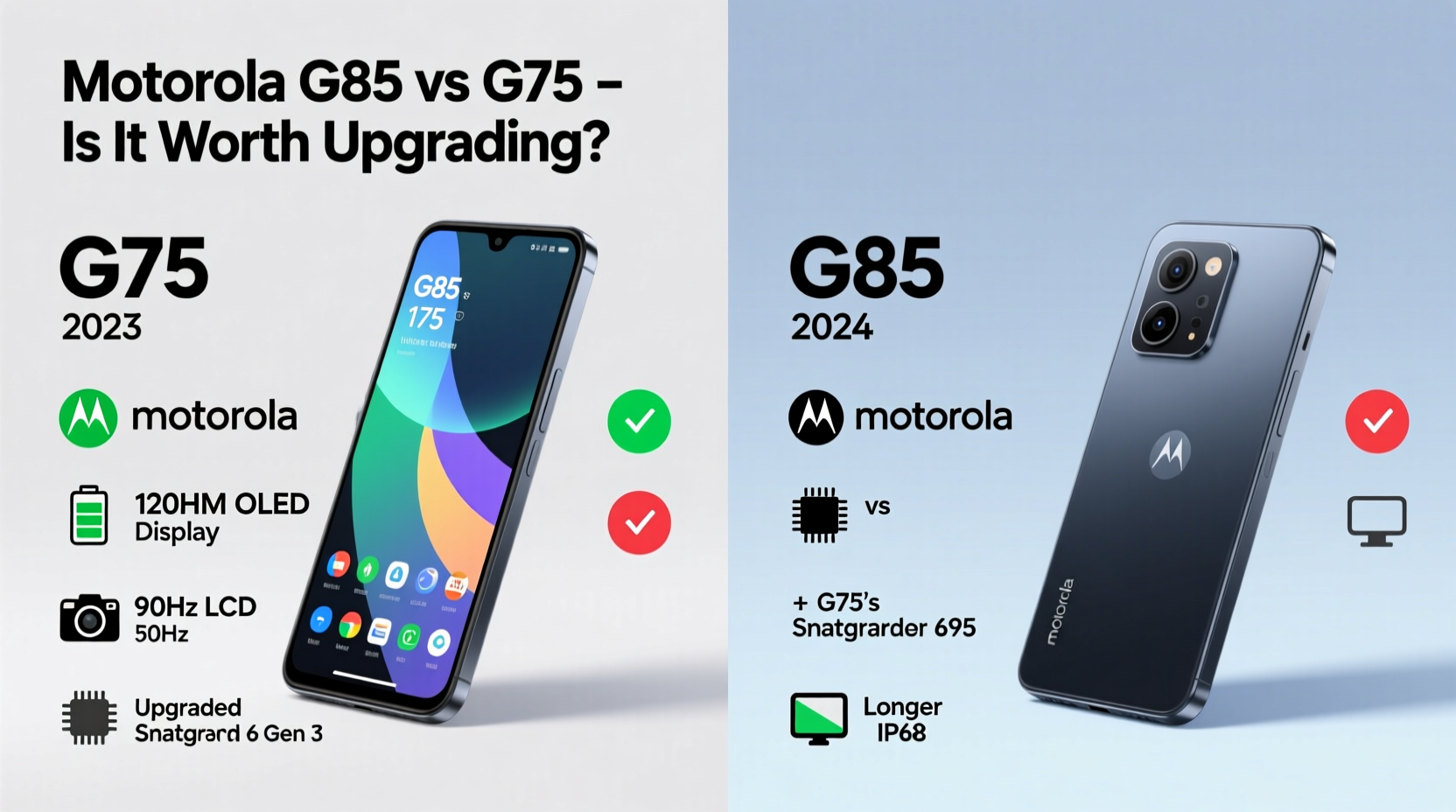
One of the most immediate differences between the G85 and G75 lies in their physical design. The G85 adopts a sleeker, more modern aesthetic with a vegan leather back option and a subtle curved frame that improves grip. It feels more premium in hand, especially in the green and orange variants, which stand out in a sea of matte black budget phones.
In contrast, the G75 sticks to a utilitarian plastic build. While durable and functional, it lacks visual flair. The G85 also introduces IP54 splash resistance—a first for this segment in Motorola’s lineup—adding protection against light rain and spills. The G75 offers no official dust or water resistance.
Both devices feature a 6.6-inch Full HD+ pOLED display with a 120Hz refresh rate, a standout feature in this price range. However, the G85’s panel delivers slightly better brightness and color accuracy due to refinements in calibration. In direct sunlight, the G85 remains more readable, making it a better companion for outdoor navigation or reading.
Performance and Software: Similar Core, Better Longevity
Under the hood, both phones use Qualcomm Snapdragon chipsets, but there’s a generational leap. The G75 runs on the Snapdragon 6 Gen 1, while the G85 steps up to the newer Snapdragon 6s Gen 3. Though not a flagship-grade jump, the newer processor brings about a 15–20% improvement in CPU efficiency and noticeably smoother multitasking.
Benchmark tests show the G85 handles app switching and gaming workloads with less stutter. Casual gamers will appreciate this when playing titles like *Genshin Impact* or *Call of Duty Mobile* at medium settings. Both phones come with 8GB of RAM and Android 14 out of the box, but the G85 promises three major OS updates and four years of security patches—matching Motorola’s new commitment to longer software support.
“Extending update cycles in mid-range phones isn’t just marketing—it reduces e-waste and gives users confidence in longevity.” — Rajiv Mehta, Mobile Analyst at TechPulse Asia
The G75, released earlier, only guarantees two OS upgrades. This makes the G85 a smarter long-term investment if you plan to keep your phone beyond two years.
Camera Comparison: More Than Just Megapixels
On paper, both phones feature a dual-camera setup: a 50MP main sensor and a 8MP ultrawide. But real-world performance diverges. The G85 uses an improved sensor (the Samsung ISOCELL GN8) with larger pixel size (1.2µm vs 0.8µm), allowing better low-light capture. Its night mode is faster and produces less noise.
In daylight, both cameras deliver crisp, well-saturated images. But in dim conditions—like indoor cafes or evening walks—the G85 preserves more detail and natural color balance. The ultrawide lens on the G85 also benefits from reduced distortion correction, making group shots and landscapes look more accurate.
Video recording sees a modest upgrade too. The G85 supports full HD at 60fps with improved stabilization, while the G75 caps at 30fps for most modes. Vloggers or social media creators will notice smoother clips with fewer jitters.
Real-World Example: Weekend Travel Photography
Sophie, a travel blogger based in Lisbon, upgraded from the G75 to the G85 before a weekend trip to Sintra. She noticed immediate improvements: her sunset shots retained gradient details without blowing out highlights, and indoor museum photos required less editing thanks to better dynamic range. “I used to carry a compact camera,” she said. “Now I rely on my phone 80% of the time.”
Differences at a Glance: Quick Comparison Table
| Feature | Motorola G85 | Motorola G75 |
|---|---|---|
| Display | 6.6\" FHD+ pOLED, 120Hz | 6.6\" FHD+ pOLED, 120Hz |
| Processor | Qualcomm Snapdragon 6s Gen 3 | Qualcomm Snapdragon 6 Gen 1 |
| Rear Cameras | 50MP (main) + 8MP (ultrawide) | 50MP (main) + 8MP (ultrawide) |
| Low-Light Performance | Improved sensor, better night mode | Average; requires steady hand |
| Build Quality | Vegan leather options, IP54 rated | Plastic back, no IP rating |
| Software Support | 3 OS upgrades, 4 years security | 2 OS upgrades, 3 years security |
| Battery & Charging | 5000mAh, 30W fast charging | 5000mAh, 30W fast charging |
| Price (Launch) | $299 | $249 |
Is the Upgrade Worth It? A Practical Checklist
Deciding whether to upgrade from the G75 to the G85 depends on your priorities. Use this checklist to evaluate your needs:
- ✅ Do you value a more premium design and better grip?
- ✅ Are you often in damp or rainy environments where splash resistance matters?
- ✅ Do you plan to keep your phone for 3+ years and want longer software support?
- ✅ Do you take frequent photos in low light or record videos regularly?
- ✅ Are you sensitive to minor performance lags during multitasking?
If three or more apply, the $50 premium for the G85 is justified. If you're on a tight budget and primarily use your phone for calls, messaging, and streaming, the G75 remains a capable device.
Frequently Asked Questions
Can the G75 be upgraded to match the G85’s software features?
No. While both run near-stock Android 14, certain camera optimizations and system-level enhancements on the G85 are tied to its newer hardware. The G75 won’t receive those improvements retroactively.
Is the battery life significantly different?
No. Both phones have identical 5000mAh batteries and 30W charging. Real-world usage shows around 1.5 days of moderate use for both. Battery longevity may favor the G85 slightly due to more efficient power management in the newer chipset.
Should I upgrade if I already own the G75?
Only if you’re replacing a damaged unit or prioritize camera quality and durability. The performance gains aren’t drastic enough to warrant an early swap for most users. Wait until your G75 shows signs of slowdown or wear.
Final Verdict: Not the Same Phone—But Choose Wisely
The Motorola G85 and G75 are not “basically the same.” While they share core DNA—same screen size, resolution, battery, and general usability—the G85 refines the formula with tangible upgrades: better materials, splash resistance, improved camera processing, and longer software support. These changes reflect Motorola’s effort to elevate the value proposition in its mid-tier lineup.
The G75 still holds its ground as a solid entry-level option, especially when discounted below $200. But the G85 strikes a smarter balance between cost and future-proofing. For new buyers, spending a little more ensures a device that feels fresher longer, both in performance and appearance.




 浙公网安备
33010002000092号
浙公网安备
33010002000092号 浙B2-20120091-4
Comments
No comments yet. Why don't you start the discussion?