
The foldable smartphone market has evolved from a speculative niche to a fiercely competitive arena. Once dominated by Samsung’s Galaxy Z Flip series, the landscape is shifting. Enter the Motorola Razr 2023 — a bold revival of a legendary brand with modern engineering that challenges the status quo. With refined aesthetics, improved durability, and aggressive pricing, the Razr 2023 raises a critical question: Is Samsung beginning to lose its grip on the vertical foldable throne?
This isn’t just about nostalgia or form factor. It’s a battle of philosophy—Samsung’s iterative refinement versus Motorola’s disruptive reimagining. As consumers weigh value against innovation, both devices offer compelling arguments. Let’s dissect where each excels and whether the Z Flip 4 still holds an edge—or if it’s time for a new king.
Design and Build: Nostalgia Meets Modernity
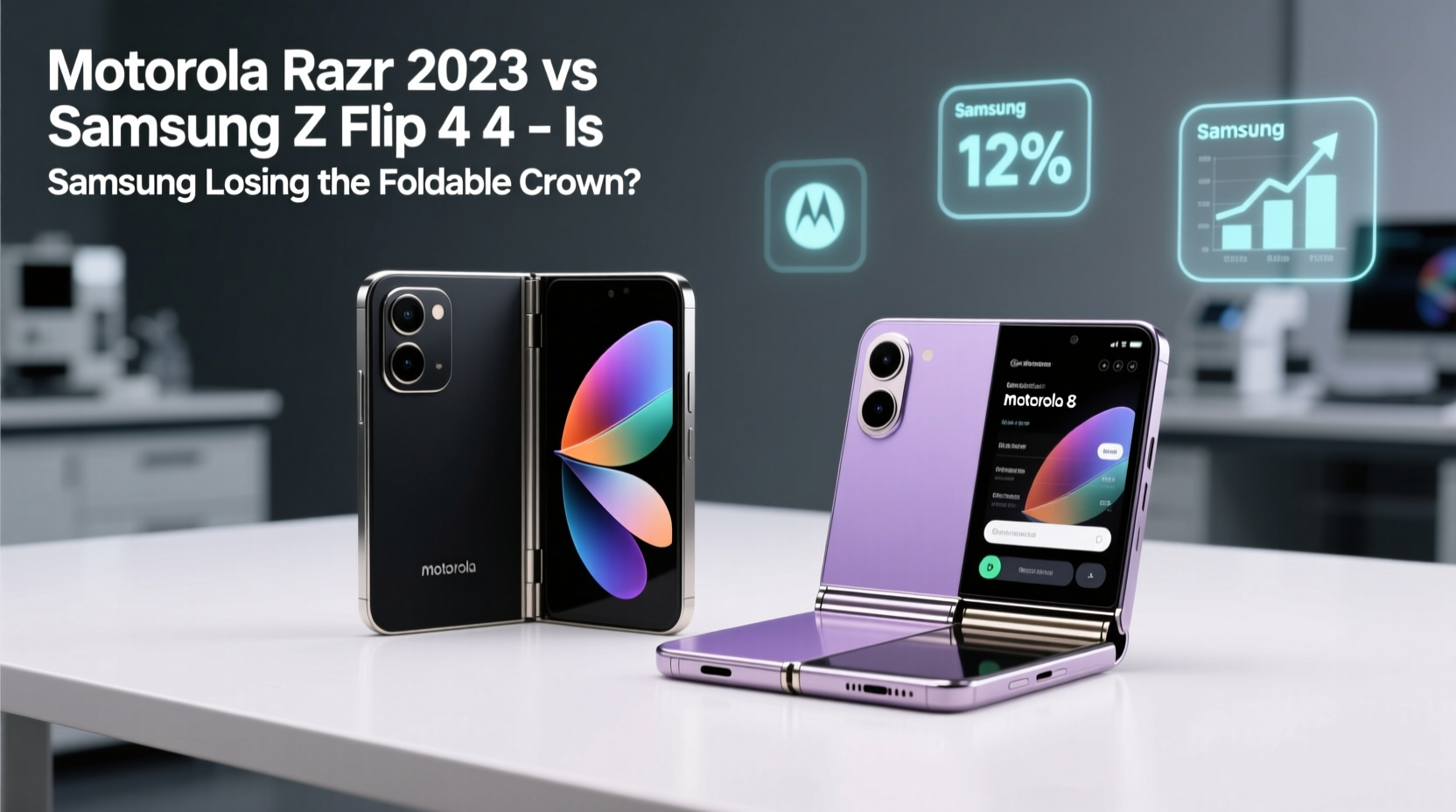
The Motorola Razr 2023 leans heavily into emotional appeal. Its clamshell design resurrects the iconic 2004 Razr V3, but now with a flexible OLED display and hinge engineered for 100,000 folds—roughly five years of daily use. The aluminum frame feels premium, and the external Quick View display has been expanded to 3.6 inches, making it more functional than ever.
In contrast, the Galaxy Z Flip 4 refines a formula Samsung has perfected over three generations. The build is sleek, compact when folded, and features IPX8 water resistance—a rarity in foldables. However, its external cover screen remains limited at 1.9 inches, useful for notifications and quick replies but less versatile than Motorola’s offering.
Motorola also introduces a “chin” below the main display when unfolded, housing dual selfie cameras. While this breaks the seamless look Samsung achieves, it enables better video call framing and eliminates the need for a punch-hole cutout in the primary screen.
Display and Durability: Flexibility Under Scrutiny
Both phones use polyimide-based flexible OLED panels, but their approaches differ. Samsung’s Ultra Thin Glass (UTG) provides a smoother, glass-like feel with fewer creases. The Z Flip 4’s crease is visible under certain lighting but rarely distracting during use.
The Razr 2023 uses a newer UTG variant with a redesigned hinge that reduces gap formation when closed. Independent lab tests show a slightly deeper crease than Samsung’s, but real-world usage suggests it’s not a usability issue. Motorola claims its display coating resists micro-scratches better, though long-term data is still emerging.
“Foldable displays have crossed a threshold—today’s users care less about the crease and more about how the device fits into their lifestyle.” — Dr. Lin Wei, Senior Analyst at Display Supply Chain Consultants
Where Samsung wins is durability certification. The Z Flip 4 is IPX8 rated, surviving submersion in up to 1.5 meters of water for 30 minutes. The Razr 2023 lacks any official ingress protection, making it vulnerable in wet conditions—an oversight for a $999 device.
Performance and Software: Power vs Polish
The hardware specs reveal a strategic divergence. The Z Flip 4 runs on Qualcomm’s Snapdragon 8+ Gen 1, a proven performer with excellent thermal efficiency. Paired with 8GB RAM and One UI 5 based on Android 13, it delivers smooth multitasking and reliable updates—Samsung promises four OS upgrades and five years of security patches.
The Razr 2023 opts for the Snapdragon 8+ Gen 1 as well, matching Samsung in raw power. But Motorola’s near-stock Android experience (with minimal bloatware) appeals to purists. Features like gesture shortcuts, split-screen multitasking, and seamless Google integration enhance usability. However, Motorola only guarantees two major Android updates—half of what Samsung offers.
| Feature | Motorola Razr 2023 | Samsung Galaxy Z Flip 4 |
|---|---|---|
| Processor | Snapdragon 8+ Gen 1 | Snapdragon 8+ Gen 1 |
| RAM / Storage | 8GB / 128–512GB | 8GB / 128–512GB |
| OS Updates | 2 major versions | 4 major versions |
| Battery | 3,800mAh | 3,700mAh |
| Charging | 30W wired, no wireless | 15W wired, 10W wireless |
| Water Resistance | None | IPX8 |
Battery life is comparable, lasting about 10–12 hours of mixed use. But Motorola’s faster 30W charging gives it an edge—reaching 50% in 15 minutes. Samsung’s slower charging is offset by wireless and reverse wireless charging, adding convenience.
User Experience and Innovation: Who Offers More?
Foldables thrive on novel interactions. The Z Flip 4’s Flex Mode splits apps automatically when partially open—useful for video calls or cooking tutorials. Samsung’s ecosystem integration with Galaxy Buds, Watches, and SmartThings adds polish.
Motorola counters with AI-driven features. The external display supports third-party app widgets, voice commands via “Hey Motorola,” and predictive actions based on usage patterns. Its dual selfie cameras (32MP main + 13MP ultra-wide) deliver superior group selfies and vlogging flexibility—something the single 10MP shooter on the Z Flip 4 can’t match.
A mini case study illustrates the difference: Sarah, a social media manager, uses her Razr 2023 for TikTok shoots. She props it open at 90 degrees, uses the outer screen to frame shots with both cameras, and edits directly on-device. With the Z Flip 4, she’d be limited to one camera and smaller preview.
Price and Value Proposition
The Razr 2023 starts at $999, identical to the Z Flip 4’s launch price—but now available at discounts as low as $799. Motorola’s device enters a market where Samsung already faces competition from Google’s Pixel Fold and OnePlus’ upcoming offerings.
Despite similar pricing, Motorola packs more novelty: larger cover screen, dual front cameras, faster charging. Samsung’s advantage lies in longevity—longer software support, proven resale value, and global service network.
- Choose the Razr 2023 if: You value innovation, photography, and a nostalgic yet modern design.
- Stick with Z Flip 4 if: You prioritize software longevity, water resistance, and seamless ecosystem integration.
FAQ
Is the Motorola Razr 2023 worth upgrading to from the Z Flip 4?
If you’re on an older Flip model and want faster charging, a larger external screen, and better selfie capabilities, yes. But if you rely on Samsung’s ecosystem or need water resistance, the upgrade may not justify the cost.
Which foldable lasts longer?
Samsung leads in software longevity with four OS updates. Hardware-wise, both are durable, but Samsung’s IP rating and stronger track record in after-sales service give it an edge in long-term reliability.
Can I use a screen protector on these foldables?
No—both devices use factory-applied protective layers. Adding a third-party screen protector can damage the flexible display or interfere with touch sensitivity.
Conclusion: The Crown Is Still Contested
Samsung hasn’t lost the foldable crown—not yet. The Galaxy Z Flip 4 remains a benchmark in refinement, ecosystem cohesion, and durability. But the Motorola Razr 2023 proves that challengers are no longer playing catch-up. It brings meaningful innovations that address real user pain points: small cover screens, weak selfie cameras, and slow charging.
The shift isn’t just technical—it’s psychological. Motorola reignites excitement around the foldable concept, reminding us that smartphones can still surprise. Samsung’s strength is consistency; Motorola’s is reinvention.
For consumers, this rivalry is a win. As competition intensifies, we’ll see faster innovation, better value, and more personalized experiences. Whether Samsung retains dominance depends on how quickly it responds to these new pressures. Until then, the crown sits lightly—and within reach of a worthy contender.




 浙公网安备
33010002000092号
浙公网安备
33010002000092号 浙B2-20120091-4
Comments
No comments yet. Why don't you start the discussion?