
The clamshell foldable phone market has evolved rapidly over the past few years, with Motorola and Samsung leading the charge. The Motorola Razr series pioneered the modern flip-style foldable, reviving nostalgia while introducing cutting-edge technology. But Samsung, with its Galaxy Z Flip line, has steadily refined its approach—culminating in the Galaxy Z Flip 7. Now, with both brands at a mature stage of development, the question arises: is Samsung finally catching up, or does the Razr remain the undisputed king?
This isn’t just about design or branding—it’s about real-world usability, durability, performance, software experience, and long-term value. Let’s dissect both devices across key categories to see where each excels and whether the balance of power has shifted.
Design and Build: Nostalgia Meets Modern Refinement
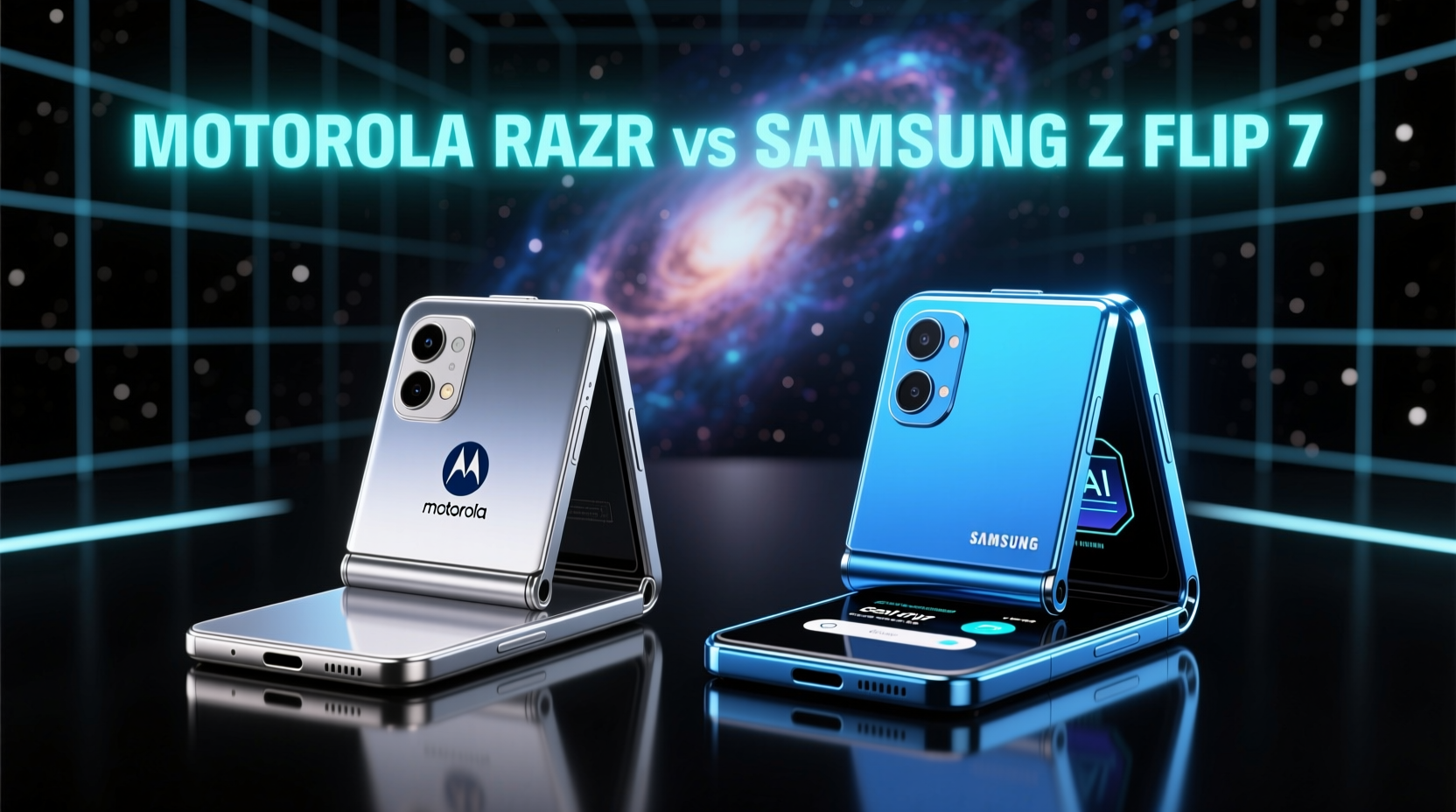
The original Motorola Razr was a cultural icon. Its revival in foldable form leaned heavily on that legacy, offering a sleek vertical folding design with a prominent external display. The latest iteration continues this aesthetic—compact, retro-inspired, with a focus on portability and elegance.
Samsung’s Galaxy Z Flip 7 takes a more minimalist, premium approach. It’s thinner, lighter, and features a slimmer hinge mechanism that reduces the gap between the folded halves. The build quality feels more polished, with Armor Aluminum frames and Gorilla Glass Victus 2 on both front and back—something Motorola hasn’t matched yet.
While the Razr has charm, Samsung’s execution feels more future-proof. The Flip 7 opens with less resistance, sits flatter when closed, and avoids the noticeable “chin” under the screen that still plagues the Razr’s design.
Display and Durability: Where the Hinge Matters Most
Both phones use flexible OLED displays, but their approaches differ significantly. The Motorola Razr features a 6.9-inch inner display with a 1344 x 1080 resolution and a 120Hz refresh rate—on paper, competitive. However, the crease remains deep and visible, especially under bright light, and the outer screen, though improved, is still small at 3.6 inches.
The Galaxy Z Flip 7 ups the ante: a 6.7-inch main display with Full HD+ resolution (2340 x 1080) and a smoother 120Hz adaptive refresh rate. More importantly, Samsung has reduced the crease through an enhanced hinge and Ultra Thin Glass (UTG) layer, making it less intrusive during daily use.
On the cover screen, Samsung has made a generational leap. The Flip 7 features a 4.0-inch external display—larger than any previous Flip model—allowing full app usage without unfolding the phone. You can reply to messages, control music, check weather, and even take selfies using the rear camera—all from the cover screen.
“Samsung’s cover screen evolution has redefined how users interact with flip phones. It’s no longer just a glance tool—it’s functional.” — David Kim, Mobile UX Analyst at TechInsight Labs
Motorola’s Quick View display, while customizable, remains limited in functionality and size. For multitasking and convenience, the Flip 7 clearly leads.
Performance and Software: Power vs Polish
Under the hood, the Galaxy Z Flip 7 runs on the latest Snapdragon 8 Gen 3 chip, ensuring top-tier performance for gaming, multitasking, and AI-driven features. It also supports 5G, Wi-Fi 6E, and Bluetooth 5.3, keeping it future-ready.
The Motorola Razr+, by contrast, uses the older Snapdragon 8+ Gen 1. While still capable, it lags slightly in efficiency and thermal management, particularly during extended use. RAM configurations are similar (8GB), but Samsung’s optimization with One UI offers better background handling and split-screen flexibility.
Software updates are another differentiator. Samsung guarantees four years of OS upgrades and five years of security patches—a commitment Motorola doesn’t match. The Razr runs near-stock Android, which some purists appreciate, but it receives updates slower and for a shorter duration.
| Feature | Motorola Razr+ | Samsung Galaxy Z Flip 7 |
|---|---|---|
| Processor | Snapdragon 8+ Gen 1 | Snapdragon 8 Gen 3 |
| Main Display | 6.9\" FHD+, 120Hz | 6.7\" FHD+, 120Hz adaptive |
| Cover Screen | 3.6\" | 4.0\" |
| Rear Camera | 50MP + 13MP | 50MP + 12MP ultrawide |
| Battery | 3700mAh | 4000mAh |
| OS Update Support | 2 major versions | 4 major versions |
Camera and Battery Life: Practicality Wins
Motorola has always emphasized photography with its Razr lineup, featuring a high-resolution 50MP main sensor and a 13MP ultra-wide. Image processing has improved, but low-light performance still falls short compared to Samsung’s computational photography.
The Galaxy Z Flip 7 includes a 50MP main camera with larger pixels and advanced HDR, plus a 12MP ultrawide lens—something the Razr lacks entirely. This gives Samsung a clear advantage for travel, group shots, and landscape photography. The Flip 7 also leverages AI-enhanced night mode and better video stabilization.
Battery life is another area where Samsung pulls ahead. The Flip 7’s 4000mAh battery consistently lasts a full day with moderate use, aided by efficient power management. The Razr+’s 3700mAh cell often requires midday charging, especially with heavy 5G or screen usage.
User Experience and Real-World Use: A Mini Case Study
Consider Sarah, a digital marketer who commutes daily and relies on her phone for messaging, social media, and quick content creation. She previously used the Motorola Razr 2023 but upgraded to the Galaxy Z Flip 7 after six months.
“I loved the Razr’s look,” she says, “but I found myself unfolding it constantly just to respond to a text or check a notification. With the Flip 7, I do 70% of my interactions on the cover screen. I can shoot TikTok videos using the rear camera without opening the phone—that’s a game-changer.”
She also noted better camera quality in dimly lit cafes and fewer instances of overheating during video calls. While she missed the stock Android simplicity, Samsung’s customization options—like Flex Mode for hands-free viewing—proved more practical in daily workflows.
Checklist: Choosing the Right Foldable for You
- Choose the Motorola Razr if: You value near-stock Android, prefer a nostalgic design, and prioritize compactness over full external screen functionality.
- Choose the Samsung Galaxy Z Flip 7 if: You want a larger cover screen, better cameras, longer software support, and a more durable, refined hinge system.
- Test both devices in-hand—foldables are highly tactile; ergonomics matter.
- Check carrier availability and pricing—Samsung often has stronger carrier partnerships and trade-in deals.
- Consider long-term ownership—software updates and repair costs will impact your experience over two years.
Frequently Asked Questions
Is the crease worse on the Razr than the Flip 7?
Yes. Due to differences in hinge design and screen materials, the Motorola Razr exhibits a deeper, more visible crease. Samsung’s use of Ultra Thin Glass and a sturdier hinge results in a smoother surface, though a crease is still present.
Can you use apps on the cover screen of the Razr?
Limited third-party app support exists, but it’s not as seamless as Samsung’s implementation. The Flip 7 allows full interaction with WhatsApp, Instagram, YouTube, and more directly from the cover screen.
Which phone is more durable?
The Galaxy Z Flip 7 edges ahead. It uses stronger glass, a more robust hinge, and has better IPX8 water resistance certification. The Razr only has IP52 splash resistance, making it less suitable for wet environments.
Conclusion: The Crown May Be Changing Hands
The Motorola Razr started the modern flip revolution, and it deserves credit for reigniting interest in compact, stylish smartphones. But innovation waits for no one. Samsung has methodically addressed every weakness in its Flip lineup—refining the hinge, expanding the cover screen, improving cameras, and delivering longer software support.
In 2024, the Galaxy Z Flip 7 isn’t just catching up—it’s setting the standard. It offers a more complete, reliable, and future-proof experience. The Razr remains a compelling option for Android purists and design enthusiasts, but for most users, the Flip 7 delivers superior everyday functionality.
If you’re choosing between them today, ask yourself: do you want a phone that looks cool, or one that works smarter? The answer might surprise you.




 浙公网安备
33010002000092号
浙公网安备
33010002000092号 浙B2-20120091-4
Comments
No comments yet. Why don't you start the discussion?